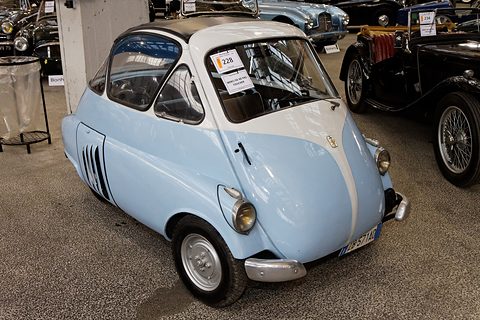
Bubble cars
A door in the nose with the steering wheel riding on it, two seats in tandem under a canopy that swings open like a fighter’s, an engine that reverses by running backwards. For a few years in the 1950s this was how a motorcyclist bought a roof, and it cost less than a Beetle.
What made a bubble car
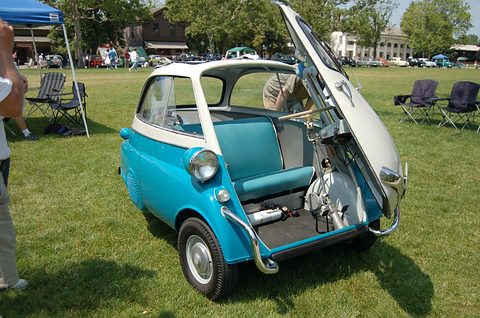
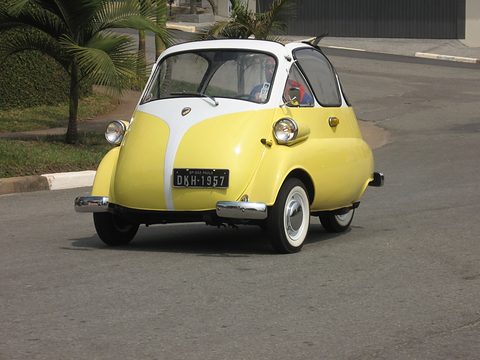
On 9 October 1951 the engineer Ermenegildo Preti and Mario Salvo, both of Milan, filed a German patent for a small motor vehicle whose cabin you entered from the front: the whole front wall was a door, and the steering went with it. The point was parking. Such a car could pull in nose first between two parked cars and let its passengers step out onto the pavement.source 1source 2 Two years later the idea went on sale as the Iso Isetta.source 2 By 1956 it was being built under licence in West Germany, France and Brazil.source 3source 4source 5
No law ever defined a bubble car. The name is informal English, and the dictionaries date its first known use to the mid-1950s; Merriam-Webster gives 1957.source 6
There’s no such thing as a ‘bubble car’: it’s just an affectionate, generic name for all the fun little three- and four-wheeled cars that came putt-putting their way out of garages and factories all over Europe in the 1950s.
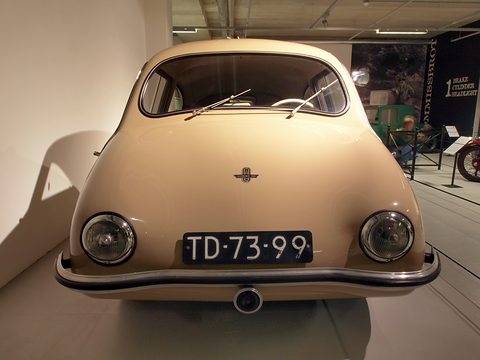
The West Germans had trade words instead. Fritz Fend’s prototype of 1952 was the FK 150, for Fend-Kabinenroller, the cabin scooter, and auto motor und sport filed the whole class under Kleinstwagen und Rollermobile, smallest cars and scooter-mobiles.source 8source 9 The name is generally given to the small cabin cars of about 1953 to 1964, above all those with a canopy or a front door: one branch of the wider family of the microcar.
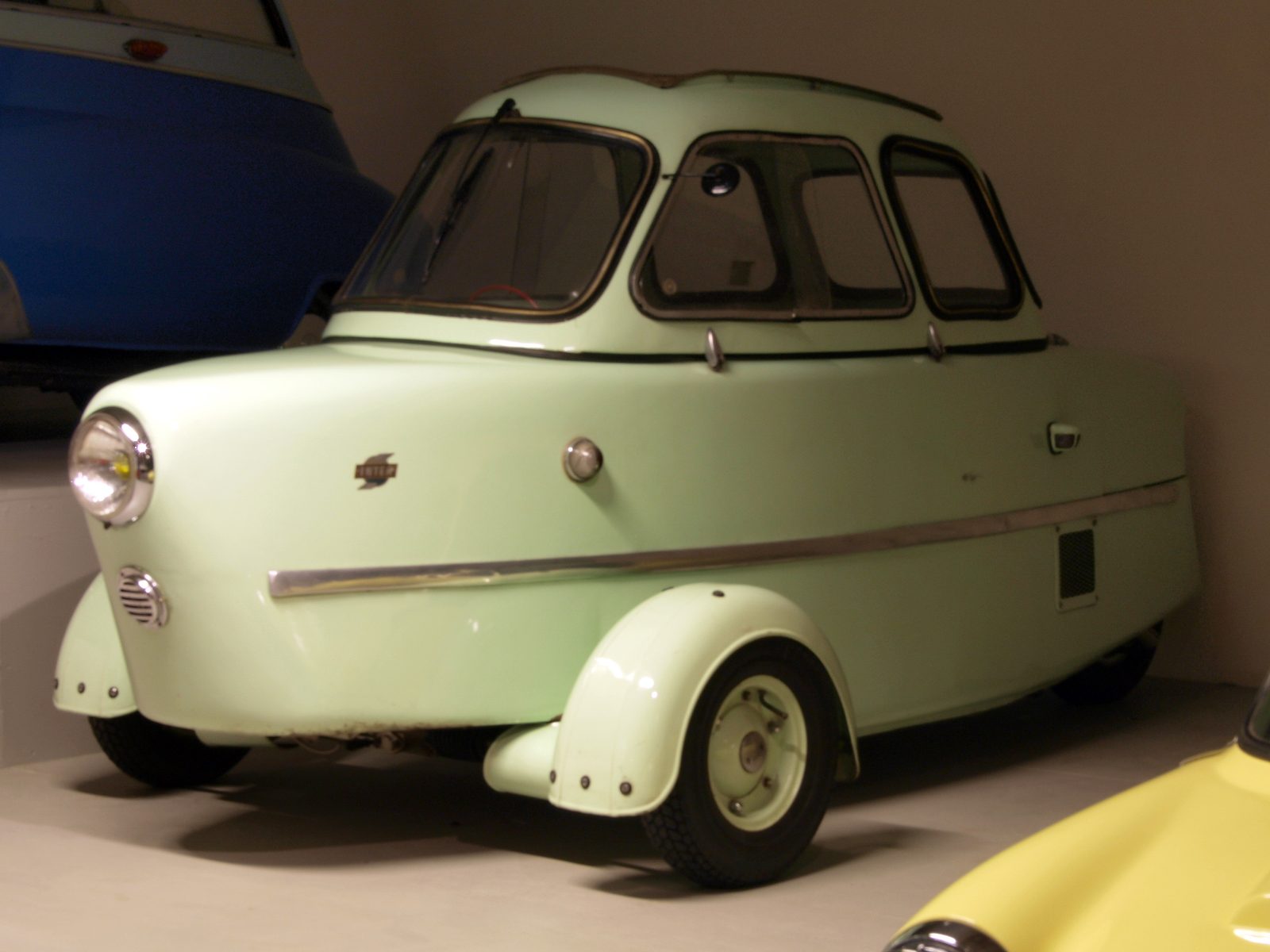
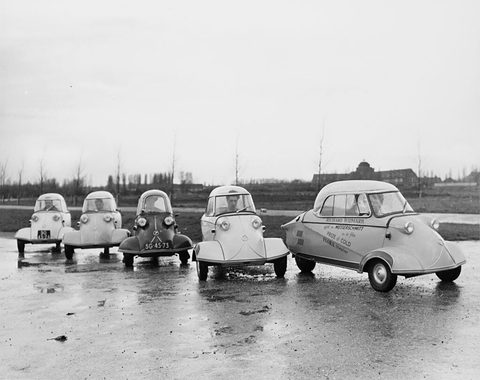
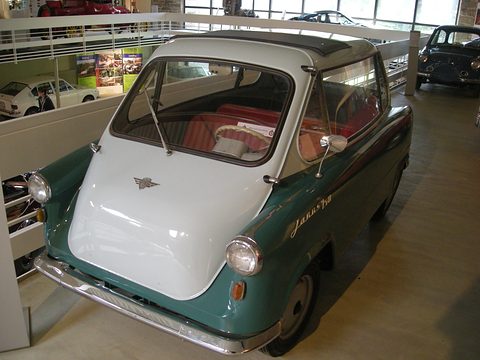
They came in a few shapes. The egg with a door in its face: the Isetta, and the Heinkel Kabine. The cockpit, with two seats one behind the other under a canopy: the Messerschmitt KR175 and its successors, and the French Inter 175 A Berline. The little cabin of the Fuldamobil and its licensed family. And the Zündapp Janus, with a door at each end and its passengers sitting back to back. The four-seat Goggomobil, the Lloyd and the Fiat Nuova 500 were not bubble cars, but they are in the story, because they were the cars that replaced them.
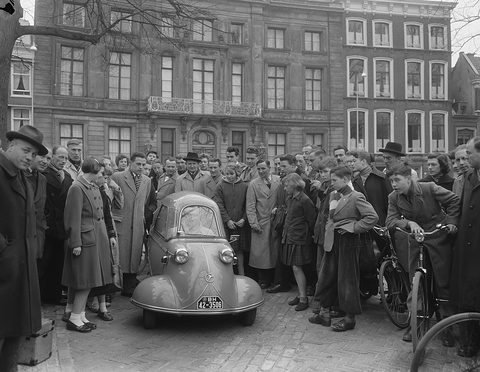
The first cabins, 1948–1955
The way in was the motorcycle. In 1955 West German factories built 165,663 motorcycles and 134,159 scooters, against 12,917 BMW Isettas.source 10 The bubble car was what came next for a motorcyclist who wanted a roof.
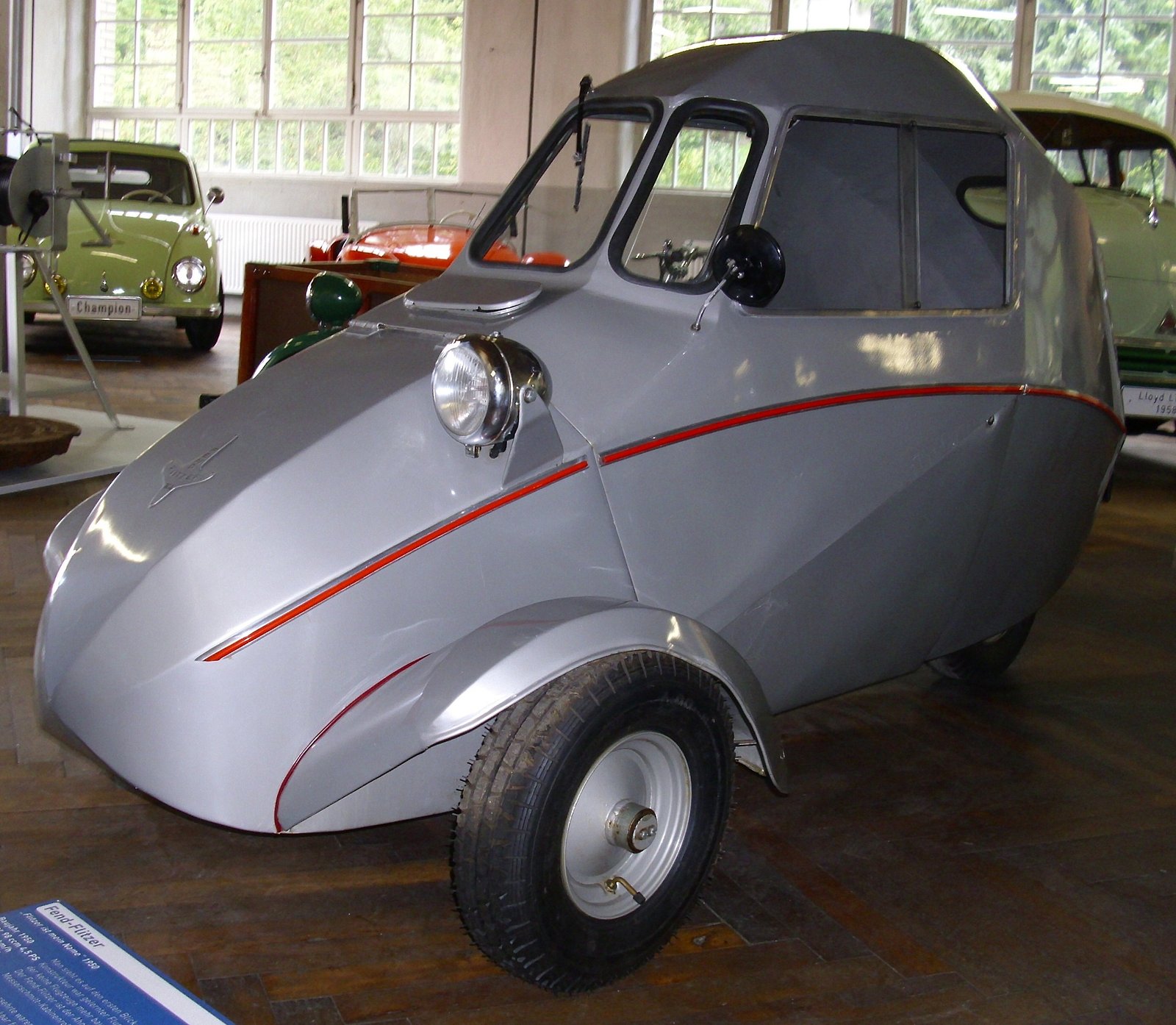
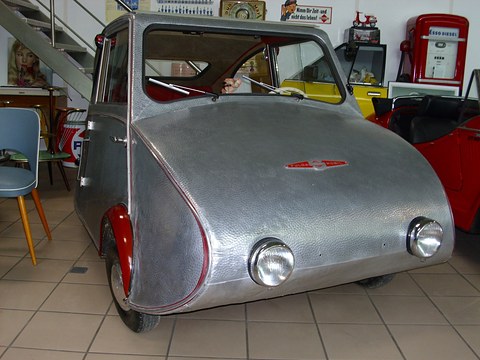
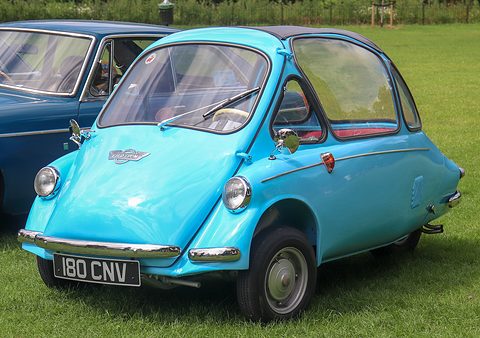
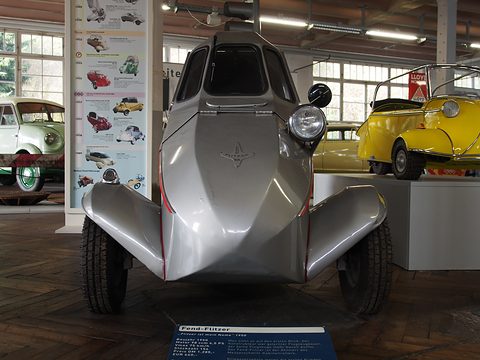
Fritz Fend began in Rosenheim in 1948 with a hand-propelled invalid tricycle, of which about 50 were sold. He then built a motorised single-seater, the Fend Flitzer, whose first series had a 38 cc Victoria engine and cost DM 938.source 11source 12 He wanted it sold not under a disabled label but as a car that suited disabled drivers too.source 13 In Fulda a journalist, Norbert Stevenson, drew a very simple three-wheeler for an electrical wholesaler, and the first bodies were plywood covered in leatherette; then came hammered aluminium, nailed on and left unpainted, and the car was nicknamed the Silberfloh, the silver flea.source 14source 15 German registrations of the Fuldamobil, excluding licence-built cars, ran to 63 in 1951 and 327 in 1954.source 15 The Kleinschnittger F125 of 1950 cost DM 1,995, less than half a Volkswagen Beetle.source 16 The same year the four-seat Lloyd LP300, plywood skinned in leatherette and nicknamed the Leukoplastbomber, the sticking-plaster bomber, sold at DM 3,334 against the Beetle’s DM 4,600.source 17 It was no bubble car, but it set the pattern of the cheap four-seater.
The Isetta came from a refrigerator and scooter maker. Renzo Rivolta of Iso had it designed by Preti and Pierluigi Raggi.source 2source 18 The first prototype ran on one rear wheel; production cars had a pair, mounted so near each other that the axle could do without a differential. It was launched at the Turin show in April 1953 with a 236 cc split-single two-stroke.source 2 At home it sold poorly: its price was barely below the Fiat Topolino’s, and then the Fiat 600 and 500 arrived. Italy is thought to have built only about 1,000 to 1,500.source 2source 18
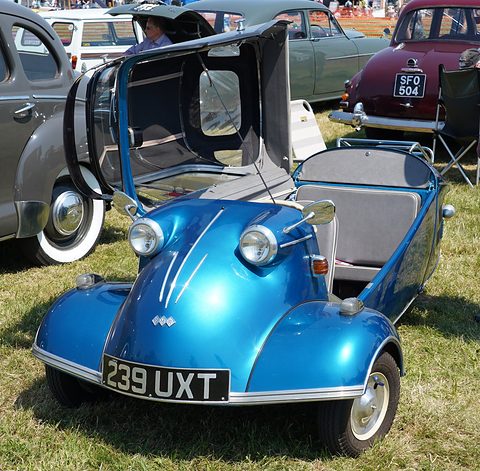
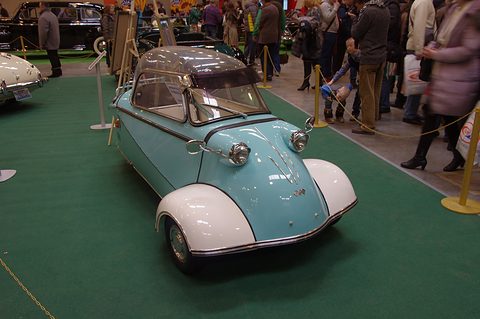
The Messerschmitt came from Fend. Built in Messerschmitt’s idle works at Regensburg and shown at Geneva in the spring of 1953, the KR175 put two people one behind the other under a Plexiglas canopy hinged at the side, steered by a bar acting directly on the track rods, with a 174 cc Fichtel & Sachs two-stroke behind them. It cost DM 2,100.source 8source 19 By February 1955 about 11,000 had been sold, far more than any other German scooter-car.source 20 No car fits the tale of aircraft makers turning to cars while aircraft were forbidden better than this one, and even this design came from outside the firm: the Messerschmitt Owners’ Club insists that Fend never worked for Messerschmitt, and that Regensburg built his car under a licence.source 21
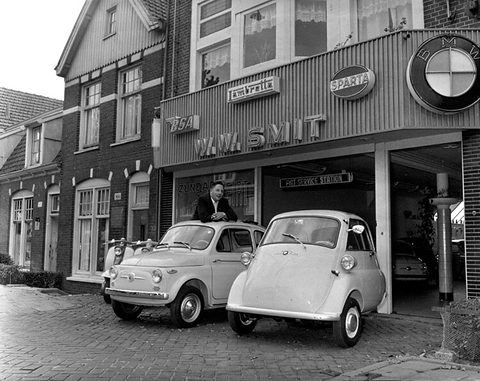
BMW, in trouble with its big 501 and 502 saloons, bought Iso’s licence and rebuilt the Isetta round its own 250 cc motorcycle four-stroke, with a four-speed gearbox and a real reverse, hydraulic brakes and a 12-volt system. It was shown to the press at Rottach-Egern on the Tegernsee on 5 March 1955, at DM 2,550.source 3 auto motor und sport called the Hoffmann cabin announced in 1954 a plagiarism of the Isetta, and by early 1955 it was already dead.source 22source 20
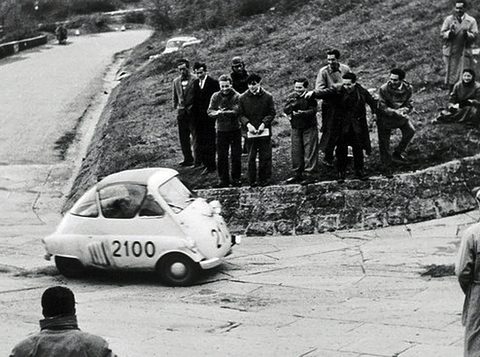
Boom years in West Germany, 1955–1957
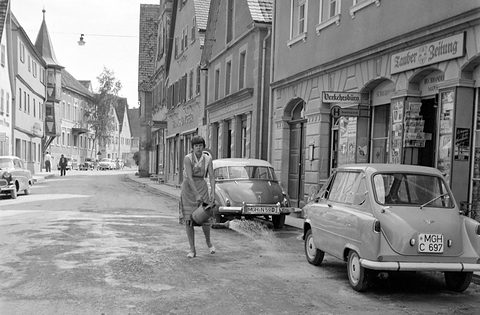
The law drew the lines that the cars were built to. Holders of the old class 4 licence, meant for motorcycles, could drive cars of no more than 250 cc as well, so the BMW Isetta 250 and the Goggomobil T250 were held to that size.source 3source 23source 24 In early 1956 the Federal Finance Ministry recommended a second line, at 200 cc, for the allowance commuters could claim against tax: 50 pfennigs a kilometre for a three- or four-wheeled Rollermobil over 200 cc, as for a car, and only the motorcyclist’s 22 for the smaller ones.source 25
… während Rollermobile bis 200 ccm (also vor allem der Messerschmitt-Kabinenroller) als Motorrad (22 Pfg./km) einzustufen sind.
The same note expected the recently and considerably increased motorcycle insurance premiums to send very many riders to a Rollermobil instead.source 25 And the price was within reach. On the official list of 22 September 1955 a Messerschmitt KR200 cost DM 2,550, a Volkswagen Standard about DM 3,800 and an Export DM 4,600; a BMW R 25/3 motorcycle cost DM 1,795 early in 1956. On the same 1955 list the four-seat Goggomobil T250 cost DM 2,940 and the Lloyd LP 400 DM 3,350.source 9source 26 A bubble car cost about a motorcycle and a half, and about two-thirds of a basic Beetle.
The market was young and already settled. Reporting on the smallest vehicles at the Frankfurt show that September, auto motor und sport found Messerschmitt and Isetta at its head, with Goggomobil, Fuldamobil and Champion behind them, and the field so settled that hardly anyone dared to join it.source 9
Bezeichnend: BMW stellt die Isetta in Frankfurt überhaupt nicht aus, und Messerschmitt begnügt sich mit einem ganz bescheidenen Stand.
In two years motorcycle output fell by two-thirds.source 10 The riders had moved indoors, and not all of them into bubble cars.
| Year | Motorcycles | Isetta | Messerschmitt | Goggomobil |
|---|---|---|---|---|
| 1955 | 165,663 | 12,917 | 11,909 | 9,916 |
| 1956 | 101,214 | 29,947 | 7,500 | 33,385 |
| 1957 | 52,860 | 33,700 | not given | 43,372 |
Messerschmitt, Heinkel and the rest
Messerschmitt had a new car to sell. The KR200 of 1955 had a wider front track, dampers on every wheel, a curved windscreen and a 191 cc engine, and no reverse gear: the driver stopped the two-stroke and started it again backwards with the key, and all four gears then worked in reverse.source 8source 27 Almost 12,000 were built in 1955, the best year any Kabinenroller had.source 8 That August a lightly streamlined KR200 ran for 24 hours at Hockenheim at 103 km/h (64 mph) and took more than 20 international class records for small three-wheeled cars.source 28source 29
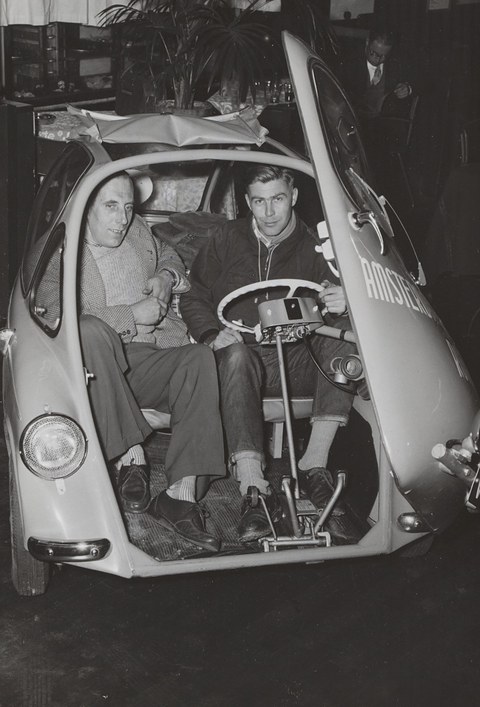
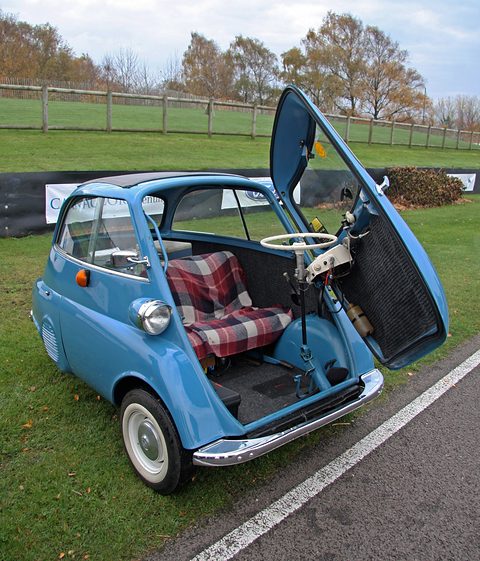
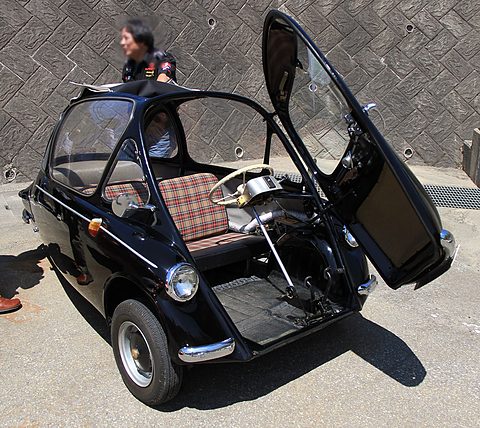
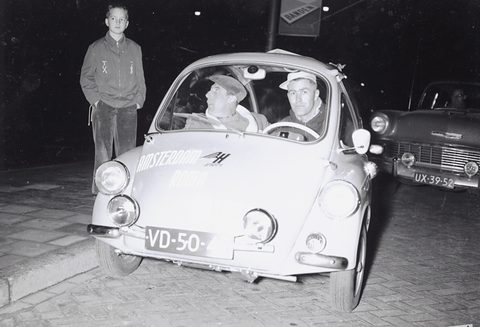
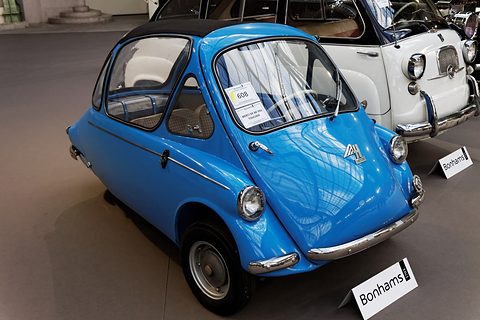
Ernst Heinkel, the aircraft designer, answered the Isetta with a front-door car of his own, built round the complete engine, gearbox and swinging-arm drive of his Tourist scooter. It weighed about 245 kg (540 lb), roughly 100 kg less than the Isetta.source 30source 31 Its door opened at the front like the Isetta’s; its steering column, though, stayed put.source 30 When Dr Paul Simsa of auto motor und sport tested one in September 1956, he judged it, without doubt, the thriftiest small vehicle on sale in Germany: even driven hard it stayed under 4.5 l/100 km (63 mpg), and most owners reported about 3.5 (81 mpg).source 31 It cost DM 2,750, the same as the Isetta 250 by then, and Germany built 11,975 between December 1955 and June 1958.source 31source 32source 33source 30 Heinkel’s four-wheeled Type 154 of 1956 had an engine of 204 cc, which the magazine thought curious, just over the 200 cc line.source 34source 30
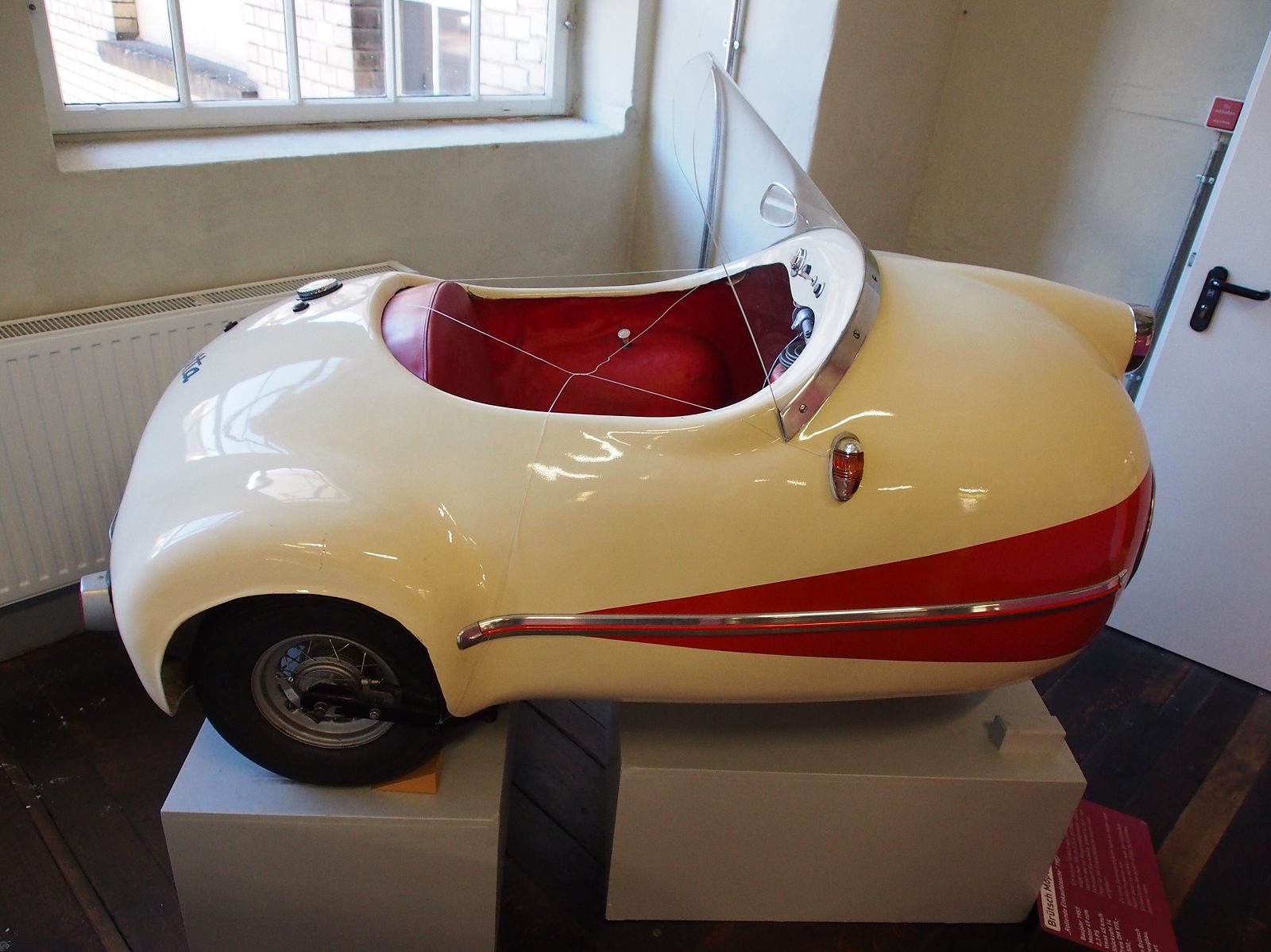
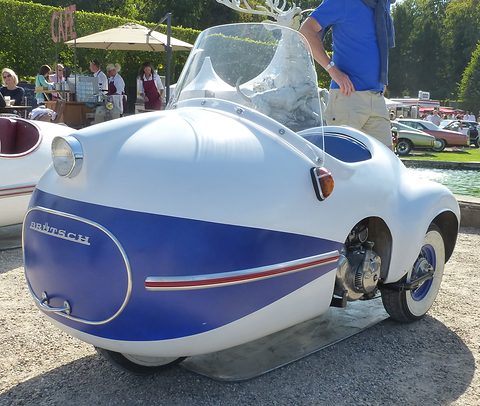
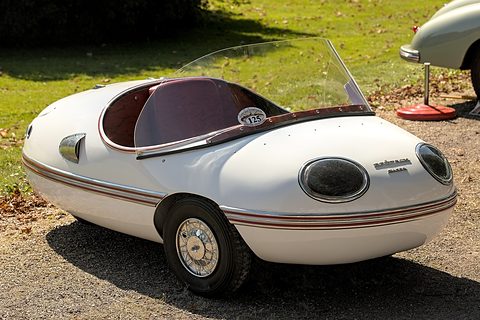
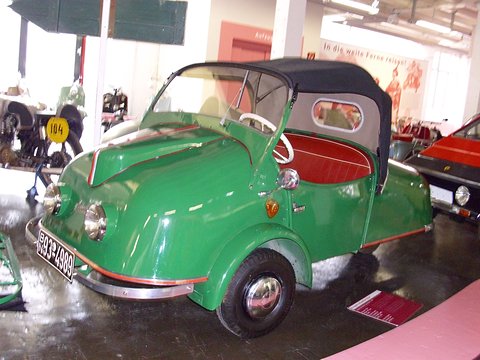
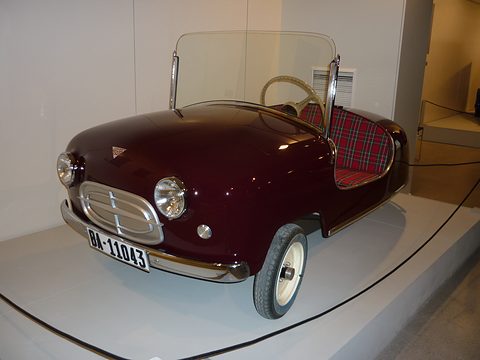
Fulda went on refining. Its S‑4 of 1955 set its twin rear wheels just 400 mm (16 in) apart and needed no differential; according to the English Wikipedia, a law of May 1956 still taxed such a pair as a single wheel.source 14 The Fuldamobil was licensed to more countries than any other bubble car: the Bambino in the Netherlands, and, as the glass-fibre S‑7, the Fram King in Sweden, the Nobel 200 in Britain, the Attica 200 in Greece and the Bambi in Argentina.source 14source 15 At the other extreme, Egon Brütsch designed about a dozen microcars between 1951 and 1958, most of them small glass-fibre three-wheelers, each made in single or low double figures; his 1955 price list ran from the 75 cc single-seat Zwerg at DM 1,475 to the Spatz at DM 2,975.source 35source 9 His Brütsch Mopetta was meant to be the smallest car in the world; 14 were built.source 36
The Janus came from a motorcycle maker in trouble. Zündapp of Nuremberg took Dornier’s Delta design, with doors at both ends, four seats back to back and a 248 cc engine of 14 PS in the middle.source 37source 38 auto motor und sport warned when it was announced in 1956 that a 250 cc single was much too little for a four-seater.source 39 At DM 3,290 it was close to a Beetle. Zündapp built 1,731 in 1957 and 6,902 in all.source 10source 37source 38 Messerschmitt went the other way: at the Frankfurt show of 1956 it priced an open Roadster just under DM 2,000, and the magazine thought it a real rival to the 200 cc scooters at about DM 1,800, far more practical and faster with the same engine.source 34
The column that swings and the column that stays
Two front doors
Britain: Suez and a second boom
Britain had its own reasons. In 1956 a light three-wheeler cost £5 a year to tax where a car cost £12 10s, and a learner was allowed to drive one unaccompanied once its reverse gear had been disabled, since it then ranked as a motorcycle combination.source 33 So the Heinkels sold in Britain kept three wheels.source 33source 30
Then came Suez. The crisis of 1956 brought petrol rationing and petrol 30 per cent dearer, and demand took off. Noble Motors had begun importing the Heinkel in July 1956 at £398 15s, when the cheapest Ford cost £443 17s; now a Dakota carried them from Hanover to Croydon, five cars a day, and from February 1957 shipments of 60 arrived by way of Rotterdam at intervals of 10 to 12 days, until the summer.source 33 Messerschmitts arrived without their wheels and batteries, to avoid the purchase tax on imported vehicles, and Britain became the largest export market for the Regensburg cars.source 40 In November 1956 the Messerschmitt Owners’ Club was formed in London.source 29
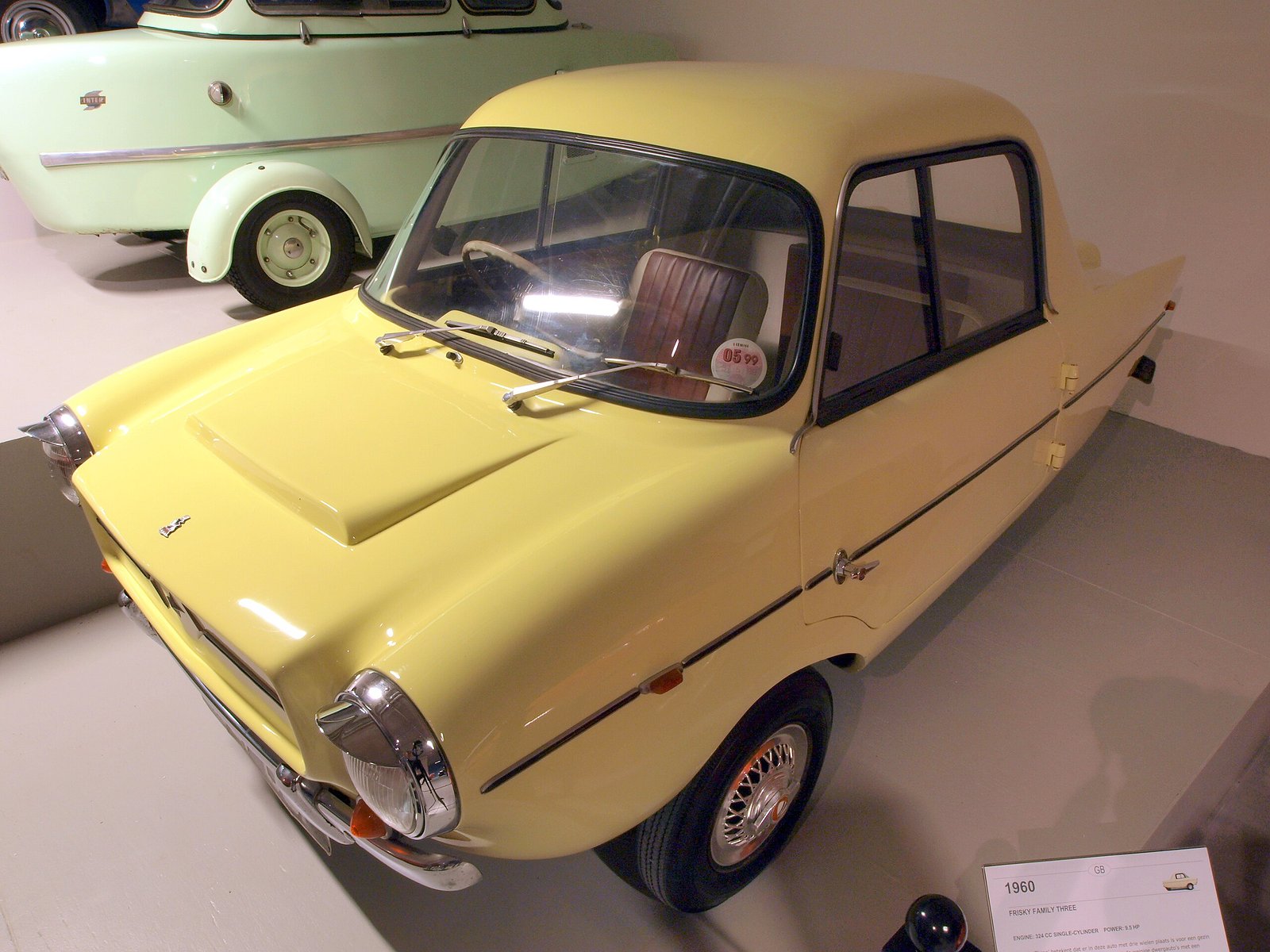
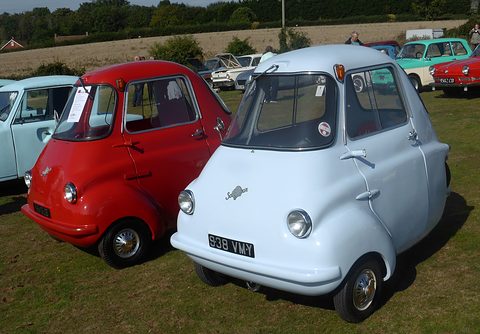
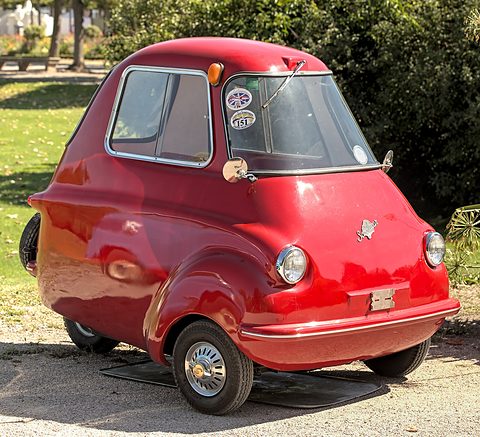
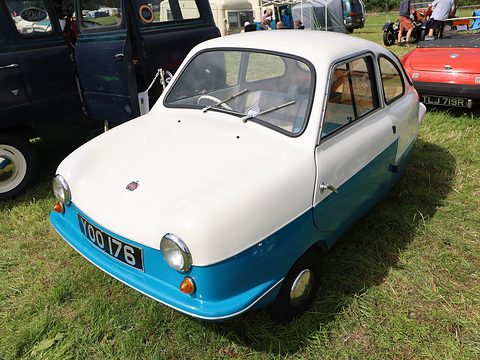
Soon the British Isles built their own. An Isetta works at Brighton, in part of the town’s railway works, started production in May 1957.source 18 Heinkel’s design was built at Dundalk in Ireland from 1958, and then by Trojan at Croydon as the Trojan 200; Trojan chassis numbers run from 7001 to 13179: about 6,000 cars, if the sequence has no gaps.source 33 The Fuldamobil became the Nobel 200, assembled in Northern Ireland by Short Brothers & Harland with bodies moulded by the Bristol Aeroplane Company; chassis numbers suggest about 400 had been built by January 1960.source 41 In Leeds a locomotive builder, Hunslet, made the Scootacar, whose shape was chalked round its designer, Henry Brown, as he sat astride a Villiers engine; about 970 were built.source 42 Henry Meadows of Wolverhampton built the Frisky, about 1,500 of all models.source 43
The answer, when it came, was British. BMC revealed the Mini on 26 August 1959: 3.05 m (120 in) long, at £496. BMW’s fiftieth-anniversary history of the Mini says it was the Suez crisis that prompted BMC to give Alec Issigonis the task.source 44 Leonard Lord, the head of BMC, is reported to have loathed bubble cars and to have wanted them off the streets.source 45 In March 1963 Motor Cycle set the prices side by side: £368 for a Mini van, which paid no purchase tax, and £369 15s for a Trojan with right-hand drive.source 33
Isettas abroad, and other cousins
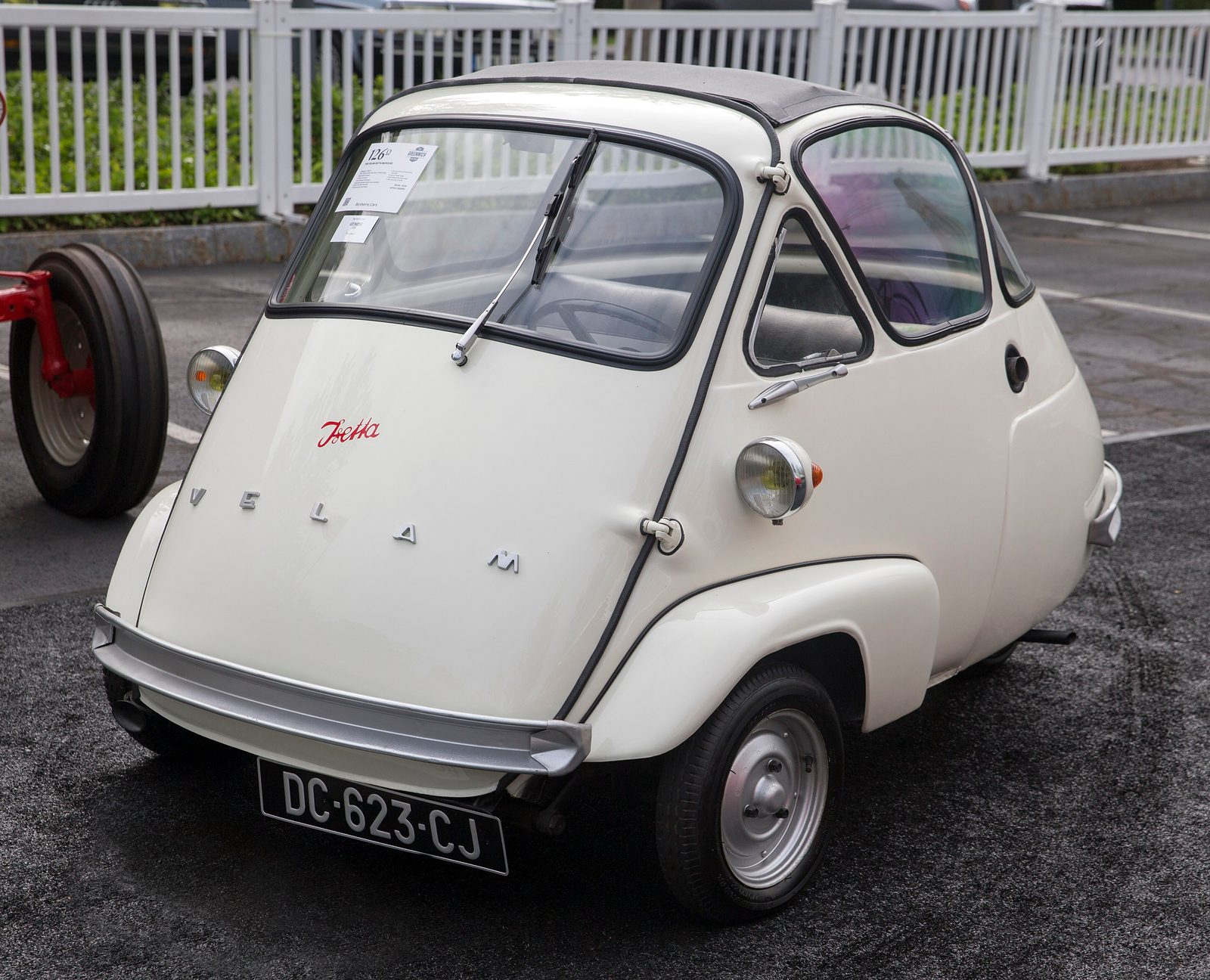
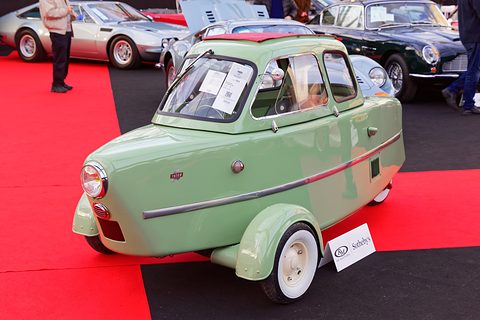
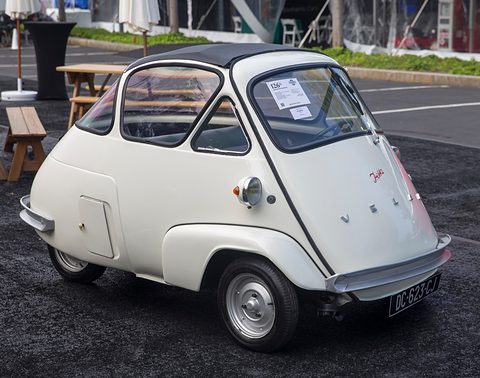
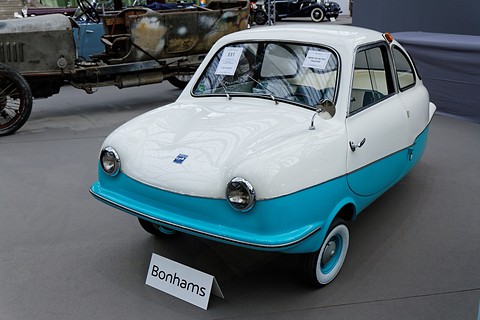
France got an Isetta of its own design. BMW had taken much of Iso’s body tooling, so VELAM designed its own body round the Iso engine for the Velam Isetta, with 34 detailed changes.source 18source 4 It cost 297,000 francs, said to undercut a Citroën 2CV by 15 per cent, but sales collapsed at the end of 1956 against the 2CV and the Renault Dauphine, and 7,115 were built.source 4source 46 SNCAN, a nationalised aircraft maker, built the Inter, a tandem canopy car whose early front wheels folded under it for parking and whose Westinghouse inertia starter whined up to speed before it turned the engine; about 300 are usually quoted.source 47source 48source 49
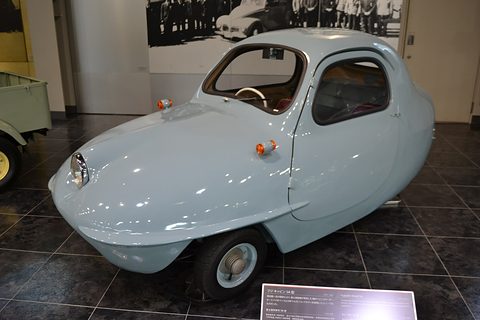
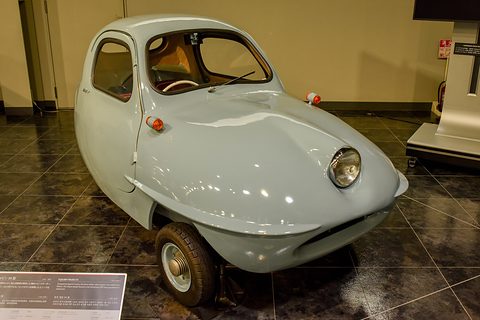
In Italy Mi-Val of Brescia assembled KR175s as the Mivalino.source 19 Iso’s Spanish company in Madrid went on building Isettas in Spain after Italy stopped, and in Bilbao the Triver was made in about 75 examples.source 18source 50source 51 Brazil’s Romi-Isetta of 1956, about 3,000 built, is often called the country’s first car; more exactly it was the first passenger car series-built in Brazil with mostly local content. The government’s incentives of 1956 required four seats, which shut out the two-seat Isetta, and it ended in 1961.source 5source 52 In Argentina the Fuldamobil-based Bambi, at 140,000 pesos, was the cheapest car on the market, and the Heinkel Kabine was built there under licence too.source 53source 33 In Japan the Fuji Cabin had a body of glass-reinforced plastic and no chassis, and only 85 were built.source 54
How it ended
In West Germany the boom was over before the Mini existed. Isetta production peaked in 1957 at 33,700, but its German registrations had already peaked the year before, at 23,679, and fell to 22,122; Messerschmitt registrations halved, from 3,251 to 1,698.source 10source 55 Buyers were moving up to the four-seat micro-saloons. In 1957 the Goggomobil outproduced the Isetta, 43,372 against 33,700, and both the Lloyd 600, with 36,333 registrations, and the Goggomobil, with 35,388, were registered in greater numbers.source 10source 55 Early in 1958 the magazine set the Janus at DM 3,400 beside the Lloyd 600 at about DM 3,700 and the various 600 cc cars at DM 3,800 to 4,300.source 10 A small four-seater no longer cost much more than a bubble.
The Fiat Nuova 500 arrived in July 1957, 2,970 mm (117 in) long, at 490,000 lire, and Fiat assembled 2,908 of them at Heilbronn that year.source 56source 10 BMW’s own successor, the four-seat BMW 600, cost DM 3,985, almost as much as a Volkswagen Standard, and failed.source 57
The makers left one by one. Messerschmitt lost interest once it could build aircraft again, and stopped the KR200 late in 1956; Fend and Valentin Knott restarted it as FMR in January 1957, and it lasted until 1964, for some years beside a four-wheeled sibling, the FMR Tg500.source 8source 40source 58 Heinkel sold its rights to Dundalk early in 1958.source 33 Zündapp sold its Nuremberg works to Bosch the same year.source 59 BMW ended the Isetta in 1962 at 161,728, the best seller of them all.source 3 The last Goggomobil, the car that had beaten them, was built on 30 June 1969.source 24
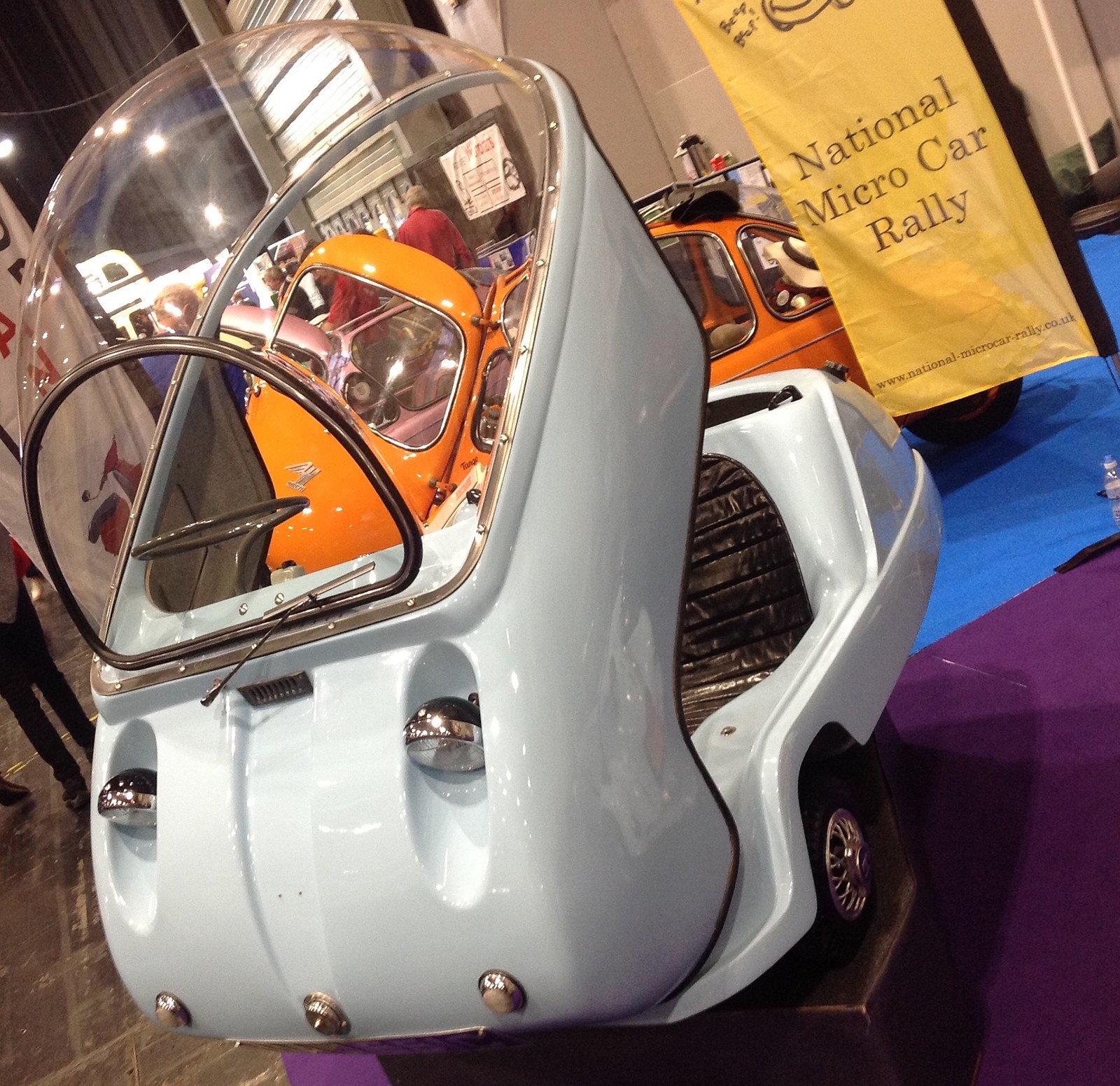
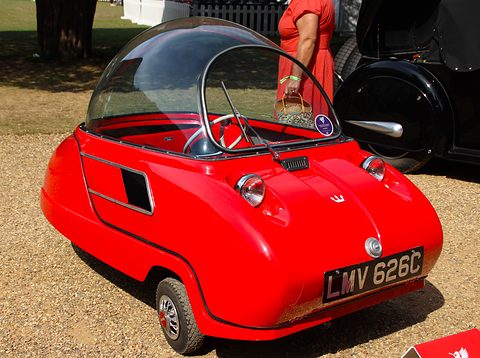
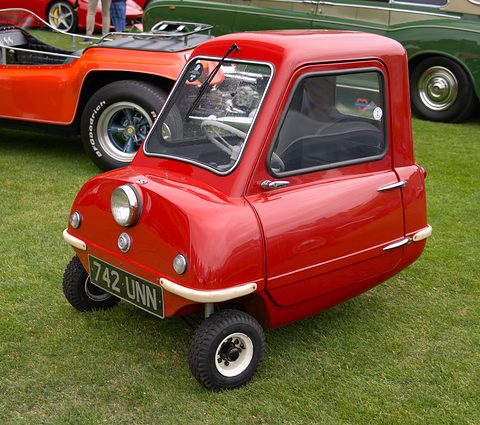
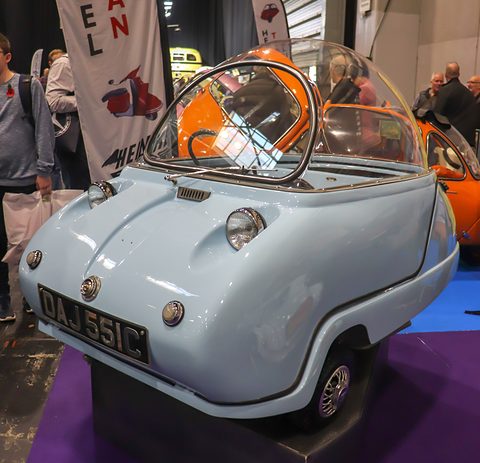
One of the last new bubbles was also one of the smallest. The Peel Trident, built on the Isle of Man from 1965, was a glass-fibre tub under a clear dome that lifted for you to climb in, with no doors at all. It cost £190, and about 45 were made.source 60source 61 It went on sale six years after the Mini.
Smallest to largest
22 cars and 2 maker groups, to scale
Each bar is the car’s length on a 3.5 metre track; the red notch is a Fiat 500.
-
Peel P501962–1965 · Isle of Man · 3 wheels
1.37 m -
Brütsch Mopetta1956–1958 · West Germany · 3 wheels
1.70 m -
Peel Trident1965–1966 · Isle of Man · 3 wheels
1.85 m -
Fend Flitzer1948–1951 · Germany · 3 wheels
2.00 m -
Brütsch1951–1958 · West Germany · 3 wheels
2.20 m -
Scootacar1957–1964 · Britain · 3 wheels
2.21 m -
Iso Isetta1953–1956 · Italy · 4 wheels
2.25 m -
BMW Isetta1955–1962 · West Germany · 4 wheels
2.29 m -
Romi-Isetta1956–1961 · Brazil · 4 wheels
2.29 m -
Velam Isetta1955–1958 · France · 4 wheels
2.38 m -
Heinkel Kabine1955–1958 · West Germany · 3 wheels
2.55 m -
Trojan 2001961–1965 · Britain · 3 wheels
2.66 m -
Messerschmitt KR1751953–1955 · West Germany · 3 wheels
2.82 m -
Messerschmitt KR2001955–1964 · West Germany · 3 wheels
2.82 m -
Fuldamobil1950–1969 · West Germany · 3 wheels
2.85 m -
Frisky1958–1961 · Britain · 4 wheels
2.86 m -
Zündapp Janus1957–1958 · West Germany · 4 wheels
2.89 m -
Fuji Cabin1955–1957 · Japan · 3 wheels
2.95 m -
FMR Tg5001958–1961 · West Germany · 4 wheels
3.00 m -
Inter 175 A Berline1953–1956 · France · 3 wheels
3.00 m -
Nobel 2001958–1962 · Britain · 3 wheels
3.20 m -
Attica 2001962–1971 · Greece · 3 wheels
length unknown -
Spanish microcars: the minor makers1941–1969 · Spain · 3 wheels
26 makers -
German Kabinenroller small makers1949–1959 · West Germany
9 makers
Pictures
13 photographs
Bubble cars 13
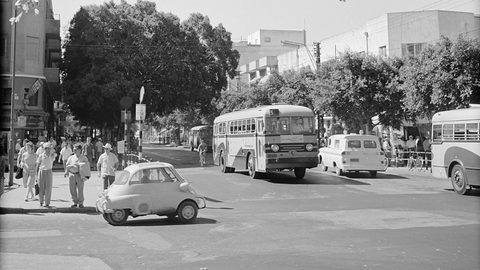
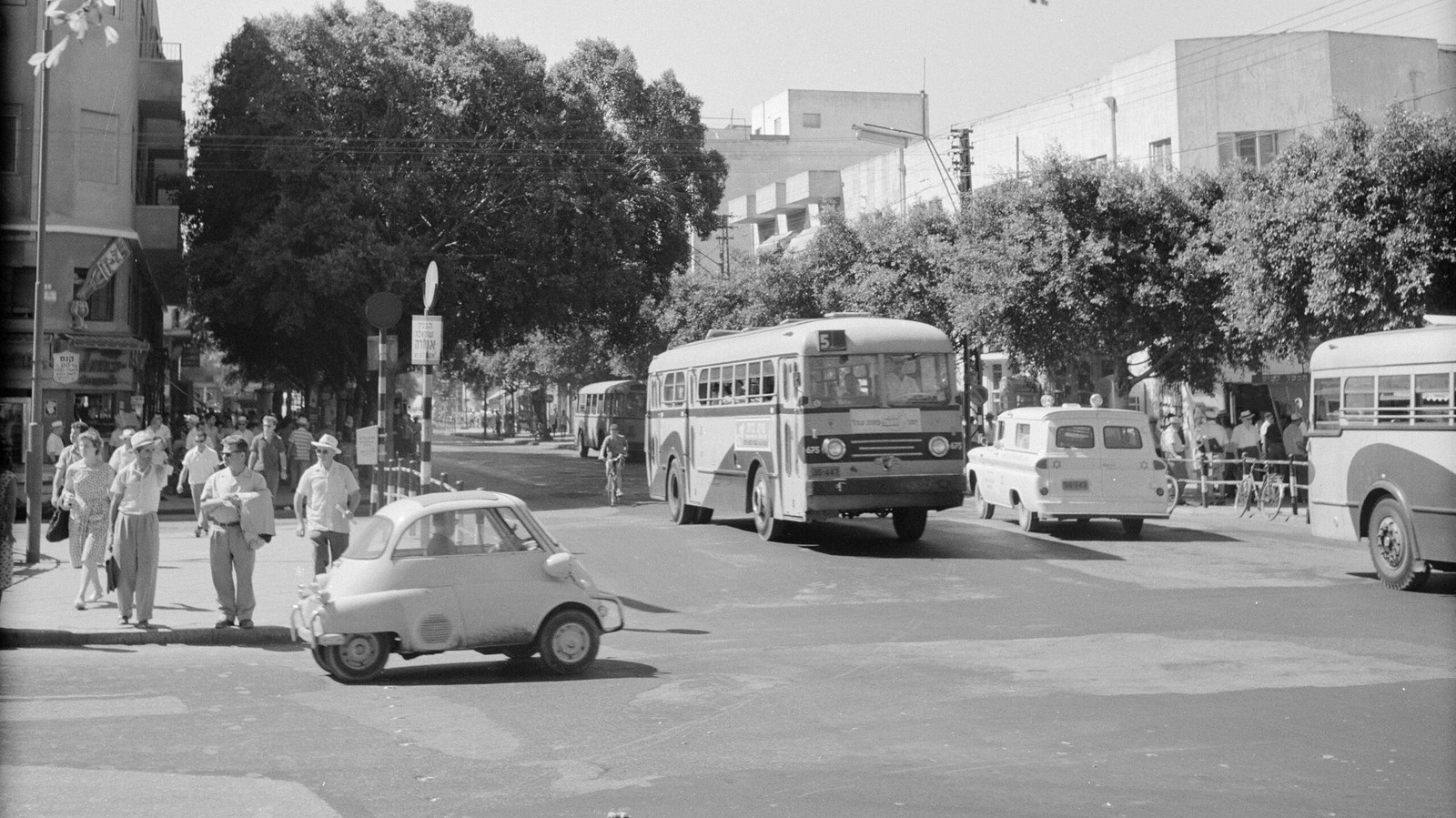
1 An Isetta crossing a busy junction with buses behind, 1964.
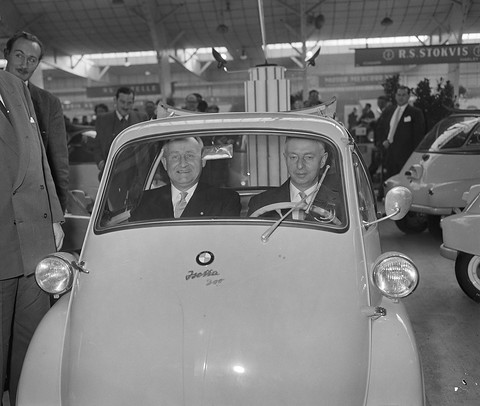
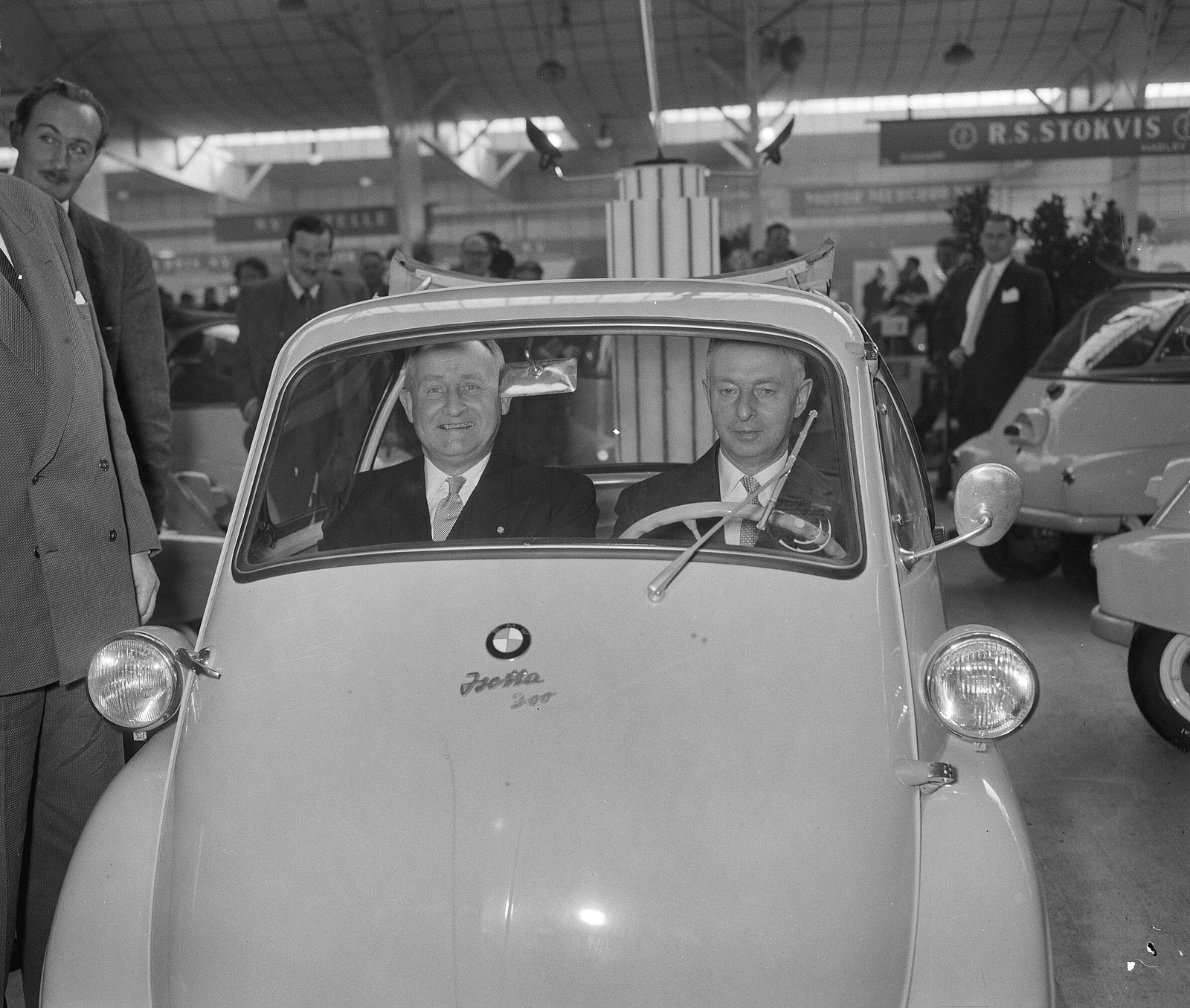
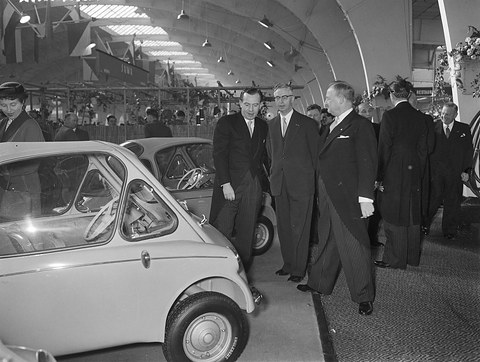
2 BMW Isetta 300 head-on with two officials at the wheel at the opening of the RAI motor-scooter show, Amsterdam, 28 February 1957.
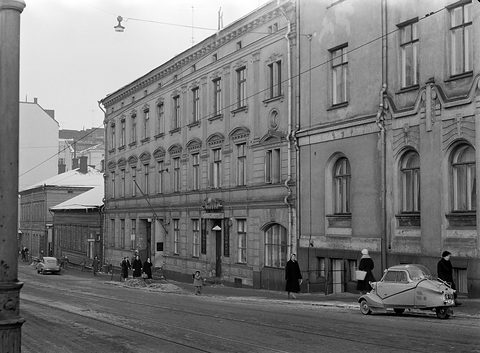
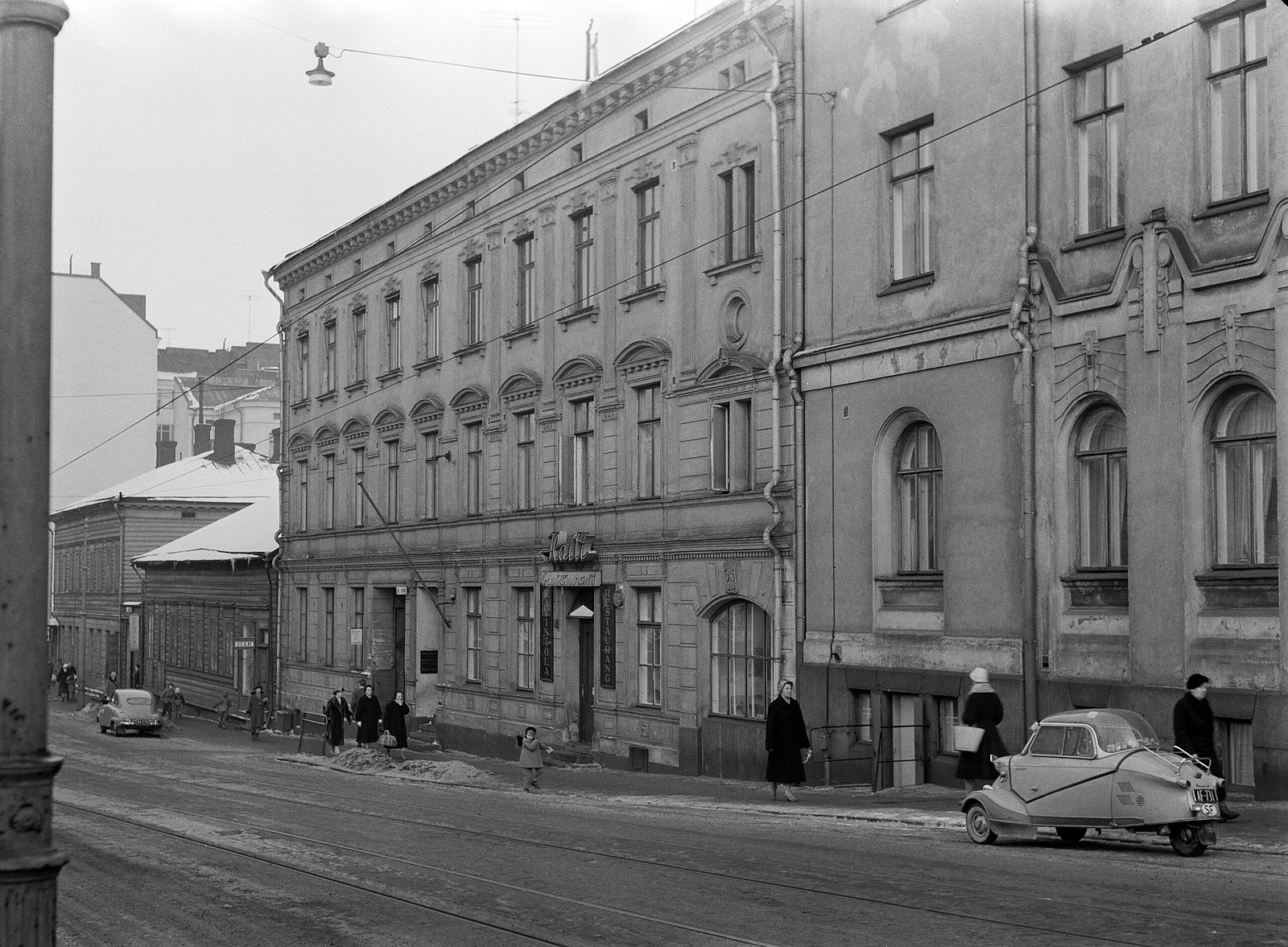
3 Messerschmitt KR200 parked at the kerb of a Helsinki street with tram tracks, about 1960.
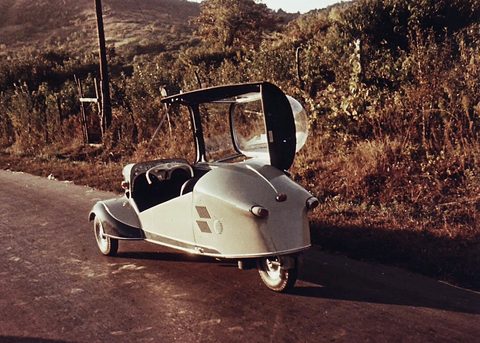
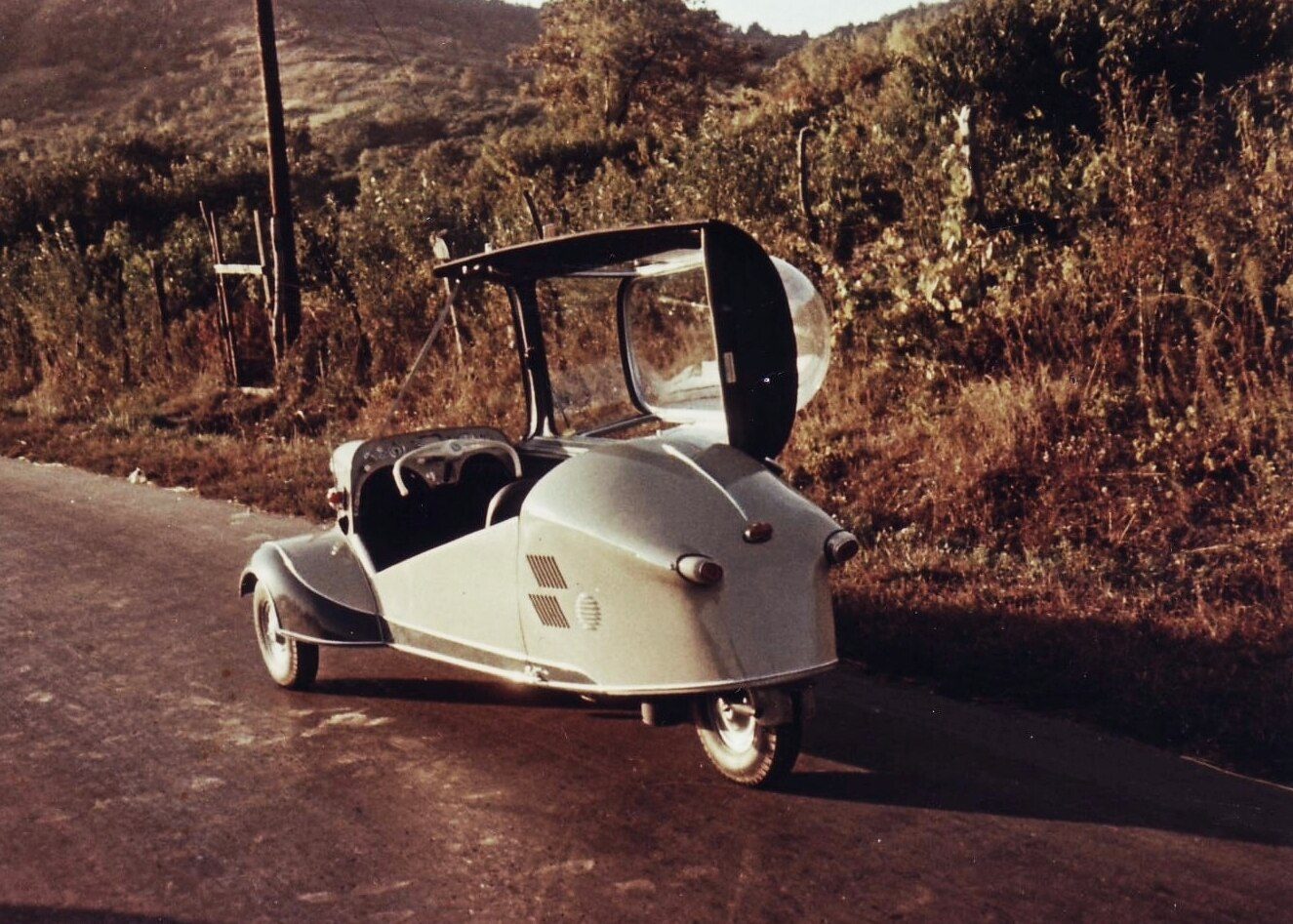
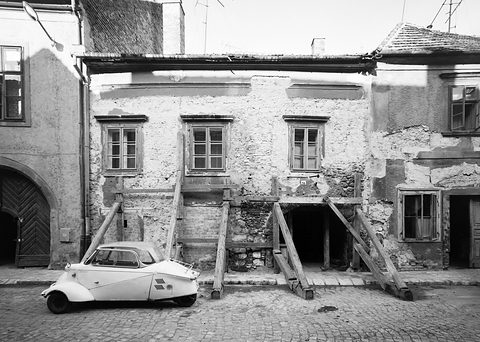
4 Hungary, 1956: a pale Messerschmitt KR200 at the roadside, its canopy swung open to the right.
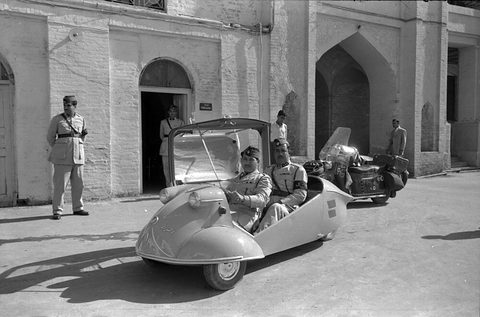
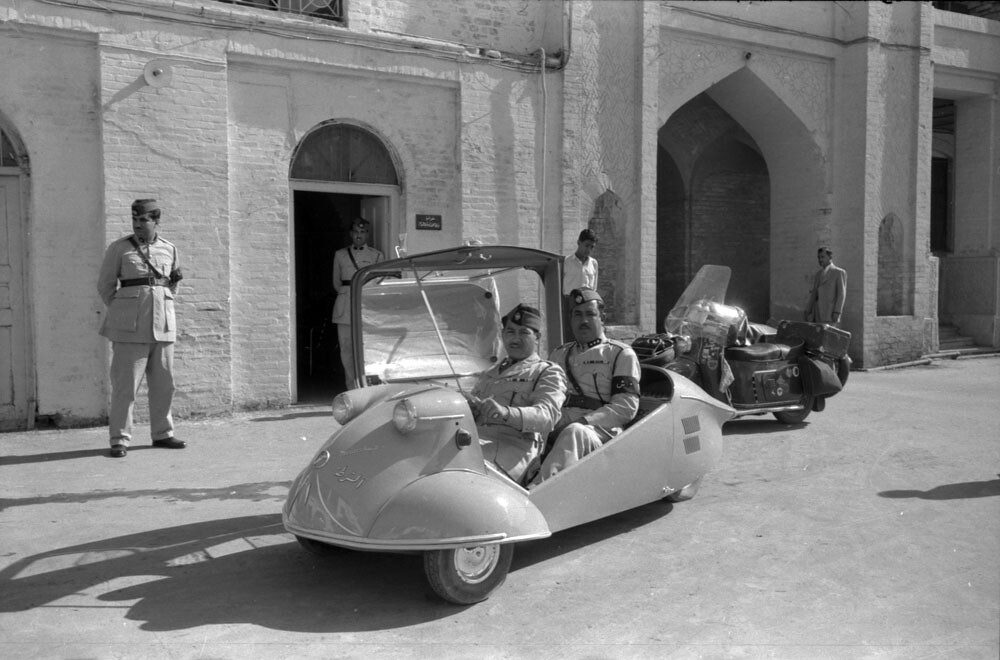
5 A KR175 on a long-distance journey, parked by an arched building with uniformed men, 1955.
8 more picturesFewer pictures
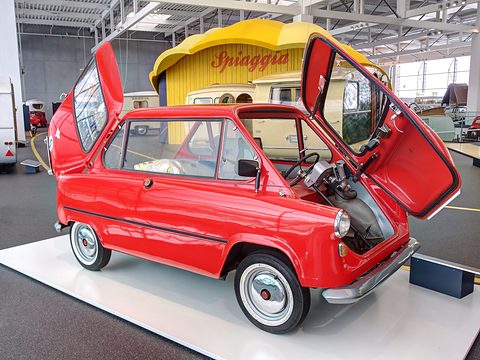
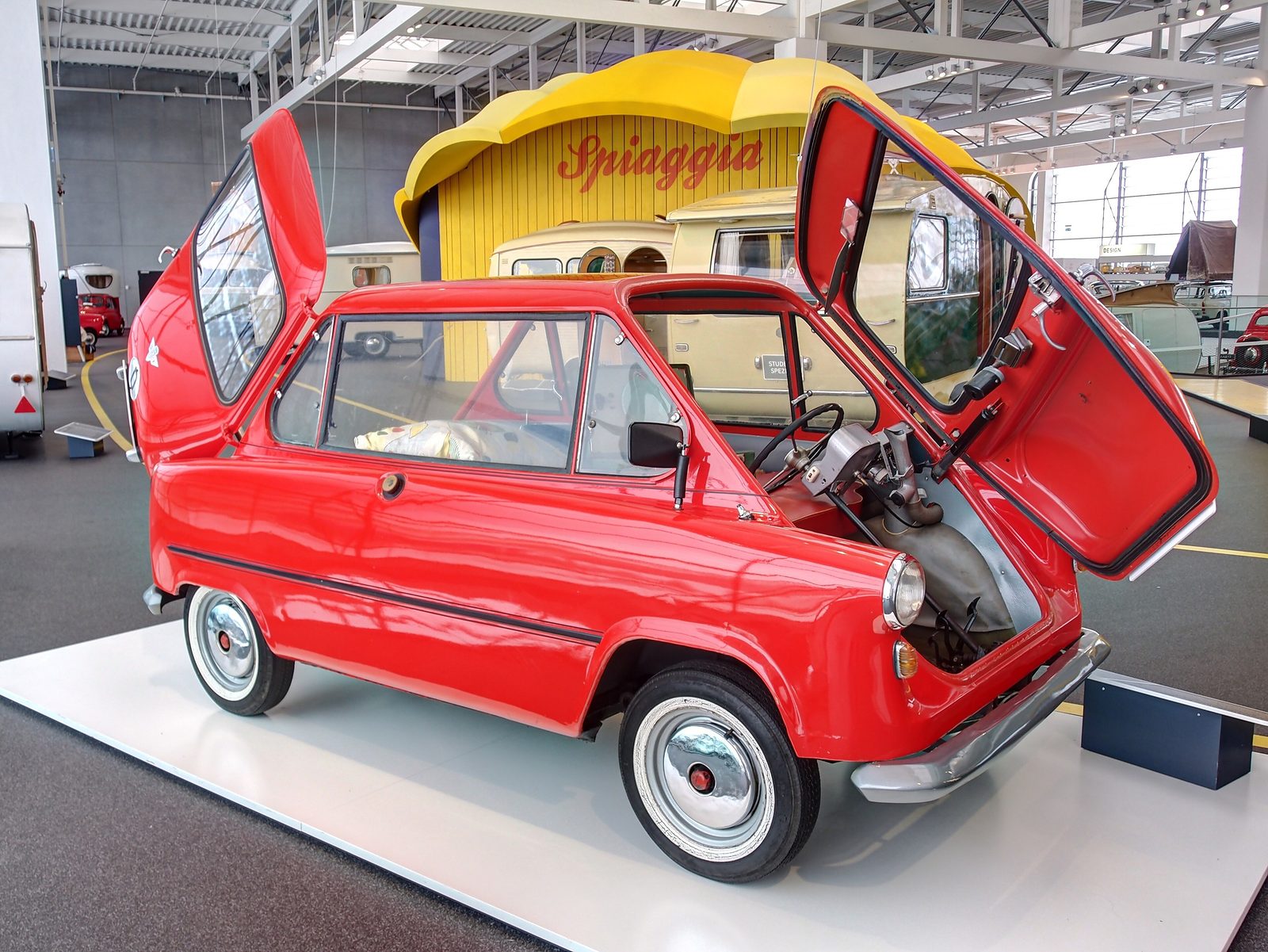
6 The red Zündapp Janus at the Erwin Hymer Museum with both its front and rear doors open, 2019.
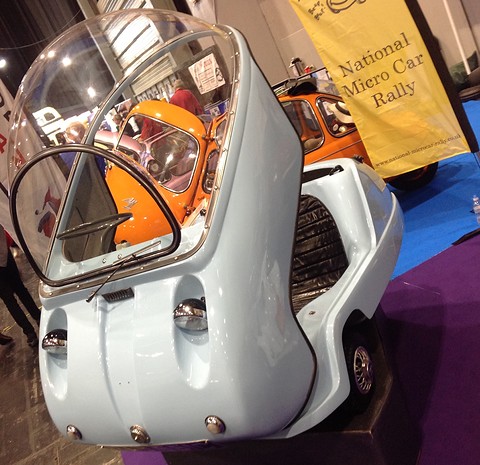
7 A 1965 Peel Trident, DAJ 551C, with its canopy fully raised at the NEC in 2018, showing how you climb in.
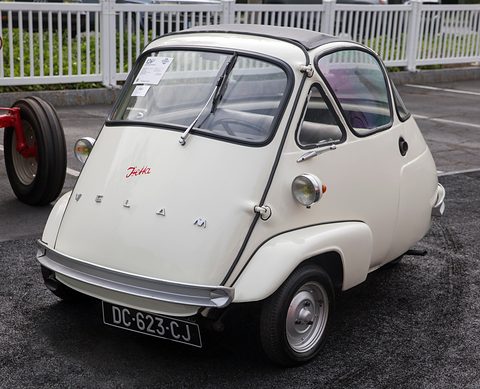
8 A white 1956 Velam Isetta at the Bonhams sale during the Greenwich Concours, Connecticut, in 2023.
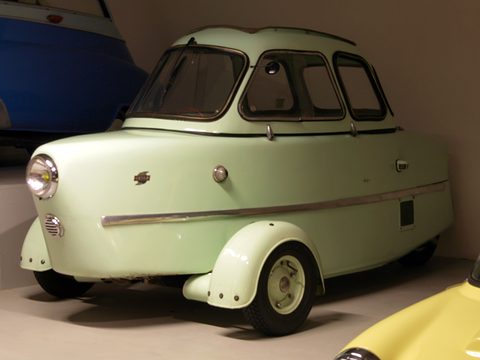
9 The pale green Inter 175 A Berline in the Louwman Museum, The Hague, in 2011.
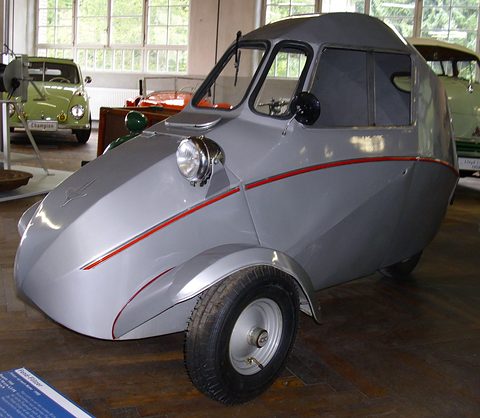
10 A 1950 Fend Flitzer 101 coupé on display in a museum in 2010.
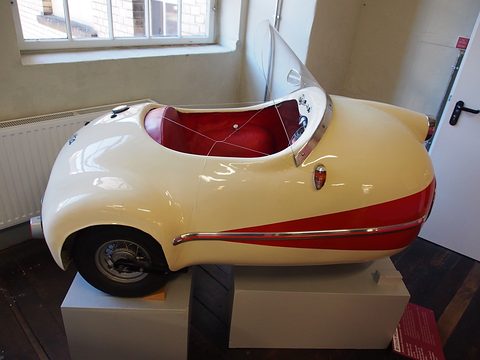
11 The cream and red 1957 Brütsch Mopetta at the ErfinderZeiten Auto- und Uhrenmuseum, Schramberg in 2015.
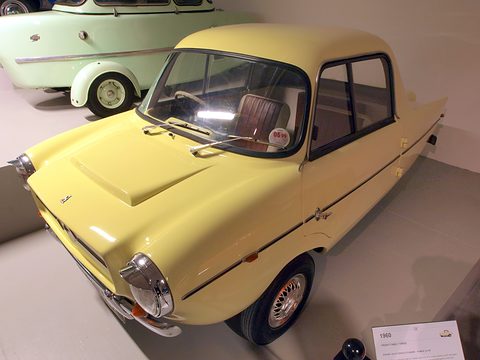
12 A yellow 1960 Frisky Family Three in the Louwman Museum, The Hague.
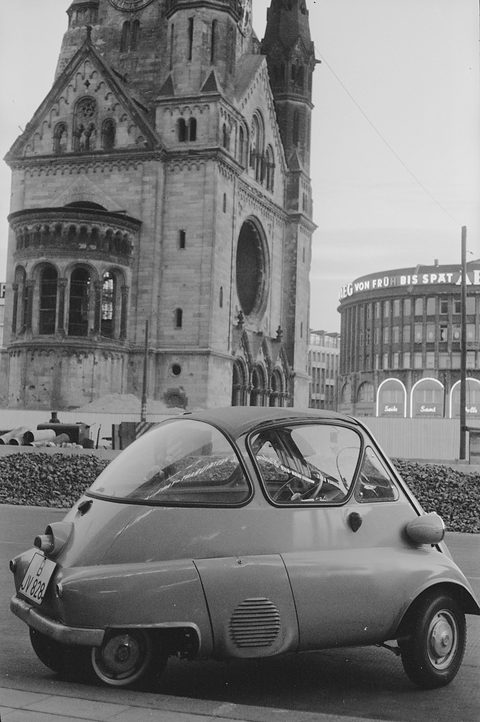
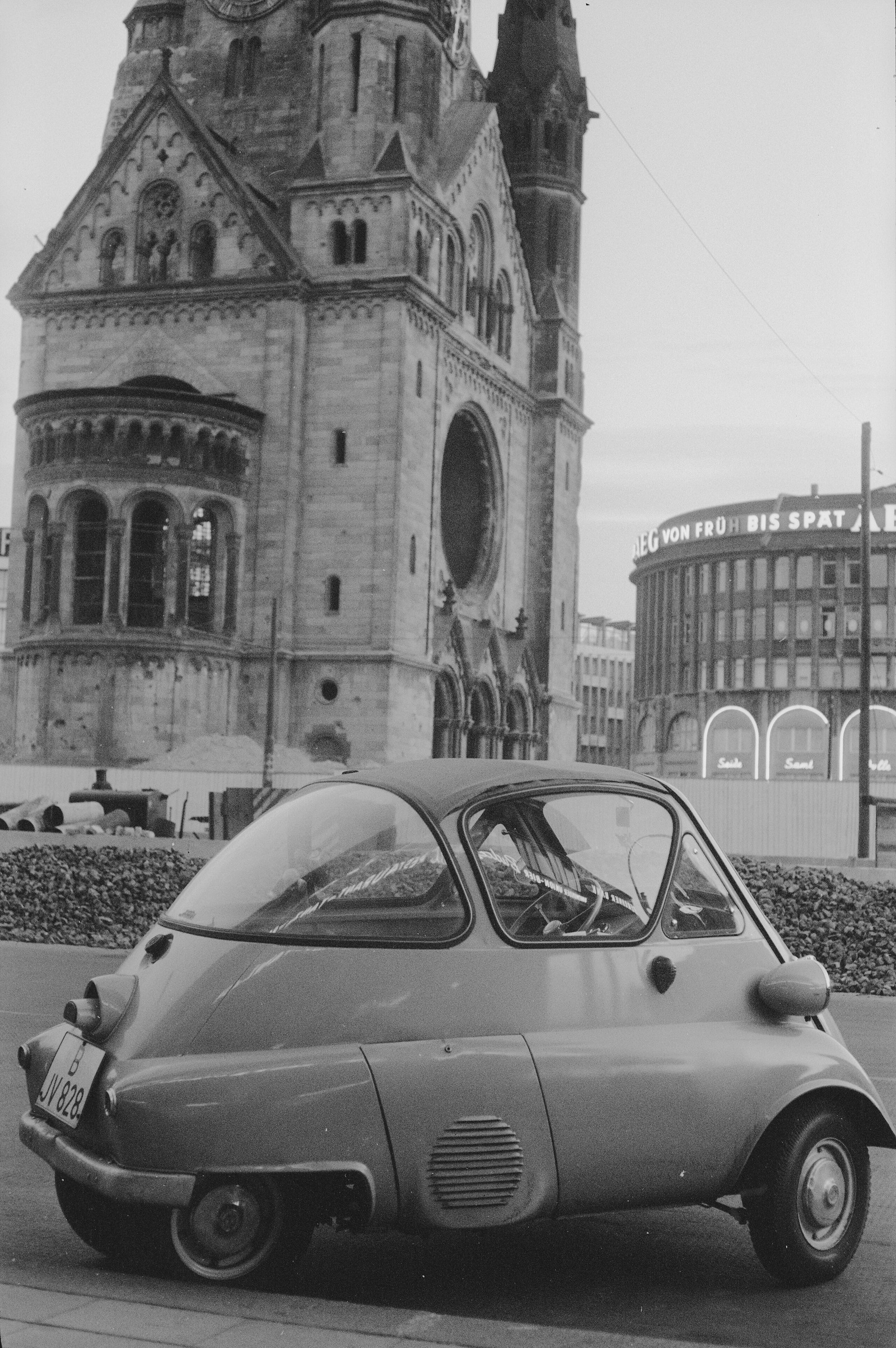
13 An Isetta parked below the ruined Kaiser Wilhelm Memorial Church in West Berlin, 29 September 1959.
Picture credits (13)
- 1 Willem van de Poll, CC0
- 2 Joop van Bilsen, Anefo, CC0
- 3 Constantin Grünberg, Helsinki City Museum, CC BY 4.0
- 4 Fortepan / Négyesi Pál, CC BY-SA 3.0
- 5 IISG, CC BY-SA 2.0
- 6 Alf van Beem, Public domain
- 7 andreboeni, CC BY 2.0
- 8 Mr.choppers, CC BY-SA 3.0
- 9 Alf van Beem, CC0
- 10 Buch-t, CC BY-SA 3.0 de
- 11 Alf van Beem, CC0
- 12 AlfvanBeem, CC0
- 13 Warren K. Leffler, Public domain
The cars
Profiles
10 more cars and 2 more maker groupsFewer
Sources
Numbered as in the text
Sources are given as plain text; the links are on the Credits page.
- German patent DE 883 244, “Motorangetriebenes Erdfahrzeug mit Kabine bzw. Führerstand”, Ermenegildo Preti and Mario Salvo, filed 9 October 1951, published 16 July 1953, via Google Patents.
- Italian Wikipedia, Iso Isetta, read in full; its bibliography includes Flavio Campetti, Da ISO a Iso Rivolta (2004).
- BMW Group PressClub, “50 Years of BMW Isetta”, press release of 25 February 2005, and its long version “50 years of the BMW Isetta”, with technical data.
- Bruce Weiner Microcar Museum, “1957 Velam Isetta”, tour page (2002).
- Pesquisa FAPESP no. 362, April 2026, “Há 70 anos nascia o primeiro carro brasileiro”.
- Merriam-Webster and Dictionary.com, entries for “bubble car” (first known use 1957; “1955–60”), read as search summaries.
- Classic & Sports Car, “Classic shrine: National Bubble and Microcar Museum”.
- German Wikipedia, Messerschmitt Kabinenroller, read in full with its references; it cites Rosellen, Deutsche Kleinwagen (1991).
- auto motor und sport 20/1955: report on the smallest vehicles at the Frankfurt show, the table “Kleinstwagen und Rollermobile” and the price list of 22 September 1955.
- “Produktionszahlen 1957”, West German production by model for 1955–57, with motorcycles, scooters and mopeds, and the Vespa 400 comparison, auto motor und sport 4/1958.
- Stadtarchiv Rosenheim, “Fritz Fend und sein ‘Flitzer’”, from Rosenheim 2000. Eine Stadt im 20. Jahrhundert (2000).
- German Wikipedia, Fend Flitzer, read in full; it draws on Rosellen (1991) and Thyssen-Bornemissza, Lexikon der vergessenen Automarken.
- Bruce Weiner Microcar Museum, “1950 Fend Flitzer 101”, tour page, archived.
- English Wikipedia, Fuldamobil, read in full; used as a lead, but detailed, citing Das Auto, auto motor und sport and club and museum sites.
- German Wikipedia, Fuldamobil, read in full with its model table; it cites Schermer, Das dritte Rad (1998), and Rosellen (1991).
- German Wikipedia, Kleinschnittger F 125, read in full; it cites Rosellen (1991), pp. 152–171.
- German Wikipedia, Lloyd 300, read in full; it cites Kurze, Borgward Typenkunde (2009), and Oswald, Deutsche Autos 1945–1975 (1979).
- English Wikipedia, Isetta, read in full; used as a lead; it cites Norm Mort (2008) and The Motor, 6 March 1957.
- English Wikipedia, Messerschmitt KR175, read in full; used as a lead; its data come from Carl Wagner, Automobile Quarterly 11 (2), 1973, and the Weiner museum.
- “Rollermobile brauchen Leistung und Sicherheit”, auto motor und sport 5/1955.
- David Garner, “Fritz Fend: father of the Messerschmitt Kabinenroller”, Messerschmitt Owners’ Club, 14 January 2014.
- Werner Oswald, “BMW-Isetta für 2550 Mark!”, auto motor und sport 8/1955, p. 11.
- German Wikipedia, BMW Isetta, read in full; used as a lead; it cites sales brochures, Motor Klassik and Der Spiegel 46/1955.
- German Wikipedia, Goggomobil, read in full with its production tables; used as a lead; it cites Oswald and Rosellen (1991).
- “Für Rollermobile”, news note on the commuting allowance and motorcycle insurance, auto motor und sport 3/1956.
- Notes on the 1956 Vespa models and on BMW motorcycle prices, auto motor und sport 4/1956.
- Dr Paul Simsa, “Unser Test: Messerschmitt Kabinenroller KR 200”, auto motor und sport 22/1955 (October 1955), pp. 12–15.
- Günther Molter, “Rekorde der Kleinsten”, auto motor und sport 19/1955, p. 25, with the record table.
- Messerschmitt Owners’ Club (UK), model pages and “Messerschmitt 200 Super: a world record breaker!” (Messerschmitt Foundation of Great Britain, May 1994).
- German Wikipedia, Heinkel Kabine, read in full; used as a lead; it cites Oswald, Deutsche Autos 1945–1990, vol. 4.
- Dr Paul Simsa, “Unser Test: Heinkel-Kabine 175 ccm”, auto motor und sport 19/1956 (15 September 1956).
- New-car price list, auto motor und sport 18/1956.
- Heinkel Trojan Club, “Cabin Cruisers”, a production history of the German, Irish, Argentine and British cars and the British imports, from Trojan’s records, Glass’s Guide and Motor Cycle, archived 2015.
- Reports from the Frankfurt show (IFMA), October 1956, auto motor und sport 22/1956.
- German Wikipedia, Brütsch (Automobilhersteller), read in full; it cites Rosellen (1991), pp. 176–197.
- German Wikipedia, Brütsch Mopetta, read in full; used as a lead; it relies on Rosellen (1991).
- German Wikipedia, Zündapp Janus, read in full; used as a lead; its production table is from Oswald, Deutsche Autos 1945–1975 (1979).
- Bruce Weiner Microcar Museum, “1958 Zundapp Janus”, tour page (2002), archived.
- Dipl.-Ing. W. Buck, “Schon wieder ein Kleinfahrzeug: Zündapp-Janus”, auto motor und sport 20/1956.
- Wolfgang Kraus, Uschi Kettenmann and Heiko Zimmermann, KR201 History, translated by David Garner, Messerschmitt Owners’ Club.
- English Wikipedia, Nobel (automobile), read in full; used as a lead; it cites Moore, Motor Makers in Ireland (1982), and Glass’s guide.
- English Wikipedia, Scootacar, read in full; used as a lead; it cites the Scootacar Register and Sedgwick and Gillies, A–Z of Cars 1945–1970 (1993).
- Bruce Weiner Microcar Museum, “1959 Frisky Family Three”, tour page (2002).
- BMW Group, “1959 – 2009: fifty years of MINI”, press release T0012284EN (2009).
- English Wikipedia, Mini; used as a lead only.
- “VELAM: The French Isetta with a couple of sporting twists”, rarefrenchsportscars.wordpress.com, PDF study, author not named.
- Lane Motor Museum, “Inter 175A Berline – 1956”, collection page.
- Richard Dredge, “SNCAN Inter 175A Autoscooter”, Below the Radar.
- RM Sotheby’s, Amelia Island, March 2018, lot 120, “1957 Inter 175A Berline”, catalogue text.
- Bruce Weiner Microcar Museum, “1958 Iso Isetta (Spanish built)”, tour page, archived.
- Toni Solans, La web de los microcoches (grupo7.com), page on Triver, in Spanish.
- Canaltech, “Romi Isetta: como foi o primeiro carro fabricado no Brasil”, about 2022–23.
- auto-historia.com.ar, “Bambi la microcupé de Fuldamobil”, archived 2016.
- Toyota Automobile Museum, collection record 85, “Fujicabin Model 5A”.
- Table “Personenwagen-Neuzulassungen 1957”: production and registrations for 1957 and 1956, export shares and registrations for the first half of 1958, auto motor und sport 20/1958.
- Italian Wikipedia, Fiat Nuova 500, read in full; it cites Alessandro Sannia, Il grande libro delle piccole Fiat (2008), and Il Sole, 3 July 1957.
- German Wikipedia, BMW 600, read in full; used as a lead; it cites Oswald (1979) and Kittler, BMW: Alle Personenwagen seit 1928 (2008).
- English Wikipedia, Messerschmitt KR200, read in full; used as a lead; it cites Automobile Quarterly 11 (2), 1973.
- “Bosch kaufte Zündapp”, auto motor und sport 15/1958.
- Bruce Weiner Microcar Museum, “1966 Peel Trident”, tour page, archived about 2015.
- Lane Motor Museum, “1965 Peel Trident”, collection page.