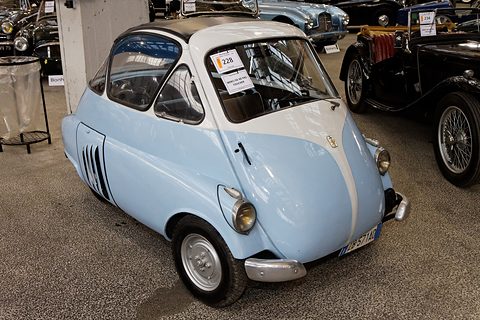
microcarfan
  • Bubble car
  • Brazil
  • Four wheels
  • Built under licence

Romi-Isetta

Also known as Romi Isetta, Romi-Isetta 300 de Luxe

On 5 September 1956 sixteen small egg-shaped cars drove out of a showroom in São Paulo, and outside the Episcopal Palace a cardinal blessed them. They were Isettas, built under licence by a firm that made machine tools and tractors, and Brazil remembers them as its first car.

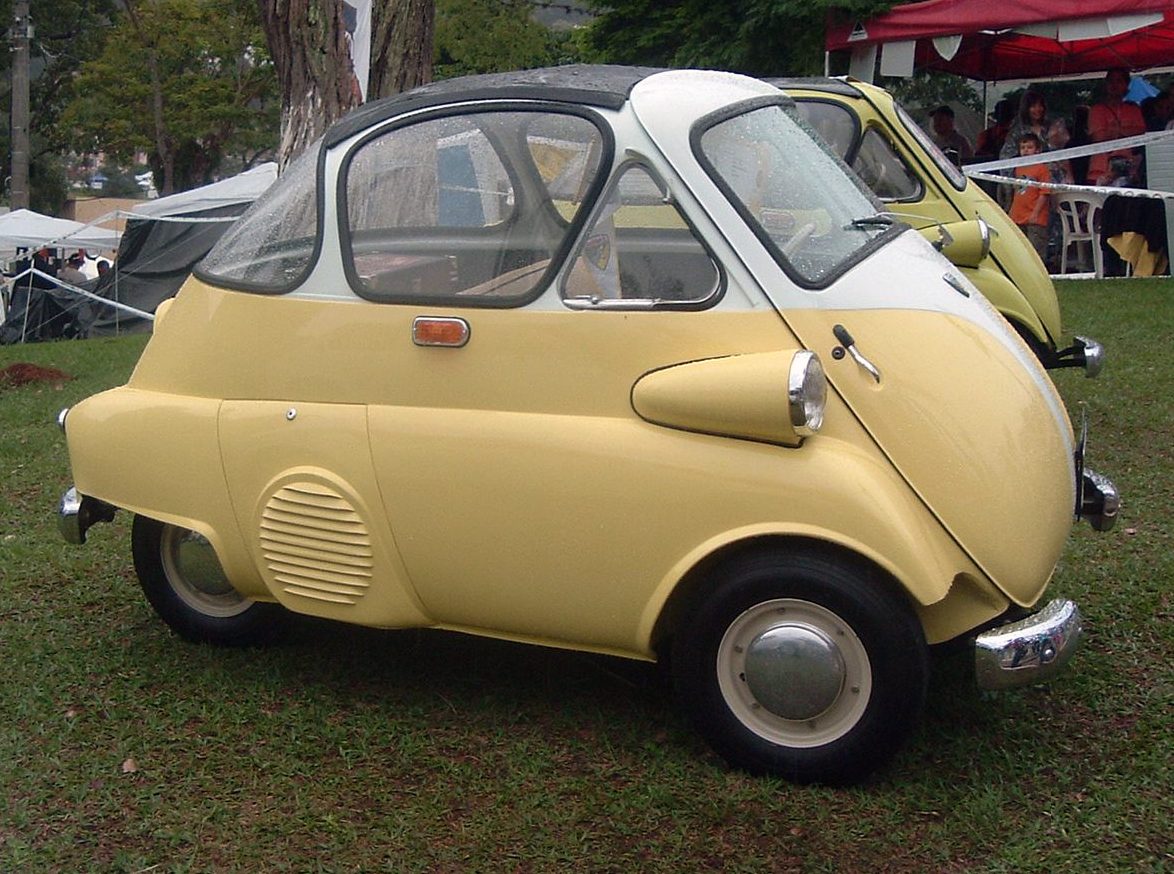
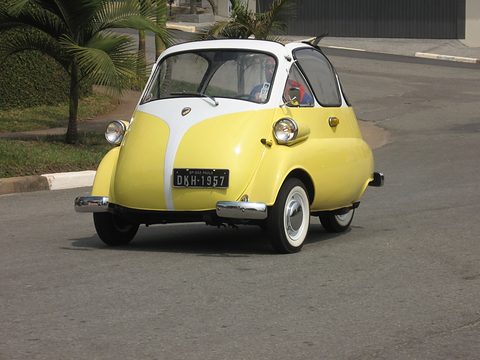
Yellow and white bubble car with a front door, round headlamps on its flanks and a Brazilian plate, on a road by palm trees.
A yellow 1957 Romi-Isetta, with the Iso engine, in Brazil in 2012.Photo: JasonVogel, CC BY-SA 3.0, via Wikimedia Commons

At a glance

The spec plate

Romi-Isetta

Iso, then BMW engine · Santa Bárbara d’Oeste

Built
1956–⁠1961From 5 September 1956 to 13 April 1961; the last cars sold in December 1961
Country
BrazilSanta Bárbara d’Oeste, São Paulo state
Maker
Indústrias RomiMachine tools, farm machinery and tractors, founded in 1930; under licence from Iso of Milan
Engine
Iso 236 cc two-stroke split-singleFrom 1959 a BMW four-stroke single of 298 cc
Power
9.5–13 cvIso, then BMW
Length
2,285 mm1,380 mm wide, 1,340 mm high
Weight
350 kgThe 300 de Luxe, by its 1959 owner’s manual
Seats
2On a bench, with room for a small child
Wheels
4Two at the front, a narrow pair at the back driven by chain
Price new
About US$1,400The equivalent, once the loss of the incentives had roughly doubled it; the 1956 price not found
Production
About 3,0001956–⁠61
Top speed
85km/h85 km/h53 mph

How big is it?

True proportion

2.29 m

It is 685 mm shorter than a Fiat 500, about 1.3 adults laid end to end.

  • 1.38 m wide
  • 350 kg: about five adults
  • A rear track of only 520 mm (20 in)
  • A door at the front, carrying the steering column
Drawn at true proportion. The track is 3.6 metres long; the adult stands at the same scale. The Peel P50 is the smallest production car, on every page for comparison.

The story

History

Indústrias Romi was founded in 1930 by Américo Emílio Romi, known as the comendador, and his stepson Carlos Chiti, at Santa Bárbara d’Oeste in the state of São Paulo. It made machine tools, industrial and farm machinery, and tractors.source 1source 2 The two men read about the Iso Isetta in an Italian magazine and decided that it suited Brazil; English Wikipedia says it was chosen for its size and economy as a city car.source 2source 3 In June 1955 they flew to Italy to meet Iso’s owner, Renzo Rivolta, and agreed to pay a royalty of 3 per cent on every car, with Iso’s engineers to help.source 2 On 28 August 1955 the Diário de São Paulo reported that Romi would build the car.source 1 Romi put up a shed of 25,000 m² for it. The bodies were pressed and painted by an outside firm, Tecnogeral of São Paulo, and Romi fitted the mechanical parts and the trim; the first car was finished 11 months after the Italian deal.source 2

It was the Iso car, a bubble car with one door at the front that carried the steering column with it, two seats on a bench, and two closely spaced rear wheels driven by chain, with no differential.source 3source 2source 4 The engine was Iso’s 236 cc two-stroke split-single, with two pistons sharing one combustion chamber, giving 9.5 cv, and a four-speed gearbox.source 2source 4 It took about 50 seconds to reach 70 km/h (43 mph), but it would do 85 km/h (53 mph) flat out, which Autoentusiastas thinks was enough for Brazil’s roads of the day, and it covered up to 25 km on a litre of petrol.source 2source 4 A fabric sunroof, an electric windscreen wiper and 12-volt electrics were all standard, which was unusual in Brazil in the 1950s.source 2

The parade

The first 16 cars set off on 5 September 1956 from the showroom of the distributor, the Companhia Distribuidora Brasileira Comércio e Indústria in rua Marquês de Itu, and drove through the centre of São Paulo.source 5source 4 In front of the Episcopal Palace in Bela Vista, Cardinal Carlos Carmelo Motta blessed them.source 5

Invoco a proteção de Deus para esta iniciativa, que visa a dar ao Brasil mais um forte apoio para sua independência econômica.

Cardinal Carlos Carmelo Motta, blessing the first cars in São Paulo, 5 September 1956, as reported by Pesquisa FAPESP in 2026. In English: “I invoke God’s protection for this undertaking, which aims to give Brazil another strong support for its economic independence.”source 5

The cars went on to the governor’s palace, where Jânio Quadros and his wife tried one.source 2source 4 That evening the Folha da Noite hailed it as the first Brazilian automobile, 70 per cent Brazilian.source 4 By weight, 72 per cent of the car was made in Brazil at its launch, already more than the 50 per cent the government would demand from July 1957.source 5source 2 A caravan of 40 cars drove from São Paulo to Rio de Janeiro and back for the publicity.source 2 The actors Eva Wilma and Anselmo Duarte and the comedienne Dercy Gonçalves were seen in Romi-Isettas, and Pelé was given one after the 1958 World Cup.source 2 One advertisement aimed it at women, showing a woman stepping out of a cage and into the car, now free.source 1

Brazil’s first car?

The claim needs care. Ford had assembled cars in Brazil from imported kits since 1919, and General Motors since 1925.source 5source 2 Strictly, the Romi-Isetta was the first passenger car series-produced in Brazil with most of its content made there, and it came 75 days before the DKW-Vemag Universal estate.source 5source 2

The four-seat rule

In June 1956, three months before the launch, President Juscelino Kubitschek had set up the Grupo Executivo da Indústria Automobilística, the GEIA, to raise the local content of Brazilian cars step by step, from 50 per cent on 1 July 1957 to 95 per cent on 1 July 1960.source 5 Its tax, exchange and credit incentives went only to vehicles that could carry at least four people. The Romi-Isetta took two, or three with a child, and was left out.source 5source 4 English Wikipedia, citing a business historian, says the car had been approved as part of the state-backed drive to found a motor industry but was built in the end without government support.source 3 Without the incentives its price roughly doubled, to the equivalent of US$1,400.source 4

Romi kept improving it. In 1957–⁠58 came larger headlamps, high beams, bigger windows and new suspension settings, and in 1959 the Iso engine and gearbox gave way to BMW’s 298 cc four-stroke single of 13 cv, in the Romi-Isetta 300 de Luxe.source 2source 1source 4 On 2 February 1960 Kubitschek himself was photographed waving from a Romi-Isetta in a caravan of Brazilian-made vehicles at Brasília.source 5 But Romi could not keep pace with the multinational makers arriving in Brazil’s boom years.source 5 Production stopped on 13 April 1961, after about 3,000 cars, and the stock was sold off until the last one went early in December.source 1source 2 The Brazilian site Best Cars later called it a European success that failed in Brazil by offering advantages nobody needed.source 1 Romi went back to its machine tools. Carlos Chiti, looking back in the 1990s, thought they had been right all along.source 5

Tínhamos razão quando quisemos entrar na produção de automóveis pensando num carro de modestas proporções e reduzido consumo.

Carlos Chiti, to Ignácio de Loyola Brandão for Oficina de sonhos (1996), as quoted by Pesquisa FAPESP in 2026. In English: “We were right when we wanted to enter car production with a car of modest proportions and low consumption.”source 5

The Romi-Isetta belongs to the family of Isettas built under licence, with the BMW Isetta and the French Velam Isetta.
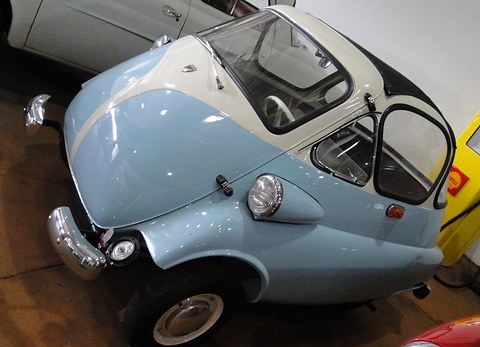
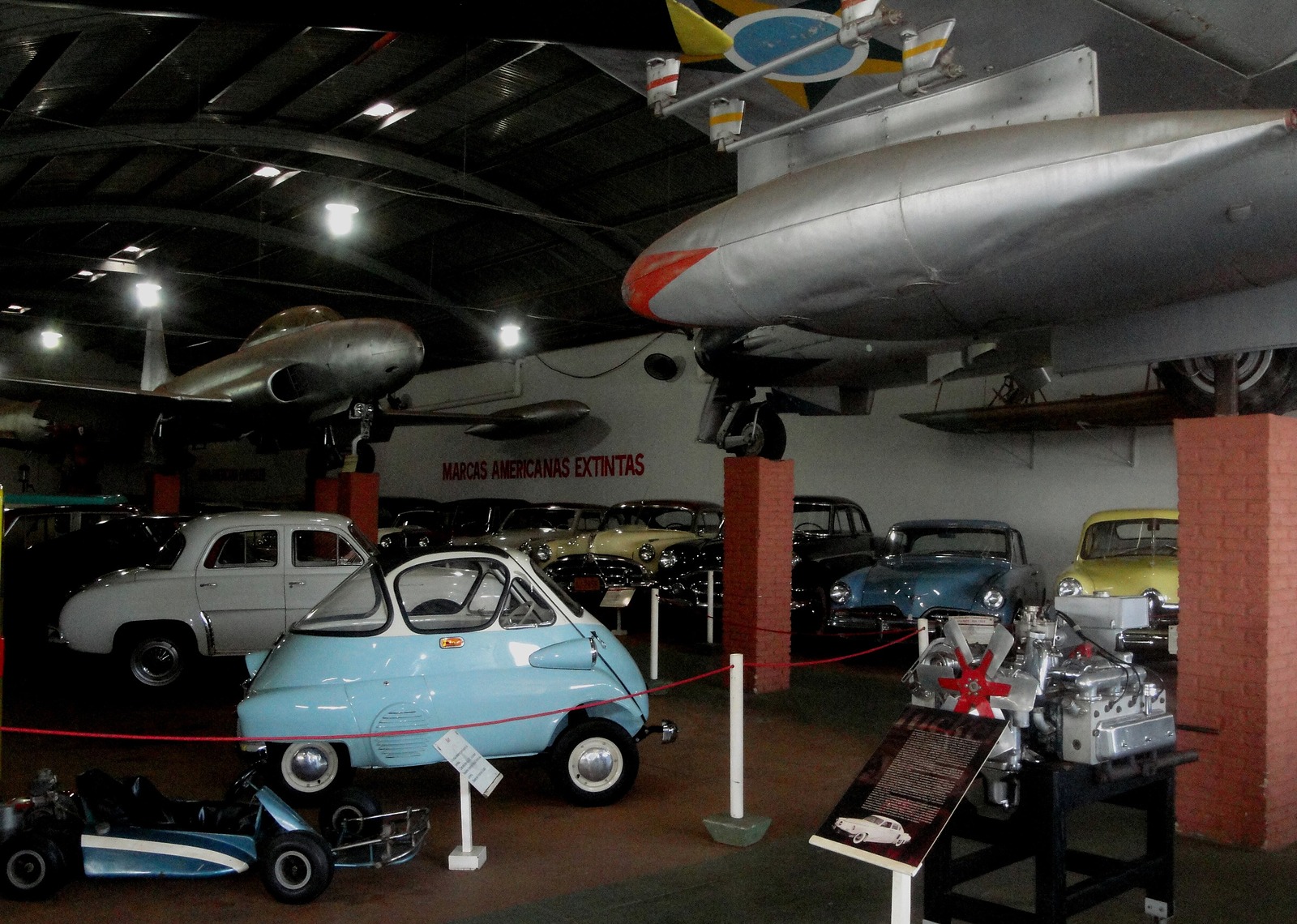
Close front quarter of a pale blue and white bubble car with its front door swung open and a chrome bumper, in a museum.
A pale blue and white Romi-Isetta with its front door open, at the Museu Eduardo André Matarazzo in Bebedouro, Brazil, in 2010.Photo: Marco Antônio, CC BY-SA 2.0, via Wikimedia Commons
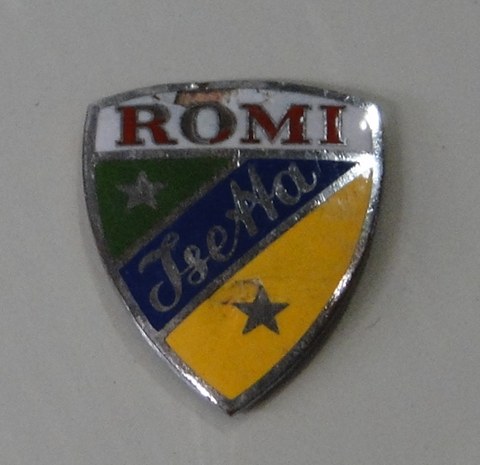
Chrome-edged shield badge with ROMI in red over green, blue and yellow fields, Isetta in script and two stars.
The Romi-Isetta badge, in the green, blue and yellow of Brazil’s flag.Photo: Marco Antônio, CC BY-SA 2.0, via Wikimedia Commons

Pictures

More photographs, old and new

Variants

Two engines

Romi-Isetta, 1956–⁠61
VariantYearsWhat differsHow many
Romi-Isetta1956–⁠58The Iso split-single and gearbox; larger headlamps, bigger windows and new suspension settings in 1957–⁠58Not split
Romi-Isetta 300 de Luxe1959–⁠61BMW’s 298 cc four-stroke single and gearboxNot split

Specification

The 300 de Luxe, from its 1959 manual, and the Iso-engined car

Engine and drive

Engine and drive
Engine, 1956–⁠58Iso two-stroke split-single, 236 cc, at the back, cooled by a fan; a Dynastart starter-dynamosource 3source 2
Engine, 1959–⁠61BMW four-stroke single, 72 × 73 mm, 298 cc, 7:1, fan-cooledsource 1
Power9.5 cv (Iso); 13 hp at 5,200 rpm (BMW)source 2source 4source 1
GearboxFour speeds and reversesource 2source 4
DriveChain to a solid rear axle, no differentialsource 3source 2

Body and chassis

Body and chassis
ConstructionSteel body on a tubular steel chassis; front door and fabric sunroofsource 1source 2
SuspensionFront: independent, swinging arms and coil springs; rear: two quarter-elliptic leaf springssource 1
BrakesHydraulic, on all four wheelssource 1
Tyres4.50 × 10, on split rimssource 1source 2
Electrics12 volts, with an electric wipersource 2

Dimensions

Dimensions
Length2,285 mm (90 in)source 12,290 mm by Autoentusiastas, 2,280 mm by Canaltech
Width1,380 mm (54 in)source 11,370 mm by Autoentusiastas
Height1,340 mm (53 in), unladensource 1
Wheelbase1,500 mm (59 in)source 1source 2
Track1,200 mm front; 520 mm rearsource 1480 mm rear by Autoentusiastas, perhaps for the Iso-engined car
WeightAbout 350 kg (772 lb); payload 230 kgsource 1source 2source 4

Performance and running

Performance and running
Top speed85 km/h (53 mph)source 2source 4
Acceleration0–70 km/h in about 50 seconds (Iso engine)source 2
Economy25 km per litre (4 litres per 100 km)source 1source 2source 4
FuelAbout 13 litres, with about 3 litres in reservesource 1
Turning circleAbout 8 msource 1

How many were built?

About 3,000 in five years

About 3,000 builtAbout 3,000 were built from 1956 to April 1961, by English Wikipedia, which cites Romi’s own corporate history, by Portuguese Wikipedia and by Canaltech. All may go back to Romi’s records; no exact or yearly figure from the Fundação Romi archive has been seen.

  1. fewer than 5,000in almost five years: a ceiling, not a countUnconfirmed

    Autoentusiastassource 2

  2. about 3,0001956–⁠61Two sources agree

    English Wikipedia; Portuguese Wikipedia; Canaltechsource 3source 1source 4

  • Two sources agreetwo good sources give the figure
  • One sourcea good source, alone
  • Unconfirmeda lead only, not yet checked

Famous for

Three points

  1. Brazil’s first car

    The first passenger car series-produced in Brazil, 72 per cent Brazilian by weight at its launch.source 5source 2

  2. Made by a machine-tool firm

    Indústrias Romi built machine tools, farm machinery and tractors.source 1source 2

  3. A cardinal’s blessing

    The first 16 cars were blessed in the street on the day of their launch.source 5

Survivors and collecting

Today

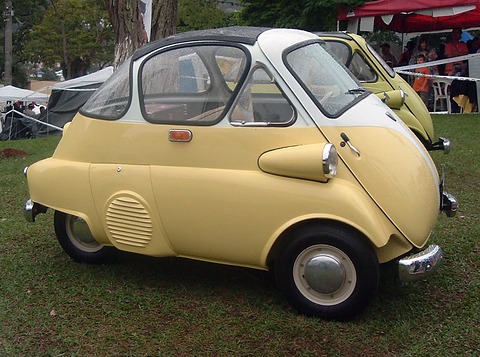
Portuguese Wikipedia says many survive with collectors, but no count has been found, and no result from the major auction houses has been found either.source 1 The Fundação Romi at Santa Bárbara d’Oeste keeps the company archive, and for the car’s fiftieth anniversary it ran a site of historical and technical documents and manuals; owners have a website of their own, “O nosso Romi-Isetta”.source 1 This page’s photographs include one in the Museu Eduardo André Matarazzo at Bebedouro, among its cars and aircraft, and another at a meeting in Brazil.

Sources

Numbered as in the text

The history rests mainly on two Brazilian anniversary articles, from Pesquisa FAPESP (2026) and Autoentusiastas (2024), on Canaltech, and on Portuguese Wikipedia’s account of the 1959 owner’s manual. No period Brazilian road test, and neither of Ignácio de Loyola Brandão’s books, was read. Sources are given as plain text; the links are on the Credits page.

  1. Portuguese Wikipedia, Isetta, the sections on the technical details and the Romi-Isetta, read in full; it cites the 1959 Romi-Isetta owner’s manual (Máquinas Agrícolas Romi S.A.).
  2. Autoentusiastas, “Romi-Isetta 68 anos: a epopeia do primeiro carro nacional”, September 2024, read in full.
  3. English Wikipedia, Isetta, the Romi section, read in full. Used as a lead; it cites Romi’s corporate history (2010) and Helen Shapiro in Business History Review 65/4 (1991).
  4. Canaltech, “Romi Isetta: como foi o primeiro carro fabricado no Brasil”, about 2022–⁠23, read in full.
  5. Pesquisa FAPESP no. 362, April 2026, “Há 70 anos nascia o primeiro carro brasileiro”, read in full.