microcarfan
  • Bubble car
  • France
  • Four wheels
  • Front door

Velam Isetta

Also known as VELAM Isetta, Isetta Vélam, “Pot de yaourt”

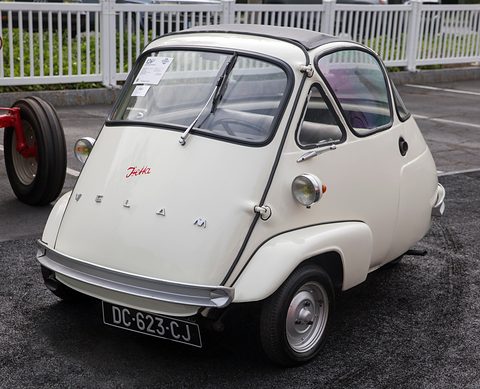
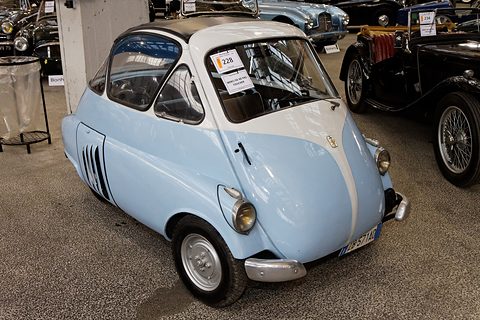
The French Isetta, built under licence and then redrawn: a rounder egg on its own steel shell, with a push-button door catch, front wings you could unbolt and the speedometer set in the middle of the steering wheel.

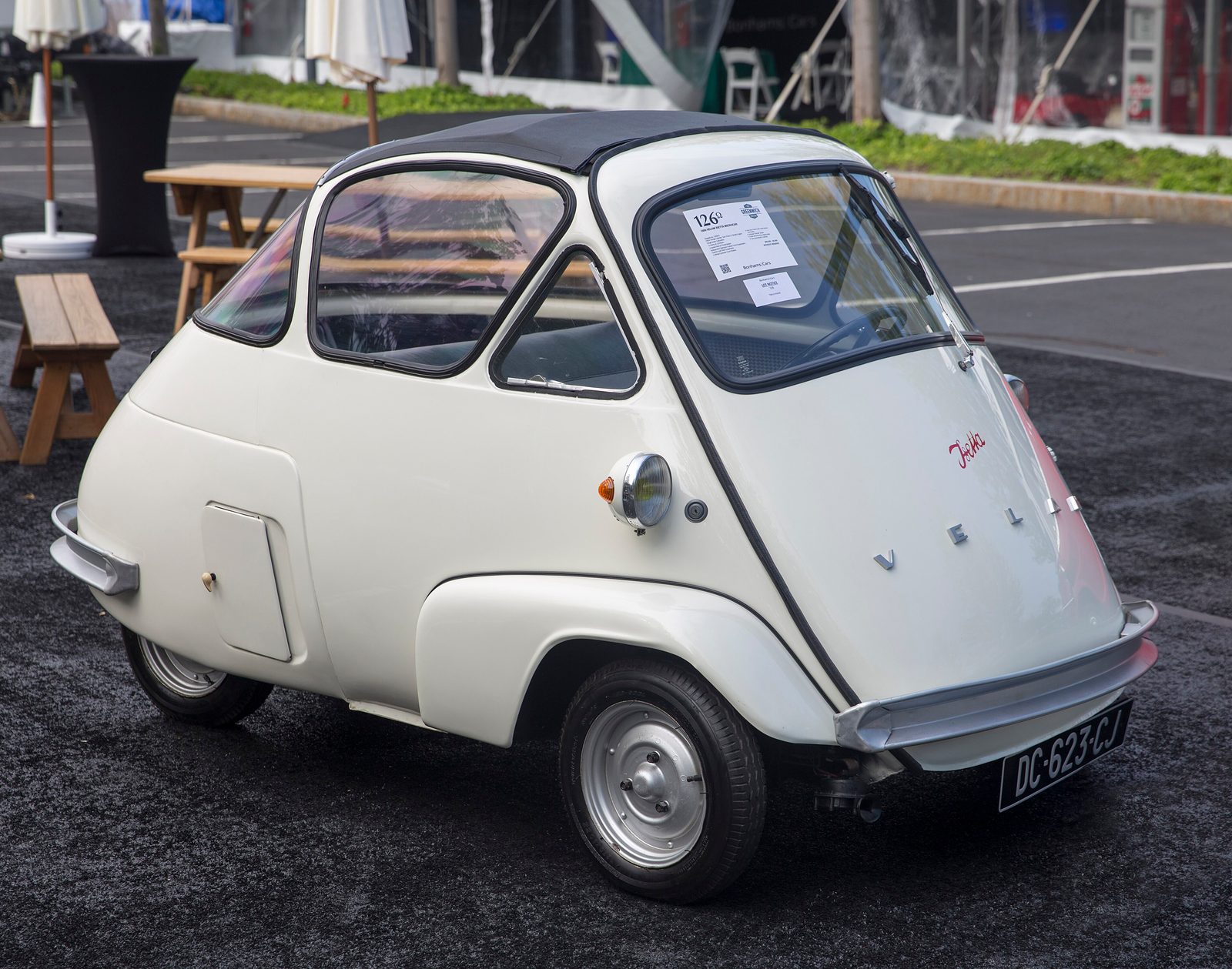
Small white egg-shaped car with a front-opening door, Isetta script and French plate DC-623-CJ, a white fence behind.
A white 1956 Velam Isetta at the Bonhams sale during the Greenwich Concours, Connecticut, in 2023.Photo: Mr.choppers, CC BY-SA 3.0, via Wikimedia Commons

At a glance

The spec plate

Velam Isetta

VELAM · Suresnes

Built
1955–⁠1958From June 1955 to January 1958
Country
FranceIn a rented part of the former Talbot works at Suresnes, near Paris
Maker
VELAM, Véhicule Léger à MoteurUnder licence from Iso of Italy
Engine
236 cc Iso split-single two-strokeThe Iso’s “twin-piston” engine, with a Dynastart
Power
9.5 hpAbout 7 kW; 10 bhp at 4,500 rpm in one account
Length
2,380 mm1,420 mm wide, 1,320 mm high
Weight
340 kg343 kg by the Weiner museum
Seats
2On a bench, behind the front door
Wheels
4The rear pair only 506 mm apart, with no differential
Price new
297,000 FThe standard car; the Écrin cost 380,000 F
Production
7,115June 1955 to January 1958
Survives
Yes“Few”, says the Weiner museum
Top speed
75km/h75 km/h80 km/h in another account

How big is it?

True proportion

2.38 m

It is 590 mm shorter than a Fiat 500, about 1.4 adults laid end to end.

  • 1.42 m wide
  • 340 kg: about five adults
  • Rear wheels only 506 mm apart
  • Two seats on a bench
Drawn at true proportion. The track is 3.6 metres long; the adult stands at the same scale. The Peel P50 is the smallest production car, on every page for comparison.

The story

History

The Iso Isetta made its debut at the Turin Show in April 1954, and its maker, Renzo Rivolta, sold licences to build it. BMW, with its BMW Isetta, was the chief licensee, and took with it, RM says, a considerable amount of the tooling.source 1 A French licence was negotiated at the same time, the start of one more licensed Isetta. M. Budin, President and Technical Director of VELAM, the Société de Construction de Véhicules Léger à Moteur, wanted what RM calls a substantial departure from the Italian car: BMW’s hold on the tooling might limit the parts Iso could supply, and he had technical and styling ideas of his own.source 1 When the licence was bought is not settled. One study says VELAM is said to have bought the right in late 1953; the English Wikipedia says 1954.source 2source 3 Nor is it clear who led the firm. The Weiner museum and RM name Budin; the study says the production lines were set up by Michel Cromback, who also hatched the plans for a wider range and for the records. They may have held different roles.source 4source 1source 2

At the Paris Salon of October 1954 VELAM’s stand still showed an Italian Iso, but the word was out about the French car, and orders were taken against deposits of 20,000 francs.source 1 Full production began only the next year, in a rented part of the old Talbot works at Suresnes, outside Paris; Tony Lago supplied parts.source 1source 4source 2 The first cars came in June 1955. The study notes later dates in some accounts, March or October 1956, and judges June 1955 the most likely.source 4source 2source 3 At its peak VELAM employed 350 people and built 20 to 22 cars a day.source 2

Thirty-four differences

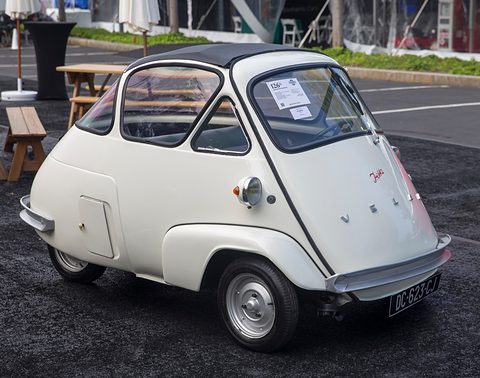
The VELAM was not a copy. It kept the Iso’s 236 cc split-single, or “twin-piston”, two-stroke, but VELAM designed its own body, a monocoque shell with subframes where the Iso had a full chassis.source 1source 3 The Weiner museum and the study list 34 changes in all. Among them were Niemann rubber-ring suspension, a better gear lever, engine access from inside the car, a new tail, lamps and bumpers, front wings that could be removed, a push-button door catch and the speedometer in the centre of the steering wheel.source 4source 2 Like every Isetta it was a bubble car with its door in the nose, and it had four wheels, the rear pair only 506 mm (20 in) apart and driven by a chain, with no differential.source 2 The French called it the pot de yaourt, the yogurt pot.source 3

Smooth and sleek as a newly peeled egg, which appealed to the fashion and style-conscious French public.

RM Auctions, describing lot 546 of the Weiner museum sale, 2013.source 1

It was also cheap. The standard car cost 297,000 F, which by the Weiner museum’s reckoning, and the study’s, was 15 per cent less than a Citroën 2CV.source 2source 4

The body and interior design was beautifully executed with French style, flair and attention to detail.

Bruce Weiner Microcar Museum, text on its 1957 Velam Isetta, about 2002.source 4

A wider range, and the end

About 5,000 cars were built in the first twelve months, to June 1956.source 2 The year began well, but towards its end sales fell sharply against the Citroën 2CV and then the Renault Dauphine, full-sized cars from big makers that the egg could not undercut by enough.source 4source 2source 3source 1 VELAM built 4,886 cars in 1956 and 1,005 in 1957.source 5source 2

It answered by widening the range and chasing records.source 2 A Décapotable of 1956 kept the front door but replaced the big rear window with a soft folding section and had a removable roof panel.source 1source 2 The Écrin, the “jewel box” of 1957, had a teardrop hardtop with sliding side windows and a panoramic rear window, hydraulic telescopic front dampers, more sound-proofing, armrests, a glovebox and a radio; its engine gave 10.5 bhp, it was claimed to reach 95 km/h (59 mph), a figure the study itself doubts, and it cost 380,000 F. About 500 were built, and several of its refinements reached the ordinary car for 1957.source 2source 4 A one-off Sport had a fixed front door and sides cut away to step over.source 2

None of it saved the firm. Production ended in January 1958, after 7,115 cars; the Weiner museum says Budin closed for financial reasons.source 4source 2 VELAM itself lasted until 1961, when it built a prototype for Kaiser-Ilin of Israel, the TA 6: a six-seater 3.30 m (10 ft 10 in) long with an air-cooled 640 cc twin.source 5 What became of the TA 6 has not been found.
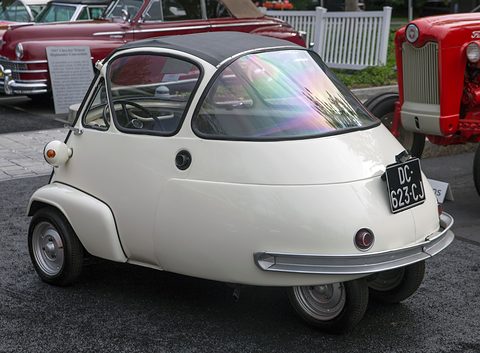
Back of a white bubble car with a wide rear window and chrome bumper, a red tractor beside it.
A white 1956 Velam Isetta from the left rear at Greenwich, Connecticut, in 2023, showing its smooth French tail and closely set rear wheels.Photo: Mr.choppers, CC BY-SA 3.0, via Wikimedia Commons
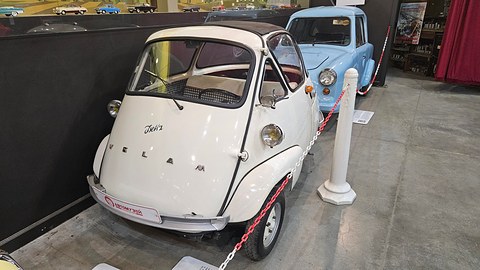
White egg-shaped car with Isetta script and spaced letters on its door, behind a red and white chain, a pale blue car beside it.
A white Velam Isetta in the Automobiles of the World museum in Moscow.Photo: Sergey A. Demidov, CC BY 4.0, via Wikimedia Commons
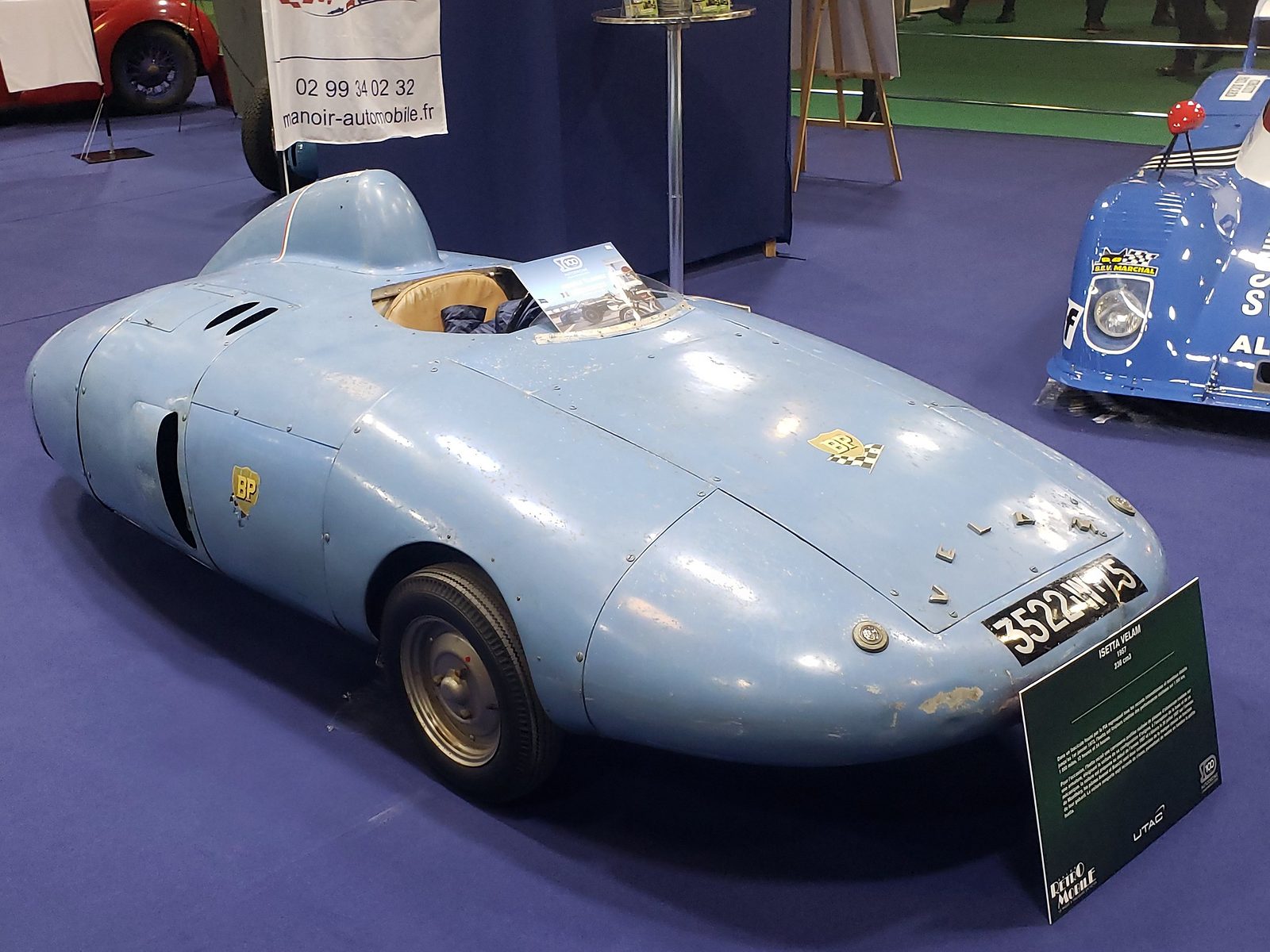
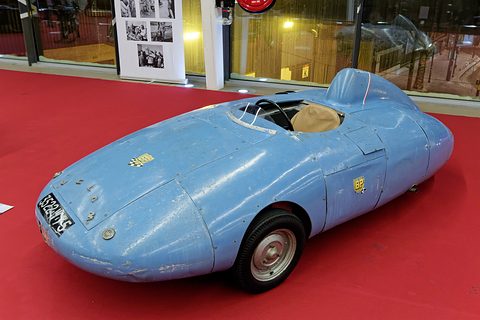
Worn pale blue aluminium streamliner with a tiny windscreen, tan seat and head fairing, seen from the front left on red carpet.
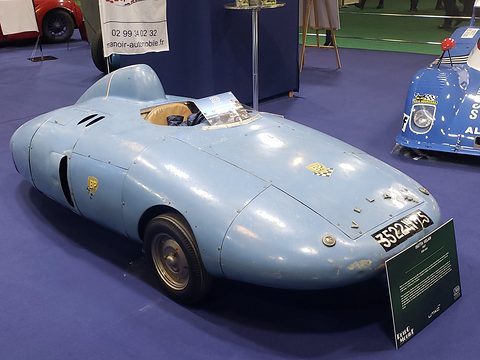
The 1957 VELAM record car at Rétromobile in Paris in 2018, its aluminium body built on the standard car’s wheelbase and tracks.Photo: Thesupermat, CC BY-SA 4.0, via Wikimedia Commons

Pictures

More photographs, old and new

Variants

Four eggs, a record car and a six-seater

The VELAM range
VariantYearsWhat differsHow many
Isetta1955–⁠58VELAM’s own monocoque, removable front wings, a push-button door catch, the speedometer in the wheel hubMost of the 7,115
Décapotable1956–A soft rear section in place of the big rear window; a removable roof panelNot known
Écrin1957Teardrop hardtop, sliding windows, panoramic rear window, telescopic front dampers, more trim; 10.5 bhpAbout 500; 50 in some sources
Sportc.1956–⁠57A fixed front door, with the sides cut away to step inOne
Record car1957Aluminium cigar body by Jean Bianchi, 590 mm high, one seat; standard baseOne
TA 61961Six-seat prototype for Kaiser-Ilin of Israel; a 640 cc air-cooled twin, 3.30 m longOne

Specification

The standard car, from the Weiner museum and the rarefrenchsportscars study

Engine and drive

Engine and drive
EngineIso split-single two-stroke, 236 cc, derived from a Puch designsource 4source 1source 2
Bore × stroke2 × 48 × 65.15 mmsource 2
Power9.5 hp (about 7 kW)source 4source 110 bhp at 4,500 rpm in the study; 10 PS in the German Wikipedia
CarburettorA single 30 mm Solex; the Iso had a 24 mm Dell’Ortosource 2
GearboxFour speeds and reverse, dog engagement, no synchromeshsource 4source 2
Final driveDouble roller chain to the rear axle, no differentialsource 2
StarterDynastartsource 4

Body and chassis

Body and chassis
StructureMonocoque, with a rubber-mounted rear subframe and a bolted-on front crossbeamsource 1source 2
Front suspensionNiemann rubber ringssource 4source 1source 2Telescopic dampers on the Écrin
Rear suspensionLeaf springs, as trailing quarter-ellipticssource 4source 2
BrakesHydraulic drums all roundsource 4source 2
SteeringRack and pinionsource 4The study doubts it on the standard car
Tyres and electrics4.40 × 11; 6 Vsource 4source 2

Dimensions

Dimensions
Length2,380 mmsource 4source 5source 2
Width1,420 mmsource 4source 2
Height1,320 mmsource 2
Wheelbase1,500 mmsource 2
Track1,228 mm front, 506 mm rearsource 2
Weight340 kgsource 26.75 cwt (343 kg) by the Weiner museum

Performance and running

Performance and running
Top speed75 km/h (47 mph)source 480 km/h in the study; 95 km/h claimed for the Écrin
FuelMixed by hand at first; an automatic 3 per cent mixer for 1957source 2
Price new297,000 F; the Écrin 380,000 Fsource 2

How many were built?

Every figure, with its source

7,115 builtFour sources agree on 7,115, and two give the same figures year by year. About 500 of them were Écrins.

  1. 7,115all VELAMs, June 1955 to January 1958Two sources agree

    Weiner museum; RM; German Wikipedia, citing Linz and Schrader; the rarefrenchsportscars studysource 4source 1source 5source 2

  2. about 5,000June 1955 to June 1956One source

    the rarefrenchsportscars studysource 2

  3. 4,886built in 1956Two sources agree

    German Wikipedia, citing Linz and Schrader; the rarefrenchsportscars studysource 5source 2

  4. 1,224built in 1955, from JuneOne source

    German Wikipedia, citing Linz and Schradersource 5

  5. 1,005built in 1957Two sources agree

    German Wikipedia, citing Linz and Schrader; the rarefrenchsportscars studysource 5source 2

  6. about 500Écrins, 1957; some sources say 50Two sources agree

    Weiner museum; the rarefrenchsportscars studysource 4source 2

  • Two sources agreetwo good sources give the figure
  • One sourcea good source, alone
  • Unconfirmeda lead only, not yet checked

Famous for

Three points

  1. The speedometer in the hub

    The dial sat in the centre of the steering wheel, one of 34 changes from the Iso.

  2. Cheaper than a 2CV

    At 297,000 F it undercut Citroën’s car by 15 per cent, by the Weiner museum’s account.

  3. A day at Montlhéry

    In 1957 a 236 cc record car covered 2,631.898 km at Montlhéry in a day.

Racing and records

Montlhéry, 1957

110km/h · 24 h

VELAM took international records in Class K, for cars up to 250 cc, at Montlhéry in 1957 (more in records and feats). The car was a cigar of aluminium, by Jean Bianchi, painted French racing blue, 2,620 mm (8 ft 7 in) long and only 590 mm (23 in) high, on the standard car’s wheelbase and tracks; its standard engine gave about 12 bhp on a special fuel, with longer gearing. Seven records fell on 30 July 1957 and 11 more between 30 September and a January date that the study prints as 1957, which cannot be right. The study names the drivers as Bianchi and Claude, the German Wikipedia as Peslier and Bianchi.source 5source 2source 3

2,631.898 km
in 24 hours, at 109.662 km/h (68 mph): 389.098 km more than the Goggomobil’s mark. It stood until October 1963, the study says.source 2
111.85 km/h
for three hours, the fastest of the runs; the best lap was 118.55 km/h.source 2
1,000 km
at 110.047 km/h, and 1,000 miles at 109.419 km/h.source 2
1956
Jean Bianchi won Class K in the Mont Ventoux hill climb.source 2

Survivors and collecting

Today

Few survive, the Weiner museum said, and no count has been found.source 4 Its car appears in Andrea and David Sparrow’s More Bubblecars & Microcars Colour Family Album, and when RM Auctions sold the collection in 2013, a 1956 VELAM made $37,375.source 4source 1 The record car survives. It was shown at Rétromobile in 2018, and the study says it was registered and driven on the road, and now carries a different registration.source 5source 2 No club devoted to the VELAM is known.

Sold at auction
CarSalePrice
1956 Isetta Velam, identification no. 103976RM Auctions, Weiner museum sale, 2013, lot 546source 1$37,375
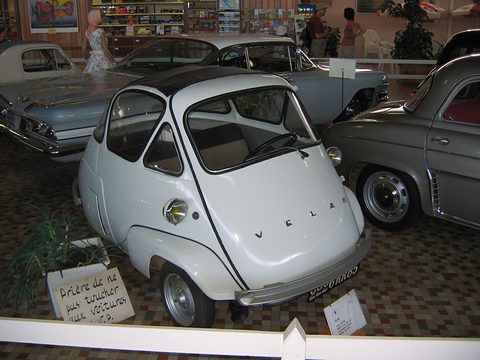
Off-white bubble car among larger classic cars on a tiled museum floor, a handwritten do-not-touch sign by its wheel.
A pale Velam Isetta in the Musée automobile de Vendée at Talmont-Saint-Hilaire in 2014.Photo: Gérard Delafond, CC BY 2.5, via Wikimedia Commons

Sources

Numbered as in the text

No period French road test has been read; much of the detail comes from one unsigned study. Sources are given as plain text; the links are on the Credits page.

  1. RM Auctions, The Bruce Weiner Microcar Museum, Madison, Georgia, 2013, lot 546, “1956 Isetta Velam”, catalogue text, read in full.
  2. “VELAM: The French Isetta with a couple of sporting twists”, rarefrenchsportscars.wordpress.com, PDF study, author not named, read in full.
  3. English Wikipedia, Isetta, section on the VELAM Isetta; it cites Revue Technique Automobile no. 119 (1956), not seen.
  4. Bruce Weiner Microcar Museum, “1957 Velam Isetta”, tour page (© 2002), read in full.
  5. German Wikipedia, Vélam, read in full; it cites Linz and Schrader for the yearly production, and Georgano’s Beaulieu Encyclopedia for the TA 6, not seen.