The story
History
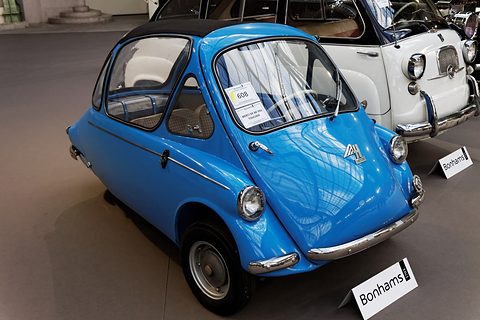
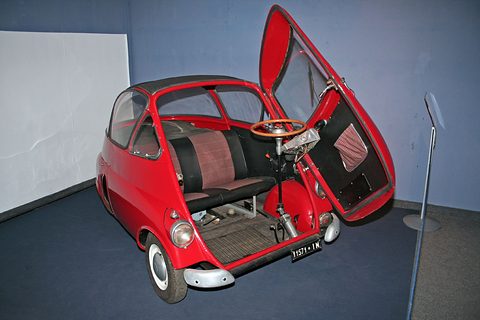
German patent DE 883 244, filed by Ermenegildo Preti and Mario Salvo of Milan on 9 October 1951, describes a motor-driven land vehicle with a cabin entered through its front wall, by a door that carries the steering. Its floor sits at about kerb height; the drive uncouples when the door opens; and the vehicle can park in unusually tight spaces between others.source 1source 2 The advantage claimed was parking: the car could nose into a gap between parked cars and its occupants step straight out onto the pavement.source 1 The example drawn has a single rear wheel, which never reached production.source 2 The idea would be built in Italy, West Germany, France, Spain and Brazil, and assembled in Belgium.source 3source 4
Refrigerators, then scooters
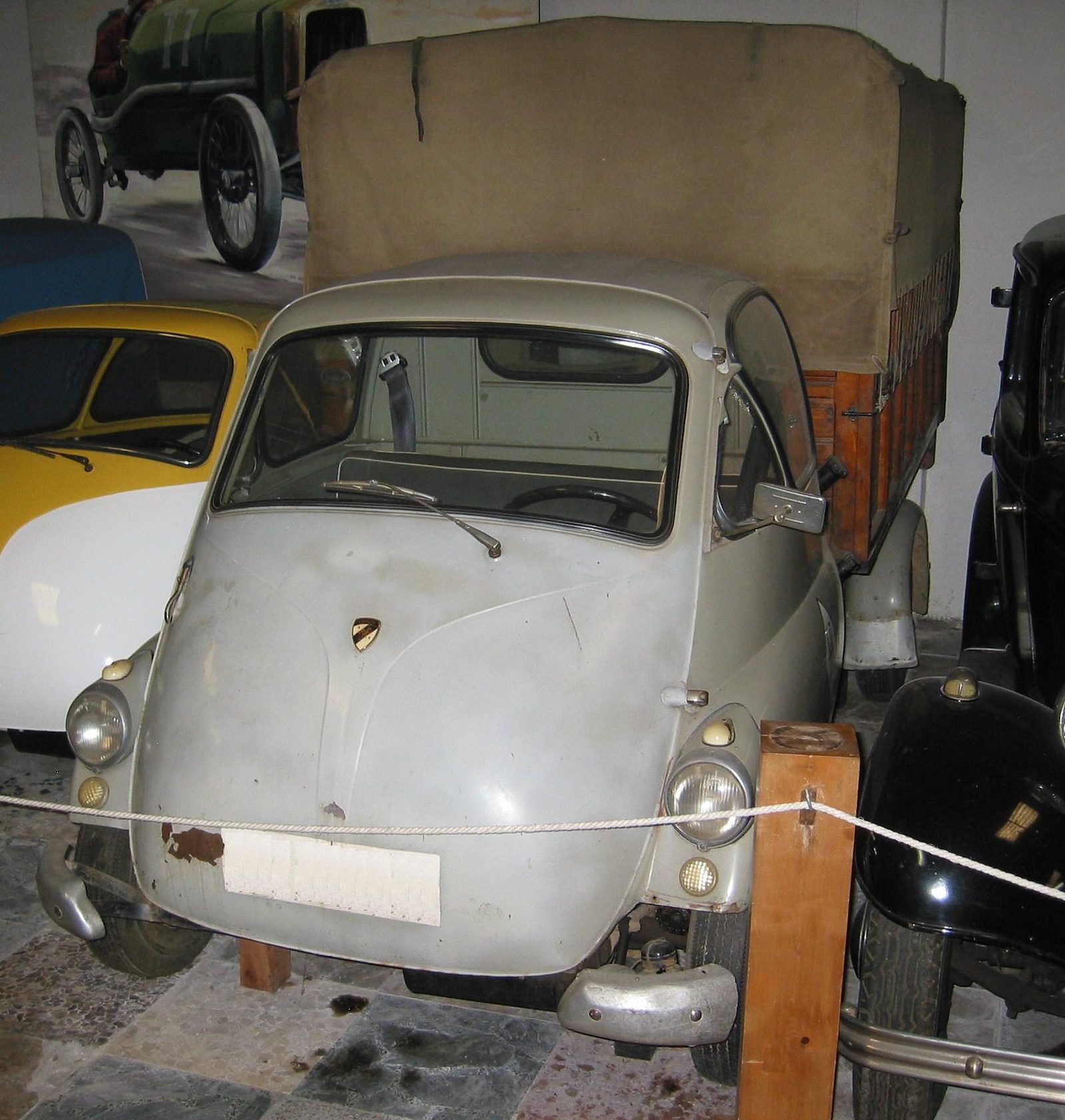
The man who paid for it was Renzo Rivolta, born at Desio on 5 September 1908. In 1939 he founded Isothermos, a refrigeration firm; after the war it built scooters and motorcycles, and by 1950 it was Iso Autoveicoli, of Bresso, outside Milan.source 5source 6 The English Wikipedia, citing Icon Wheels, calls Iso Italy’s third-largest maker of two-wheelers, behind Vespa and Lambretta.source 5 The Weiner museum tells it as a retreat: refrigerator sales were falling, so Rivolta made scooters in three forms, the Isoscooter and Isomoto two-wheelers and the Isocarro, a three-wheeler, and competition from Vespa and Lambretta then turned him towards a car.source 4 His guiding idea, by the Italian Wikipedia’s account, was to begin with the comfort of the people inside and the place of the machinery, and to shape the body only after that.source 6 The name followed the firm’s: Isetta is the Italian diminutive of Iso, the little Iso.source 3source 7
Half motorcycle and half car.
A glider designer’s car
Rivolta gave the design to two aircraft engineers.source 6source 3 Preti, born in Milan on 23 July 1918, designed gliders and light aircraft at the Politecnico di Milano’s gliding research centre: among them the CVV 6 Canguro, 32 of which went to the Italian Air Force, and the PM.280 Tartuca racer of 1947.source 8 In the war he had designed the AL.12P transport and assault glider for Aeronautica Lombarda at Cantù, which stayed a prototype.source 8 The Italian Wikipedia traces the Isetta’s nose to it: the AL.12 design had a front section, the cockpit, hinged on one side so that it opened fully, and Preti had described it in his degree thesis.source 6 He had thought about a small car during the war, foreseeing the shortages to come, and talked it over with his wife, Piarosa.source 6 He is one of several aircraft engineers who turned to small cars, and one of the outsiders among the designers of microcars.
Preti laid out the concept and handed the body and frame to Pierluigi Raggi, a young engineer with an aeronautical background.source 6source 3 Another of Preti’s collaborators, an engineer named Genoni, adapted the motorcycle engine, and Giovanni Michelotti was consulted on the windows of the production car. Late in the project it was Preti who suggested fixing the steering column to the door.source 6 These details rest on the Italian Wikipedia alone.
Three wheels, then four
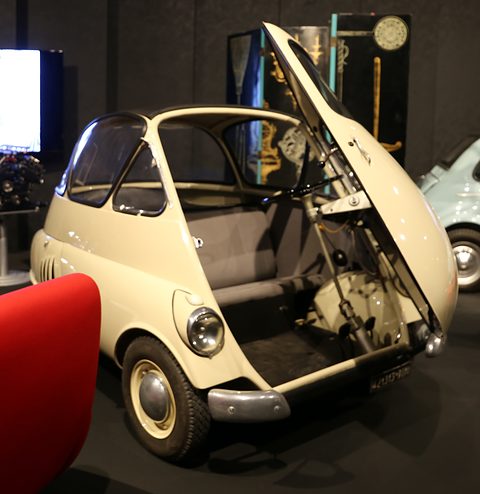
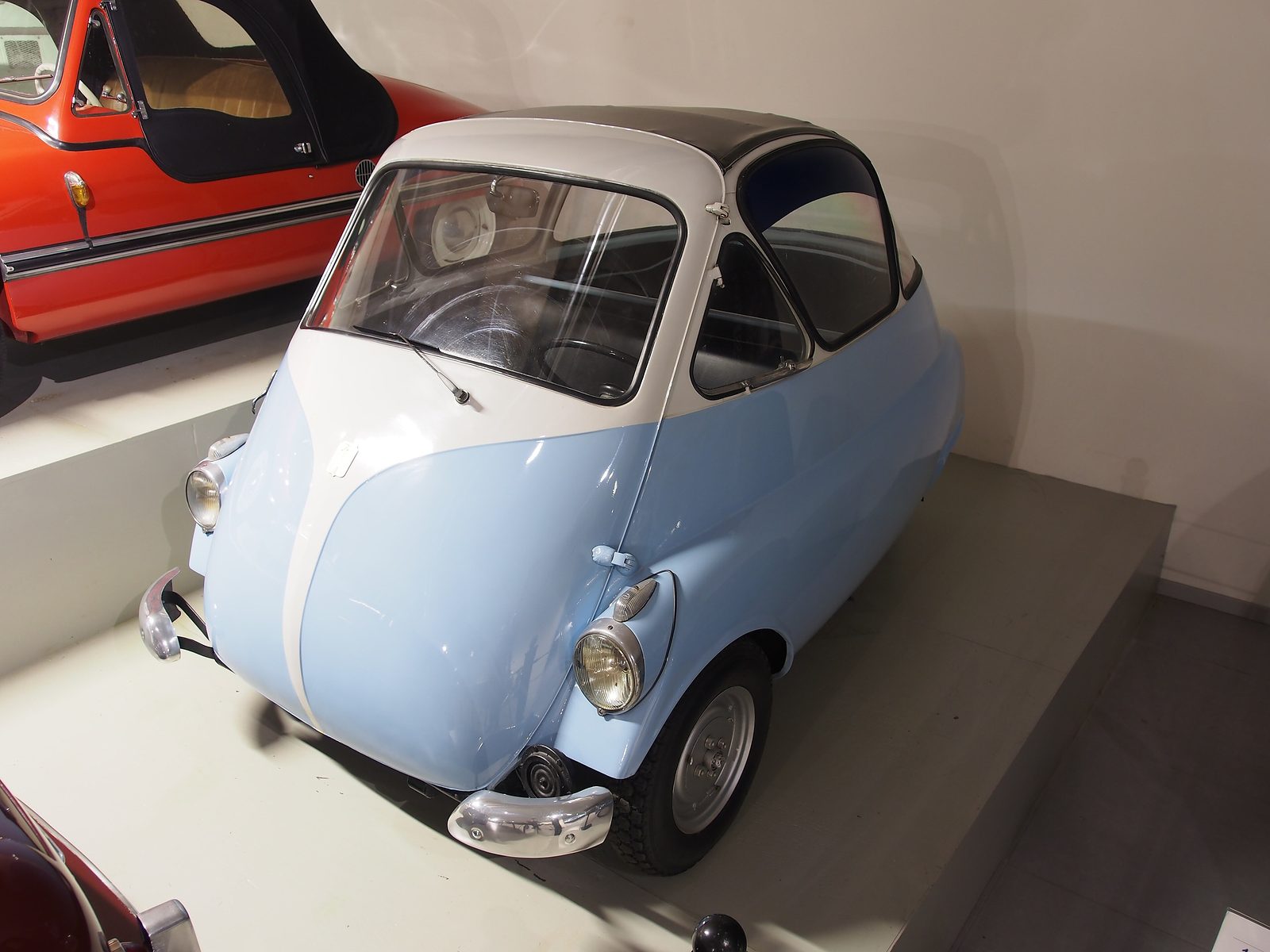
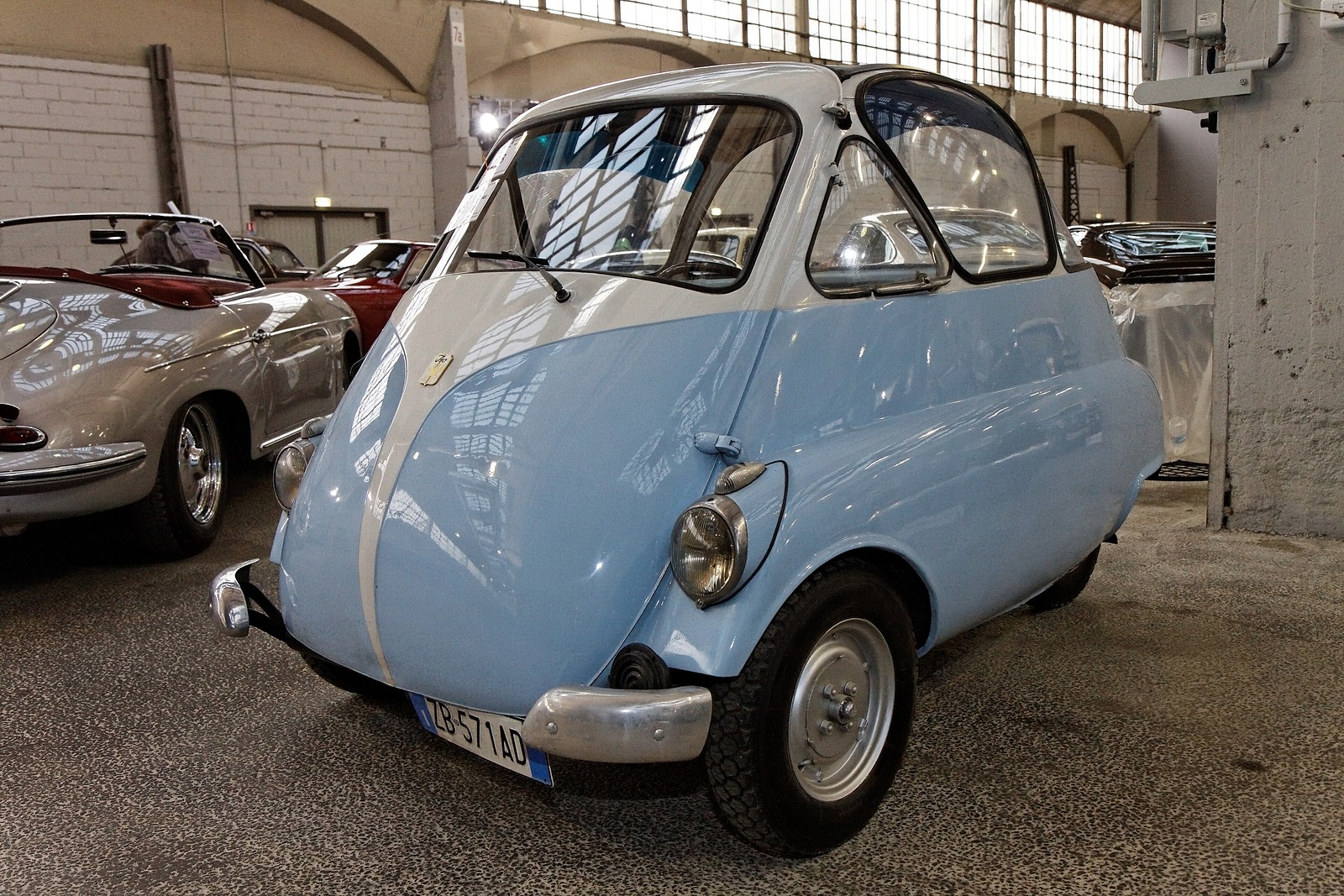
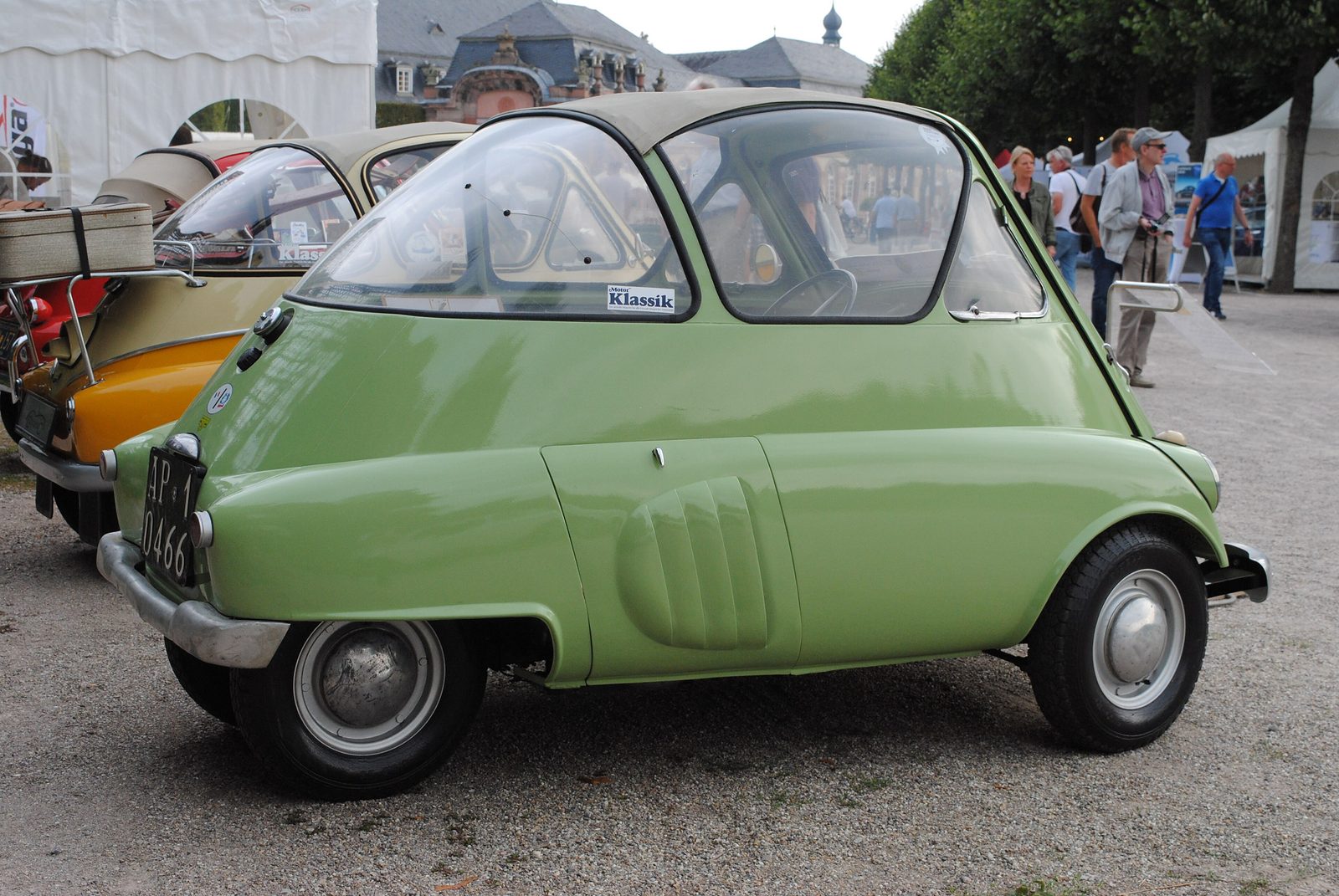
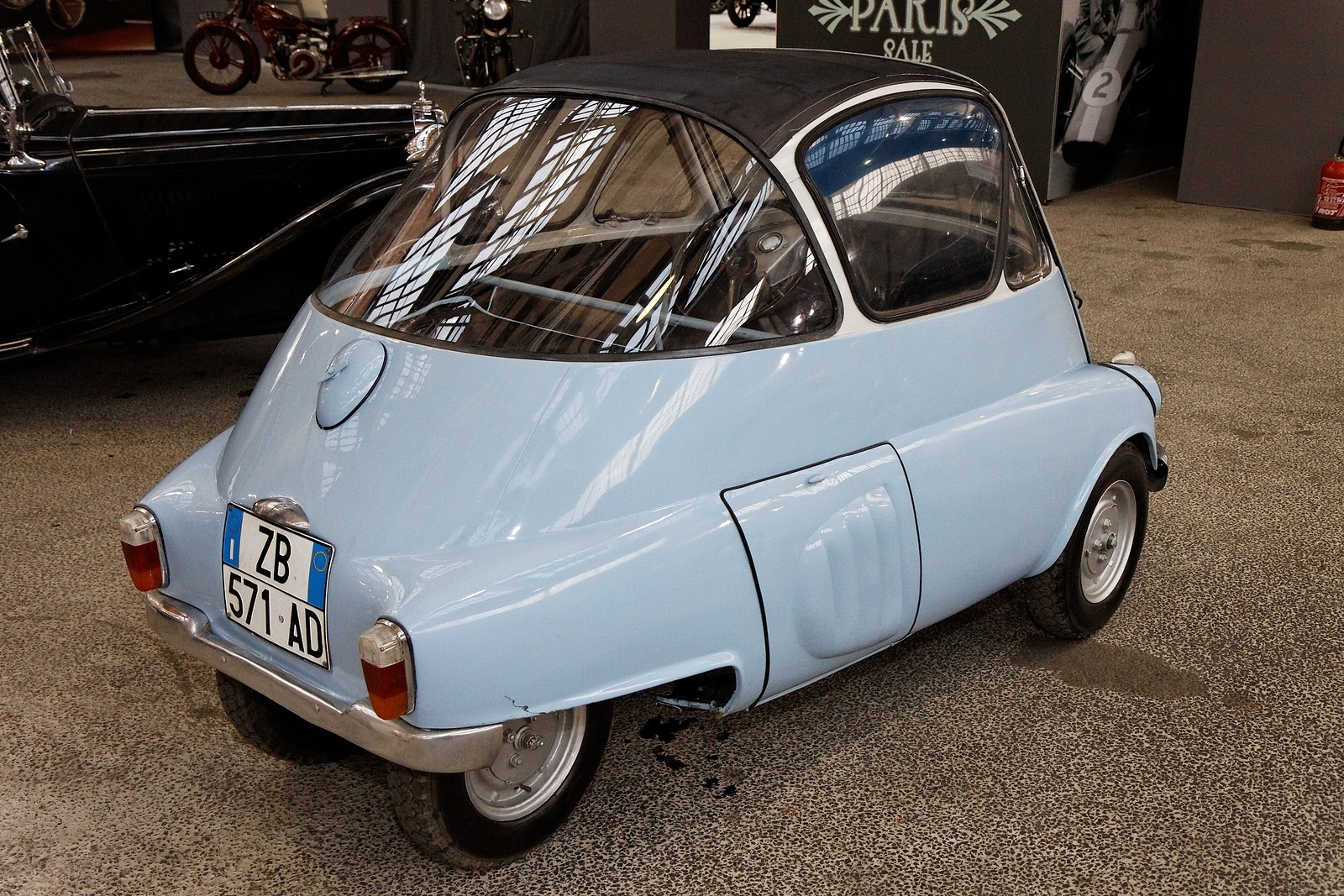
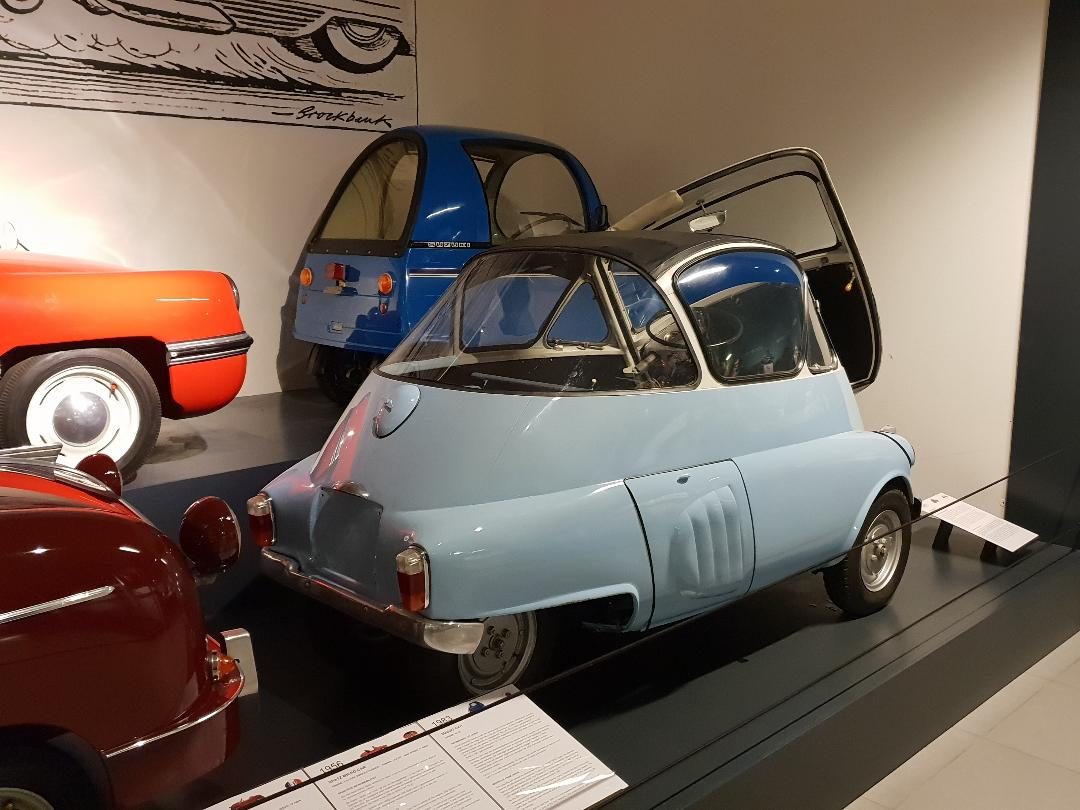
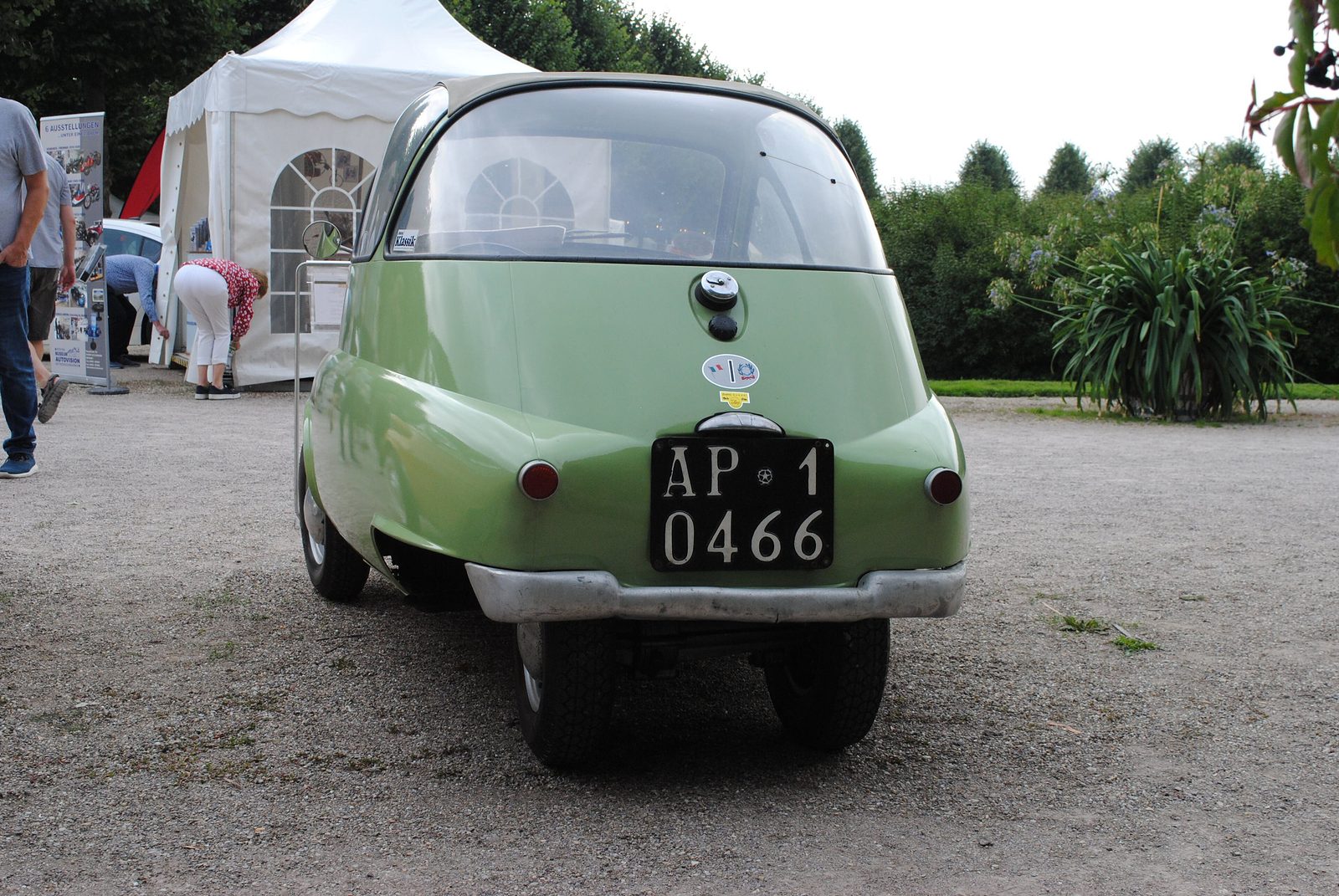
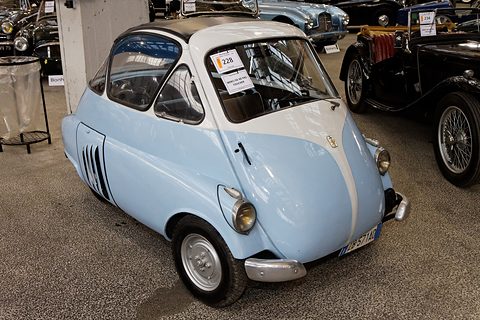
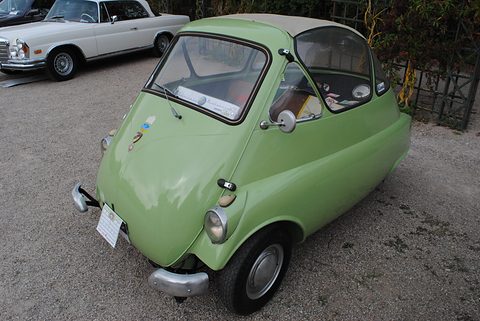
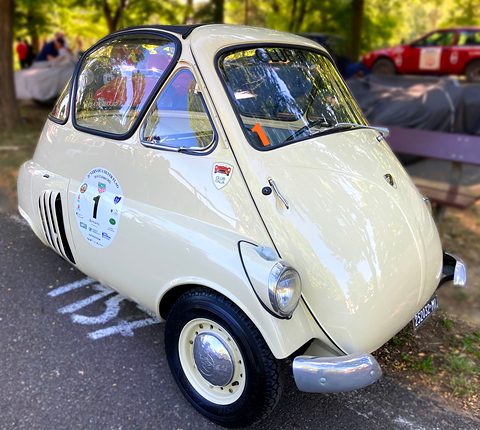
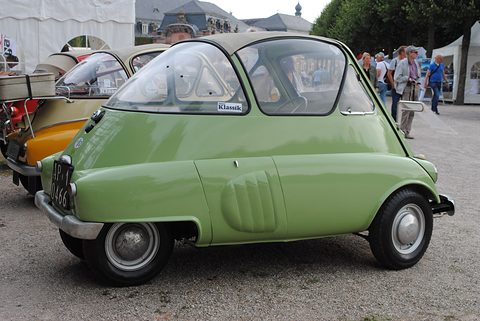
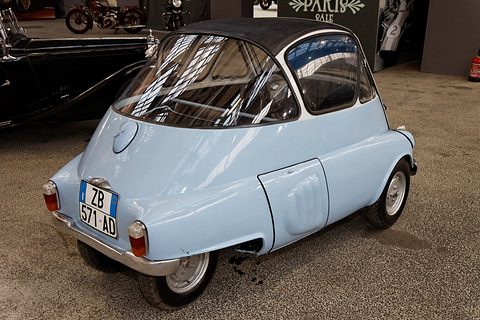
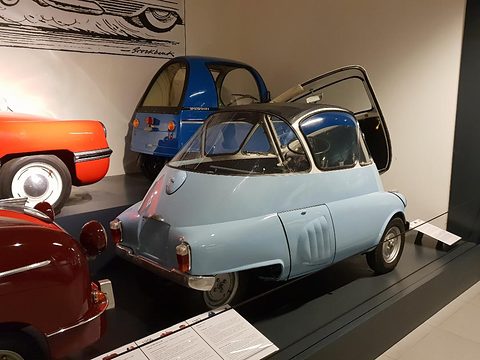
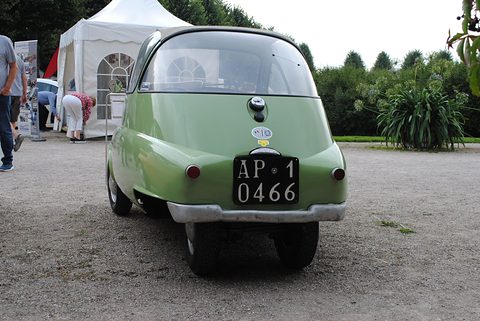
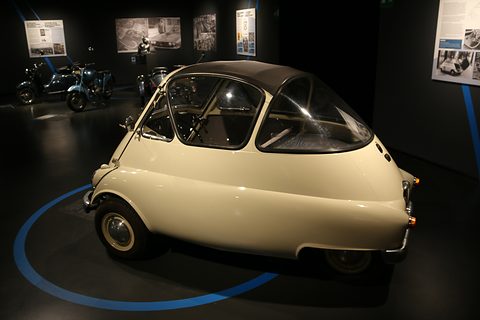
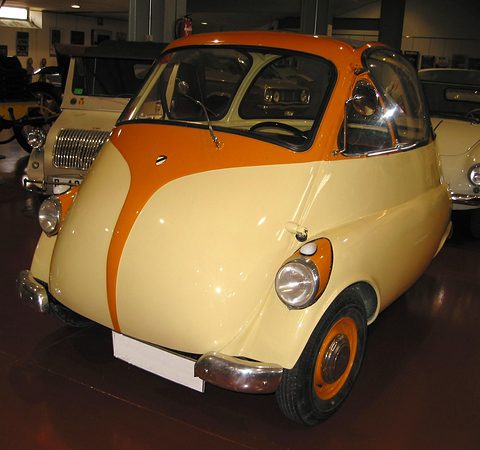
The first prototype ran in the summer of 1952. It already had the egg shape, the motorcycle mechanicals and the single door forming the whole nose, with a steel body and large windows on a tubular steel frame, and three wheels: a pair at the front and a single one at the back.source 6 On the road the single rear wheel proved dangerous: in a puncture, the Italian Wikipedia says; because the car was prone to roll over, says the English.source 6source 3 So the back got two wheels, set so close together that no differential was needed.source 6source 3source 2 Mouldings were added along the lower flanks to the tail to make the body look less clumsy.source 6
The engine came from the Iso 200 motorcycle. The Italian Wikipedia says it was partly derived from an auxiliary engine used to start Isotta Fraschini aero engines, and that it began at 198 cc and about 8–9 CV and was bored out to 236 cc shortly before the launch.source 6 It was a split-single, or “twingle”: two pistons in two bores sharing one combustion chamber, cooled by a fan, giving 9.5 CV at 4,750 rpm.source 6source 2
Turin, April 1953
The press saw it in early April 1953, and the official presentation was at the Turin motor show on 22 April.source 6source 9 The English Wikipedia dates its introduction to the press, in Turin, to November 1953; the Italian sources’ April is followed here.source 3 Little had changed from the last prototype beyond distributor ignition and the steering column fixed to the door.source 6 The Italian Wikipedia describes great astonishment at a car shaped like the cabin of a helicopter or a glider, almost futuristic beside rivals that looked like cartoons; the English Wikipedia and the Weiner museum both say it caused a sensation.source 6source 3source 4
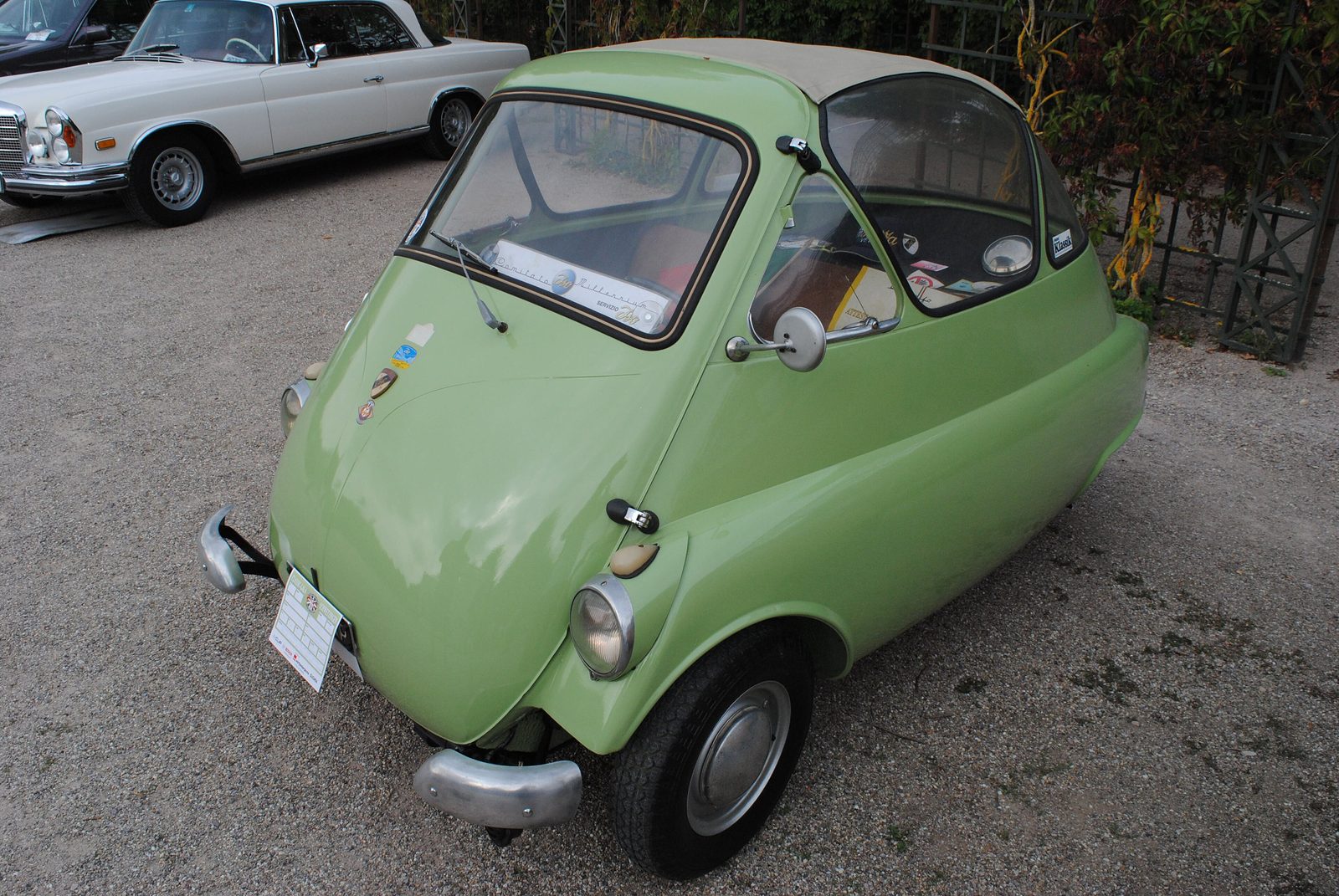
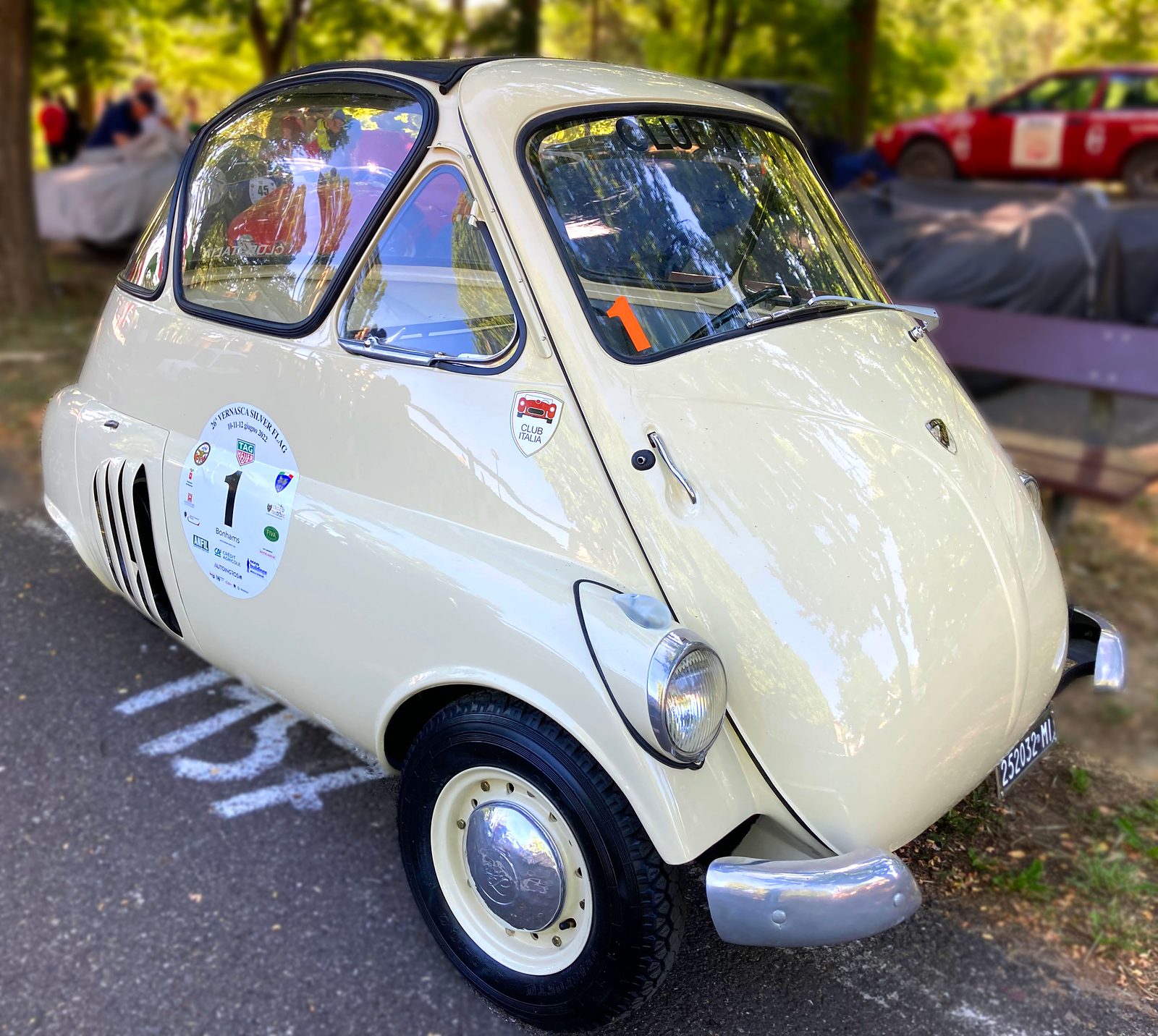
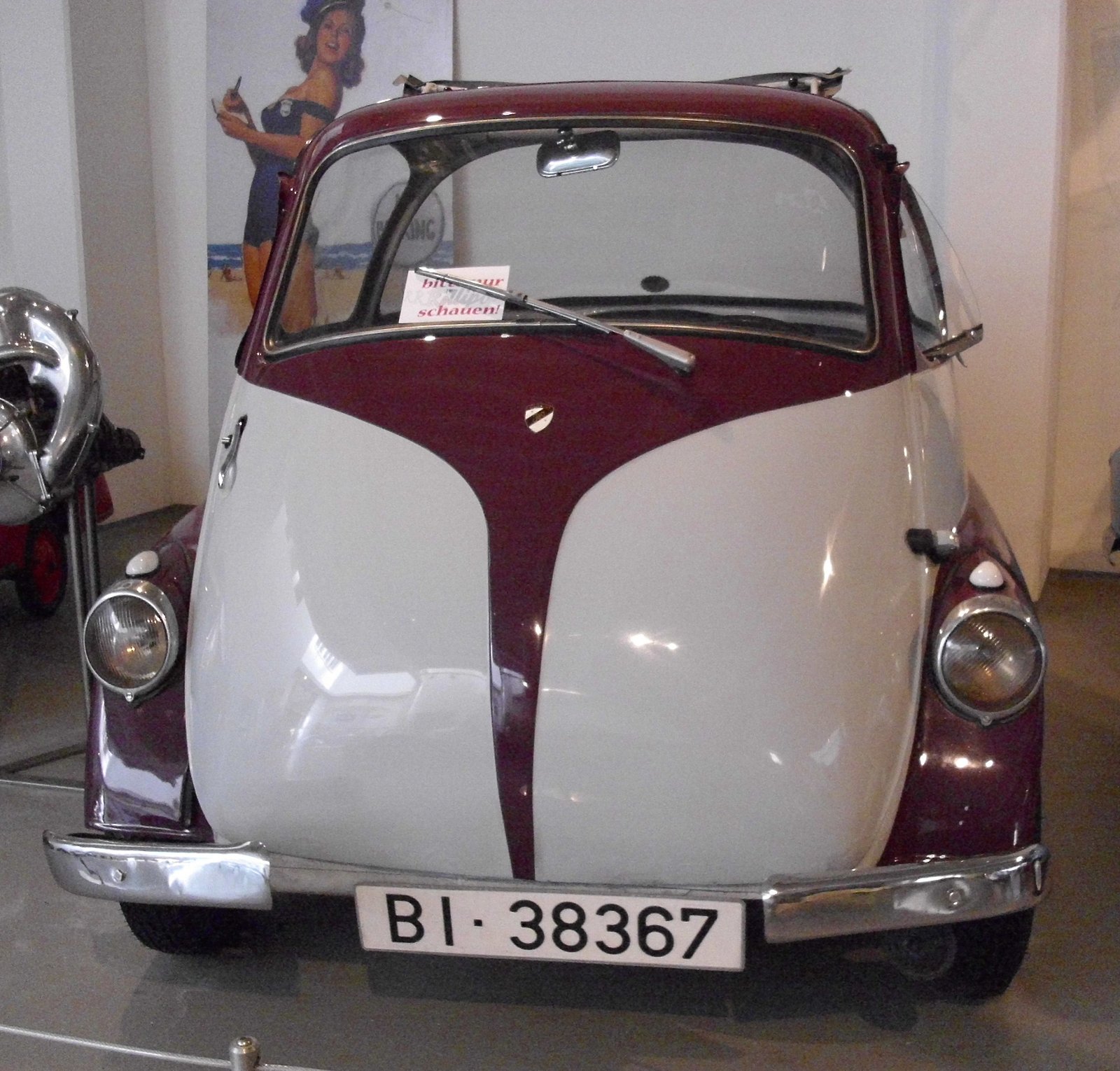
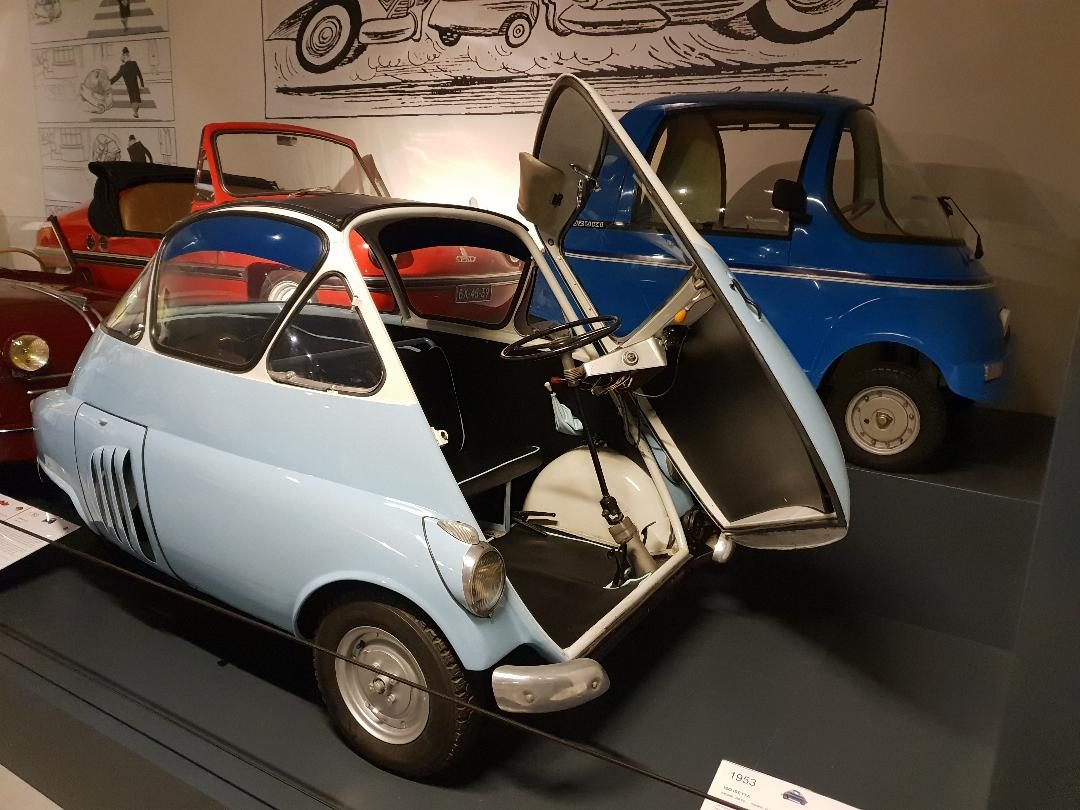
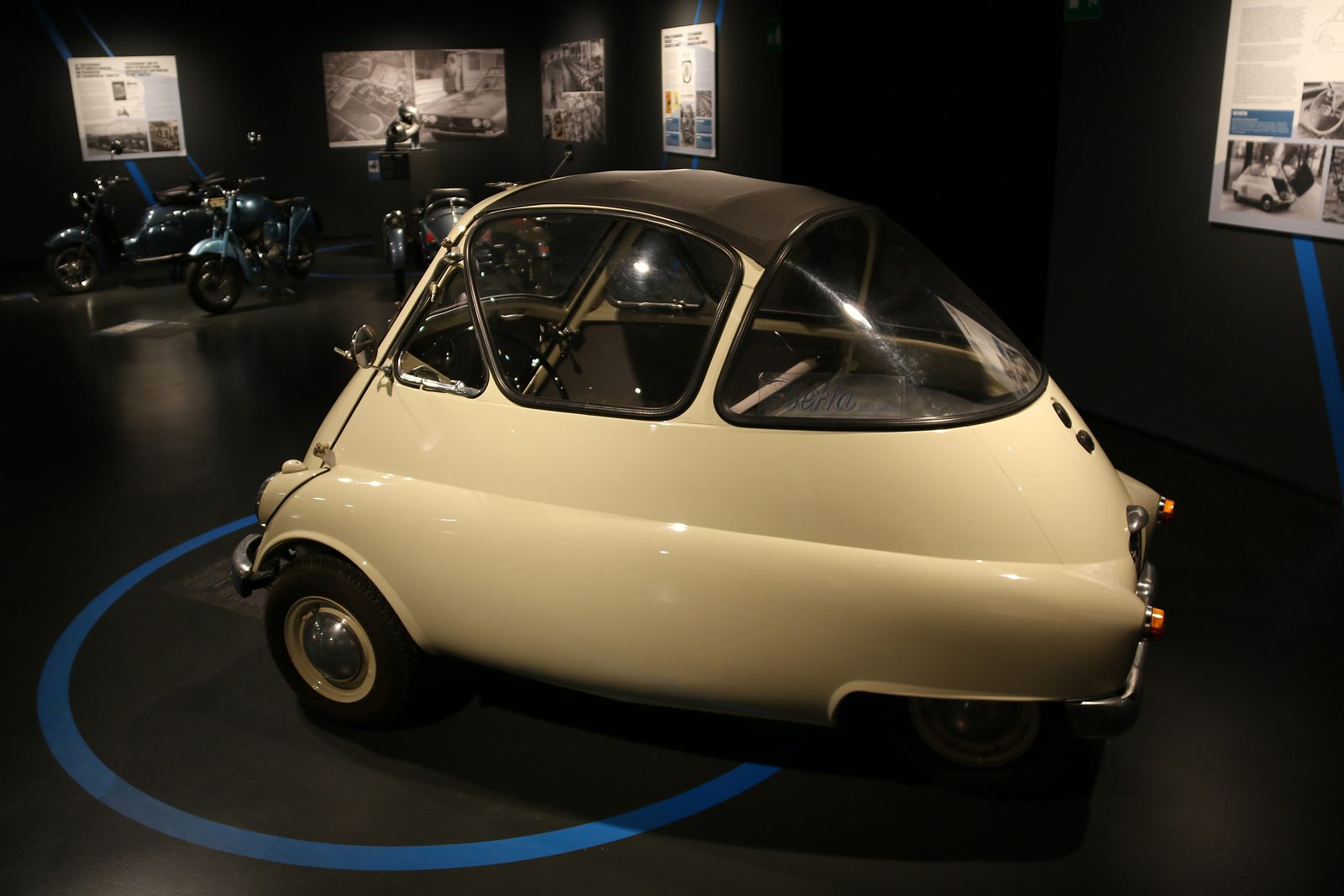
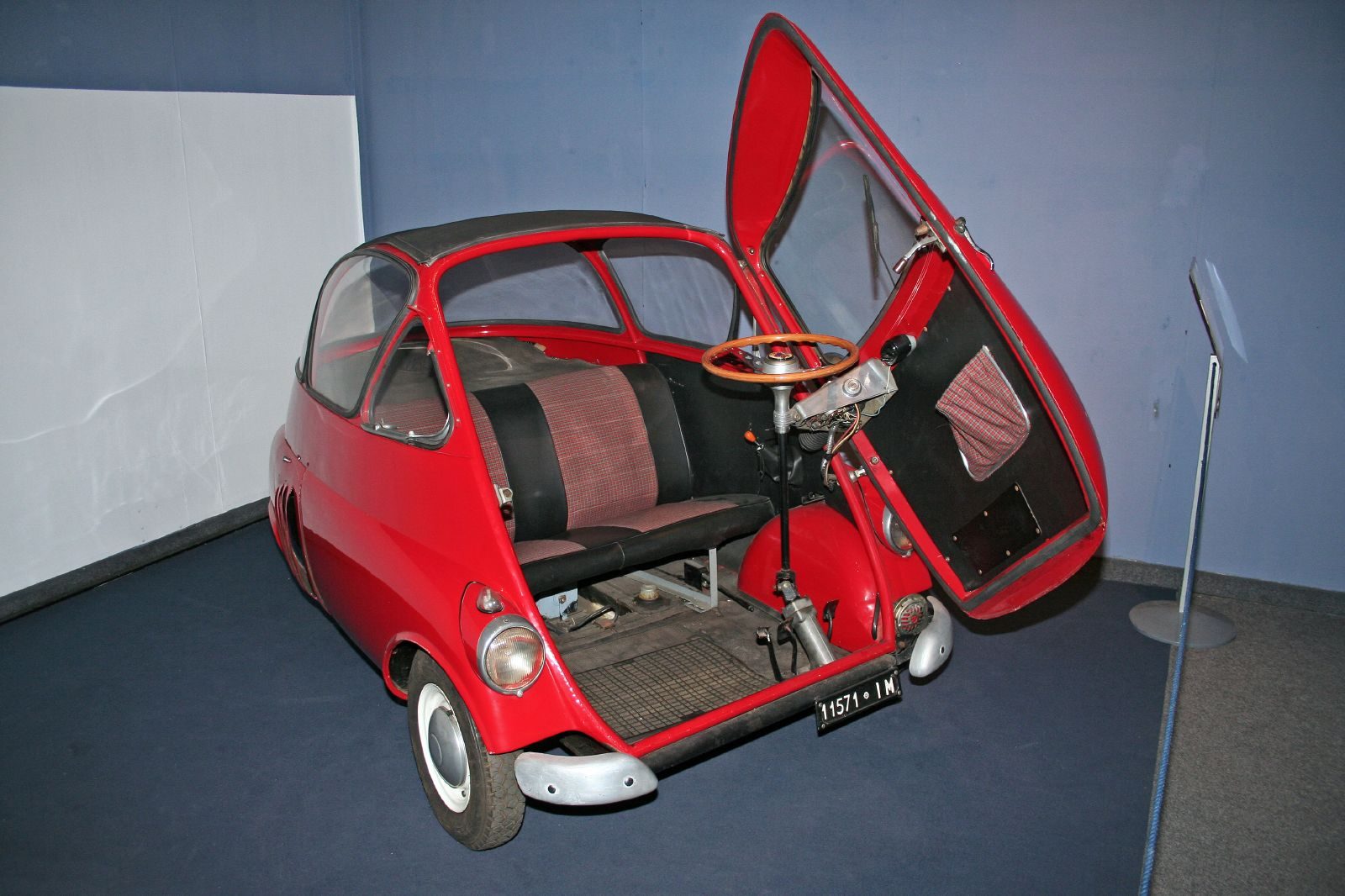
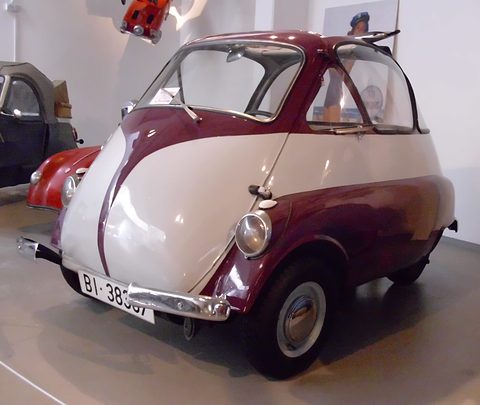
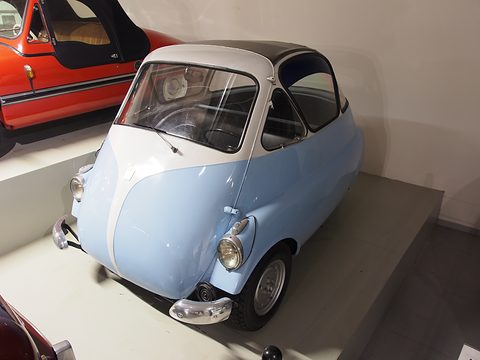
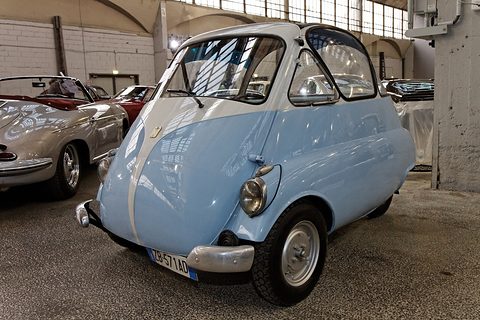
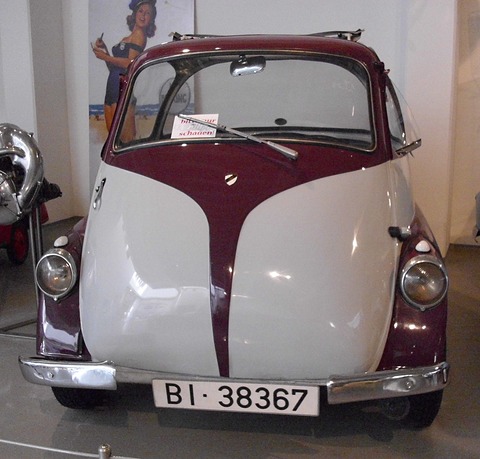
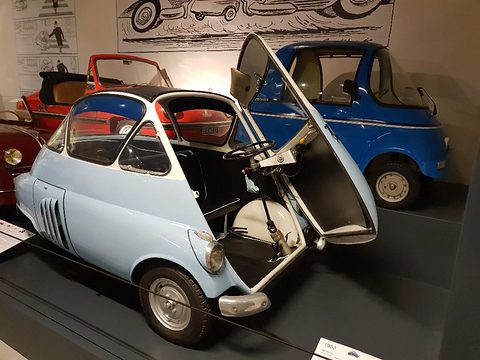
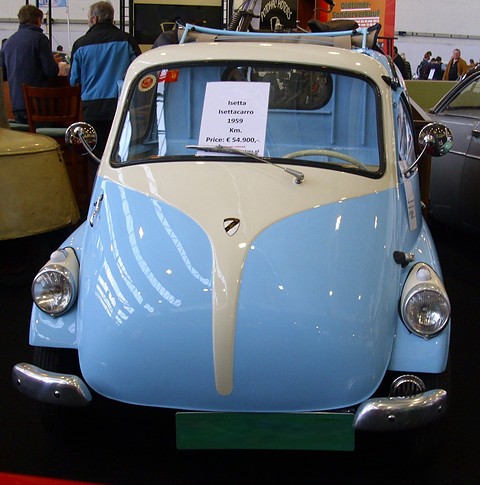
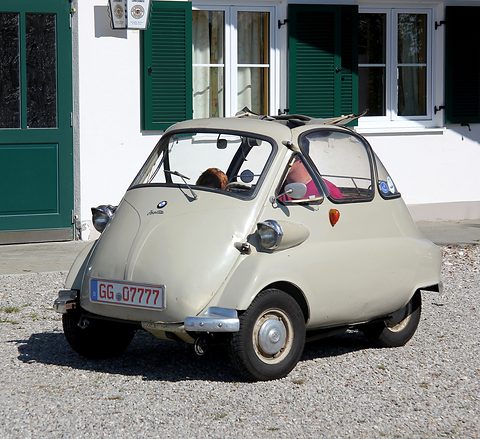
Getting in was the point of it. The front of the car was the door, and the steering wheel and instrument panel swung out with it, so that two people stepped in from the front and sat side by side on one bench, with perhaps room for a small child.source 6source 3 The engine sat behind them on the right, with a small luggage space beside it.source 6 The English Wikipedia adds a parcel shelf behind the seat with the spare wheel below, an optional heater, fresh air through the front quarter-lights and the sunroof, and the canvas sunroof as the way out after an accident.source 3 There was so much glass that the Italian Wikipedia compares the view to a luxury saloon’s.source 6
Underneath, a shaft took the drive to an enclosed chain case, which also served as a trailing arm, and a chain turned the rigid rear axle; the rear wheels ran about 480–500 mm (19–20 in) apart.source 3source 2source 10 Each front wheel hung on a Dubonnet-type trailing arm with a rubber spring, and swivelled as a whole to steer.source 6source 2source 4 The Weiner museum notes the twin-piston engine’s distinctive sound. The Italian Wikipedia gives a top speed of about 85 km/h (53 mph), and says the car had trouble only on hills.source 4source 6
A hard sell
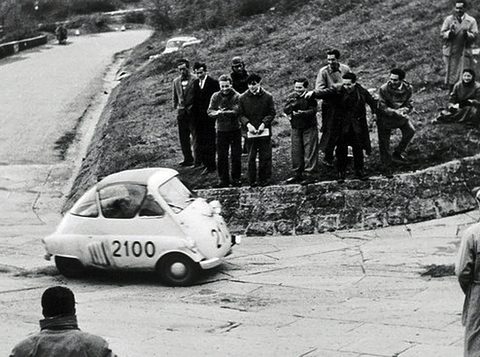
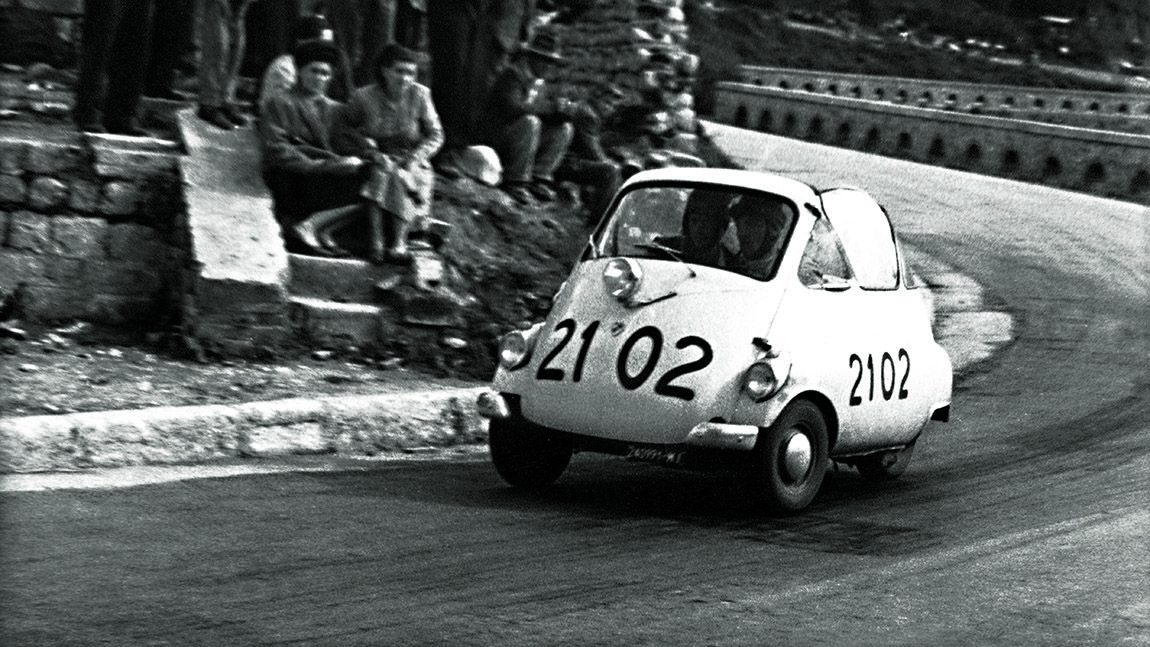
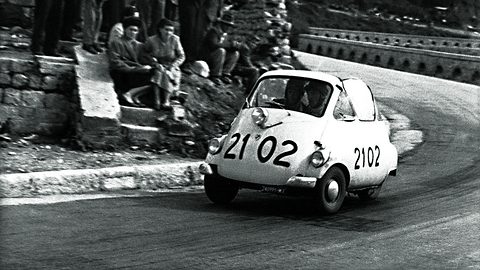
Sales began in the autumn of 1953; the museum dates the start of production to December.source 6source 4 The car did not sell. The Italian Wikipedia blames a price only slightly below that of the Fiat 500 Topolino; the English Wikipedia blames renewed competition from Fiat, as the 600 and then the Nuova 500 arrived.source 6source 3 To prove the car Iso entered seven in the Mille Miglia of May 1954, and five came home, the best at about 72 km/h (45 mph) over some 1,600 km (1,000 miles).source 6source 9source 11 The English magazine Motor Sport noticed them.
The last car to complete the course was an Isetta, a midget economy saloon balanced on wheel-barrow wheels and powered by a 350-c.c. two-stroke engine … Seven of these incredible little vehicles competed, four qualified, and the fastest averaged approximately 45 m.p.h. for the 1,000 miles.
The results, the Italian Wikipedia says, did nothing for sales in Italy.source 6
Geneva, Turin, Munich
Its future lay elsewhere. Iso showed the Isetta at the Geneva show in March 1954, where BMW’s Swiss importer, C. A. Drenowatz, noticed it and told Munich. BMW sent Eberhard Wolff, the head of its test department, to the Turin show the next month; the first agreements with Rivolta were reached there, and Kurt Donath and Fritz Fiedler completed the deal in Milan.source 6 Rivolta wanted to concentrate on sports cars and was keen on licences.source 3 BMW took the drawings and, by the English Wikipedia’s account, the complete body tooling, but not the split-single, which it thought too weak.source 6source 3 The sale was settled at the end of 1954, and the drawings and tools went to Munich.source 6
BMW presented its Isetta, the BMW 250, on 5 March 1955. It fitted its own four-strokes, of 247 and later 297 cc, and re-engineered the car until none of its parts would interchange with the Iso’s.source 6source 3 It built 161,728, by the English Wikipedia’s count, or 161,360 by the Italian.source 3source 6 When the 50,000th was finished, the Italian Wikipedia says, BMW wrote to Iso to thank it for selling the design, and it counts the Isetta as the car that saved BMW.source 6
Three continents
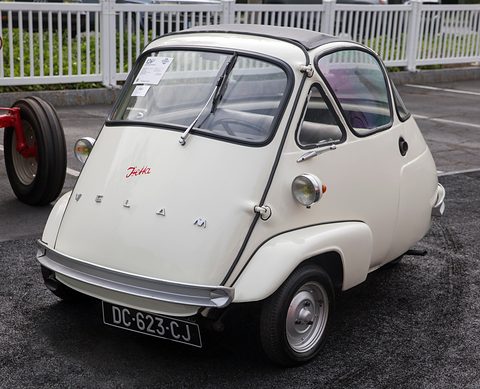
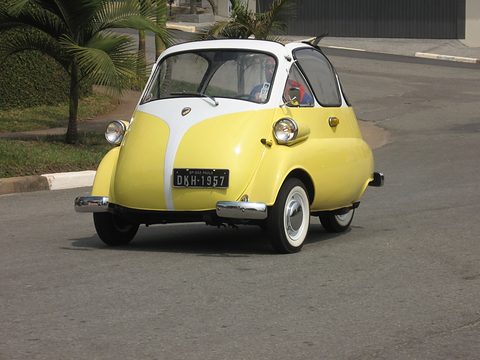
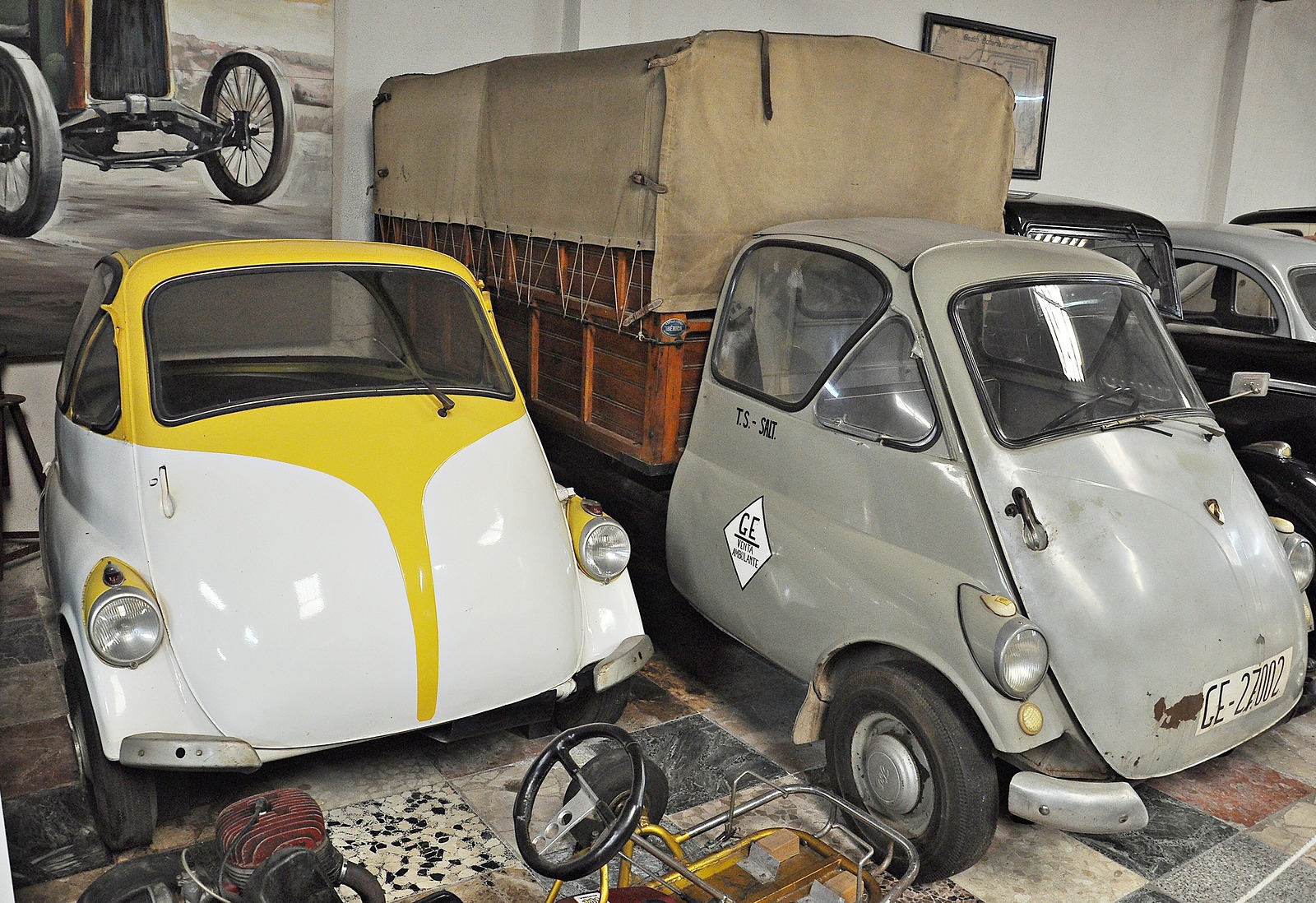
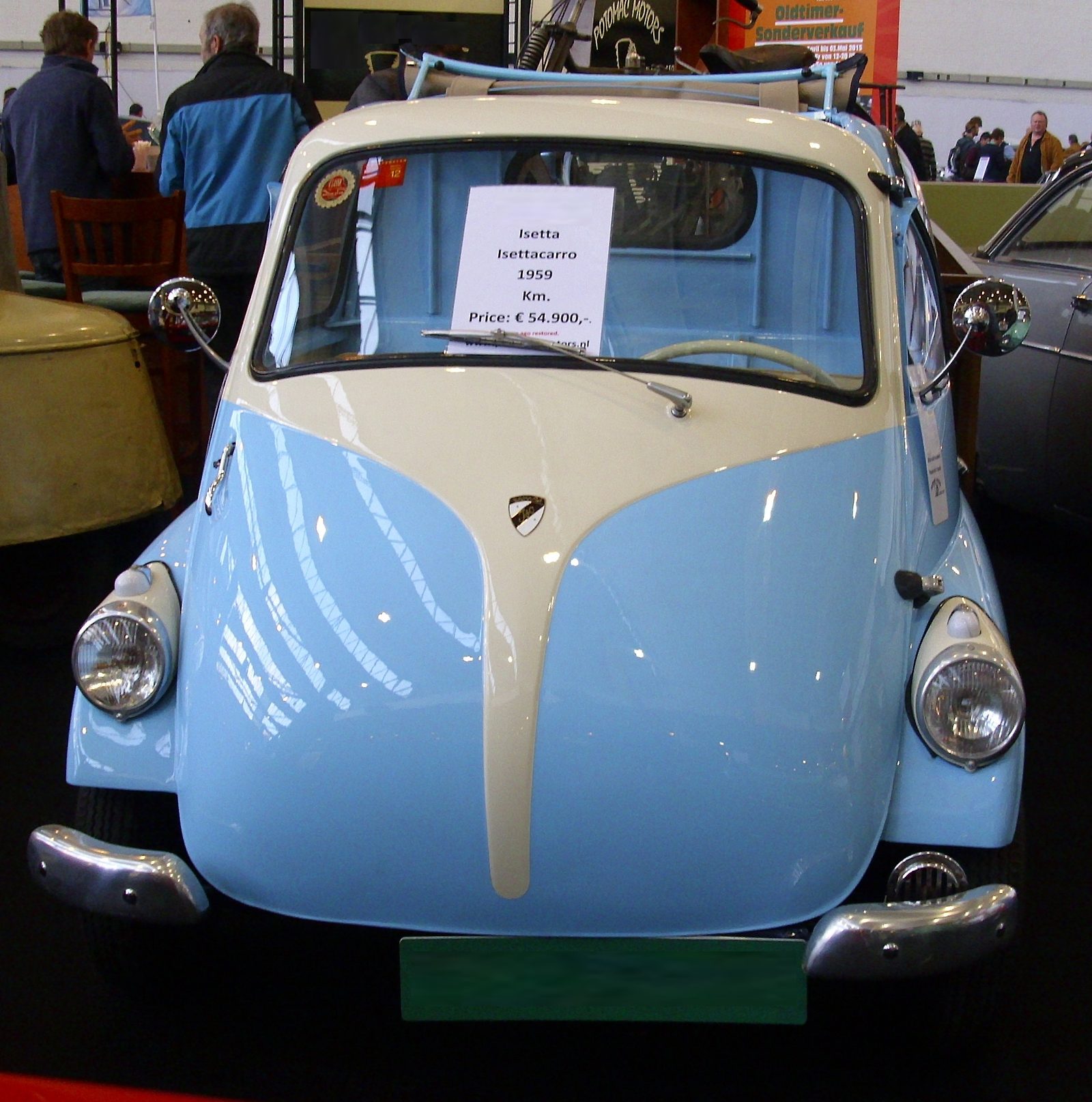
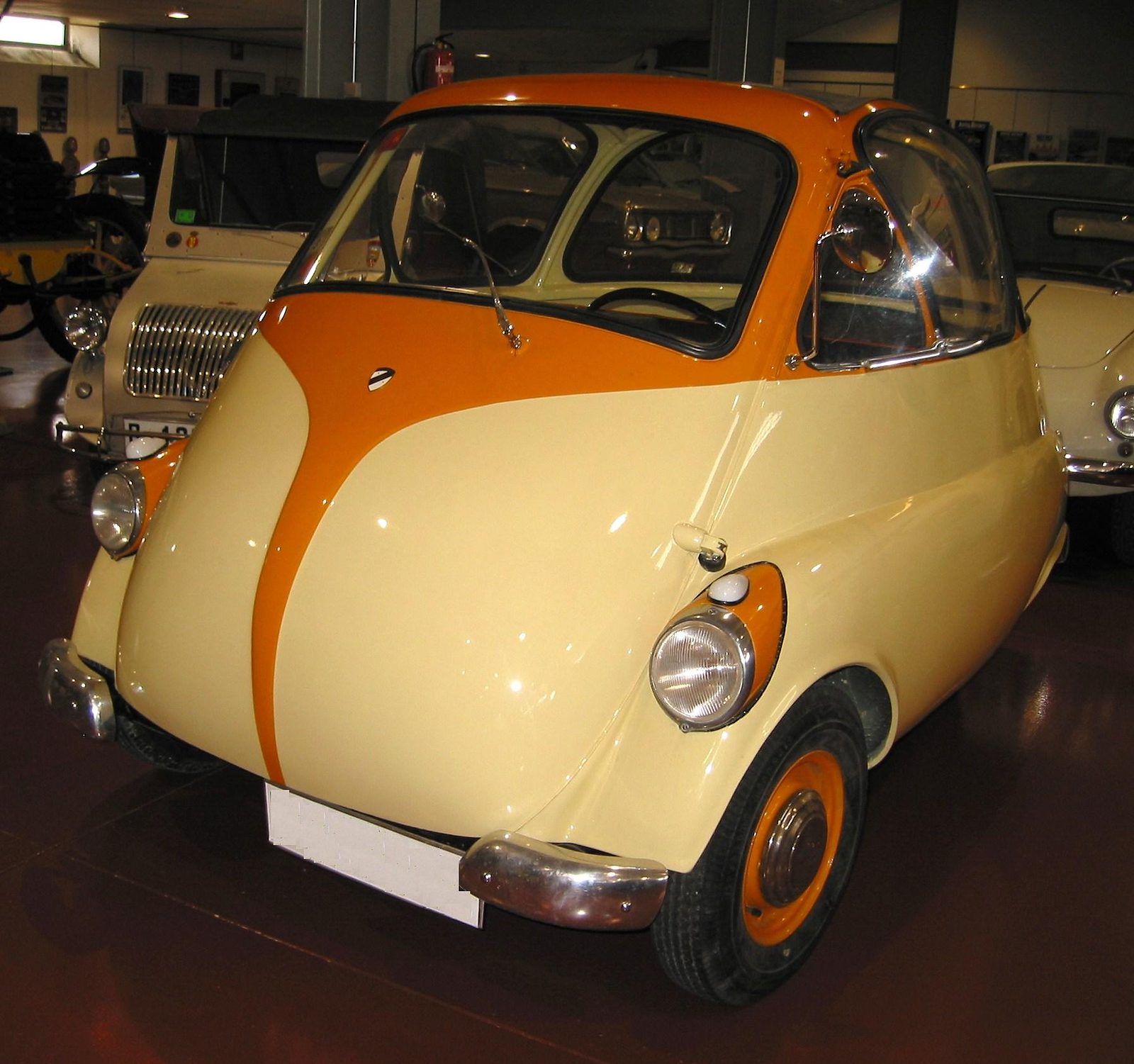
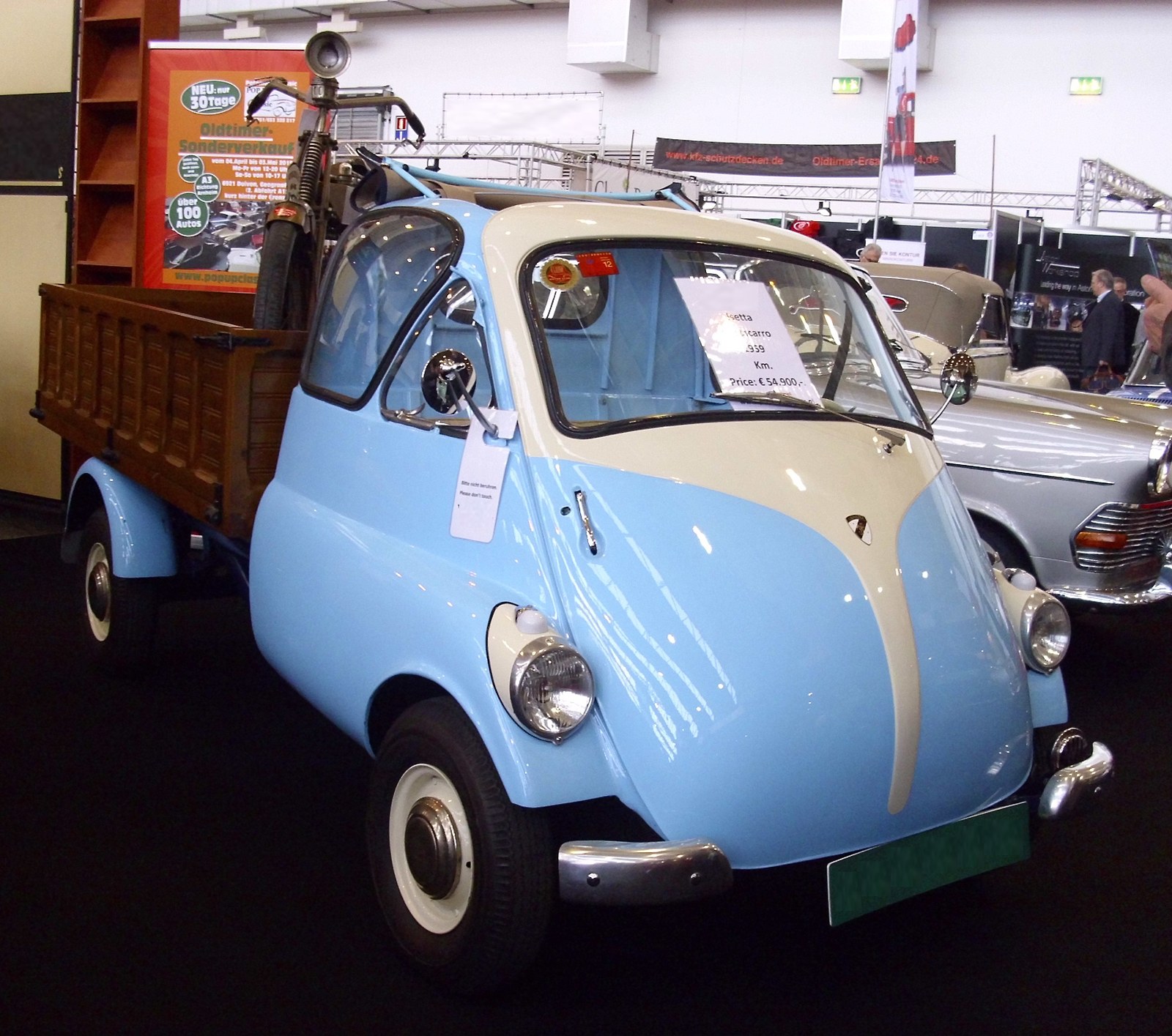
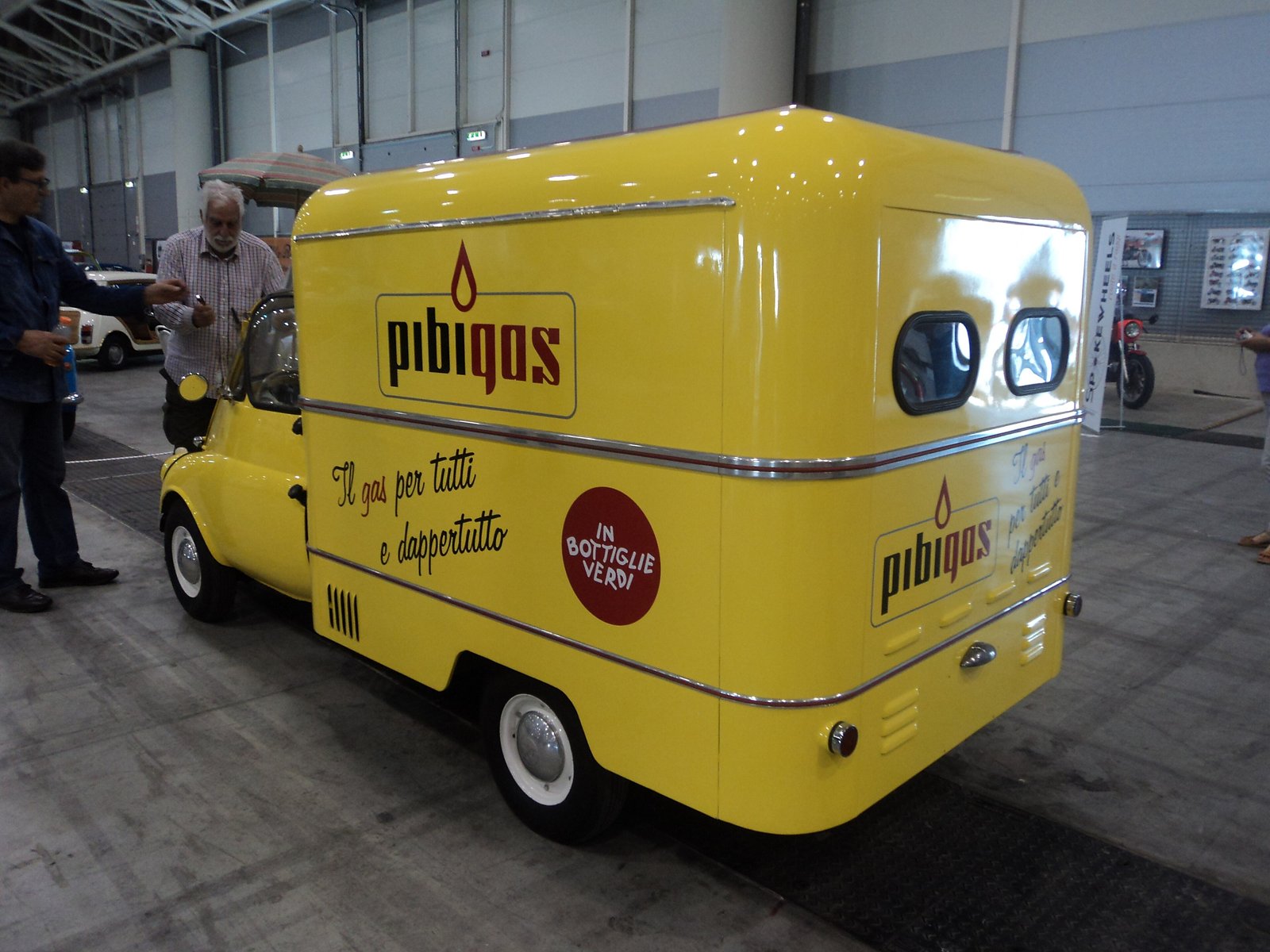
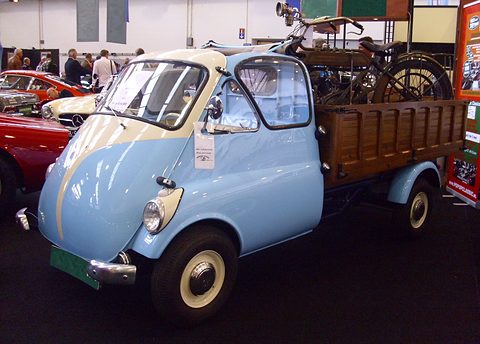
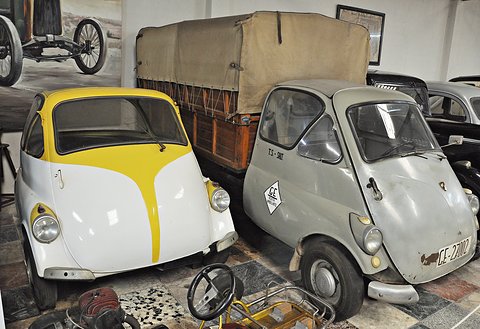
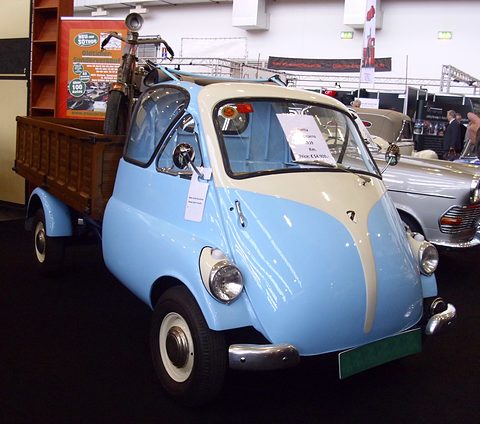
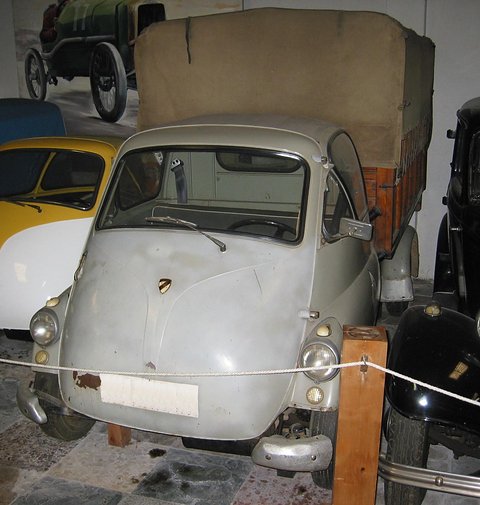
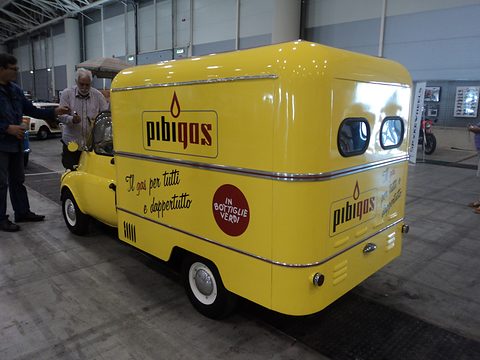
Iso sold more licences, and the Isetta became the biggest family of microcars built under licence. In France VELAM, which could not have the tooling, drew its own rounder monocoque body round the Iso engine and built the Velam Isetta at Suresnes from 1955 to January 1958.source 3 In Brazil the machine-tool maker Indústrias Romi, of Santa Bárbara d’Oeste, released the Romi-Isetta on 5 September 1956 and built about 3,000 by 1961, with Iso engines until 1958.source 3 Iso’s own company in Madrid went on building the Isetta and its Isettacarro truck after Italy had stopped.source 3 The English Wikipedia also says Spanish and Belgian plants were assembling Isettas and Autocarros from Italian parts before the BMW deal, and the museum says a licence went to Belgium, but no Belgian firm has been found.source 3source 4 The British Isettas of Brighton and the Argentine ones of De Carlo were built under BMW’s licence, not Iso’s.source 3
The end in Italy
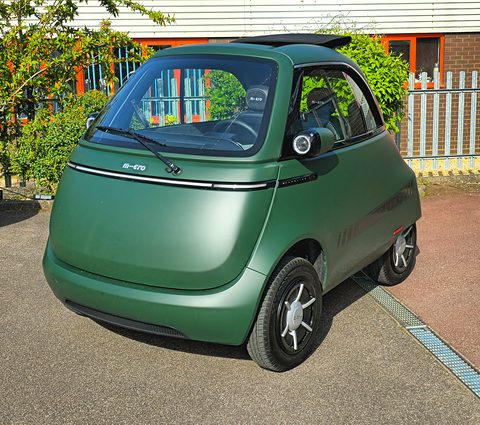
Italian production ended in 1955, by the English and German Wikipedias, or in October 1956, by the Italian Wikipedia and Automoto.it.source 3source 2source 6source 13 Rivolta had moved on. Iso built grand tourers with Chevrolet engines, the Iso Rivolta IR 300 and the Grifo, and won its class at Le Mans in 1965. Renzo Rivolta died on 20 August 1966, and his son Piero, then 25, took over.source 5 The egg outlived them. The Microlino, an electric microcar shown at Geneva in 2016 and built by Cecomp in Turin from 2022–23, has a design that plainly recalls the Isetta.source 6source 3