microcarfan
  • Microcar
  • West Germany
  • Four seats

Lloyd LP300

Also known as LP 300, Lloyd 300, “Leukoplastbomber”

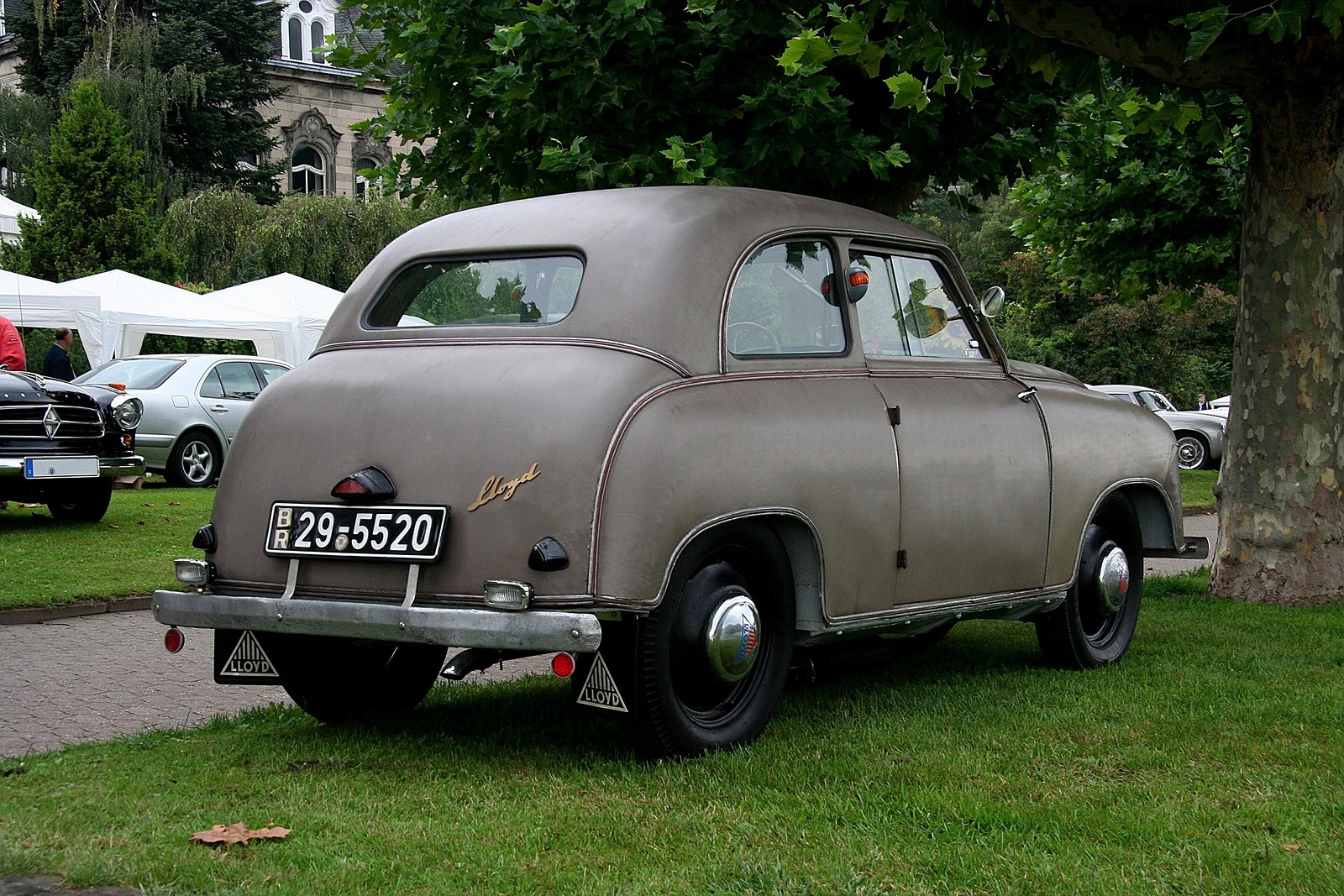
A four-seater for DM 3,334 in 1950, when a Beetle cost DM 4,600, built on a wooden frame. Under the leatherette skin of the Lloyd LP300 was plywood, and the skin looked so like sticking plaster that the car became the Leukoplastbomber.

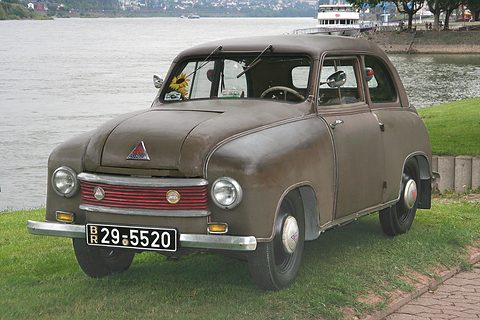
Weathered brown-grey small saloon with red slatted grille and triangular badge, parked on grass beside a wide river.
A first-series Lloyd LP 300 saloon with the narrow bonnet, beside the Rhine in Germany in 2007.Photo: Lothar Spurzem, CC BY-SA 2.0 de, via Wikimedia Commons

At a glance

The spec plate

Lloyd LP300

LP 300 saloon · Bremen

Built
1950–⁠1953From May 1950 to the beginning of 1953
Country
West GermanyBremen
Maker
Lloyd Maschinenfabrik GmbHLloyd Motoren Werke GmbH from January 1951; part of Carl F. W. Borgward’s group
Engine
293 cc air-cooled two-stroke twinTransverse, ahead of the front axle, driving the front wheels
Power
10 PS7.4 kW at 4,000 rpm
Length
3,200 mm1,320 mm wide, 1,360 mm high
Weight
480 kg
Seats
4
Wheels
4Front-wheel drive, the engine across the car ahead of the front axle
Price new
DM 3,334May 1950; DM 3,664 from February 1952
Production
18,5191950 to early 1953; 18,087 to the end of 1952
Survives
very fewMost were thrown away when better cars came along
Top speed
75km/h75 km/hGerman Wikipedia says about 70 km/h

How big is it?

True proportion

3.20 m

It is 230 mm longer than a Fiat 500, about 1.8 adults laid end to end.

  • 1.32 m wide
  • 480 kg: about six adults
  • Four seats on 10 PS (7.4 kW)
  • A boot you could load only from inside
Drawn at true proportion. The track is 3.6 metres long; the adult stands at the same scale. The Peel P50 is the smallest production car, on every page for comparison.

The story

History

Steel was scarce in West Germany in 1950, and press tools were dear. So Borgward built the body of its new small car on a wooden frame, panelled it in plywood and shaped sheet, laid felt over that, and covered the lot in synthetic leather.source 1source 2source 3source 4 The finish looked like Leukoplast, the German surgical tape, and Leukoplast was also said to be good for repairing it. The Leukoplastbomber, the sticking-plaster bomber, passed into German car slang; the Lane Motor Museum, in Nashville, translates it as the “Band-Aid bomber”.source 1source 2source 5

„Die Karosserie des Lloyd war wegen der notorischen Materialknappheit der Industrie Anfang der 1950er Jahre aus Sperrholz gefertigt und mit Kunstleder überzogen.“

ErfinderZeiten Auto- und Uhrenmuseum, Schramberg, object text for its 1952 LP 300. In English: “Because of industry’s notorious shortage of materials in the early 1950s, the Lloyd’s body was made of plywood and covered with synthetic leather.”source 4

The name was older than the car. Lloyd had begun in 1906 as the Norddeutsche Automobil und Motoren GmbH, building electric vehicles; it merged with Hansa in 1914 to make Hansa-Lloyd, and Borgward bought Hansa-Lloyd in 1929.source 5source 3 After the war Carl F. W. Borgward revived the Lloyd name for the cheap end of a range that also included Borgward and Goliath.source 6source 5 The firm was Lloyd Maschinenfabrik GmbH, renamed Lloyd Motoren Werke in January 1951.source 1source 2

Engine and gearbox came from INKA, an engineering office at Hude, near Oldenburg, staffed by former Auto Union engineers from Chemnitz, and the likeness to the pre-war DKW F8 was unmistakable.source 1source 2 A 293 cc air-cooled two-stroke twin of 10 PS (7.4 kW) sat across the car ahead of the front axle and drove the front wheels through three speeds, with no synchromesh and a “walking-stick” lever coming out of the dashboard.source 1source 2source 6 The frame was a central tube with cross-members and a steel floor.source 1source 2 The doors were hinged at the back, the side windows slid instead of winding, and the boot could be loaded only from inside the car.source 1source 2source 4 At 3,200 mm (126 in) long it is over this site’s size limit for a microcar. It is here as a defining cheap car of its day, one that microcar collections keep.source 6source 4

Cheaper than the Beetle

The LP300 saloon went on sale in May 1950 at DM 3,334, well below the Volkswagen’s DM 4,600.source 1source 2source 4 The Lane museum gives April.source 5 In spring 1951 an LS estate, an LK van and an LC coupé joined it, and at the end of that year the very narrow bonnet lid was made wider. From January 1952 dampers could be had, for DM 70 extra.source 1source 2 In February 1952 the price went up to DM 3,664 just as the Beetle’s came down to DM 4,400, and 1952 was still the best year, with 9,981 built; Volkswagen built 114,348 Beetles that year.source 2 The Lane museum says the Lloyd ranked third in German sales, behind Volkswagen and Opel, and cost 25 per cent less than a Beetle.source 5

English Wikipedia’s verdict is that the Lloyd and the Beetle were both small, cramped and slow, but that for most purposes the Lloyd was a class smaller; it also used markedly less fuel.source 2 The Weiner museum preferred it to the more intimate bubble cars, such as the BMW Isetta or the Heinkel Kabine: it had large wheels, enough speed and room for four.source 6 The Lane museum also calls it the first car with a transverse front engine driving through an in-line gearbox. It is a claim no other source makes, and it remains unverified.source 5

The 400, and a postscript

The Lloyd 400 replaced it at the start of 1953 and was shown to the press on 30 January: 386 cc, 13 PS (9.6 kW), and hydraulic brakes from March. The leatherette went in stages, with steel side panels from March 1953, a steel bonnet and tail from January 1954 and a steel roof from November 1954; the Weiner museum dates the change 1954–⁠55.source 1source 7source 6 The bigger bore brought cooling and lubrication failures. Rather than a public recall, Lloyd reportedly invited owners to the factory for coffee and cake and swapped their engines while they were shown round; the press, it is said, never found out.source 7 A 250 cc version followed in 1956 for drivers with the old class IV licence, and 109,878 Lloyd 400s were built in five years.source 7 The Lloyd 600 came in 1955, and the Borgward group collapsed in 1961, in a famous bankruptcy.source 2source 6

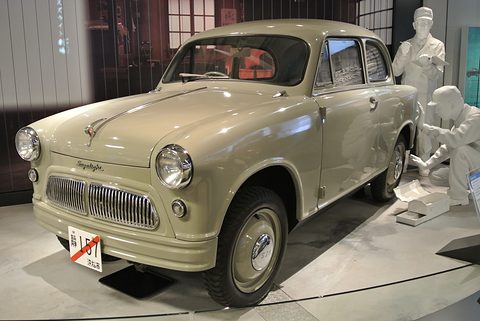
A 400 also went record-breaking. The Wiesbaden racer and Borgward dealer Karl-Heinz Schäuferle built a record car on it in 1953–⁠54, the “Roland”, also called the “Weiße Maus”, and with Hubertus Ricker and Adolf Brudes he took 14 class records, including 120.85 km/h (75 mph) for three hours and 112.10 km/h over 5,000 miles (8,047 km).source 7 And in Japan, Suzuki took a Lloyd 400 apart, with a Beetle, a Renault 4CV and a Citroën 2CV, and chose the Lloyd as the model for its first kei car, the Suzuki Suzulight.source 8
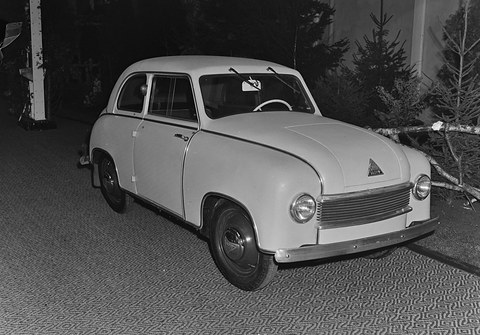
Black-and-white photograph of a light-coloured small saloon on patterned carpet, fir trees and a birch log behind.
Plate I · 1952 The LP300, billed as the cheapest car at the show, at the Amsterdam RAI on 28 February 1952.Photo: Harry Pot / Anefo, CC0, via Wikimedia Commons
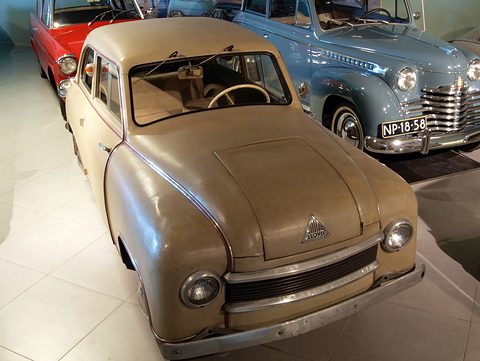
Beige small saloon seen from above the front, with slatted grille, triangle badge and pale steering wheel inside.
A 1951 LP300 at the Louwman Museum, The Hague, in 2011, its leatherette skin worn at the edges.Photo: Alf van Beem, CC0, via Wikimedia Commons

Pictures

More photographs, old and new

Variants

Four bodies, then the 400

The Lloyd 300 range and its successor
VariantYearsWhat differsHow many
LP 300 saloonMay 1950 – early 1953Two-door saloon, rear-hinged doors, sliding windowsNot given separately
LS 300 estate1951–⁠52Estate car (Stationswagen)Not given separately
LK 300 van1951–⁠52Panel van (Kastenwagen)Not given separately
LC 300 coupé1951–⁠52Coupé, or convertible saloonNot given separately
Lloyd 4001953–⁠57386 cc, 13 PS, hydraulic brakes; the body went over to steel bit by bit109,878source 7
Lloyd 250From 1956A 250 cc economy 400 for holders of the old class IV licenceNot found

Specification

The LP 300

Engine and drive

Engine and drive
EngineAir-cooled two-stroke twin, transverse, ahead of the front axle; Solex 30 BFRH carburettorsource 1source 2
Capacity293 ccsource 1source 2source 6source 5
Power10 PS (7.4 kW) at 4,000 rpmsource 1source 2source 6source 5
LubricationPetrol and oil mixed 25 to 1source 1source 2
GearboxThree speeds and reverse, no synchromesh, a “walking-stick” lever on the dashboardsource 1source 2source 6
DriveFront wheelssource 1source 2The Lane museum says by chain

Body and chassis

Body and chassis
FrameA central tube with cross-members and a steel floor platformsource 1source 2
BodyWooden frame, plywood and bent sheet panels, a layer of felt, synthetic leather skinsource 1source 2source 4
Front suspensionIndependent, two transverse leaf springssource 1source 2source 6
Rear suspensionSwing axle on longitudinal semi-elliptic springssource 1source 2source 6
DampersNone as standard; DM 70 extra from January 1952source 1source 2
SteeringRack and pinion, 2¼ turns lock to lock; turning circle 11 msource 2source 6
BrakesCable-operated drums; the handbrake works on all four wheelssource 2source 6
Tyres4.25 × 15source 6
Electrics6 V, electric startersource 2source 6

Dimensions

Dimensions
Length3,200 mmsource 6source 4
Width1,320 mmsource 6source 4
Height1,360 mmsource 6source 4
Weight480 kgsource 6

Performance and running

Performance and running
Top speed75 km/hsource 2source 6About 70 km/h by German Wikipedia; 46 mph by the Lane museum
Consumption5.5 litres per 100 kmsource 1
Fuel tank18 litres, under the bonnetsource 2
Price newDM 3,334 (May 1950); DM 3,664 (February 1952)source 1source 2

How many were built?

Every figure, with its source

About 18,500 built18,519 from 1950 to early 1953, the figure German Wikipedia takes from the period magazine’s production table and a standard reference book. The 18,087 given by English Wikipedia and the Lane museum stops at the end of 1952.

  1. 18,5191950 to early 1953One source

    German Wikipedia, citing auto motor und sport 3/1955 and Oswald, Deutsche Autos 1945–⁠1975source 1

  2. 18,087to the end of 1952Two sources agree

    English Wikipedia and the Lane Motor Museumsource 2source 5

  3. 9,981in 1952 alone, the peak yearOne source

    English Wikipediasource 2

  • Two sources agreetwo good sources give the figure
  • One sourcea good source, alone
  • Unconfirmeda lead only, not yet checked

Famous for

Three points

  1. The Leukoplastbomber

    A plywood body under a leatherette skin that looked like sticking plaster, which was said to mend it.

  2. Under the Beetle’s price

    DM 3,334 for four seats in 1950, against DM 4,600 for a Volkswagen.

  3. Sliding windows, rear doors

    Doors hinged at the back, windows that slid instead of winding, and a boot loaded only from inside.

Survivors and collecting

Today

Very few survive. Once better cars came along most were thrown away, which is why the Louwman Museum calls a good one remarkable.source 6source 3 The Louwman Museum in The Hague and the Lane Motor Museum in Nashville each have a 1951 LP300, and the ErfinderZeiten museum in Schramberg a 1952 car; the Weiner museum had a 1952 LS 300 estate (see museums and meets).source 3source 5source 4source 6 No auction results have been found. The marque has its own books: Peter Kurze and Ralf Kiese’s Lloyd – der Wagen für Dich (2006), Kurze’s Borgward Typenkunde (2009) and Georg Schmidt’s Borgward (1986).source 1

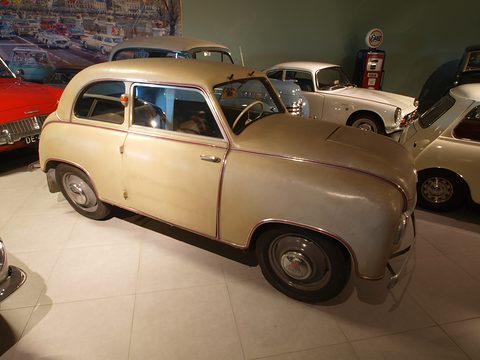
Beige small two-door saloon with red-piped seams on a pale tiled museum floor among other cars.
The Louwman Museum’s 1951 LP300 in profile in 2011, the piped seams of its leatherette skin plain to see.Photo: Alf van Beem, CC0, via Wikimedia Commons

Sources

Numbered as in the text

Sources are given as plain text; the links are on the Credits page.

  1. German Wikipedia, Lloyd 300, read in full with its references. It cites Kurze, Borgward Typenkunde (2009), pp. 11–12; auto motor und sport 3/1955, p. 14; Oswald, Deutsche Autos 1945–⁠1975 (1979), pp. 459–461.
  2. English Wikipedia, Lloyd 300, read in full; used as a lead.
  3. Louwman Museum, “Lloyd LP 300”, collection page.
  4. museum-digital Baden-Württemberg, “Kleinwagen Lloyd LP 300”, ErfinderZeiten Auto- und Uhrenmuseum, Schramberg, object record.
  5. Lane Motor Museum, “Lloyd LP 300”, collection page.
  6. Bruce Weiner Microcar Museum, “1952 Lloyd LS 300”, tour page, archived, read in full.
  7. German Wikipedia, Lloyd 400, read in full; it cites Oswald, Deutsche Autos 1945–⁠1990, vol. 4 (2001), pp. 446–447.
  8. Japanese Wikipedia, スズキ・スズライト (Suzuki Suzulight), read in full; on Suzuki’s choice of the Lloyd 400 as its model.