microcarfan
  • Licence-free car
  • France
  • 14 makers

French licence-free car makers of the 1970s and 1980s

Also known as Voiturettes sans permis

France’s licence-free cars were not all built by big names. Fourteen smaller firms made them too: a Limoges metal works, a Paris firm whose open runabout was the cheapest car in France in 1979, an engineer with an electric single-seater, and a maker who fitted a Wankel engine.

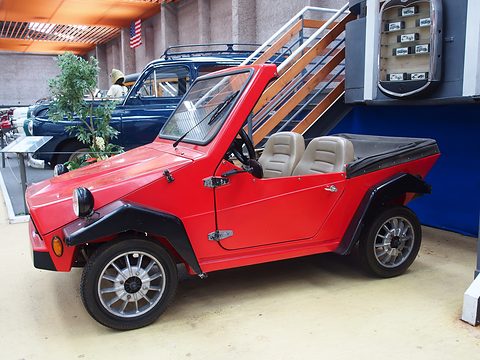
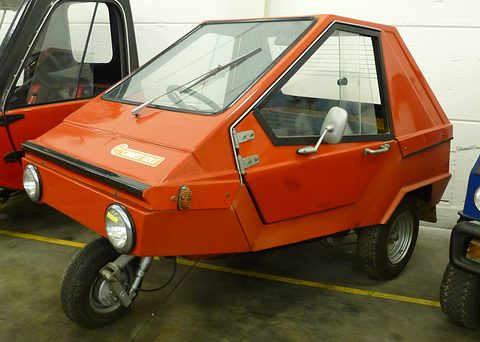
Red open microcar with black wheel-arch flares, alloy wheels and two beige seats, on a sandy museum floor.
A red open Tomcar in the ALAAC collection in Lorraine in 2013.Photo: Alf van Beem, CC0, via Wikimedia Commons

At a glance

The spec plate

French licence-free car makers of the 1970s and 1980s

14 makers · France

Built
1970–⁠1994From Polycarters’ first cars, shown in October 1970, to Duport’s successor firm, which traded until 1994
Country
FranceFrom Wingles in the north to Antibes in the south
Engine
From 47 cc, or electricPolycarters: Sachs 50 cc. Cico: Sachs 47 cc, Motobécane 49.9 cc, 50 or 125 cc in the Matic. SECAM: Sachs 47 cc, Morini four-stroke. Vitrex: Sachs 47 cc, Peugeot 49 cc. Marden: two electric motors, petrol engines of 125 or 500 cc, a Sachs Wankel of 23 PS, a 2CV engine or a 125 cc motorcycle engine. Duport: Lombardini 510 cc diesel. Cedre: electric, 1.2 or 5 kW. MDP: Peugeot 49 cc. GMT: Sachs 47 cc, a 125 cc, Motobécane 49 cc. Kikos: Motobécane 50 cc, Zündapp 125 cc; Renault engines in its sports cars. Tomcar: Peugeot 49 cc, BCB 125 cc, Lombardini 325 cc diesel. Noval: petrol of 50 or 125 cc, a 231 cc diesel, a 2.4 kW electric motor. Gateau: petrol and diesel of 50 to 500 cc, electric motors of 1.8 and 2.2 kW. Charlatte: 50 cc, or a 1,000 cc four
Seats
1 to 4One in the Cedre Midinette; four in the Duport Parco
Price new
6,110 F to 23,500 FThe cheapest Addax in 1975 to the Cedre 1000 in 1981
Production
About 2,400 Addax in 1977The only yearly figure found; about 50 Cèdres in all
Survives
A fewA restored Cèdre; the Weiner museum had a Cicostar
Top speed
45km/h45 km/hThe electric Cedre Midinette was credited with 50 km/h

Not yet recordedpower and wheels and layout.

The story

History

After 1970, the Weiner museum says, French law let anyone over 14 drive a 50 cc cyclomoteur carrossé, an enclosed moped, without a licence, at up to 45 km/h (28 mph), and some thirty companies took up the idea over the following decade.source 1 The 45 km/h limit came later, though: by the titles of the orders in the Journal officiel, the moped limit was 50 km/h (31 mph) from 1962 and became 45 km/h only with an order of 8 December 1975.source 2 The museum ties this to an energy crisis looming in 1970, and to a government that encouraged regional firms to build such vehicles; but the oil crisis came only in 1973, and no source used here confirms the encouragement.source 1

The better-known makers have pages of their own: the Acoma Mini Comtesse, the Arola, the Bellier Véloto, the SEAB Flipper, the Minicat and the Erad, and then the bigger firms that followed, among them Aixam, Ligier, Microcar, Chatenet and JDM. This page gathers 14 smaller ones, in the order of the dates given for them.

Most were small regional firms. They laid up polyester bodies on steel-tube chassis and bought in their engines: Sachs singles of 47 cc, Motobécane and Peugeot engines of 49 or 50 cc, BCB engines of 50 or 125 cc, and from the early 1980s Lombardini diesels.source 3source 4source 5source 6source 7source 8 Several also built cars that a licence-free driver could not have used: Charlatte’s 1,000 cc car, Marden’s Wankel and 2CV engines, and Kikos’s sports cars; whether Duport’s 510 cc diesels all qualified is not clear.source 9source 10source 11source 6 By the dates in the sections below, only three of the fourteen, Marden, Gateau and Duport, were still at work in 1990.source 10source 12source 6
Polycarters

1970–⁠1972 · a record on this page

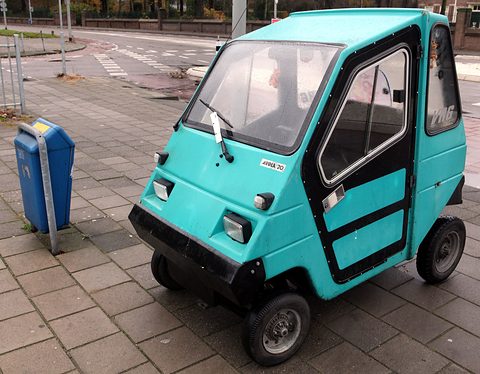
Polycarters, of Sorigny in Indre-et-Loire, was run by G. de Tayrac and showed its cars at the Paris Salon in October 1970, which makes it one of the earliest of the decade’s licence-free makers.source 13 It offered two. One was a small car with a 50 cc Sachs engine, licence-free in France. The other was a beach car on the Renault 4, with a roof and doors that came off, of which several dozen were made. In 1972 the firm stopped building cars and turned to engines and turbines.source 13 Nothing more about the small car has been found.

Addax

1975–⁠1980 · a record on this page

SECAM, the Société Anonyme d’Études et de Construction Automobiles et Motocycles, traded at Chambly, in the Oise, from 1975 to 1978.source 4 Its Addax was a three-wheeler with a lone front wheel, 1,830 mm (72 in) long and 1,120 mm (44 in) wide. The polyester body came in five colours and with two roofs, a standard one and the “Bord de mer” canopy for the seaside. A Sachs 47 cc single normally gave 2.6 PS (1.9 kW), and a sport version 4.3 PS (3.2 kW); from 1976 there was also a Morini four-stroke of 4 PS (2.9 kW).source 4 Prices, from Bellu’s Automobilia, ran from 6,110–8,043 F in 1975 to 8,046–9,784 F in 1978. SECAM built about 2,400 in 1977, which for one year made it a sizeable maker. From 1977 it also offered the Autozodiaco Charly, whose story is told with the All Cars Snuggy.source 4

In 1978 Vitrex Industrie took over the Addax.source 4source 5 Vitrex was a Paris company whose designer was Jacques Riboud, and the car that carried his name, built for Vitrex from 1974 to 1980 by Marland SARL, was an open three- or four-wheeler with a Sachs 47 cc of 2.4 PS (1.8 kW), 1,950 mm (77 in) long and weighing about 100 kg (220 lb).source 5 At 6,430 F in 1979, German Wikipedia says, the Riboud was the cheapest car in France.source 5 Who Marland were has not been found; the old microcarfan.com says that Marland, and then Vitrex, sold the Snuggy in France.source 14 Vitrex built the Addax until 1980, and in 1980 added the Garbo, a closed two-seater with a Peugeot 49 cc engine, which passed to MDP Transmission as the Puma Garbo.source 5

Marden

1975–⁠1992 · a record on this page

Marden was founded in 1975 at Neuilly-sur-Seine by Teddy Marson and a partner named Denape, and their names make the name: MAR-DEN.source 10 The Espace I of 1975 was 2.1 m (6 ft 11 in) long, with two electric motors or a petrol engine of 125 or 500 cc. The Espace II of 1976 had, mounted at the back and cooled by air, a single-rotor Sachs Wankel engine of 23 PS (17 kW). A third model, of 1978, measured 2.65 m (8 ft 8 in) and took a Citroën 2CV engine or a 125 cc motorcycle engine.source 10 The firm, later based at Offranville in the Seine-Maritime, became the Société d’Exploitation Marden-Automobile in 1979 and stopped building cars in 1992.source 10 The larger engines put some Mardens outside the licence-free class.

Duport

1977–⁠1994 · a record on this page

Guy Duport’s firm, at Saint-Ferréol in Haute-Savoie, traded as Établissements Duport from 1977 to 1992 and as the Société Nouvelle Duport until 1994. It built the Caddy, a two-seater, and from 1981 the 511, a 2 + 2, and the Parco, a four-seater, all with a Lombardini diesel of 510 cc.source 6 At that size the Duports may not all have been licence-free; the sources do not say. Nothing on their production has been found.

Cedre Midinette

1979–⁠1987 · a record on this page

CEDRE was an acronym, for Centre d’Études pour la Développement et la Réussite des Entreprises, source 15source 16 and its founder was François Guerbet, an engineer from Toulouse.source 15source 17 He had argued for years that an electric town car was possible. Lead-acid batteries could not match petrol, he reasoned, but a very light tricycle limited to 50 km/h, carrying 200 kg (441 lb) of batteries, could cover 100 km (62 miles) with a load of 120 kg (265 lb).source 16 The firm traded as Société Seve-Cedre from 1975 to 1979 and then as Cedre SARL until 1987, at Sainte-Croix-Volvestre by German Wikipedia, or at neighbouring Montesquieu-Volvestre by English Wikipedia.source 15source 16

The Midinette was first shown on 25 April 1975, at the Concours Lépine, the annual inventions fair in Paris, and Guerbet took it to an electric-car symposium in Düsseldorf in September 1976, to Brussels and onto the Champs-Élysées.source 16 It was a single-seat three-wheeler with one wheel in front, a polyester body on a small tubular chassis and a sliding door on the left; German Wikipedia speaks of sliding doors. It measured 1,800 mm (71 in) by 880 mm (35 in). A 1.2 kW motor gave 50 km/h (31 mph) and a range of 60 km (37 miles), and a 5 kW model is recorded too.source 15source 16 Quoted at 9,540 F in 1975, just under the price of a Citroën 2CV, it waited for money until 1978; the first customers took delivery in September 1978, at 14,110 F, and series production began in 1979.source 16source 15

In 1981 the Cedre 1000 replaced it: 2,000 mm (79 in) long, about 40 km/h, a range of 120 km (75 miles), charged overnight from a household socket, with solar panels on the roof as an option, worth about 20 km more on a sunny day, at 23,500 F, again just under a 2CV.source 16 Cedre also showed a five-wheeler, the 5×5 Solaire.source 15source 16 A restorer interviewed by automobile-propre.com says about 50 Cèdres were built in all, that Guerbet placed cars at a seaside resort until the fairground operators complained of the competition, and that a car he calls a Cèdre 1000 appears in the 1980 French comedy Mais qu’est-ce que j’ai fait au bon Dieu pour avoir une femme qui boit dans les cafés avec les hommes ?, from which Guerbet hoped for publicity.source 17 The firm closed in 1987.source 15source 16

Cicostar

1979–⁠1984 · a record on this page

Cico stood for Chaudronnerie Industrielle du Centre-Ouest, a metalworking firm at 52–54 rue Léonard-Samie in the Magré-Romanet industrial area of Limoges.source 3 The Weiner museum dated its Cicostar to 1971 and gave production as 1971–⁠83. German Wikipedia gives 1979–⁠84, and the museum’s own specification card names the model the LCS 79, so 1979 is the likelier start.source 1source 3

There was a three-wheeler with a Sachs 47 cc engine and a four-wheeler with a Motobécane of 49.9 cc; the Cicostar Matic of 1980 came with a 50 cc or a 125 cc engine, and the Starvan got no further than a prototype.source 3 German Wikipedia gives the car as 1,940 mm (76 in) long, 1,120 mm (44 in) wide and 1,440 mm (57 in) high; the Weiner card says 194 cm by 120 cm.source 3source 1 The card adds a Motobécane of 3.2 hp (2.4 kW) driving the rear wheels through a Grimeca variable automatic transmission, strut suspension, hydraulic brakes, 4.00 × 8 wheels and a top speed of 45 km/h.source 1 Cico sold it with a slogan.

La plus élégante des petites voitures

Cico’s slogan for the Cicostar, as quoted by the Bruce Weiner Microcar Museum. In English: “The most elegant of small cars.”source 1

No count of Cicostars has been found.

Puma Garbo

1980–⁠1982 · a record on this page

MDP Transmission, of Neaufles-Saint-Martin in the Eure, was founded in 1980 and bought the right to build Vitrex’s Garbo, which it reworked and sold under the name Puma. Vitrex showed the Garbo, and MDP its Puma, at the Paris Salon of October 1980.source 5source 18 It was MDP’s only model: a closed two-seat coupé 2,160 mm (85 in) long, 1,230 mm (48 in) wide and 1,550 mm (61 in) high, with a Peugeot 49 cc engine at the back.source 18 Production ended in 1982 by Georgano’s account, or in 1989 by Linz and Schrader’s.source 18 No price, wheel count or production figure has been found.

GMT Rivelaine

1980–⁠1983 · a record on this page

The Générale de Mécanique et de Thermique built cars at Wingles, in the Pas-de-Calais, from 1980 to 1983, and the Rivelaine was its only model. It was a two-seater, 2,420 mm (95 in) long, 1,300 mm (51 in) wide and 1,450 mm (57 in) high, with an automatic transmission and a large boot under a big tailgate. The engine was a Sachs 47 cc, later a 125 cc, or a Motobécane 49 cc.source 19 No production figure has been found.

Kikos

1980–⁠1985 · a record on this page

The Société Française Kikos was founded at Antibes in June 1979 and built cars from 1980 to 1985.source 11 Its Kikos T.040 of 1981 was a three-wheeler with one wheel in front, open or closed, and rear-engined: an air-cooled Motobécane of 50 cc or a water-cooled Zündapp of 125 cc, with an automatic transmission. Then it changed course entirely. The IVE-RS 82, from 1982, was a sports car with a Renault 12 engine and parts of the Alpine A110, and the IVE-RS 85 was based on the second-generation Renault 5.source 11

Tomcar

1981–⁠1985 · a record on this page

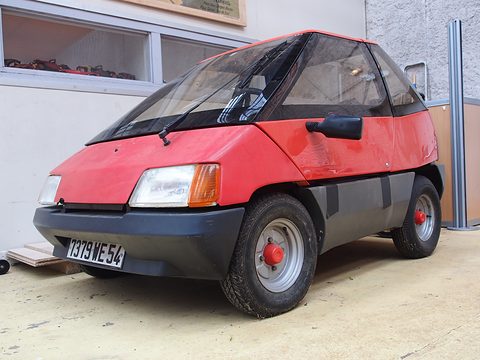
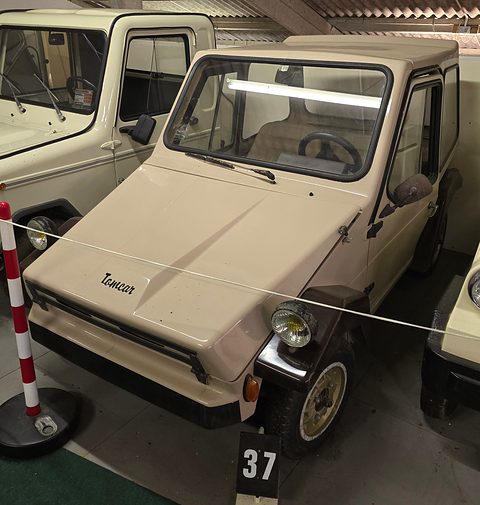
Founded in 1981 at Saint-Just-en-Chaussée, in the Oise, and run by G. Jacquier, SA Tomcar later moved to Breteuil-sur-Noye. Production began in 1981 or 1983 and ended in 1985.source 8 There were two bodies, a Berline and a cabriolet, each 2,460 mm (97 in) long, 1,290 mm (51 in) wide and 1,320 mm (52 in) high, with a Peugeot 49 cc two-stroke, a BCB 125 cc or a Lombardini 325 cc diesel. In October 1981 the cabriolet cost 22,600 F and the Berline 22,900 F.source 8 The design outlived the firm: in 1986 the Spanish maker Pypper used it for prototypes.source 8 The photographs on this page show an open red Tomcar in the ALAAC collection in Lorraine in 2013, and a cream closed one on display in 2024.

Cream angular four-wheeled microcar with Tomcar script on its bonnet, behind a rope with a number board in front.
A cream Tomcar with its closed body, on display in 2024.Photo: Calreyn88, CC BY-SA 4.0, via Wikimedia Commons

Noval

1982–⁠1984 · a record on this page

Noval built cars at Reuilly, in the Indre, from 1982 to 1984. No model name has been found. It had a steel-tube chassis and a polyester body, 2,250 mm (89 in) long, 1,290 mm (51 in) wide and 1,400 mm (55 in) high on a 1,500 mm (59 in) wheelbase, and a choice of engines: petrol of 50 or 125 cc, a 231 cc diesel, or a 2.4 kW electric motor.source 7

Gateau

1983–⁠1992 · a record on this page

Automobiles Gateau, of Machecoul in the Loire-Atlantique, was part of Gateau International of Saint-Gilles-Croix-de-Vie, and traded from 1983 to 1992; its designer was Joël Brétecher.source 12 Its range ran to seven names, the Break, Egzo 3, Egzo 7, Forum, Grande, Maximini and Vison, and many were suitable for disabled drivers. They had petrol and diesel engines of 50 to 500 cc, or electric motors of 1.8 and 2.2 kW, and measured 2,360 mm (93 in) long and 1,270 mm (50 in) wide on a 1,650 mm (65 in) wheelbase, at 250 to 270 kg (551–595 lb).source 12

Charlatte

1984–⁠1988 · a record on this page

Charlatte, of Migennes in the Yonne, succeeded Hrubon of Guebwiller. It was founded in 1984 or 1985 and stopped building cars in 1986 or 1988; the sources disagree.source 9 Its car looked like a Mini Moke in miniature, and came with a 50 cc engine, which made it licence-free, or with a 1,000 cc four-cylinder, which did not.source 9 Little else about it has been found.

Pictures

More photographs, old and new

Variants

Fourteen makers, in the order of this page

The makers and their cars
VariantYearsWhat differsHow many
Polycarters1970–⁠72Sorigny; a Sachs 50 cc car, and a beach car on the Renault 4Several dozen beach carssource 13
SECAM Addax1975–⁠78Chambly; three wheels, one in front; Sachs 47 cc, or a Morini four-stroke from 1976About 2,400 in 1977source 4
Vitrex1974–⁠80Paris; the Riboud, the Addax and the GarboNot knownsource 5
Marden1975–⁠92The Espace I, electric or petrol; the Espace II with a Sachs WankelNot knownsource 10
Duport1977–⁠94Caddy, 511 and Parco; a Lombardini 510 cc dieselNot knownsource 6
Cedre Midinette1979–⁠87An electric single-seater on three wheels; the Cedre 1000 from 1981About 50 Cèdressource 17
Cico Cicostar1979–⁠84Limoges; three wheels with a Sachs 47 cc, four with a Motobécane 49.9 ccNot knownsource 3
MDP Puma1980–?The ex-Vitrex Garbo; a Peugeot 49 cc at the back; ended 1982 or 1989Not knownsource 18
GMT Rivelaine1980–⁠83Wingles; a two-seater with a big tailgate; Sachs or MotobécaneNot knownsource 19
Kikos1980–⁠85Antibes; the T.040 three-wheeler, then Renault-based sports carsNot knownsource 11
Tomcar1981–⁠85Berline and cabriolet; Peugeot 49 cc, BCB 125 cc or Lombardini dieselNot knownsource 8
Noval1982–⁠84Reuilly; petrol, diesel or electricNot knownsource 7
Gateau1983–⁠92Machecoul; seven models, many suited to disabled driversNot knownsource 12
CharlatteMid-1980sMigennes; a small Moke-like car, 50 cc or 1,000 ccNot knownsource 9

How many were built?

What was counted

Two counts in fourteen makersOnly two counts have been found for the whole group: about 2,400 Addax built by SECAM in 1977, which made it a sizeable maker for a year, and about 50 Cèdres in all. Polycarters made several dozen of its beach car, which was built on the Renault 4. Every other maker’s output is unknown.

  1. about 2,400Addax three-wheelers, in 1977 aloneOne source

    German Wikipedia, citing René Bellu’s Automobiliasource 4

  2. about 50Cèdres of all kindsOne source

    a restorer interviewed by automobile-propre.comsource 17

  • Two sources agreetwo good sources give the figure
  • One sourcea good source, alone
  • Unconfirmeda lead only, not yet checked

Famous for

Three points

  1. The cheapest car in France

    At 6,430 F in 1979, the Vitrex Riboud was the least expensive car on sale in France.

  2. A Wankel in a small car

    Marden’s Espace II of 1976 had a single-rotor Sachs rotary engine at the back.

  3. Electric, and cheaper than a 2CV

    Cedre’s single-seat Midinette was priced just under a Citroën 2CV, and its successor could carry solar panels.

Survivors and collecting

Today

Few of these cars are documented today. The Bruce Weiner Microcar Museum had a Cicostar.source 1 A three-wheeled Cèdre with a sliding door has been restored by two enthusiasts and has raced at an event at Vincennes.source 17 The Tomcars in the photographs on this page were on display in 2013 and 2024. No other survivors are documented in the sources used here.

Sources

Numbered as in the text

Almost every maker rests on one German Wikipedia article, and those articles draw on the same reference books: Linz and Schrader’s encyclopaedia, Georgano’s, and René Bellu’s Automobilia Salon annuals. No period press was read for any of them. Sources are given as plain text; the links are on the Credits page.

  1. Bruce Weiner Microcar Museum, “1971 Cicostar”, tour page, read in full via the Internet Archive.
  2. Légifrance, titles of orders in the Journal officiel: “Vitesse maximum des cyclomoteurs (50 kms/heure)”, 29 October 1962, and “Vitesse maximum de circulation des cyclomoteurs – 45 km/h”, 8 December 1975; titles only.
  3. German Wikipedia, Cico SA, citing Linz and Schrader, Georgano and Bellu’s Automobilia (1980–⁠83).
  4. German Wikipedia, Société Anonyme d’Études et de Construction Automobiles et Motocycles, citing Bellu’s Automobilia (1975–⁠78).
  5. German Wikipedia, Vitrex Industrie.
  6. German Wikipedia, Établissements Duport.
  7. German Wikipedia, Noval (Automobilhersteller).
  8. German Wikipedia, SA Tomcar.
  9. German Wikipedia, Charlatte.
  10. German Wikipedia, Marden-Automobile.
  11. German Wikipedia, Société Française Kikos.
  12. German Wikipedia, Automobiles Gateau, citing Automobilia 96 (2009).
  13. German Wikipedia, Polycarters, citing Bellu’s Automobilia (2007).
  14. The original microcarfan.com (2006–⁠2016), marque page “ALL-CAR”, one collector’s account, read from the archived copy.
  15. German Wikipedia, Cedre, citing Linz and Schrader, Georgano and Bellu’s Automobilia.
  16. English Wikipedia, Cedre, citing Bellu’s Automobilia page by page.
  17. Philippe Schwoerer, “Quand la passion de l’automobile mène aux anciennes microcars électriques”, automobile-propre.com, an interview with a restorer, with readers’ comments.
  18. German Wikipedia, MDP Transmission, citing Linz and Schrader, Georgano and Bellu’s Automobilia.
  19. German Wikipedia, Générale de Mécanique et de Thermique.