microcarfan
  • Licence-free car
  • France
  • Four wheels
  • Pedals

Bellier Véloto

Also known as Véloto, Super Véloto

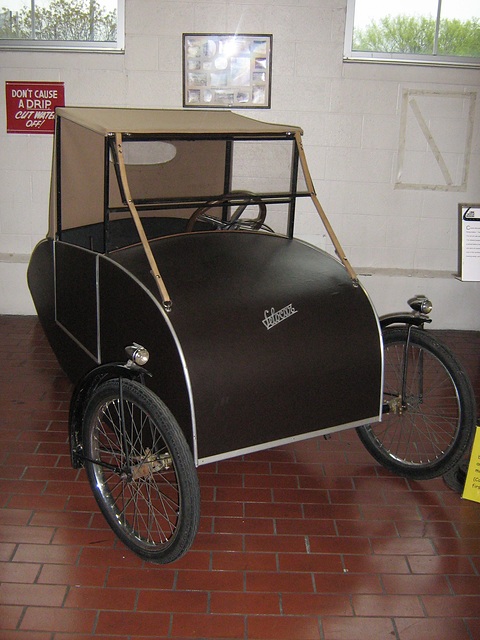
A grown-up pedal car with a Solex engine added: started by pedalling, helped along by pedalling, and for several years the only licence-free car in France that could carry two adults.

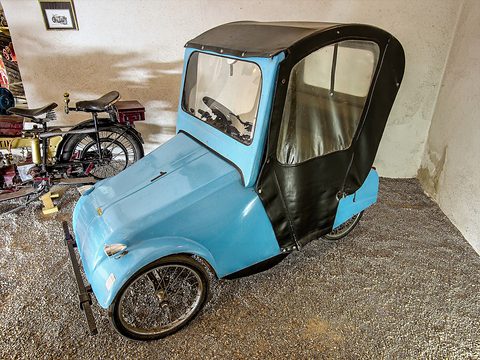
Pale blue four-wheeled voiturette with large spoked bicycle wheels, a black hood and black fabric doors, standing on gravel.
A Bellier Véloto with soft top and roll-up doors at the Musée Maurice Dufresne, Azay-le-Rideau, in 2017.Photo: Alf van Beem, Public domain, via Wikimedia Commons

At a glance

The spec plate

Bellier Véloto

Type BL · Les Sables-d’Olonne

Built
1974–⁠1980A pedal car from 1974; with an engine from the 1975 or 1976 Paris Salon
Country
FranceLes Sables-d’Olonne, Vendée
Maker
Jean Bellier’s firm, then Bel-Motors InternationalBel-Motors formed with SOTRAM in February 1977
Engine
49 cc Motobécane two-stroke singleA Solex at first; the early cars were started by pedalling
Power
about 3 hpAbout 2.2 kW, Type BL
Length
2,100 mm1,050 mm wide
Weight
120 kgThe Type BL of 1978
Seats
2Side by side
Wheels
4Large bicycle-type wheels; the engine at the back
Price new
5,950 FAt the launch, October 1976
Top speed
40km/h40 km/h25–30 km/h for the first Solex cars; 45 km/h for the C12S

How big is it?

True proportion

2.10 m

It is 870 mm shorter than a Fiat 500, about 1.2 adults laid end to end, and one and a half times the length of a Peel P50.

  • 1.05 m wide
  • 120 kg: about two adults
  • Two seats side by side
Drawn at true proportion. The track is 3.6 metres long; the adult stands at the same scale. The Peel P50 is the smallest production car, on every page for comparison.

The story

History

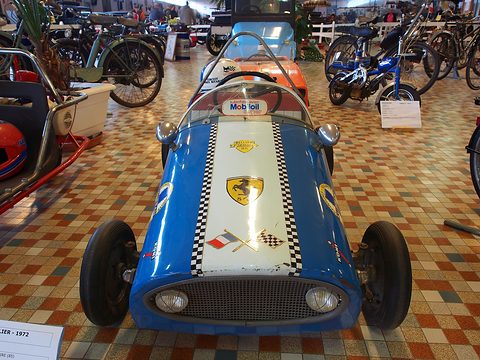
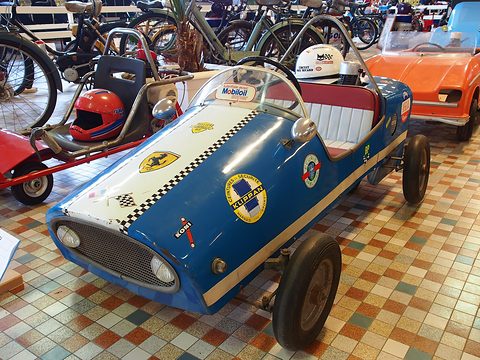
Jean Bellier’s business at Les Sables-d’Olonne, on the Vendée coast, was founded in 1946 to make car batteries.source 1source 2 Its first vehicles, in 1968, were for children. The old site describes a kart and a small car, both driven by a Solex engine; the Weiner museum describes a small Solex-powered three-wheeler for teaching children road safety.source 1source 2 In 1972 it launched the Buggy Formule 85 at the toy fair, the Salon du Jouet. The buggy was used on Prévention routière tracks to teach children road safety, and by 1976 it had been exported to 48 countries.source 2source 1

The first Véloto, in 1974, was a pedal car for adults with no body and no engine.source 1 The English Wikipedia says Bellier built such quadricycles for the bicycle-hire shops of the beach resorts, and then thought of adding a Solex engine and the look of a car.source 3 The collector behind the original microcarfan.com saw in it the Mochet Vélocar reborn: a pedal quadricycle with a helper engine, which is what the maker called it.source 1

Pedal to start

When the engine arrived is disputed. The old site says two Solex versions joined the range at the 1975 Paris Salon, one bare and one with front and rear covers and a fringed sun canopy; the Weiner museum and the English Wikipedia place the launch at the Salon of October 1976.source 1source 2source 3 Either way the car weighed 80 kg (176 lb), the pedals helped the engine, and on the flat it did 25 to 30 km/h (16 to 19 mph) with one or two aboard.source 1source 3 A hard roof came first, then soft doors that folded from back to front, round aluminium headlamps and whitewall tyres, and during the year a 50 cc Motobécane version, still started by pedalling.source 1 It was sold in sky blue, orange, mustard, white or prairie green, always with a black top like a tent.source 2 It cost 5,950 F at the launch and 6,850 F by June 1977.source 3

What set it apart was the second seat. For years it was the only licence-free car that could legally take two adults.source 1source 2

It was essentially aimed at retirees who had given up driving.

Bruce Weiner Microcar Museum, undated tour card for a 1976 Véloto.source 2

Bel-Motors and the black C10

In February 1977 Jean Bellier joined SOTRAM, a metalworking firm, to form Bel-Motors International, which built and sold the Véloto and nothing else; the English Wikipedia dates Bel Motors to 1976.source 1source 3 The top could now be folded down, the doors rolled up from the bottom, and the engine disappeared inside the rear bodywork. By 1978 there were two versions: the Type A, started by pedal and keeping two independent sets of pedals, at 100 kg (220 lb) and 7,600 F; and the Type BL, with an electric starter, one emergency set of pedals, chrome bumpers, a luggage rack, a mileometer and foot pedals for throttle and brake, at 120 kg (265 lb), 40 km/h (25 mph) and 9,300 F.source 1source 3

The C10 that followed is known by its 10-inch wheels, the Motobécane Mobyx’s size. It gained front brakes, and its pedals gave way to an emergency lever pumped back and forth to move the car, compulsory then on every enclosed moped. A proper fuel tank replaced the Renault jerrycan of the earlier cars. It came in black with a beige hood; the old-site author knew of no other licence-free car ever offered in black.source 1 The C10S “Super Deluxe” of 1979 had a fully enclosed glass-fibre body, and the Weiner museum says 50 were made.source 4 The Super Véloto, shown in July 1979 and built in very small numbers, became the C12S for 1980, with plastic bumpers, rectangular lamps, a reverse gear and 45 km/h (28 mph).source 1 The English Wikipedia names the types differently, calling the first motorised model the Super Véloto (1976–⁠1978) and dating the C‑10 S to 1979; this page follows the old site’s dated sequence.source 3

Two roads after 1980

In 1980 Jean Bellier and Bel-Motors went separate ways. Bel-Motors built one more car, the Minoto, and filed for bankruptcy in February 1981.source 1source 5 Bellier started again under his own name with the Formule 85, reviving the children’s buggy’s name: a Motobécane 50 cc, 45 km/h and, a luxury in 1980, wind-down windows. A 125 cc Sachs at the back came later, then front-wheel drive with a Sachs 50 cc or a 325 cc Lombardini diesel, and in 1987 the XLD.source 1

Bellier Automobiles, at Talmont-Saint-Hilaire under Jean-Jacques Bellier, carried on.source 6 In 2004 the failure of a polyester subcontractor stopped production for two months and pushed the firm into receivership, and on 1 December 2004 it joined the Fast group of La Roche-sur-Yon, a coach builder and operator.source 7 What it has done since 2005 is not recorded here.
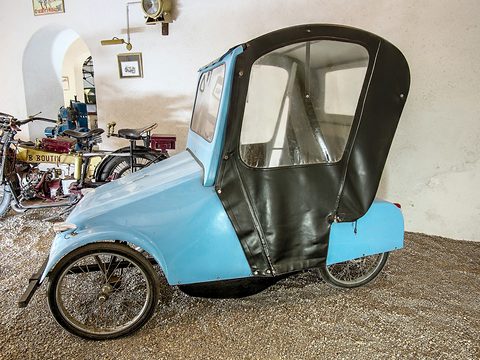
Side view of a pale blue voiturette with tall spoked wheels, a black fabric cab with clear windows and veteran motorcycles behind.
A sky-blue Bellier Véloto in profile at the Musée Maurice Dufresne, Azay-le-Rideau, France, in 2017, showing its bicycle-type wheels and the rear engine cover behind the cab.Photo: Alf van Beem, Public domain, via Wikimedia Commons

Pictures

More photographs, old and new

Variants

From pedal car to saloon

Véloto types, in the old site’s order
VariantYearsWhat differsHow many
Buggy Formule 851972–⁠1976A children’s road-safety buggy, Vélosolex engineExported to 48 countries
Véloto, pedal1974An adult pedal car, no body, no engineNot known
Véloto, Solex1975/76–1977Motorised, pedal start, 80 kgNot known
Véloto, Motobécane1976–⁠1977Motobécane 50 cc, still pedal startNot known
Type A1978Pedal start, two sets of pedals, 100 kgNot known
Type BL (or B)1978Electric start, chrome bumpers, mileometer, 120 kg, 40 km/hSome 100
C101978–⁠197910 in Mobyx wheels, front brakes, a lever instead of pedals; black with a beige hoodNot known
C10S “Super Deluxe”1979–⁠1980A fully enclosed glass-fibre body, independent suspension50
Super Véloto, then C12SJuly 1979; 1980Rectangular lamps, plastic bumpers, reverse, 45 km/hVery small numbers
Formule 85 (Bellier)1980–⁠1987A new modern body with wind-down windowsNot known

Specification

The Type BL, from the Weiner museum’s card unless noted

Engine and drive

Engine and drive
EngineMotobécane two-stroke single, 49 cc, about 3 hp
TransmissionVariator
StarterElectric, with one emergency set of pedalssource 1source 2

Body and chassis

Body and chassis
FrameMetal, with polyester panels
SuspensionA rubber ring at the front; none at the back
SteeringRack and pinion
BrakesCable
WheelsBicycle-type, spokedThe card’s “2 × 16 in” is ambiguous; the C10 brought 10 in wheels

Dimensions

Dimensions
Length2,100 mm2,120 mm in the English Wikipedia
Width1,050 mm
Wheelbase1,460 mmsource 3
Weight120 kgsource 1source 2150 kg empty for the 1976 car, in the English Wikipedia
C12S2,200 × 1,030 × 1,490 mmsource 1

Performance and running

Performance and running
Top speed40 km/hsource 1source 2
Electrics12 V
Prices5,950 F (October 1976); 6,850 F (June 1977); 7,600 F Type A, 9,300 F Type B (1978)source 3

How many were built?

What was counted

No total recordedThe Weiner museum gives counts for two versions only, without saying where they come from. Low, but plausible for a small maker in the Vendée.

  1. some 100Type BLOne source

    Bruce Weiner Microcar Museumsource 2

  2. 50C10S “Super Deluxe”One source

    Bruce Weiner Microcar Museumsource 4

  • Two sources agreetwo good sources give the figure
  • One sourcea good source, alone
  • Unconfirmeda lead only, not yet checked

Famous for

Three points

  1. Pedal and engine

    A pedal quadricycle with a helper engine, in the line of Mochet’s Vélocar.

  2. Two adults aboard

    For several years the only licence-free car that could legally carry two.

  3. The black C10

    Black with a beige hood: the old site knew of no other licence-free car sold in black.

Survivors and collecting

Today

The Bruce Weiner Microcar Museum had a 1976 Type BL and a 1980 C10S Super Deluxe, and the original microcarfan.com collection held a BL, a C10 and the rare C10S.source 2source 4source 1 No club, register or serious auction result has been found.

Sources

Numbered as in the text

Most of the Véloto’s type-by-type history rests on one collector’s account, the old microcarfan.com; the Weiner museum and the English Wikipedia confirm the outline, the launch and the prices. Sources are given as plain text; the links are on the Credits page.

  1. The original microcarfan.com (2006–⁠2016), marque page “BELLIER”, one collector’s account, read in full from the archived copies of 2007 and 2015.
  2. Bruce Weiner Microcar Museum, “1976 Veloto”, tour page, read via the Internet Archive.
  3. English Wikipedia, Bel Motors, citing Linz and Schrader, Georgano and Automobilia (1977, 1979).
  4. Bruce Weiner Microcar Museum, “1980 Veloto Super Deluxe”, tour page, read via the Internet Archive.
  5. The original microcarfan.com (2006–⁠2016), marque page “BEL MOTOR”, read in full from the archived copy.
  6. German Wikipedia, Bellier.
  7. “Bellier : un nouveau départ”, Journal de l’Automobile, 1 April 2005.