The story
History
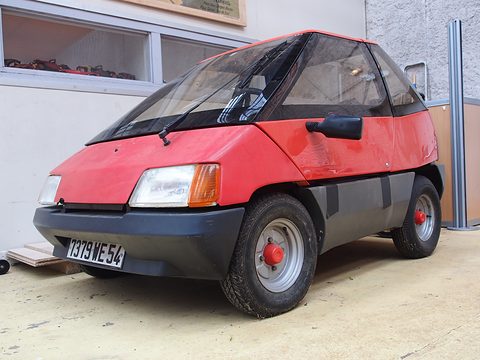
French law called such a car a cyclomoteur carrossé, a moped with a body, and that made it a licence-free car. The Minicat took the words literally.source 1 Its maker was Serge Aziosmanoff, who, the old microcarfan.com says, was known in motor racing as the creator of the GRAC racing cars of the 1970s.source 1 His firm was founded in 1978 at Chabeuil, near Valence, and the first car seems to date from that year.source 2source 1
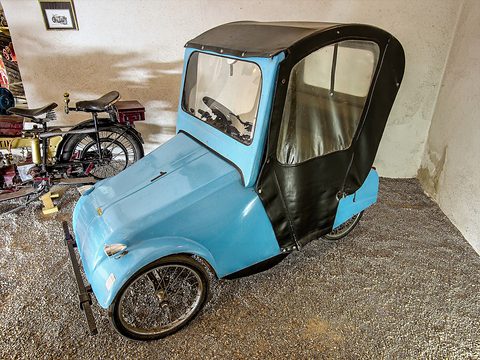
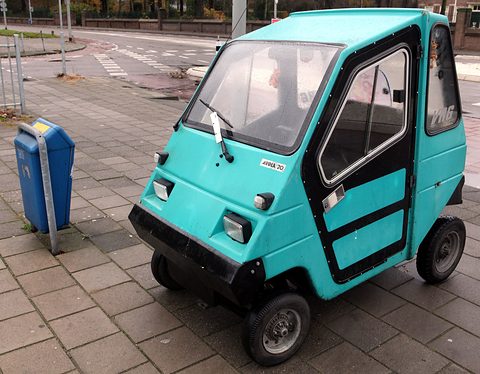
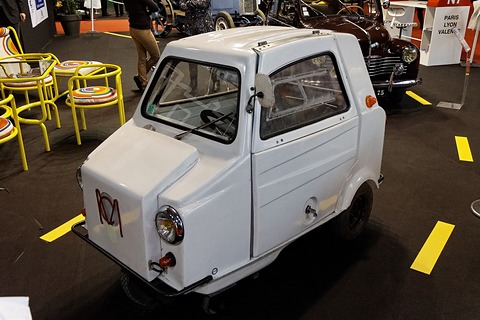
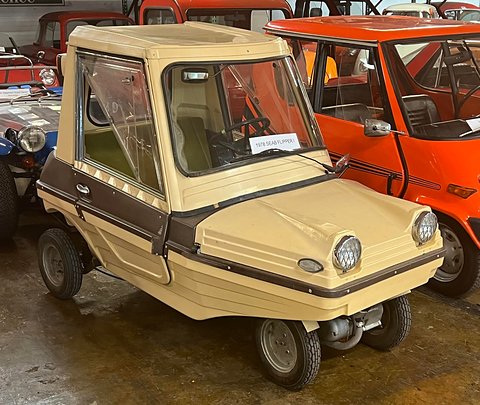
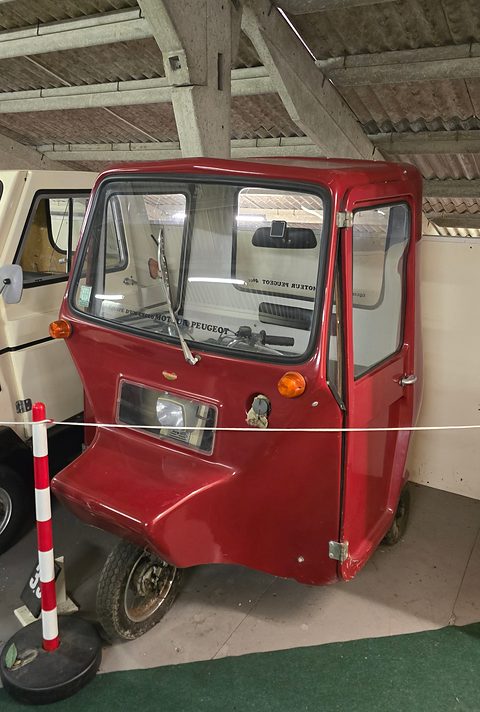
Under the polyester body was an entirely standard Peugeot GL 10 moped, its engine at the back, with two little 4-inch side wheels added like a child’s stabilisers. A sticker at the foot of the windscreen said that the car was fitted with a Peugeot moped.source 1 The moped kept its pedals, and they started the engine. A lever in the middle, with a tiny wheel on its end, lifted the car onto a stand until the rear wheel was off the ground. The driver turned on the fuel, set the choke, opened the decompressor and pedalled; pushing the lever forward set the car back down, and off it went.source 1 The side wheels meant that, unlike the moped inside it, it would not lean into corners.source 1
The German Wikipedia gives its size as 1,580 mm (5 ft 2 in) long, 1,120 mm (3 ft 8 in) wide and 1,600 mm (5 ft 3 in) high, so it was a little taller than it was long, and its weight as 125 kg (276 lb).source 2 It describes the car as a single-seat three-wheeler with one wheel at the front.source 2 The old site, whose author owned one, describes the moped’s two wheels and the two side wheels instead, and its first-hand account is the one followed here.source 1
The AZ49
A new Minicat, the AZ49, was soon announced to the specialist press and shown at the 1979 Salon. It kept a Peugeot engine, of 50 cc, but had four wheels in a conventional layout.source 1source 2 The old site found only one photograph of it, taken at the Salon; the advertisements showed a drawing. Several customers ordered one, and very few of them ever received a car.source 1 In 1980 the firm moved to Tain-l’Hermitage, and production ended that year.source 2
The German Wikipedia says that Jeanneau then took over the rights and brought similar vehicles to market under the name Microcar.source 2source 3 No French source found confirms it, and the Microcar RJ49, a front-wheel-drive two-seater, bears little obvious resemblance to a single-seat moped in a shell.
How many Minicats were made, nobody knows: the old site called the venture short-lived and obscure. It knew of at least one survivor, because it owned it.source 1