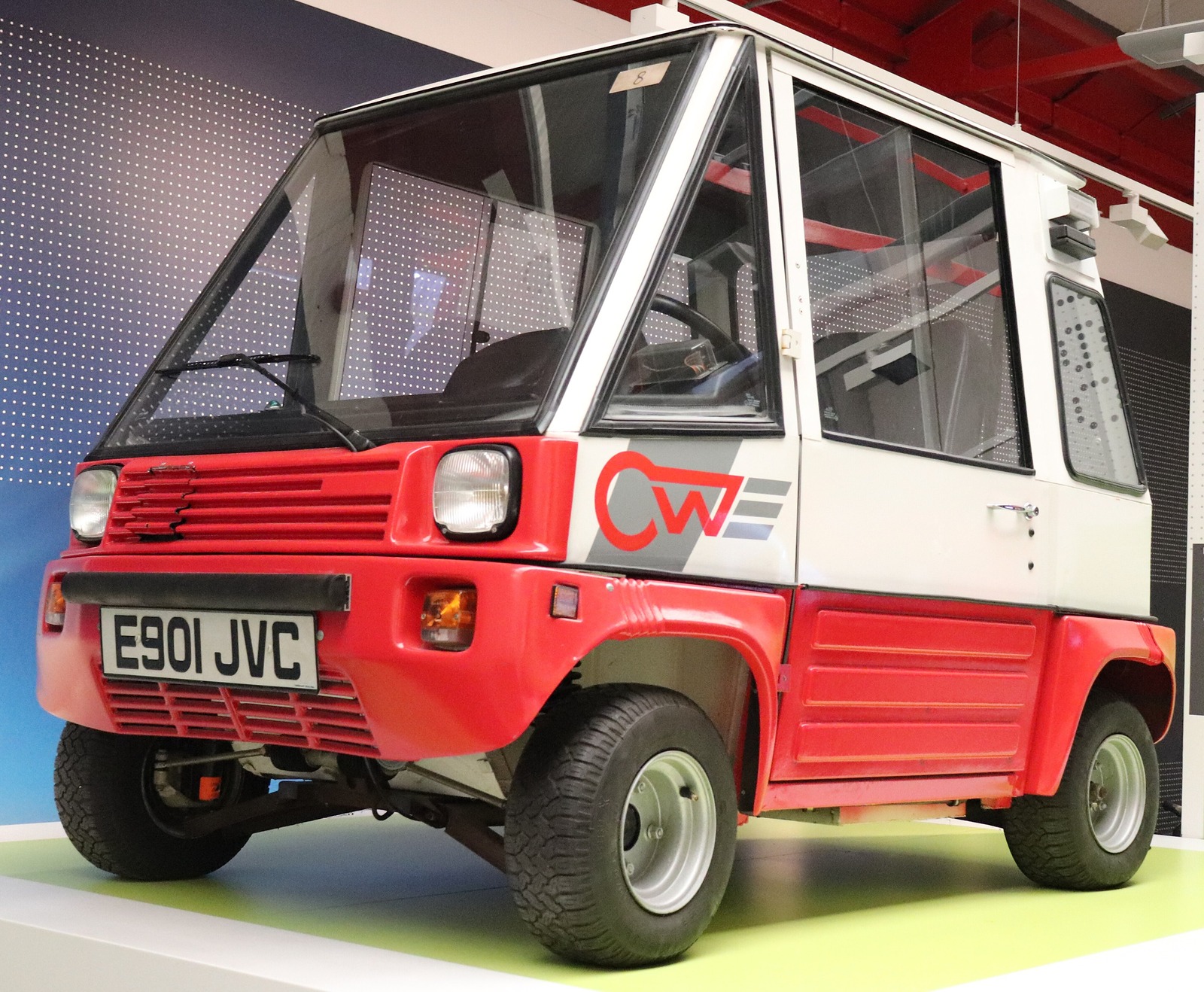
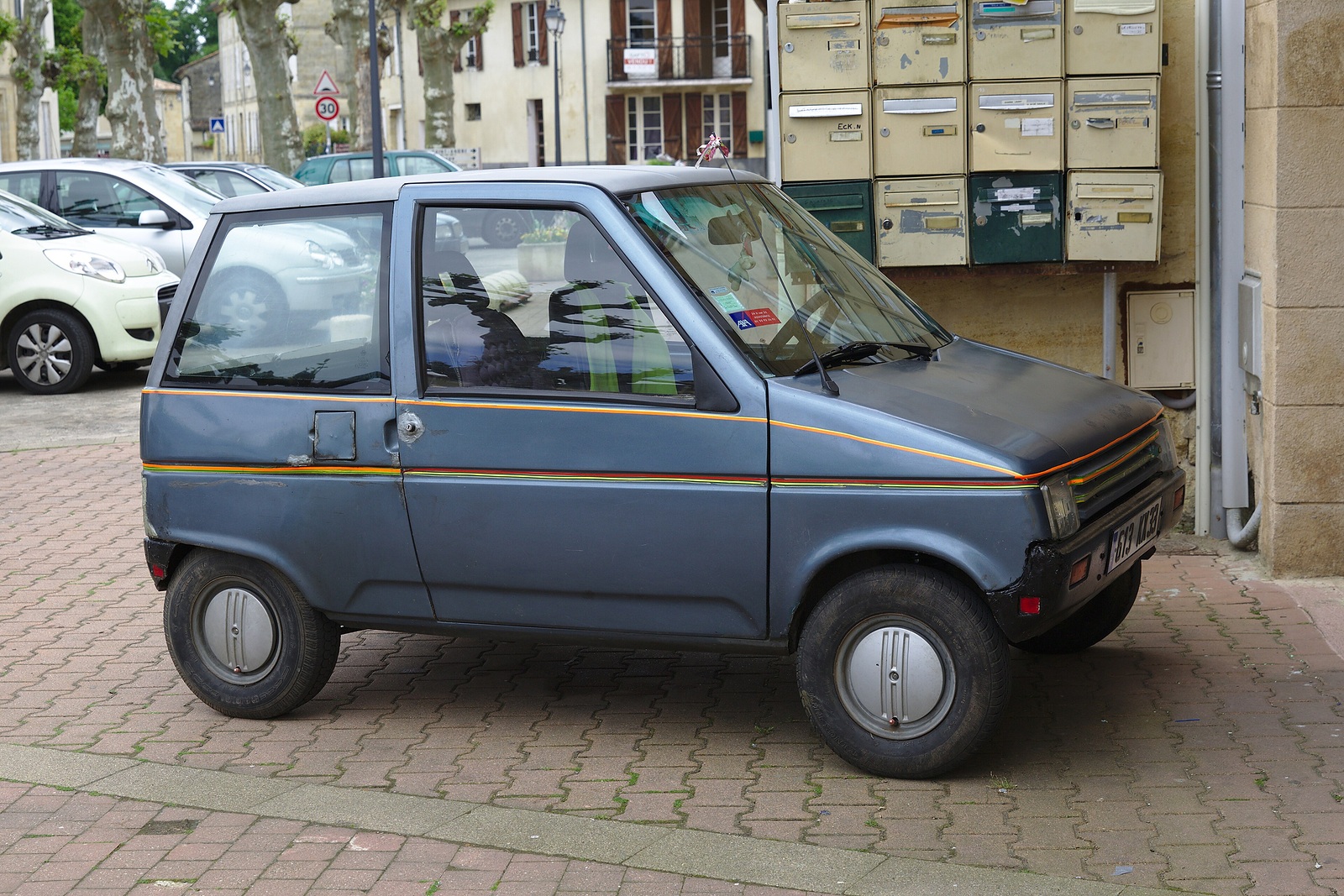
Jeanneau’s rival of October 1980, Ligier’s since 2008
Microcar RJ49
1980–1985 · France · length unknown
Its maker raced in Formula One and built cabs for Renault. In July 1980 Ligier showed a box designed round one of those cabs, with two seats, a 49 cc moped engine and a little Grand Prix glamour, and in France you needed no licence to drive it.
The spec plate
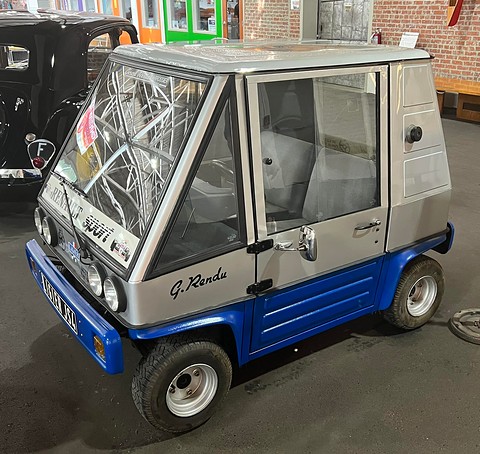
Ligier JS4
JS4 · Abrest, near Vichy
Not yet recordedweight.
True proportion
1.97 m
It is 996 mm shorter than a Fiat 500, about 1.1 adults laid end to end.
History
Guy Ligier had played rugby, raced motorcycles and driven in Formula One before he built cars of his own, from 1969 by one account and 1970 by the company’s.source 1source 2 Every one of them was called JS, in memory of his friend Jo Schlesser, who was killed in 1968.source 2source 1 A Ligier JS2 coupé finished second overall at Le Mans in 1975, and the next year Équipe Ligier began racing in Formula One.source 1source 2
After it gave up making sports cars, Ligier turned subcontractor: from 1978 it built cabs for Renault, and the JS4 was designed round one of them.source 3source 4 Which Renault cab it was is not settled. The English Wikipedia names Renault Véhicules Industriels, which built lorries; the French Wikipedia says the car was made from the cab of a farm tractor.source 3source 5 The design is credited to the stylist Robert Broyer by L’Automobile Ancienne, and to Guy’s son, Philippe Ligier, by the Lane Motor Museum. The English Wikipedia names both, and the two credits may be compatible, but no source says how.source 4source 6source 3
It was a licence-free car: under 50 cc and held to 45 km/h (28 mph), so that it could be driven with no licence at all.source 3 L’Automobile Ancienne says it was aimed at elderly country people with no driving licence, stranded as rural buses and trains were cut; the English Wikipedia adds the young and those who had lost their licence.source 4source 3 It was first shown on 25 July 1980.source 3 Ligier’s own history dates its start in licence-free cars to the same year, and the company used its Formula One name to sell them.source 2source 4
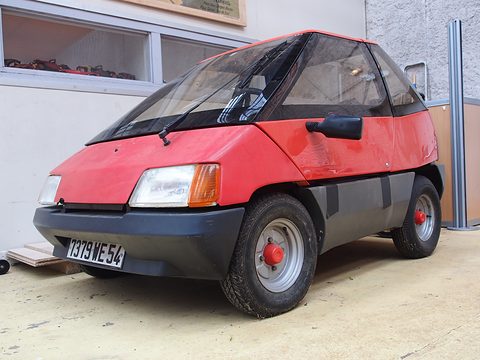
The JS4 was built more like a small car than an enclosed moped. Its body was a steel monocoque with three doors, square lines, big flat panes of glass and a glazed rear door, on a short wheelbase and, for the class, a wide track.source 3source 4 The suspension was independent all round, the steering was rack and pinion, and the tyres were unusually fat, at a time when most of its rivals ran on bicycle-type tyres.source 3source 4 Two people sat side by side.source 3 The engine, a 49 cc Motobécane 99Z two-stroke single of 3.2 hp (2.4 kW), sat at the back under the luggage floor and drove the rear wheels through a continuously variable transmission.source 3source 6source 4
It sold. In 1981, its first full year, 6,941 found buyers; the Lane museum says 7,000, and calls it France’s best-selling microcar that year.source 3source 6 Late in 1981 the range was split into Standard, Luxe and Grand Luxe.source 3source 4
The steel that made the JS4 feel solid also made it heavy, and a moped engine was asked to haul it. Drive shafts, variators and gearboxes failed under the load, and the bodies rusted where the plastic rivals did not.source 3source 4 L’Automobile Ancienne blames a lack of attention to weight, and lists an unsuitable variator, undersized drive shafts and a fragile gearbox.source 4
Ligier answered with bigger engines and more bodies. The JS8 of 1982 had a 125 cc BCB two-stroke of 7.5 hp (5.5 kW). That put it outside the licence-free rules, which the JS4 met by staying under 5 hp and 45 km/h, and its driver needed an A4 licence for tricycles and quadricycles.source 3 At the end of 1983 came the JS10, a utility 2.65 m (8 ft 8 in) long, as a pick-up or a box van, with a 430 cc diesel of 8 hp (5.9 kW), a payload of 350 kg (772 lb) and about 75 km/h (47 mph).source 3 The French post office considered it as a replacement for its large fleet of Piaggio Ape three-wheelers, and a military version was planned; no evidence has been found that either happened.source 3
For 1984 the JS6 replaced the JS4. It had a rounder nose, square headlamps and a black plastic dummy grille. The Motobécane gave way to a 49 cc Derbi D50L of 5 hp, the most the rules allowed, and a 327 cc Ducati-VM diesel of the same power was offered beside it.source 3 The trims were JS6, JS6L and JS6GL, and there was a topless JS8 “Plage” and a single-seat cargo version, the Société.source 3 L’argus counts the diesel JS6D as the second microcar in Ligier’s history.source 7
The JS8 and JS10 became the 330 and 430, by which time the petrol engines had gone. The 330 CLD had 5 hp (3.7 kW); the 430 XLD’s larger VM engine gave 10 hp (7.4 kW) and needed an A4 licence, and the truck became the 330 U and UL.source 3 A last facelift late in 1986 made the car the Ligier Série 5. It was built for about a year and then replaced by the Série 7.source 3
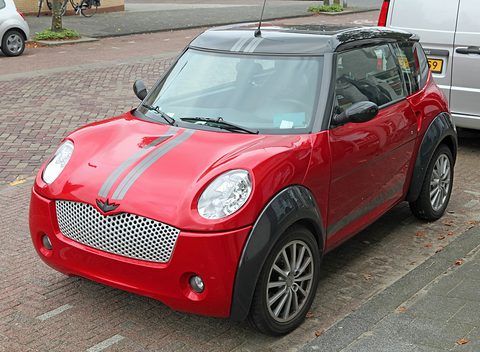
The licence-free car outlived Ligier’s racing team and became the whole business. In April 2008 Ligier, led by Philippe Ligier and backed by the private-equity fund 21 Centrale Partners, bought its old rival Microcar, the maker of the Microcar RJ49.source 1 The two companies merged as Groupe Ligier in 2014.source 1source 2 In 2009, the year after the purchase, Microcar’s European sales came to 6,124 and Ligier’s to 5,792.source 5 Today the group builds only light vehicles, among them the Ligier JS50, and is Europe’s second-largest maker of licence-free cars.source 2source 1
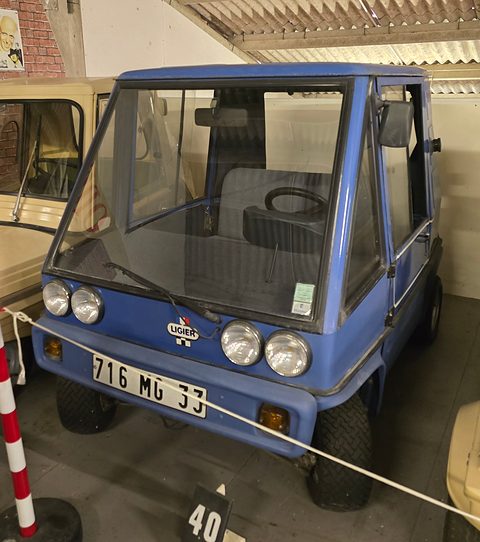
More photographs, old and new
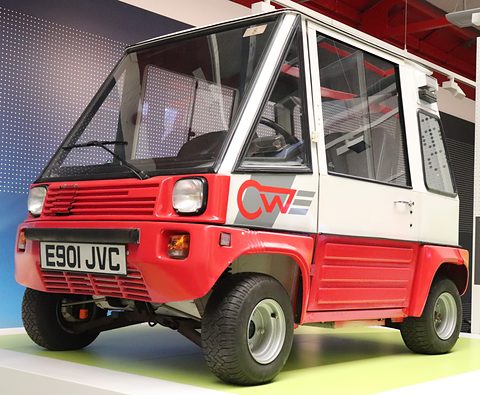
1 The 1987 Ligier JS6 City Wheels electric prototype in the Coventry Transport Museum in 2018.
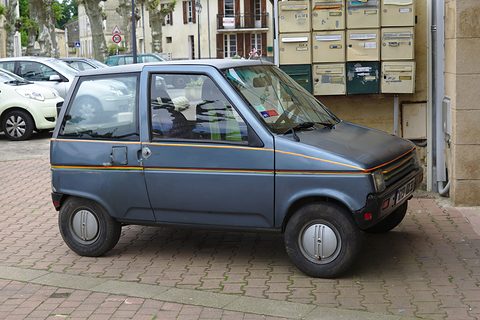
2 A grey Ligier Série 7, a later Ligier voiturette, parked in a French street in 2015.
From the JS4 to the Série 5
| Variant | Years | What differs | How many |
|---|---|---|---|
| JS4 | 1980–82 or 1983 | Steel monocoque; Motobécane 49 cc; variator | About 7,000 sold in 1981 |
| JS4 Luxe and Grand Luxe | Late 1981– | More equipment and trim | Not known |
| JS8 | 1982– | A 125 cc BCB of 7.5 hp, so a licence was needed; an open “Plage” later | Not known |
| JS10 | Late 1983– | A 2.65 m pick-up or box van, 350 kg payload; 430 cc diesel | Not known |
| JS6, JS6L, JS6GL | 1984– | Rounder nose, square lamps, dummy grille; Derbi 49 cc or Ducati-VM 327 cc diesel | Not known |
| Société | 1980s | A single-seat cargo version | Not known |
| 330 and 430 | Mid-1980s | Diesel-only JS8 and JS10; the 430 XLD needed a licence | Not known |
| Série 5 | 1986–c. 1987 | A longer front; replaced by the Série 7 | Not known |
The JS4 of 1980
| Engine | Motobécane type 99Z, single-cylinder two-stroke, 49 ccsource 3source 449.9 cc in L’Automobile Ancienne |
|---|---|
| Power | 3.2 hp (2.4 kW)source 3 |
| Transmission | Continuously variable, by variatorsource 3source 6How it reversed is not described |
| Layout | Engine at the rear under the luggage floor, rear-wheel drivesource 3source 6The Lane museum calls it mid-engined |
| Length | 1,974 mmsource 3From a catalogue the English Wikipedia cites |
|---|---|
| Width | 1,280 mm |
| Height | 1,422 mm |
| Wheelbase | 1,350 mm |
| Weight | 215 kg or 150 kgThe English Wikipedia and L’Automobile Ancienne disagree |
Every figure, with its source
About 7,000 in 19816,941 sold in 1981, its first full year, which the Lane museum gives as 7,000: the best-selling licence-free car in France that year. That single year is the one figure two sources agree on; no lifetime total is confirmed.
Three points
The first licence-free car from a Grand Prix constructor, sold on Ligier’s racing name.
Ligier designed it round one of the cabs it was building for Renault from 1978.
About 7,000 were sold in its first full year, more than any other licence-free car in France.
Today
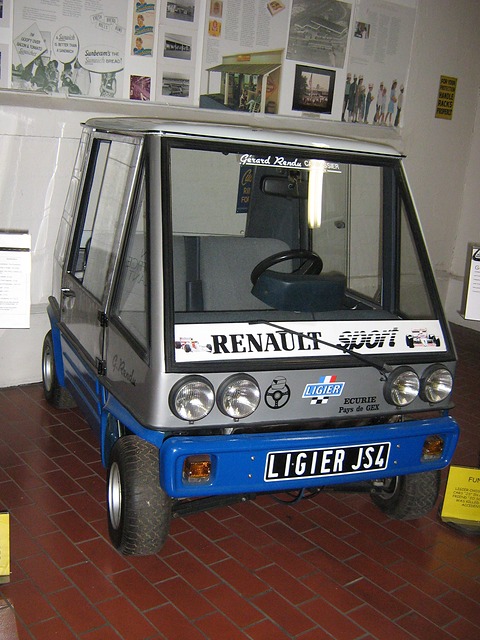
The best-known JS4 is in the collection of the Lane Motor Museum in Nashville. It is a 1980 car that served in the racing pits as part of Ligier’s Formula One fleet, and it is painted in team colours.source 3source 6 According to the museum, its roof carries the signatures of Jean Ragnotti, Jacques Laffite, Philippe Bugalski and Philippe Camandona.source 6
The later cars turn up too. A diesel JS6D sold at Artcurial in July 2012 for €2,383, and L’argus reported a 1983 JS6D with 21,000 km on the clock offered on Leboncoin for €1,500, out of a barn.source 7 No club or register has been found, and no count of survivors.
Rivals and successors
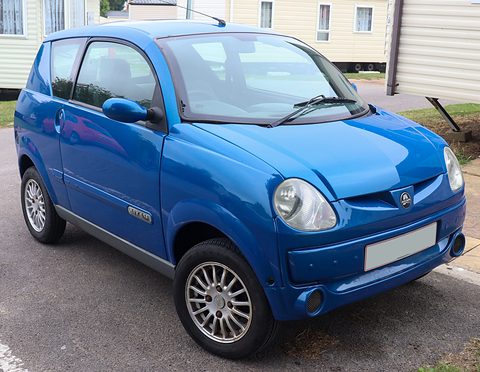
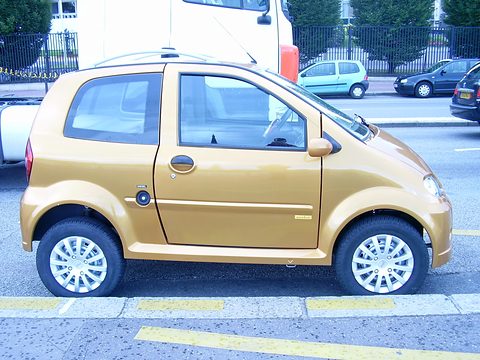
Jeanneau’s rival of October 1980, Ligier’s since 2008
1980–1985 · France · length unknown
Numbered as in the text
No period road test and no price new were found. The later models, from the JS8 to the Série 5, and the post-office and army plans, rest on the English Wikipedia alone. Sources are given as plain text; the links are on the Credits page.