The story
History
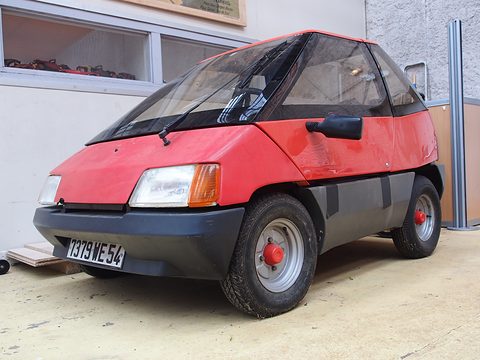
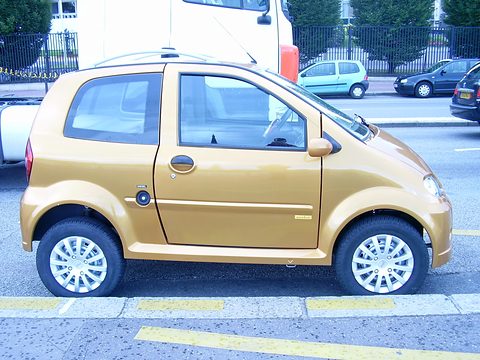
At the end of the 1970s Jeanneau, a builder of pleasure boats at Les Herbiers in the Vendée, decided to open a new line of business that would still use what it knew about polyester.source 1 The Lane Motor Museum puts it more simply: a fibreglass boat builder went into cars.source 2 The result was the RJ49, a licence-free car presented in October 1980, at the Paris Salon according to the German Wikipedia, under the name Microcar.source 1source 2source 3
Its technical adviser was Jean Rondeau, who had won the 24 Hours of Le Mans in 1980 in a car of his own make.source 1source 2 The collector behind the original microcarfan.com credited him with the car’s maturity. While its rivals were still enclosed mopeds with handlebars and cable brakes, the RJ49 was a real small car: front-wheel drive with the mechanicals easy to reach, two proper seats side by side, and a 440-litre (15.5 cu ft) boot behind them.source 1 The Lane museum notes that the boot matched a 2016 Toyota Camry’s.source 2
The German Wikipedia says Jeanneau took the design over from Serge Aziosmanoff’s Minicat and improved it.source 3source 4 That claim rests on the German Wikipedia alone, which cites encyclopaedias not seen here; the French sources read for this page do not mention it, and how much of the Minicat, if anything, lived on in the RJ49 is not known.
Glass fibre over steel
The body was polyester laminated over a metal structure.source 1source 2 The first engines were 50 cc Motobécane or Peugeot two-strokes, driving through a variator with a reverser, so that the car had both forward and reverse.source 1source 2 In April 1983 a Sachs SC50 replaced them. Its fuel pump allowed the tank to move under the floor, with a filler outside, so the owner no longer had to open the bonnet to refuel; the Lane museum adds that the change gave more room and more safety.source 1source 2
There were two trims: the RJ49E, for économique, and the RJ49S, with side stripes and chrome hubcaps.source 1source 2 Over the years four plastic 6-volt headlamps gave way to two ordinary 12-volt car lamps, of which only the dipped beam was wired, and the slotted wheels became plain ones.source 1
A family on one base
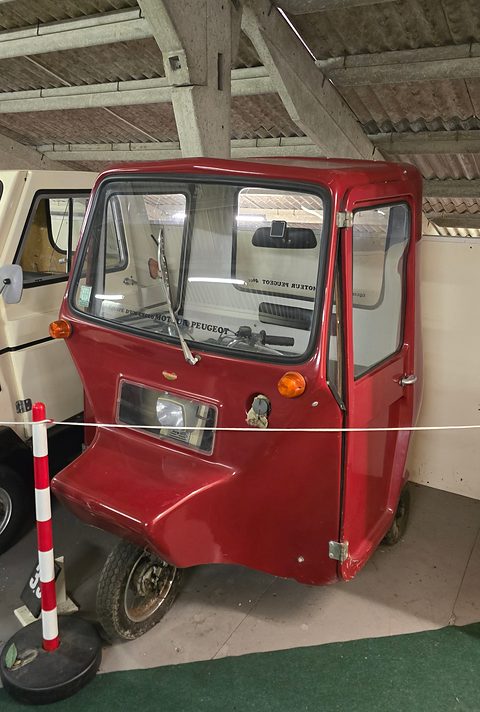
The DX49 was the same car with a different body. The old site wondered whether it was too modern for its buyers, and says fewer were built than of the RJ.source 1 For drivers with a licence there was a 125 cc Montesa version, the RJ125 or DX125: 10 hp (7.5 kW) at 6,500 rpm and 75 km/h (47 mph), with wider tyres, stronger brakes and firmer suspension.source 1source 2 A small utility van was built on the same base, as the U50, a 125 and a diesel. The Soléa, open and doorless in bright colours, was announced in 1983 and seems to have been built only for 1984.source 1
Microcar did not advertise in the motoring press. Its advertisements ran in Le Chasseur Français, Le Pèlerin and Notre Temps.source 1 The old site called the RJ49 a first attempt that proved a masterstroke, and said that first-generation cars were still to be seen on country roads, thanks to how well they were built.source 1
After the RJ
The Microcar 50 replaced it in 1984 and 1985. It kept the RJ’s basic design under a new bonnet that took in the wings and headlamps, with a 50 cc Sachs, a 125 cc Montesa or a Yanmar L40 diesel.source 1 The RJ49 ended in 1985.source 1source 2 Ligier’s company history claims that Microcar was the first to fit seat belts to licence-free cars, in 1985; the same history dates Microcar’s founding to 1982, which no other source supports.source 5 From 1987 the range was diesel only, and by then, by the old site’s count, more than 20,000 Microcars had been sold through 190 dealers.source 1source 2
The marque outlived its parent’s independence. Bénéteau took over Jeanneau, and Microcar with it, in 1995.source 3 In 1999 L’argus reported that Microcar’s share of the French market had grown from 8 per cent in January 1996 to nearly 20 per cent, with 140 staff at Les Herbiers and a new factory on the way.source 6 The new plant at Boufféré opened in 2000.source 3source 7 Ligier bought Microcar in 2008, in April or September by different accounts, and absorbed it in 2014; its later cars are on the Microcar MC1 and MC2 page.source 3source 7 The brand was dropped at the end of 2024, and the plant closed early in 2025.source 3source 7
The old site once thought the name so apt that it might become the French word for every car of the kind, as Frigidaire and Mobylette had. It never did.source 1