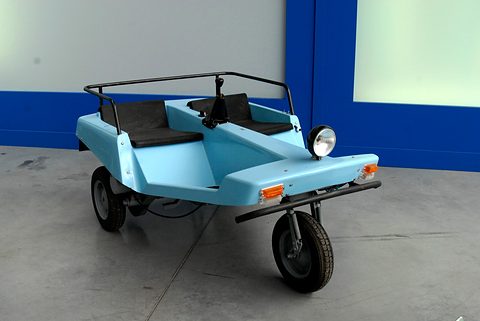
Another French electric of the early 1970s, also with EDF behind it
La Voiture Électronique Porquerolles
1968–1976 · France · 1.80 m
Also known as TVE Citadine, Teilhol voiture électrique
In 1972 Raoul Teilhol lost his driving licence for speeding. He swore he would keep on driving anyway, in a car of his own, and built an electric three-wheeler that you entered, like an Isetta, through a door in its nose.
The spec plate
Teilhol Citadine
TVE Citadine · Puy-de-Dôme
True proportion
2.12 m
It is 850 mm shorter than a Fiat 500, about 1.2 adults laid end to end, and one and a half times the length of a Peel P50.
History
Raoul Teilhol was a coachbuilder in the Puy-de-Dôme. He made trailers and bodies for utility vehicles, and he was working in polyester by the end of the 1950s.source 3 His firm was founded in 1958 as the Ateliers de Construction du Livradois, ACL, and renamed Teilhol in 1978. With Renault it built the Rodéo, Renault’s answer to Citroën’s Méhari, in Rodéo 4, 6 and 5 forms.source 4 Its main works was at Courpière, with a second at Arlanc, about 50 km away.source 3
Teilhol, by automobile-propre.com’s account, loved speed. When he lost his licence for speeding in 1972, he vowed to keep driving in an original licence-free car of his own.source 3 English Wikipedia tells the same story.source 5 A first prototype appeared that summer; English Wikipedia and Lane both say the Citadine came out in 1972, which is the prototype’s date.source 3source 5source 1 Robert Broyer, the Renault stylist responsible for the lines of the R12, worked on the design, and EDF took part in its development.source 3 A third factory, between Courpière and Arlanc, was given over to the Citadine and its utility sister.source 3
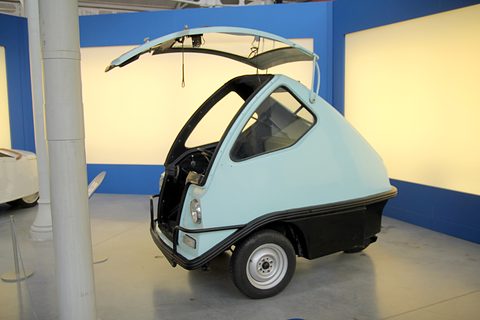
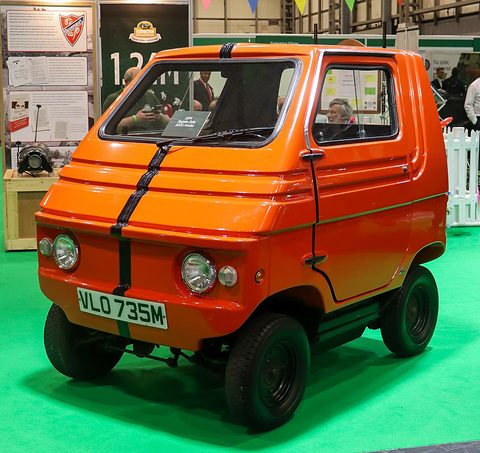
The Citadine was a three-wheeler: its two front wheels steered, and the single wheel behind was driven.source 3 Lane puts the motor in the middle at the rear, driving that wheel.source 1 The body was glass fibre bonded to a tubular frame, and it had a single door, in the nose, hinged at the top, as on the Isetta, so that you could park nose to the kerb and step straight out onto the pavement.source 3source 1 It had two seats.source 5 The batteries sat in a tunnel that kept the occupants away from their acid.source 3
It went on sale in 1974.source 3 That November L’Action Automobile et Touristique praised its acceleration and its visibility, and found its range enough for daily trips.source 3
Première fois qu’un véhicule électrique est vendu au public
That is the magazine’s claim, not a record: electric cars had been sold in France earlier, and in the war Peugeot alone made 377 of its Peugeot VLV two-seaters.source 6
What the Citadine could do depends on whom you read. automobile-propre.com, working from period documents, gives a separately excited 96 V DC motor of 4 kW by Unelec or Leroy-Somer, eight 12 V batteries weighing 275 kg (606 lb) between them, 50 km/h (31 mph) reached in 10 seconds, a range of 75 to 100 km (47–62 miles), pneumatic suspension, and 600 kg (1,323 lb) in running order with a payload of 250 kg (551 lb).source 3 In September 1977 it cost about 22,000 F, including tax.source 3 The Lane Motor Museum, describing its own car, gives 1 kW, 25 km/h (16 mph) and over half a ton, with electronic control, forward and reverse.source 1
The difference matters, because whether the Citadine was a licence-free car at all is not settled. A 25 km/h car might have qualified where a 50 km/h one probably would not, and a slow version did exist on the same platform, the Messagette.source 3source 1 That is our reading of the figures; no source says which Citadines, if any, could be driven without a licence.
The Messagette was a utility about 200 kg (441 lb) lighter, with four 12 V 88 Ah batteries and a top speed of 25 km/h, and it was sold to EDF and Air France. The Handicar had four wheels and a hydraulic platform at the back for a wheelchair.source 3 Lane mentions beach versions too.source 1
Sales of the Citadine ended in 1986.source 3 That year Teilhol filed for bankruptcy, and then worked for Citroën, lengthening C15 vans and converting AX vans, C35s and BXs. From 1987 to 1990 it built the Tangara, a leisure car on the 2CV 6, of which about 1,350 were made; it is too big for this site.source 4 The firm went into liquidation in March 1990, and in 1994 the REXIAA group bought what was left, which became Concept Composites Auvergne. Raoul Teilhol died on 18 April 2008.source 4
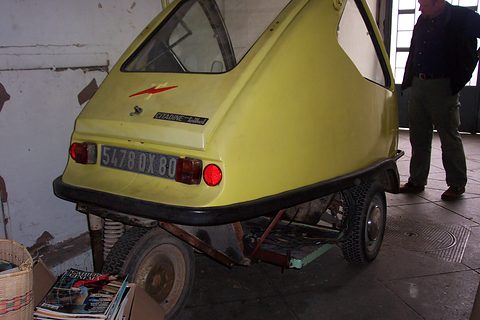
More photographs, old and new
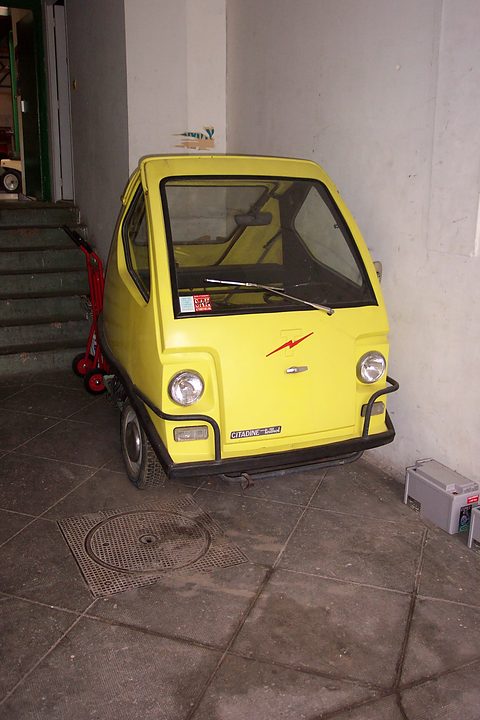
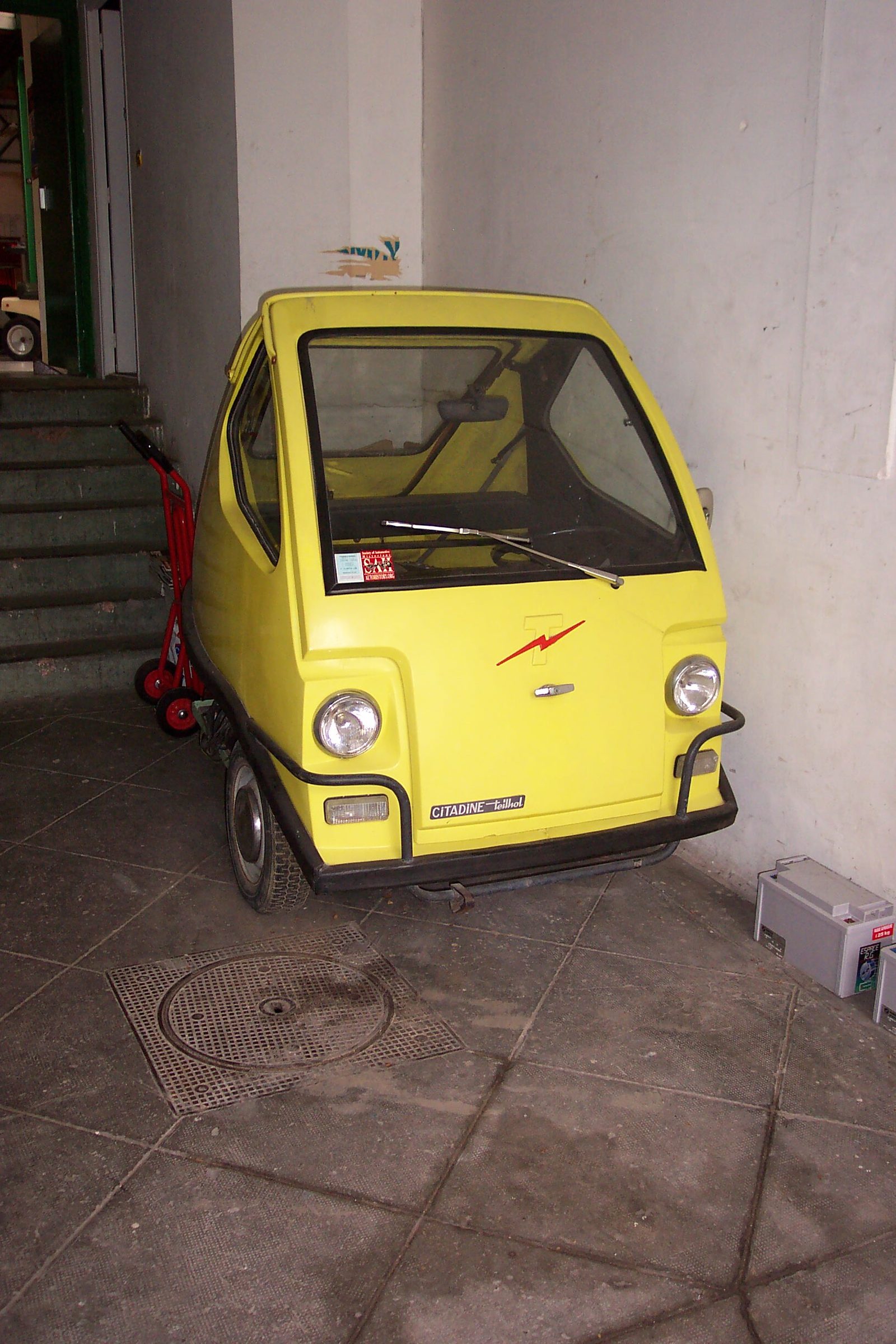
1 A yellow Teilhol Citadine from the front, parked in a Paris courtyard in 2004.
One platform, three jobs
| Variant | Years | What differs | How many |
|---|---|---|---|
| Citadine | 1974–86 | The two-seat three-wheeler with a door in the nose; prototype 1972 | About 500, or about 30source 3source 1 |
| Messagette | Not known | A utility about 200 kg lighter; four 12 V 88 Ah batteries; 25 km/h; sold to EDF and Air France | Not knownsource 3 |
| Handicar | Not known | Four wheels and a hydraulic platform at the back for a wheelchair | Not knownsource 3 |
| Beach version | Not known | Mentioned by Lane | Not knownsource 1 |
Two sets of figures: period documents, and Lane’s 1975 car in the notes
Two figures, far apart
About 500, or about 30Period documents, as summarised by automobile-propre.com, give about 500 between 1974 and 1986; the Lane Motor Museum says only around 30. No source reconciles them, so both stand.
Three points
Park nose to the kerb, lift the front, and step out onto the pavement, as from an Isetta.
Raoul Teilhol began it, by automobile-propre.com’s account, after losing his licence for speeding in 1972.
The same platform made the Messagette for EDF and Air France, and the Handicar for wheelchair users.
Today
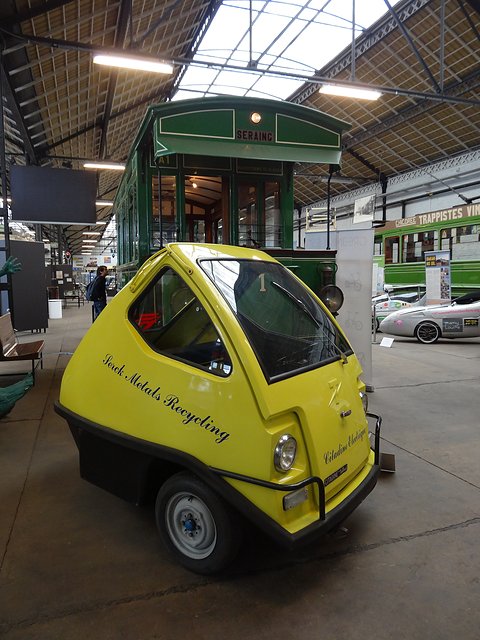
A TVE Citadine belongs to the Lane Motor Museum of Nashville,source 2 catalogued as a 1974 car and dated 1975.source 1 Among the photographs here are a Citadine shown at Châtellerault’s motor museum in 2022, one in a recycling firm’s lettering at the public-transport museum in Liège in 2013, and one in Paris in 2004. No auction results and no club have been found.
Doors in the nose, and other French electrics
Another French electric of the early 1970s, also with EDF behind it
1968–1976 · France · 1.80 m
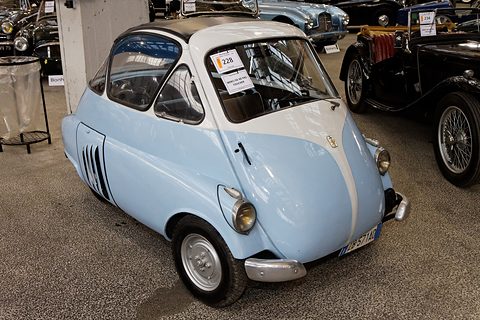
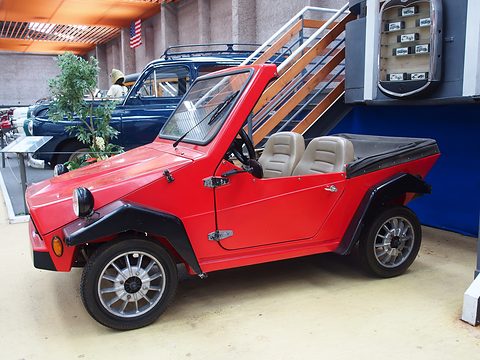
Cedre’s electric Midinette, and the small licence-free makers
1970–1994 · France · 14 makers
Numbered as in the text
Most of the car’s story rests on one article, automobile-propre.com’s, built on period documents and press; the company’s history rests on French Wikipedia. The 1974 road test itself was not read. Sources are given as plain text; the links are on the Credits page.