microcarfan
  • Microcar
  • Britain
  • Four wheels

Fairthorpe Atom

The youngest Air Vice-Marshal in the history of the RAF, who had led the wartime Pathfinders, wanted a small car for young people with sporting ambitions: 97 km/h (60 mph) and 60 miles to the gallon. It was called the Atom.

No photograph yet. No picture of the Atom has been cleared for this page. We will never draw one; when a free photograph of the car can be confirmed, it goes here.

At a glance

The spec plate

Fairthorpe Atom

Atom · Chalfont St Peter

Built
1954–⁠1957Replaced by the Atomota in 1957
Country
BritainThe Market Place, Chalfont St Peter, Buckinghamshire
Maker
Fairthorpe LtdFounded by Air Vice-Marshal Don Bennett
Engine
BSA single or Anzani twin, motorcycle type250 or 350 cc BSA, or 322 cc Anzani, by Robson; also an Excelsior two-stroke and BSAs of 249 to 650 cc in other sources
Seats
2Two to four by German Wikipedia
Wheels
4Motorcycle engine at the back, chain drive to the rear axle
Production
44By Robson; about 50 with three one-offs by another account

Not yet recordedpower, top speed, length and weight.

How big is it?

True proportion

Length unknown

No reliable length has been found. The Fiat 500, the Peel P50 and the adult stay, so the gap is shown, not hidden.

Drawn at true proportion. The track is 3.6 metres long; the adult stands at the same scale. The Peel P50 is the smallest production car, on every page for comparison.

Beside its contemporaries

The British microcars on the road in 1954, on the same 3.5 m scale. Lengths of cars without a page yet come from the census and are unverified.

  1. Bond Minicar1949–⁠1966 · Britain

    2.69 m
  2. Invacar1946–⁠1977 · Britain

    2.97 m
  3. AC Petite1953–⁠1958 · Britain

    3.12 m
  4. Reliant Regal1952–⁠1973 · Britain

    3.43 m
  5. Fairthorpe Atom1954–⁠1957 · Britain

    length unknown

The story

History

Donald Bennett (1910–⁠1986) was born in Australia, commanded the RAF’s Pathfinder Force from 1942 to 1945 and became the youngest Air Vice-Marshal it ever had. In 1945 he was a Liberal MP, for Middlesbrough West, for 73 days, and afterwards he founded Airflight, which flew in the Berlin Airlift.source 1 He designed and built light aircraft as well as cars (see aircraft makers).source 1 In 1954 he set up a factory in the middle of Chalfont St Peter, in Buckinghamshire. Fairthorpe Ltd was listed that year as a firm for development work and special machining, with Bennett as chairman and Dart Aircraft as an associate company.source 2source 3source 4

The Atom, launched in 1954, was the first Fairthorpe.source 2source 4 The owners’ club says Bennett wanted a car for younger people with sporting pretensions that would do 97 km/h and 60 miles per gallon.source 3 It was a glass-fibre coupé with a motorcycle engine at the back, a three-speed Albion motorcycle gearbox, chain drive to the rear axle, a backbone chassis, independent coil springs all round and hydraulic brakes.source 2 Which engines it had depends on whom you read. Robson lists 250 and 350 cc BSA singles and a 322 cc Anzani twin; the club names an Excelsior two-stroke and BSA engines of 250 and 650 cc; German Wikipedia gives BSAs of 249, 348 and 646 cc.source 2source 3source 5

Glass fibre was new, and, the club says, everyone was learning how to work it, Bennett included. It adds, with a pun on the name, that the Atom perhaps did not go like one. There was development work and there were export orders from America, but the car was not a great commercial success.source 3 Robson counts 44.source 2

A van on paper

A leaflet of about 1956 offered an Atom Wagonette van, 3,429 mm (11 ft 3 in) long and 1,575 mm (5 ft 2 in) wide, at £255 plus purchase tax with a manual starter, £15 more with an electric one, and up to £327 plus tax for the 3E. A differential was an extra, and 55 to 60 miles per gallon was claimed. Old Classic Car, which describes the leaflet, says the equivalent Atom cars cost about £4 more. Whether any Wagonette was built is not known.source 6

The Atomota, and after

In 1957 a new general manager, John Green, formerly of Daimler, led a redesign. The Atomota moved the engine to the front: a 646 cc BSA twin from the Golden Flash motorcycle, driving through a Standard gearbox (from the Standard 10 by one account, the Standard 8 by another) and a propeller shaft to a hypoid rear axle.source 2source 3 It was shown at Earls Court in 1957, and the last seems to have been made in 1960; how many were made is uncertain.source 3source 2 Giles Chapman later put it in his book The Worst Cars Ever Sold (2011).source 5

Fairthorpe’s future lay in kit sports cars: the Electron of 1956 and the Electron Minor of 1957, which became its mainstays, sold as kits from 1959.source 2source 3 The firm moved to Gerrards Cross in 1961 and Denham in 1964, Bennett’s son Torix joined in 1967, and it closed in the mid-1970s.source 4source 2
Russon

1951–⁠1952 · a record on this page

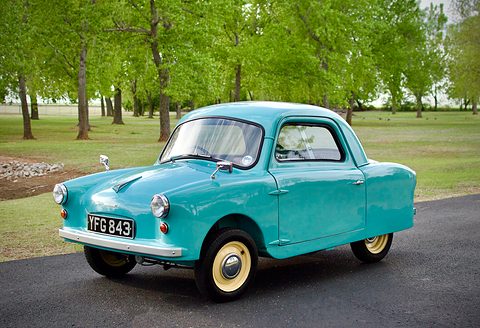
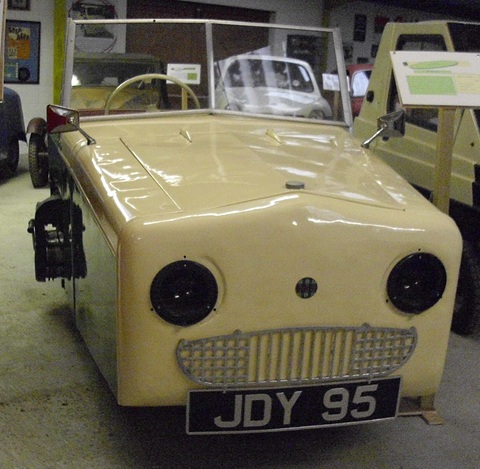
Like the Atom, the Russon came from the world of aircraft, if model ones. D. A. Russell, the editor of Aeromodeller, thought of it, and Derek Currie designed it.source 7 Russon Cars Ltd was at Eaton Bray in Bedfordshire, or at Leighton Buzzard by German Wikipedia’s account.source 7source 8 It was an open two-door car styled as a miniature Jaguar XK120, built like a coachbuilt car with aluminium panels on an ash frame over a tubular chassis, with independent coil springs all round and seats, it was claimed, for three abreast.source 7source 9 An early prototype had a 197 cc engine, a JAP by English Wikipedia’s account. The production cars had a 250 cc Excelsior two-stroke twin at the back, driving the rear wheels through a three-speed gearbox; 80 km/h (50 mph) and 65 miles per gallon were claimed.source 7source 9

The price killed it. At £491 in 1951 it cost as much as an ordinary family saloon, or a new Ford Anglia in Classic & Sports Car’s comparison, and production stopped in mid-1952 after fewer than ten cars; the magazine estimates five or six.source 7source 9 Air Vice-Marshal Bennett then bought the company’s assets as he prepared to start Fairthorpe, which is why the Russon is told here; what, if anything, of it went into the Atom is not recorded.source 7 No survivor is known.

Variants

Atom and after

The Atom and its successor
VariantYearsWhat differsHow many
Atom1954–⁠1957Rear engine, backbone chassis, independent coil springs all round44
Atom Mk 1, 2A and 3Ec.1956Price levels in a leaflet: manual or electric startNot known
Atom Wagonettec.1956A van, 3,429 mm (11 ft 3 in) long, offered in a leafletPerhaps none
Atomota1957–c.1960Engine moved to the front: a 646 cc BSA twin, a Standard gearbox and a propeller shaftNot known

How many were built?

Every figure, with its source

44 built44 Atoms, the figure in Robson’s A–Z of British Cars. A second account, seen only in summary, gives about 50 including three one-offs.

  1. about 50including three one-offs: a convertible, the Wagonette van and a narrowed carUnconfirmed

    Unique Cars and Parts, seen only as a search summarysource 10

  2. 44AtomsOne source

    Robson, A–Z British Cars 1945–⁠1980, via English Wikipediasource 2

  • Two sources agreetwo good sources give the figure
  • One sourcea good source, alone
  • Unconfirmeda lead only, not yet checked

Survivors and collecting

Today

No surviving Atom is recorded in the sources read. The Fairthorpe Sports Car Club keeps the marque’s history.source 3

Sources

Numbered as in the text

No dimensions, weight, top speed or period test of the Atom were found, and no survivor is recorded in the sources read. Sources are given as plain text; the links are on the Credits page.

  1. English Wikipedia, Don Bennett, read (the relevant sections).
  2. English Wikipedia, Fairthorpe Cars, read in full. Used as a lead; it cites Robson, A–Z British Cars 1945–⁠1980 (2006), and Sedgwick, A–Z of Cars 1945–⁠1970 (1993).
  3. Fairthorpe Sports Car Club, “Fairthorpe Limited – The vision of Air Vice Marshall Donald (Pathfinder) Bennett”, read in full.
  4. Grace’s Guide, “Fairthorpe”, read in full.
  5. German Wikipedia, Fairthorpe, read in full; it cites Hole, A–Z of Kit Cars (2012), and Chapman, The Worst Cars Ever Sold (2011).
  6. R. Jones, “Fairthorpe Wagonette”, Old Classic Car, read in full.
  7. English Wikipedia, Russon, read in full. Used as a lead; it cites Tony Marshall, Microcars (Sutton, 1999).
  8. German Wikipedia, Russon Cars, read in full; it cites Culshaw and Horrobin.
  9. Classic & Sports Car, A–Z of classics, “Russon Minicar”, read in full.
  10. Unique Cars and Parts (Australia), “Fairthorpe”, seen only as a search summary; the page could not be opened.