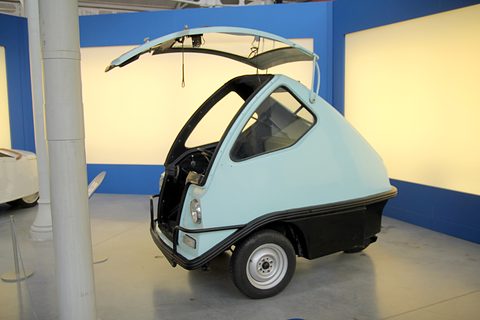
Another French electric of the early 1970s, with EDF behind it
Teilhol Citadine
1972–1986 · France · 2.12 m
Also known as Jarret Porquerolles
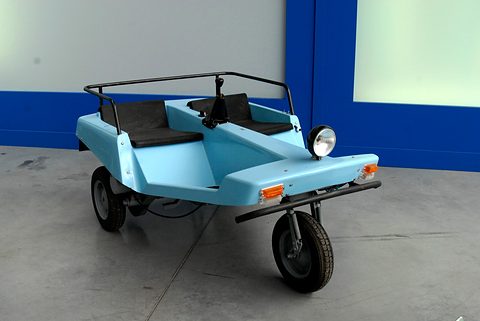
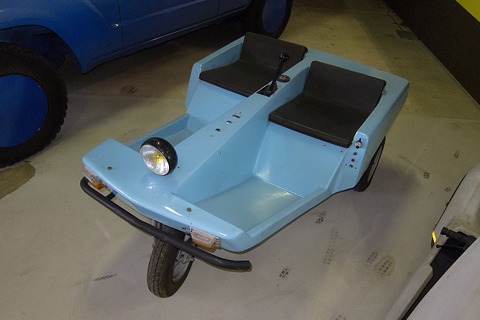
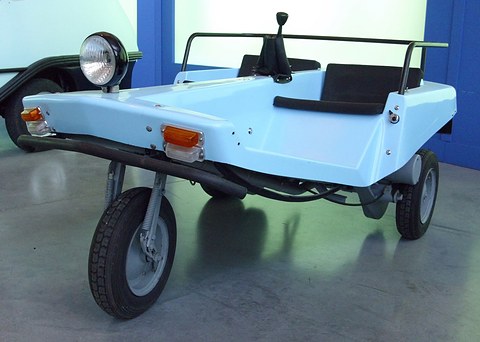
A two-seat plastic tub with no steering wheel. One stick, called the Stil by one museum, made it go, stop and turn, and the steering, by the museums’ accounts, worked by running one rear wheel faster than the other.
The spec plate
La Voiture Électronique Porquerolles
Porquerolles · Creutzwald
Not yet recordedpower.
True proportion
1.80 m
It is 1,170 mm shorter than a Fiat 500, about one adult laid end to end.
History
The brothers Jean and Jacques Jarret founded La Voiture Électronique in 1968, and showed a prototype at that year’s Paris Motor Show, where it drew a good deal of interest.source 3source 1source 4 What they had in mind, as the Weiner museum quotes the company, was a vehicle for short trips.
a revolutionary new means of locomotion adapted to the constraints of today’s lifestyle, for short hauls of 50m to 50km, for use by one or two people
The first cars were the most daring. Lane says they ran on the Jarrets’ own switched-reluctance motors, each a steel flywheel on an axle driven round by 24 magnetic coils switched on in sequence, and that only seven were made: two prototypes and five pre-production cars.source 1 The museum calls the original the first drive-by-wire vehicle ever produced. That is Lane’s superlative, and no other source used here repeats it.source 1 In 1969 the car was presented to President Georges Pompidou, and 1969 is the year both museums give their cars.source 1source 4source 5
There was no steering wheel. A single joystick governed acceleration, braking and steering; the Weiner museum calls it the Stil, the 1972 report the Stilic, and the museum says the name came from the column of classical Greece, a symbol of purity, simplicity and elegance.source 5source 4 Each of the two rear wheels had its own electric motor, driving it by chain. To turn, the two museums explain, the electronics sent more current to one motor than the other, so one wheel ran faster, and the single front wheel simply followed, like a castor.source 5source 1source 4 The two seats sat in a triangular polyester tub on a steel chassis, and the whole three-wheeler was 1,800 mm (71 in) long and 1,100 mm (43 in) wide.source 5source 3source 4
The Porquerolles itself was built from May 1972.source 3source 4 According to Lane, the series cars used conventional DC motors and mechanical steering, still worked by the joystick, and four 12 V lead-acid batteries gave them 48 V.source 1source 4 So the steering by motor speed may belong to the earliest cars rather than to every Porquerolles; the sources do not settle it. The 1972 report put the works at Creutzwald, in the Moselle, and named the shareholders: EDF, the motor maker Leroy-Somer, Sofirem and the Institut de développement industriel.source 4 German Wikipedia places the company in Paris’s 16th arrondissement.source 3 Why the car bore the name of Porquerolles, an island off Hyères, no source explains, and whether it could be driven without a licence, like the licence-free cars of the same years, has not been found either.
In August 1972 the magazine L’Automobile tested a Porquerolles, and its account is known today through a retelling on automobile-propre.com.source 4 The tester normally drove Ferraris and Maseratis. The stick took practice: on his first real start the car shot away like a rocket, zigzagging. He liked its tiny footprint, its manoeuvrability and its range, which he found acceptable, and thought it an excellent car for holiday resorts.source 4
He found plenty against it. It was too dear, at 5,960 F including tax; it gave its occupants no protection; it held its line poorly downhill; and its brakes were weak, their cables needing re-tensioning after three hours. Paris traffic, in so exposed a machine, daunted him. The maker claimed 25 km/h (16 mph), and he managed about 20 (12 mph); the report gave the range as about 50 km (31 miles), or three hours on one charge.source 4
In October 1972 came the Cab, the same car with a windscreen and, by the Weiner museum’s account, a rudimentary roof and 60 V electrics.source 3source 5 The Cob of 1973 was a small utility, 2,540 mm (100 in) long and 1,200 mm (47 in) wide, with a full body, 96 V electrics by the museum’s account, and a steering wheel: it was the only model to have one.source 5source 3 No count of either has been found. Production ended in 1976, German Wikipedia says.source 3 No account has been found of what became of the company after that, or of the Jarret brothers.
From prototype to utility
| Variant | Years | What differs | How many |
|---|---|---|---|
| Prototypes and pre-series | 1968–69 | The Jarrets’ switched-reluctance motors | 7source 1 |
| Porquerolles | 1972– | Open; conventional DC motors, 48 V; joystick control | 100, about 170 or 200source 1source 4source 5 |
| Cab | 1972– | From October 1972: a windscreen and a simple roof; 60 V by the Weiner museum | Not knownsource 3source 5 |
| Cob | 1973– | A small utility with a full body and a steering wheel; 2,540 × 1,200 mm; 96 V by the Weiner museum | Not knownsource 3source 5 |
The Porquerolles; where the sources differ, the note says so
| Motors | Two electric motors, one for each rear wheel, driving by chainsource 1source 4 |
|---|---|
| Batteries | Four 12 V lead-acid batteries, 48 Vsource 1source 4 |
| Control | One joystick for accelerating, braking and steeringsource 5source 4Called the Stil by the Weiner museum, the Stilic in the 1972 report |
| Earlier cars | The Jarrets’ switched-reluctance motorssource 1 |
| Steering | By the difference in speed between the two rear motors; the front wheel castorssource 5source 1Lane says the series cars had mechanical steering, still worked by the joysticksource 1 |
|---|---|
| Suspension | None at the front, rubber at the rear, by the Weiner museumsource 5 |
| Chassis and body | Steel chassis, polyester bodysource 5 |
| Brakes | Cable-operated, by the 1972 reportsource 4The Weiner museum calls them electronic; Lane mentions a mechanical handbrakesource 5source 1 |
| Seats | 2source 5source 3 |
| Top speed | 25 km/h (16 mph) claimed; about 20 km/h (12 mph) in the 1972 testsource 4German Wikipedia gives 24 km/h, the Weiner museum 30 km/h and Lane about 18 mphsource 3source 5source 1 |
|---|---|
| Range | About 50 km (31 miles), or three hours on a chargesource 4German Wikipedia gives 64 kmsource 3 |
| Price new | 5,960 F including tax, 1972source 4 |
Every figure, with its source
100 to 200 builtThree figures are given for the Porquerolles. We lean towards about 170, because it comes from a retelling of a period article and is the most specific, but that is a judgement, not a settled count, and the range runs from 100 to 200.
200PorquerollesOne source
the Bruce Weiner Microcar Museumsource 5
about 170Porquerolles, built from May 1972One source
automobile-propre.com, retelling the 1972 L’Automobile reportsource 4
100Porquerolles, 1969–72One source
the Lane Motor Museumsource 1
7two prototypes and five pre-production cars before itOne source
the Lane Motor Museumsource 1
Three points
A single joystick worked the accelerator, the brakes and the steering; there was no wheel to turn.
By the museums’ accounts it turned by running one rear motor faster than the other; Lane gives the series cars mechanical steering.
The car was presented to Georges Pompidou in 1969; by 1972 EDF and Leroy-Somer were among the firm’s shareholders.
Today
Nashville’s Lane Motor Museum owns one, catalogued as a Jarret La Voiture Electronique of 1969.source 2source 1 The Bruce Weiner Microcar Museum showed a 1969 Porquerolles (see museums and meets).source 5 In the photographs here, one stands at the Musée auto-moto-vélo in Châtellerault and another at Autoworld in Brussels. No other survivors, auction results or club have been found.
France’s other early electrics
Another French electric of the early 1970s, with EDF behind it
1972–1986 · France · 2.12 m
Cedre’s electric Midinette came later in the decade
1970–1994 · France · 14 makers
Numbered as in the text
Most of the story rests on two museum pages and on one modern retelling of the 1972 road test, whose original text was not read. Nothing was found on the company’s end or on the Jarret brothers’ later careers. Sources are given as plain text; the links are on the Credits page.