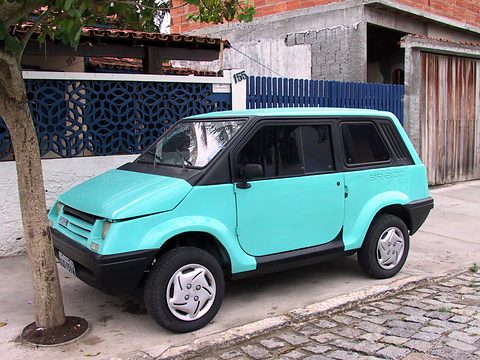
microcarfan
  • Electric microcar
  • Brazil
  • Four wheels
  • Battery electric

Gurgel Itaipu E150

Also known as Itaipu E‑150, Gurgel Itaipu

In 1974 a Brazilian engineer showed a little wedge of glass fibre at the São Paulo motor show and named it after the Itaipu dam, then being built on the border with Paraguay. It ran on ten 12-volt batteries, and he meant every one of his cars to have its own parking place with a charging post.

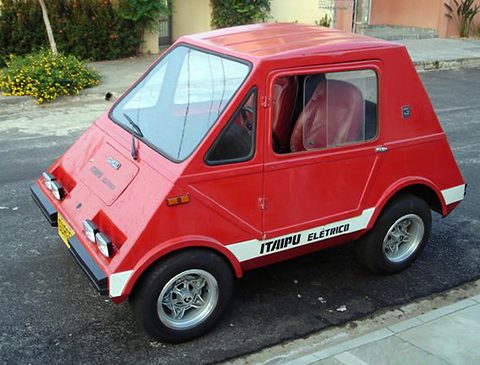
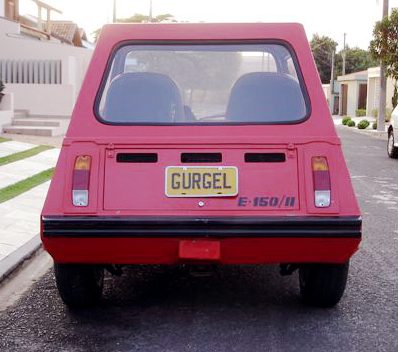
A small red angular car with a large flat windscreen, square headlamps and a white ITAIPU ELÉTRICO sill stripe.
Red Gurgel Itaipu E150 electric car from the front quarter, parked in a street in Brazil.Photo: Marcelo Bezerra Cavalcanti, edited by Mr.choppers, CC BY 3.0, via Wikimedia Commons

At a glance

The spec plate

Gurgel Itaipu E150

Pre-series electric · São Paulo

Built
1974–⁠1976Shown in 1974; a few pre-series cars, never sold to the public
Country
BrazilGurgel of São Paulo; to be built at Rio Claro
Maker
GurgelJoão Augusto Conrado do Amaral Gurgel’s company
Engine
Compound-wound DC electric motor120 volts, from ten 12-volt lead-acid batteries
Power
3 kW4.2 hp
Length
2,650 mm1,400 mm wide, 1,450 mm high
Weight
780 kgWith 320 kg of batteries; 460 kg without them
Seats
2
Wheels
4Electric motor under the middle of the car, driving the rear wheels
Price new
Cr$22,577Planned: a VW Fusca 1300’s price in December 1974
Production
About 20 to 27Pre-series cars; never sold to the public
Top speed
60km/h60 km/hThe prototype 30 km/h

How big is it?

True proportion

2.65 m

It is 320 mm shorter than a Fiat 500, about 1.5 adults laid end to end, and twice the length of a Peel P50.

  • 1.40 m wide
  • 780 kg: about ten adults
  • About a metre of luggage space behind the seats
  • Batteries weighing 320 kg (705 lb)
Drawn at true proportion. The track is 3.6 metres long; the adult stands at the same scale. The Peel P50 is the smallest production car, on every page for comparison.

The story

History

João Augusto Conrado do Amaral Gurgel, a mechanical and electrical engineer, opened his company in São Paulo on 1 September 1969, and that month put his first car, the Ipanema buggy, on sale.source 1source 2 The oil crisis of 1973 brought shortages and price rises, and in 1974 Gurgel finished an electric car.source 2 It was shown at that year’s São Paulo Salão do Automóvel, and it was the first electric car developed in Latin America.source 3source 4source 2source 1 He named it Itaipu, after the hydro-electric dam then under construction on the border of Brazil and Paraguay.source 3source 2source 1

It was a two-seater with two doors and a trapezoidal body of glass fibre on Plasteel, Gurgel’s patented frame of glass fibre and steel tubes, 2,650 mm (104 in) long, 1,400 mm (55 in) across.source 2source 5 Quatro Rodas later said that it would have been called a micro-MPV, had the term existed.source 2 A compound-wound DC motor of 3 kW (4.2 hp), mounted lengthways under the middle of the car, drove the rear wheels through a single reduction gear; a lever beside the wheel chose forward, neutral or reverse.source 2source 5 Ten 12-volt lead-acid batteries in series gave it 120 volts. They weighed 320 kg (705 lb), and the whole car 780 kg (1,720 lb).source 3source 5 The dashboard had a speedometer in the middle, an ammeter on one side and a voltmeter on the other.source 2

A car with its own charging post

Quatro Rodas drove the prototype in January 1975. It had a three-spoke sports steering wheel and magnesium wheels, three batteries in front, two behind the seats and five at the back, and it would do 30 km/h (19 mph).source 2 Gurgel’s plan went beyond the car. From June 1975 a fleet of 20 would run on the streets of Rio Claro, where his factory was, to test the car and a system to go with it: each car would have its own parking space, with a small post carrying its charging socket.source 2 Pesquisa FAPESP adds that he meant to rent the cars out from charging points around the town.source 6 Series production was to start in December 1975, at the price of a Volkswagen Fusca 1300, which in December 1974 was Cr$22,577.source 2

The later cars carried their batteries behind the seats and under the floor, with a separate 12-volt battery in front for the lights, and reached 60 km/h (37 mph).source 3source 2source 5 A full charge took ten hours.source 2source 1source 5 In 2007 the owner of a surviving car told Quatro Rodas that it went 60 to 80 km on a charge; Autoesporte gives 50 km.source 2source 1 Its tester found it impressively silent, easy to manoeuvre and steady under braking, at about 50 km/h, though the fixed seats made it awkward to get in.source 2 An electrical engineer from the Gurgel club explained why the motor’s two field windings suited it: the series winding gave strong pulling from rest, the shunt winding even control of speed.source 2

Never on sale

It never went on general sale. The weight of the batteries, their small capacity and the ten-hour charge kept it a pre-series car: Autoesporte calls these problems that still exist today. The federal government did not back battery development, and Gurgel gave up electric cars.source 2source 1 About twenty pre-series cars were built by English Wikipedia’s account, or 27 by Autoesporte’s; both say they are now collectors’ items.source 3source 1 The Itaipu name came back on the larger E400 electric van of the early 1980s, used by power and telephone companies, which became the basis of Gurgel’s G800 van.source 3source 2source 1source 6

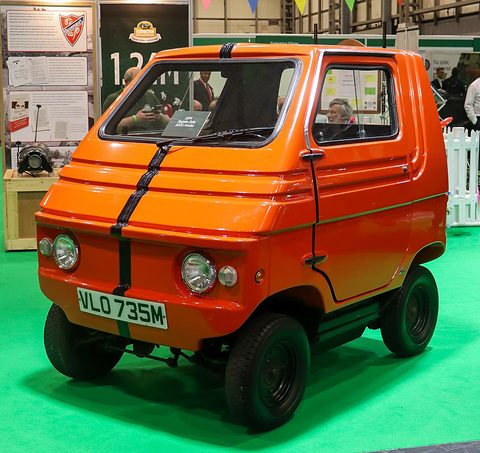
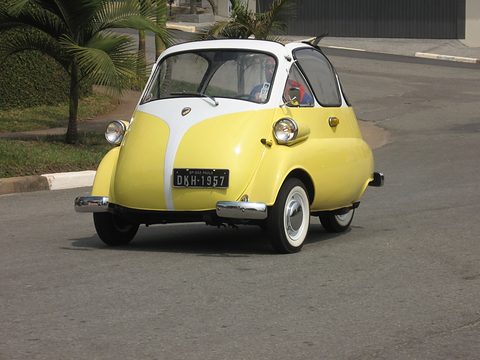
Gurgel himself went on to the BR-800; as a student he had wanted to design a popular car for his final project.source 6 Over 27 years his firm sold about 30,000 vehicles and exported about 4,000 to more than 40 countries, and he liked to call it not multinacional but muitonacional, “very national”, for its wholly Brazilian capital; it went bankrupt in 1994.source 1source 6 The Itaipu belongs to the third wave of electric microcars, the one set off by the oil crisis, alongside the American CitiCar and the Italian Zagato Zele.
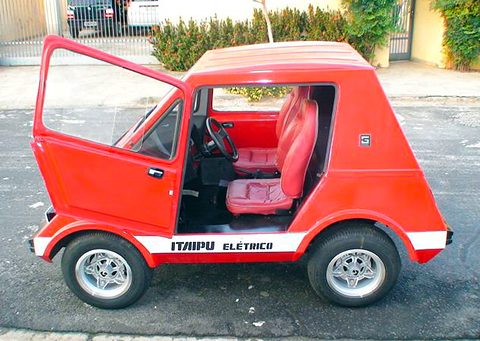
Side view of a small red trapezoid-shaped car with its large door open, red seats inside and ITAIPU ELÉTRICO on the sill.
A red Itaipu E150 in profile with its door open on the red seats and plain dashboard, in a street in Brazil.Photo: Marcelo Bezerra Cavalcanti, edited by Mr.choppers, CC BY 3.0, via Wikimedia Commons

Pictures

More photographs, old and new

Variants

Prototype and pre-series

Gurgel Itaipu E150, 1974–⁠76
VariantYearsWhat differsHow many
Prototype1974–⁠75Batteries in front, behind the seats and at the back; a three-spoke wheel; 30 km/h—
Itaipu E1501975–⁠76Batteries behind the seats and under the floor, a separate 12-volt battery for the lights; 60 km/hAbout 20, or 27

Specification

From the Gurgel 800 site’s data sheet and Quatro Rodas

Motor and drive

Motor and drive
MotorCompound-wound DC, 3,000 W at 120 V, 4.2 hp, lengthways under the middle of the carsource 2source 53.2 kW by Autoesporte
ControlElectronic chopper, 2–120 Vsource 5
TransmissionOne speed, reduction 1:4.35; a forward, neutral and reverse lever beside the wheelsource 2source 5
BatteriesTen 12 V lead-acid, 84 Ah; a 12 V, 36 Ah battery for the lightssource 2source 5
Charging10 hours from empty; 2 h 30 min from half fullsource 5source 2

Body and chassis

Body and chassis
StructurePlasteel, Gurgel’s patent: glass fibre with steel tubes; two doors, two seatssource 2source 5
SuspensionFront: MacPherson struts and coil springs; rear: torsion barssource 2source 5
BrakesHydraulic drums all roundsource 2source 5
WheelsMagnesium, 13 × 6 in; tyres 165 × 13source 2source 5

Dimensions

Dimensions
Length2,650 mm (104 in)source 2source 5
Width1,400 mm (55 in)source 2source 5
Height1,450 mm (57 in)source 2source 5
Wheelbase1,620 mm (64 in)source 2source 5
Weight780 kg (1,720 lb): 460 kg of car and 320 kg of batteriessource 3source 5Autoesporte reads it as 460 kg in all

Performance and running

Performance and running
Top speed30 km/h (19 mph) for the prototype; 60 km/h (37 mph) for the later carssource 3source 5
Range60–80 km by the owner of a survivor in 2007; 50 km by Autoesportesource 2source 1
Price, plannedCr$22,577, December 1974source 2

How many were built?

A pre-series, never sold

About 20 to 27 builtOnly a pre-series was made, and none was sold to the public. English Wikipedia, citing Quatro Rodas, says about twenty; Autoesporte says 27. Neither figure can be preferred on the evidence read.

  1. 27cars made, now collectors’ itemsOne source

    Autoesporte, 2021source 1

  2. about 20pre-series carsOne source

    English Wikipedia, citing Quatro Rodas, 2007source 3

  • Two sources agreetwo good sources give the figure
  • One sourcea good source, alone
  • Unconfirmeda lead only, not yet checked

Famous for

Three points

  1. Latin America’s first electric car

    Developed by João Gurgel and shown at São Paulo in 1974.source 3source 2

  2. Parking and charging

    Each car was to have its own space and charging post, and to be rented out.source 2source 6

  3. Named for a dam

    Itaipu, the hydro-electric dam on the Brazil–Paraguay border.source 3source 2

Survivors and collecting

Today

No count of survivors has been found, though English Wikipedia and Autoesporte both describe the cars as collectors’ items.source 3source 1 In 2007 Quatro Rodas photographed and drove one belonging to an industrialist in the interior of São Paulo state.source 2 Gurgel owners are looked after by the GurgelClube and the BR800 group.source 3source 2 No auction results have been found.

Sources

Numbered as in the text

The history rests mainly on Quatro Rodas’s look back of April 2007, which summarises its own drive of the prototype in January 1975 (not read in the original), on Autoesporte (2021) and on the data sheet of the Gurgel 800 enthusiasts’ site. Sources are given as plain text; the links are on the Credits page.

  1. Autoesporte, “Gurgel Itaipu foi o primeiro carro elétrico nacional, mas morreu por problemas que existem até hoje”, 2 April 2021, updated 18 April 2024, read in full.
  2. Fabiano Pereira, “Clássicos: Grandes Brasileiros: Gurgel Itaipu”, Quatro Rodas, April 2007, archived copy, read in full.
  3. English Wikipedia, Gurgel Itaipu, revision of 17 February 2024, read in full. Used as a lead; it cites Quatro Rodas (April 2007) and the Gurgel 800 site.
  4. Portuguese Wikipedia, Gurgel Itaipu, read in full.
  5. Gurgel 800 (an enthusiasts’ site), “Especificações técnicas do Gurgel Itaipu”, archived copy of 2010, read in full.
  6. Pesquisa FAPESP no. 362, April 2026, “Há 70 anos nascia o primeiro carro brasileiro”, the Gurgel sections read in full.