microcarfan
  • Microcar
  • Spain
  • Four wheels
  • Open two-seater

PTV 250

Also known as PTV, AUSA PTV

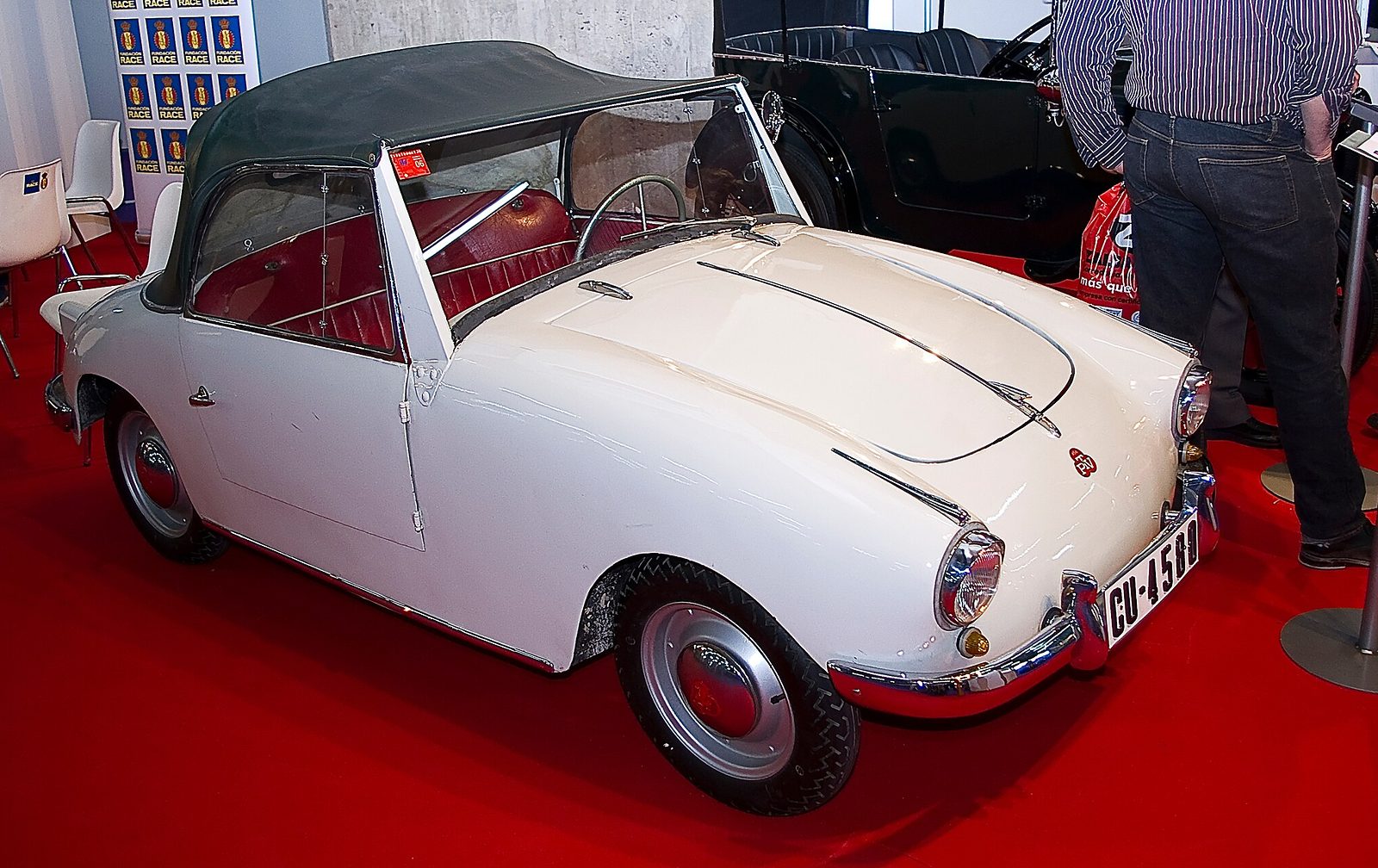
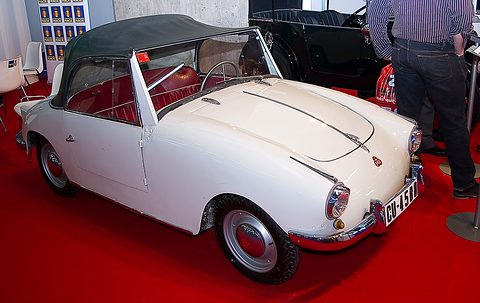
Of Spain’s four best-selling microcars, two were foreign designs built under licence. The PTV was Catalan from its tubular frame to its two-stroke engine, it came in two-tone paint with chrome, and its maker survived it by building dumpers.

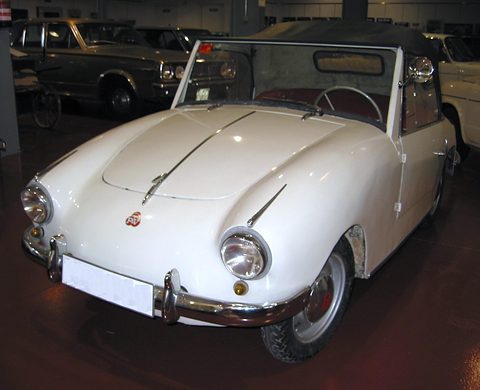
White open two-seater with chrome bumpers, round headlamps and a creased bonnet, seen from the front left, older cars behind.
A white PTV 250 with doors and a black hood, on display in a museum in 2009.Photo: Buch-t, Public domain, via Wikimedia Commons

At a glance

The spec plate

PTV 250

PTV 250 · Manresa

Built
1956–⁠1961Company founded on 4 May 1956
Country
SpainAutomóviles Utilitarios S.A. (AUSA), Manresa, Catalonia
Maker
Automóviles Utilitarios S.A. (AUSA), ManresaNamed from its founders: Perramon, Tachó and Vila
Engine
247 cc AUSA two-stroke singleMounted across the car at the back
Power
11 CVAt 4,500 rpm; the Weiner museum gives 13 hp
Length
2,950 mm1,320 mm wide, 1,250 mm high
Weight
330 kgBy the Spanish sources; 320 kg by the Weiner museum
Seats
2“2/3 seats” in the advertising
Wheels
4Engine across the tail, driving the rear wheels
Price new
44,500–55,000 pesetas
Production
about 1,1001,235 or 1,325 by the local club’s bulletin
Top speed
75km/h75 km/h47 mph; the Weiner museum’s 95 km/h is out of line

How big is it?

True proportion

2.95 m

It is 20 mm shorter than a Fiat 500, about 1.7 adults laid end to end.

  • 1.32 m wide
  • 330 kg: about four adults
  • Two seats, open, with or without doors
Drawn at true proportion. The track is 3.6 metres long; the adult stands at the same scale. The Peel P50 is the smallest production car, on every page for comparison.

The story

History

Guillem Tachó of Manresa, in the province of Barcelona, built one-off cars of his own first: “La Ballena”, the whale, in 1950, and “El Coca” in 1953. The second gave him the idea of a microcar in series.source 1source 2 On 4 May 1956 he and his brother Antoni founded Automóviles Utilitarios, S.A., AUSA for short, with Maurici Perramon and Josep Vila, and the car took its name from three of the surnames: Perramon, Tachó, Vila.source 1source 2 The Spanish sources write the founders’ names in Castilian, as Guillermo, Antonio and Mauricio Perramón; the Catalan ones use the forms here.

The car took about two years to develop. The prototype of 1956 had AUSA’s own 250 cc engine, with an alloy piston and cylinder head.source 3 In production it was a 247 cc two-stroke single of 11 CV, mounted across the tail and driving the rear wheels, under an open steel body on a tubular frame, with or without doors.source 1source 2 At 2,950 mm (9 ft 8 in) it was only just shorter than a Fiat Nuova 500, the car this site measures every microcar against.source 1source 2 It was shown on a stand at the Barcelona trade fair, the Feria de Muestras, and it cost 44,500 to 55,000 pesetas.source 1source 2

A step above the Biscúter

Doors, two-tone paint, chrome and 12-inch wheels aimed the PTV at buyers who wanted more than a Biscúter. The Weiner museum notes that with independent front suspension, big wheels and an enclosed body, the PTV even allowed some talk of comfort, which a Biscúter did not.source 3 It is remembered as the best-looking of Spain’s home-grown microcars, especially in two-tone paint.source 1source 2 It sold across Spain, and Spanish Wikipedia counts the exports: 18 cars to Portugal, one to the United States and one to an Arab sheikh.source 1 Bumpers and other extras were added over the years.source 3

AUSA also built 45 commercial vehicles on the 250 between 1959 and 1961, though with the engine at the back there was little room for a load. A van prototype with its engine at the front stayed a one-off, and AUSA used it as a works vehicle for years.source 1source 2 In 1960 came the PTV 400, longer, with a supercharged two-stroke twin of 396.83 cc and 19 CV for 110 km/h (68 mph). It stayed a prototype: it was ready just as the SEAT 600 arrived.source 1source 2 A 350 cc engine was also planned, but it never went into production.source 3

The micro-killer

The SEAT 600, known in Spain as the micro-killer, overwhelmed it.source 1source 2source 3 Production stopped in 1961. By the Weiner museum’s reckoning the PTV had been Spain’s second-biggest-selling microcar, after the Biscúter; the Spanish sources put it fourth, behind the Biscúter, the Spanish Goggomobil and the Spanish Isetta.source 3source 1source 2 Both can be true, if it was second among cars designed in Spain and fourth once licence-built foreign designs are counted; that reading is ours. Its smaller countrymen are on the page of Spanish microcars.

AUSA did not close. Around 1961 it built a tipping tricycle, which led to its famous Dumper, and it became a world leader in site dumpers and forklifts under three tonnes.source 1source 2source 3
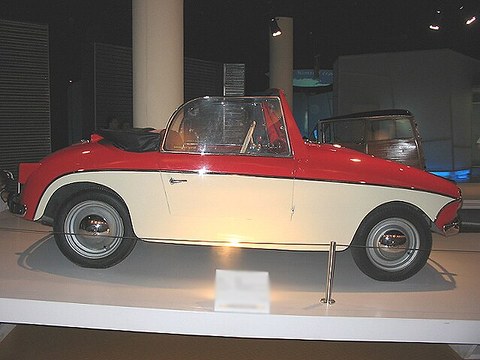
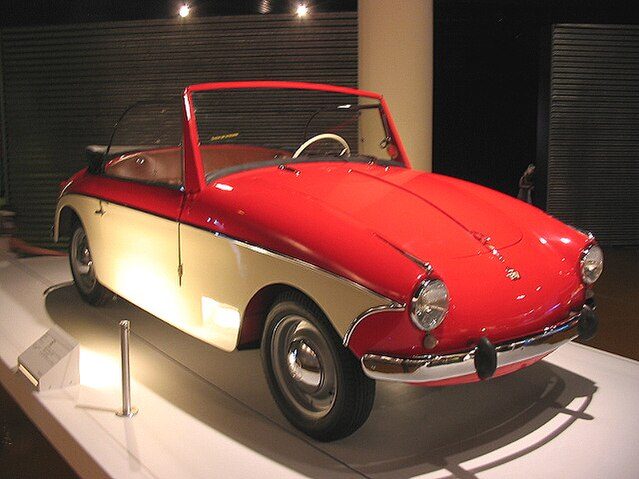
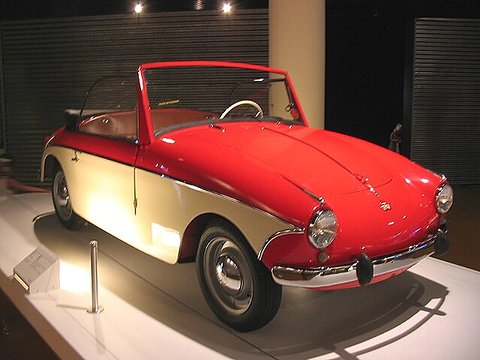
Side view of a small red open car with a cream lower body and chrome wheel discs on a white plinth.
A red and cream PTV 250 with doors, in profile on a museum plinth in 2004.Photo: Pablo Alberto Salguero Quiles, CC BY-SA 3.0, via Wikimedia Commons
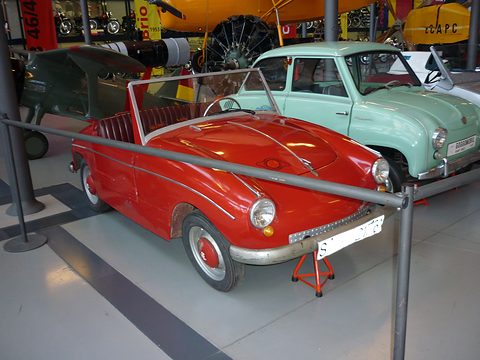
Red open two-seater without doors, low windscreen and red seats, behind a steel rail beside a pale green Goggomobil.
A doorless PTV 250 at the MNACTEC museum in Terrassa, Catalonia, in 2012.Photo: Peprovira, CC BY-SA 3.0, via Wikimedia Commons

Pictures

More photographs, old and new

Variants

Doors, no doors, and two that never were

The PTV family
VariantYearsWhat differsHow many
PTV 250 with doors1956–⁠1961Doors, chrome, often two-toneIn about 1,100
PTV 250 without doors1956–⁠1961Doorless open two-seaterIn about 1,100
Commercials1959–⁠1961Load-carriers on the 250; little room, with the engine at the back45
Front-engined vanPrototypeEngine at the front for a proper load space; used by AUSA for yearsOne
PTV 4001960Supercharged 396.83 cc twin, 19 CV, 110 km/h; 3,260 mm longOne prototype

Specification

From the club’s bulletin, via grupo7.com, unless noted

Engine and drive

Engine and drive
EngineSingle-cylinder two-stroke, mounted across the car at the backsource 1source 2
Capacity247 cc (66 × 72 mm), compression 6.2:1source 1source 2
Power11 CV at 4,500 rpmsource 1source 213 hp by the Weiner museum
CarburettorTachó, single choke, 22 mmsource 2
Clutch and gearboxMulti-plate clutch in oil; three speeds and reversesource 2source 3
Electrics12 V, with a dynastartersource 2

Body and chassis

Body and chassis
Frame and bodySteel body on a tubular steel framesource 2source 3
SuspensionIndependent at the front; a Panhard rod at the back; hydraulic damperssource 2The Weiner museum says coil springs
SteeringScrew and nutsource 2Rack and pinion by the Weiner museum
BrakesHydraulic drums all roundsource 2source 3
Wheels12 in steel, 4.00 × 12 tyressource 2source 3

Dimensions

Dimensions
Length2,950 mmsource 1source 22,820 mm by the Weiner museum
Width and height1,320 mm and 1,250 mmsource 1source 2Width 1,240 mm by the Weiner museum
Wheelbase and track1,800 mm and 1,000 mmsource 2
Weight330 kgsource 1source 2320 kg by the Weiner museum

Performance and running

Performance and running
Top speed75 km/h (47 mph)source 1source 295 km/h by the Weiner museum
Consumption4.5 litres per 100 kmsource 2
Fuel tank18 litressource 2
Price new44,500–55,000 pesetassource 1source 2

How many were built?

Every figure, with its source

About 1,100 builtAbout 1,100. Spanish Wikipedia and the Weiner museum, which is independent of the Spanish pages, agree on it. The local club’s bulletin gives 1,235 in one place and 1,325 in another, so one of those is probably a slip for the other.

  1. 1,325PTVs, in the data boxUnconfirmed

    grupo7.com, from the Motor Club del Bages bulletinsource 2

  2. 1,235PTVs, in the textUnconfirmed

    The same pagesource 2

  3. 1,100PTVs, 1956–⁠61Two sources agree

    Spanish and Catalan Wikipedia and the Weiner museumsource 1source 3source 4

  4. 45commercials, 1959–⁠61, perhaps within the totalsOne source

    grupo7.com, repeated by Spanish Wikipediasource 2source 1

  • Two sources agreetwo good sources give the figure
  • One sourcea good source, alone
  • Unconfirmeda lead only, not yet checked

Famous for

Three points

  1. All Spanish

    With the Biscúter, the only fully Spanish design among Spain’s best-selling microcars.

  2. The looker

    Spain’s best-looking home-grown microcar, by its admirers’ account, above all in two tones.

  3. From cars to dumpers

    Its maker, AUSA, went on to lead the world in small site dumpers.

Survivors and collecting

Today

No count of surviving PTVs has been found. The Weiner museum in the United States owned a blue 1959 car.source 3 At home the PTV is looked after by Manresa’s Clàssic Motor Club del Bages, whose bulletin Info Clàssic supplied much of its history.source 2 The club has run the Trobada Internacional de Microcotxes, an international microcar meet, in Manresa since 1989, and in 2026 the 20th Trobada celebrated the PTV’s 70th anniversary (more in museums and meets).source 5

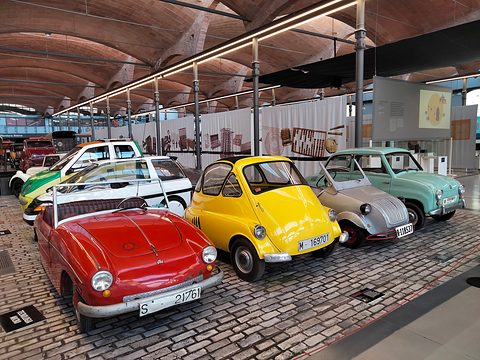
Red open two-seater at the front of a row of small cars, a yellow Isetta beside it, under a vaulted brick roof.
The doorless PTV at the head of the microcar line-up in MNACTEC’s transport exhibition, Terrassa, in 2026.Photo: Enric, CC BY-SA 4.0, via Wikimedia Commons

Sources

Numbered as in the text

The two Wikipedia pages draw on grupo7.com, so most of the company’s story rests on one local account; only the Weiner museum stands apart. No period road test was found. Sources are given as plain text; the links are on the Credits page.

  1. Spanish Wikipedia, PTV (automóviles), read in full.
  2. Toni Solans, “PTV, Manresa Barcelona”, grupo7.com, with data and photographs from the Motor Club del Bages bulletin Info Clàssic, read in full.
  3. Bruce Weiner Microcar Museum, “1959 PTV”, tour page, read in full.
  4. Catalan Wikipedia, PTV 250, read in full; it cites grupo7.com.
  5. Clàssic Motor Club del Bages, club website, read 7 October 2026, including its post of 25 May 2026 on the 20th Trobada.