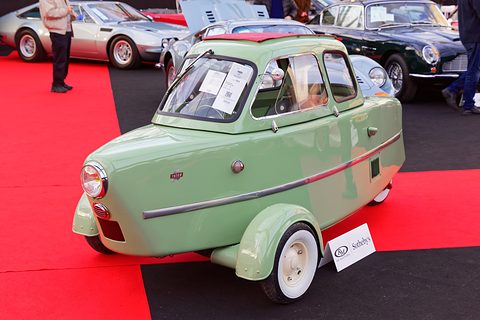
microcarfan
  • Microcar
  • France
  • Three wheels
  • Fibreglass body

P. Vallée Chantecler

Also known as Paul Vallée Chantecler

A bulbous fibreglass teardrop for two, named after a rooster because its maker ran a Grand Prix team with a rooster for its emblem, and started by holding up a lever while a flywheel whined.

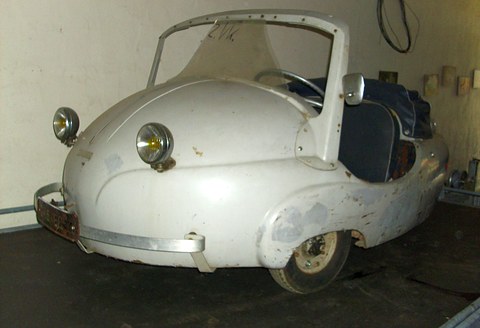
Tired pale grey open three-wheeler with two front lamps, a windscreen frame and a dark seat, against a bare wall.
An unrestored P. Vallée Chantecler in a store, its paint patched and worn.Photo: Buch-t, Public domain, via Wikimedia Commons

At a glance

The spec plate

P. Vallée Chantecler

Chantecler · Blois

Built
1956–⁠1958Shown in October 1955; built from the autumn of 1956 to 1958, or to 1957
Country
FranceBlois, Loir-et-Cher
Maker
S.I.C.R.A.F., BloisPaul Vallée’s works; the Société Colas built the cars
Engine
125 or 175 cc Ydral two-stroke singleThe 125 needed no licence; a Westinghouse Gyrostarter
Power
5 to 6 hpAbout 4 kW, the 125; 8 hp for the 175
Length
3,100 mm1,320 mm wide
Seats
2On a wide bench
Wheels
3Two at the front; the engine ahead of the single driven rear wheel
Production
about 200By the Weiner museum and RM
Survives
YesVery few; chassis 1203 has sold twice
Top speed
75km/h75 km/hAbout 47 mph

Not yet recordedweight.

How big is it?

True proportion

3.10 m

It is 130 mm longer than a Fiat 500, about 1.8 adults laid end to end.

  • 1.32 m wide
  • Two seats on a wide bench
  • An open fibreglass body with a folding hood
Drawn at true proportion. The track is 3.6 metres long; the adult stands at the same scale. The Peel P50 is the smallest production car, on every page for comparison.

The story

History

Chantecler is a rooster’s name, and the Weiner museum explains the choice: the car’s maker, Paul Vallée, had directed a French racing team, and the rooster was its emblem.source 1source 2 RM fills in the man. He ran a transport business, married into wealth, opened his own engineering works, S.I.C.R.A.F., the Société Industrielle de Constructions et de Réparation des Automobiles Françaises, and founded the Écurie France, a Grand Prix team that raced Talbot-Lago T26s with Louis Chiron among its drivers. Racing, for him, was publicity for his other businesses.source 2

He could anticipate novel ideas before others, yet he did not carry them through in practical terms.

RM Auctions, on Paul Vallée, in the 2013 Weiner sale catalogue.source 2

In 1949 he launched a scooter with an open frame, “with a big splash at Montlhéry”, the Weiner museum says.source 1 RM admired its finish and its large telescopic fork, but it proved unstable, and Vespa and Lambretta left it behind. Replacing the front fork with a load platform on two wheels turned it into the Paul Vallée Triporteur, and that sold: RM counts about 5,000, seen scuttling about in every village in France.source 2 The German Wikipedia records that the firm, in Blois, began with three-wheeled scooters and load tricycles.source 3

From racer to runabout

At the Paris Salon of October 1952 Vallée showed a tiny streamlined single-seat racer on the Triporteur 175’s chassis and engine, with a steel body by Paul Née, a Brooklands-style screen and a rooster badge, and a promise of nearly 100 km/h (62 mph). Studies for a two-seater with a bench seat and a full-width screen stood beside it.source 2 The Weiner museum says that the 1952 single-seater was already called Chantecler, so the name may be that old.source 1 In 1954, the German Wikipedia says, production passed to the Société Colas of Blois.source 3

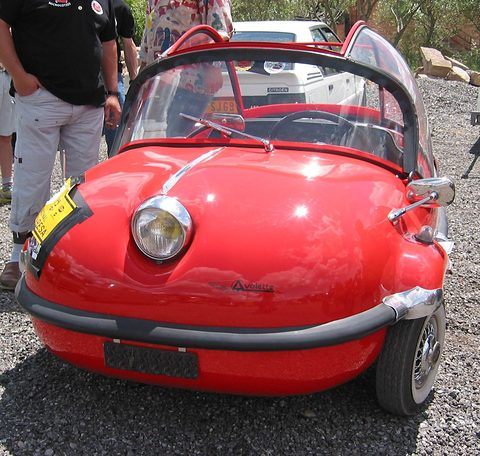
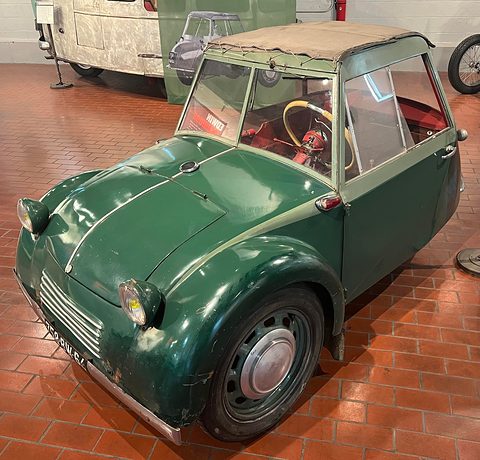
The Chantecler proper was shown at the Paris Salon of 1955.source 2 It was a bulbous teardrop in fibreglass, open, with a wide bench for two and a D-shaped steering wheel.source 1source 2 The first version had a single central headlamp, a windscreen frame of steel tube, a front bumper moulded into the body and a sharply cut-off tail, and it was identical to another car at the same Salon, the short-lived Decolon PB, whose initials RM says stood for Pierre Brissonet.source 1source 2 The production car, by the Weiner museum’s account, had two headlamps, aluminium bumpers, a fibreglass screen frame and a rounded tail, and came in ivory, red or two-tone, later blue.source 1 RM found flat spring-steel bumpers front and rear on its car, and a very solid screen with sturdy posts for the hood and side screens; the hood hung on a single T-shaped bow of fibreglass that folded away into the body.source 2 The Weiner museum says the Chantecler used the Triporteur’s frame, but RM, describing the same car, found a square-tube ladder frame with angled swing arms, which settles it.source 1source 2

It was a three-wheeler with its pair of wheels at the front and an Ydral engine ahead of the single driven wheel at the back.source 3source 2 With the 125 cc Ydral, of 5 or 6 hp, no driving licence was needed, which put it among the licence-free cars of 1950s France; the 175 cc version, with 8 hp, needed one.source 2source 3

Starting it

Like the Inter 175 A Berline, it had a Westinghouse Gyrostarter.source 1source 2 RM describes the ritual: you raise a lever in the cockpit and hold it up for at least ten seconds while the flywheel spins up with a whine that rises in pitch, then drop it, and a clutch passes the flywheel’s energy to the engine. It makes, RM adds, “for an interesting public display”.source 2 The Weiner museum judged the little car well suited to the limited job it was designed for.source 1

Two endings

The Chantecler was built from the autumn of 1956 to 1958, by the Weiner museum’s dates, or until 1957 by the German Wikipedia’s.source 1source 3 How it ended depends on whom you read.

…enjoyed a happy but brief life, cut short by the death by heart attack of M. Vallée on April 3, 1957.

Bruce Weiner Microcar Museum, writing of its 1956 Chantecler.source 1

RM tells it otherwise: the relative failure of the scooter was no great loss to Vallée, who shrugged and moved on, buying into a large Rolls-Royce and Ferrari dealership.source 2 The two may not conflict, if RM’s line is about the scooter years before 1957, but no obituary or other record has been found to settle it.
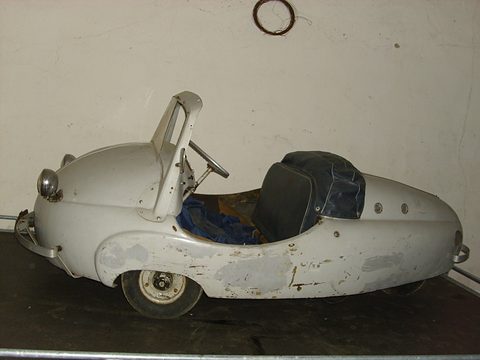
Open pale grey teardrop-shaped car in profile with patchy paint, a raised screen frame and a dark cover over the seat.
An unrestored P. Vallée Chantecler in profile in 2010, showing its open body and pointed tail.Photo: Buch-t, Public domain, via Wikimedia Commons

Variants

From racer to runabout

Paul Vallée’s three-wheeled cars
VariantYearsWhat differsHow many
Single-seat racer1952Triporteur 175 chassis, a steel body by Paul Née, a Brooklands-style screen and a rooster badgeShown at the Salon
Two-seat study1952A bench seat and a full-width screenA study
Chantecler, first form1955One central headlamp, a moulded front bumper and a cut-off tail; the same car as the PBShown at the Salon
Chantecler 1251956–⁠58Ydral 125 cc, 5 to 6 hp; licence-freeWithin about 200
Chantecler 1751956–⁠58Ydral 175 cc, 8 hp; a licence neededWithin about 200

Specification

The Chantecler 125, chassis 1203, from the Weiner museum and RM

Engine and drive

Engine and drive
EngineYdral single-cylinder two-stroke, 125 ccsource 1source 2
Power6 hp (about 4.4 kW)source 15 hp by RM, 5 PS by the German Wikipedia
GearboxFour speeds and reversesource 1
StarterWestinghouse Gyrostartersource 1source 2
Other engineYdral 175 cc, 8 hp, by the German Wikipediasource 3

Body and chassis

Body and chassis
FrameSquare-tube ladder frame with angled swing armssource 2Tube, says the Weiner museum
BodyFibreglasssource 1source 2
SuspensionNiemann rubber rings, front and rearsource 1source 2
BrakesCablesource 1
SteeringRack and pinion, with a D-shaped wheelsource 1source 2
Tyres and electrics4.40 × 8; 6 Vsource 1

Dimensions

Dimensions
Length3,100 mmsource 110 ft 1 in (3.07 m) by RM
Width1,320 mmsource 1
WeightNot known

Performance and running

Performance and running
Top speed75 km/h (47 mph)source 1
Price newNot found

How many were built?

How many were built?

About 200 builtThe Weiner museum and RM both give 200 for the Chantecler, but they describe the same car and share an origin, so we write about 200.

  1. 200ChanteclersUnconfirmed

    Bruce Weiner Microcar Museum; RM’s catalogues of 2013 and 2018source 1source 2source 4

  2. about 200vehicles in all, 1952–⁠57Unconfirmed

    German Wikipedia, citing Linz and Schradersource 3

  • Two sources agreetwo good sources give the figure
  • One sourcea good source, alone
  • Unconfirmeda lead only, not yet checked

Famous for

Three points

  1. The rooster

    Named after a rooster, the emblem of Paul Vallée’s Grand Prix team.

  2. Ten seconds of whine

    Hold the Gyrostarter’s lever up while the flywheel spins, then drop it.

  3. A hood on one bow

    The hood hung on a single T-shaped fibreglass bow that folded into the body.

Survivors and collecting

Today

Very few survive.source 1source 4 The best known is chassis 1203, the Weiner museum’s car, which RM Auctions sold fully restored in 2013, and RM Sotheby’s sold again in Los Angeles in 2018, with engine 43511 and in French racing blue. Its price fell by almost half between the two sales.source 2source 4 No owners’ club is known.

Chassis 1203 at auction
CarSalePrice
1956 Chantecler, chassis 1203RM Auctions, Weiner museum sale, 2013, lot 284source 2$98,900
The same carRM Sotheby’s, Petersen Automotive Museum sale, Los Angeles, 2018, lot 185source 4$53,200
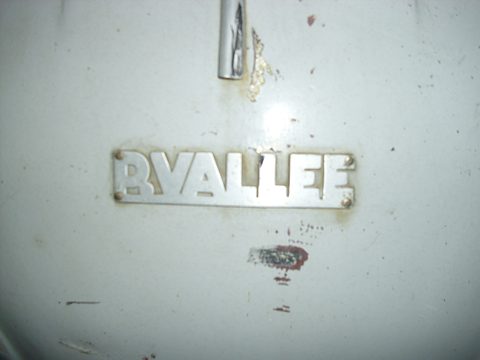
Chrome P. VALLEE nameplate on a pale grey, chipped and scuffed curved body panel.
The P. VALLEE nameplate on the nose of an unrestored P. Vallée Chantecler, photographed in 2010.Photo: Buch-t, Public domain, via Wikimedia Commons

Sources

Numbered as in the text

No period source has been read. Most of the story rests on the Weiner museum and RM, who describe one car, chassis 1203. Sources are given as plain text; the links are on the Credits page.

  1. Bruce Weiner Microcar Museum, “1956 P. Vallee Chantecler”, tour page, read in full.
  2. RM Auctions, The Bruce Weiner Microcar Museum, Madison, Georgia, 2013, lot 284, “1956 Paul Vallée”, catalogue text, read in full.
  3. German Wikipedia, P. Vallée, read in full; it cites Linz and Schrader, and Georgano, not seen.
  4. RM Sotheby’s, The Petersen Automotive Museum Auction, Los Angeles, 2018, lot 185, “1956 Paul Vallée Chantecler”, catalogue text, read in full.