The story
History
Shankarrao Kulkarni’s schooling ended at the seventh standard, at about 12, yet he became a respected engineer (one of the designers on this site).source 1source 2 In 1945, with India still under British rule, he resolved to build an affordable car for the country. The first, in 1949, was a two-seater, registered with Maharashtra’s transport department as MHK 1906.source 2
The second, of 1951, seated three. Its placard gives a 19 hp air-cooled in-line twin, about 55 mph (89 km/h) and nearly 50 mpg (US); Asianet gives 90 km/h and 21 km per litre.source 1source 2 It rode on rubber, which Kulkarni said did away with more than 100 spare parts and kept a jolt at one wheel from reaching the other. He said the ground clearance could be set anywhere from 6 to 11 inches.source 1source 2
It should be increased when traveling on a rugged road and reduced when traveling in speed on a smooth road.
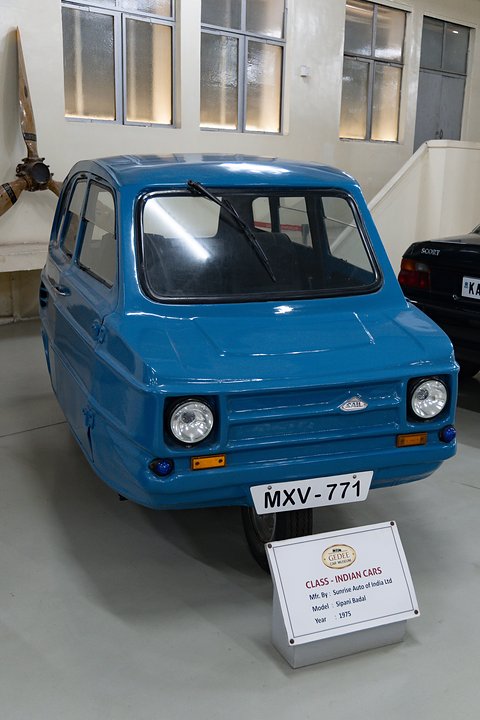
A third prototype followed in 1960. About 1970 he settled the final design, smaller than before, wedge-shaped and still rear-engined, with three doors: one for the driver and two on the passenger’s side.source 1source 2 By 1975 it was a four-seater meant for production, with a 14 hp water-cooled V-twin, four gears and about 21 km per litre, to sell for ₹12,000. Jalopnik puts that at about US$3,500 in 2018 money.source 1source 2
Red tape
Asianet says Kulkarni submitted the car to the government for approval.source 2 He drove it to Mumbai for an exhibition, and the municipality of Jaysingpur, near Kolhapur, offered him free land for a factory.source 1source 2 It came to nothing. His grandson, Hemant Kulkarni, blamed red tape and bureaucracy.source 1source 2 Asianet adds that Kulkarni built five more cars and spent about ₹50 lakh, but won neither permission to use the roads nor a patent, and in the end gave up; no other source confirms it.source 2 India’s small-car market was transformed instead in 1983 by Maruti Udyog’s Suzuki-based Maruti 800.source 2
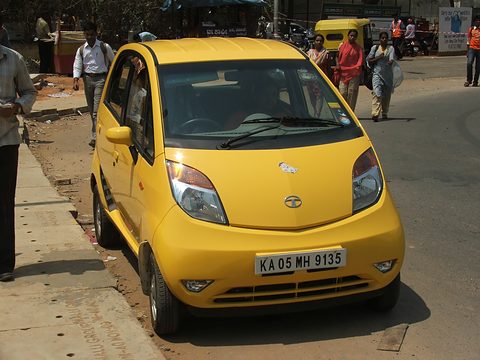
When the Nano was launched in 2008, the family recalled their grandfather’s dream, and wanted to be among its first buyers.source 1
What we do not know
Everything here comes from two articles of 2018 and 2019, which rest on the cars’ placards and on the family. No dimensions or weights, no dates for Kulkarni’s birth and death, and no report from the years he worked have been found.