microcarfan
  • Microcar
  • France

Voisin Biscooter

Also known as Biscooter C31, Voisin C31

Two chairs, a flat windscreen and a big canvas top on a shell of bare aluminium. Gabriel Voisin, who had built aeroplanes before the First World War, drew it for a France that could afford almost nothing. More than a thousand people ordered one, and none was ever built for them.

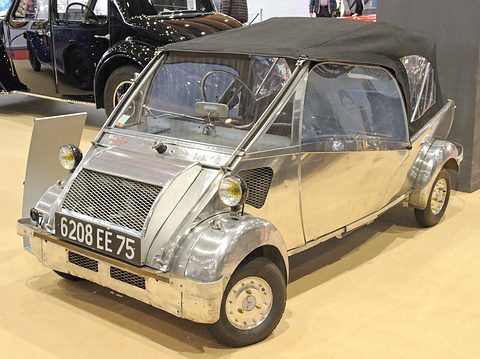
Gleaming aluminium microcar with a black fabric hood, mesh grille and Paris plate on a sand-coloured floor.
A polished aluminium 1956 Voisin C31 Biscooter with its black hood up at Retro Classics, Stuttgart, in 2020.Photo: Alexander Migl, CC BY-SA 4.0, via Wikimedia Commons

At a glance

The spec plate

Voisin Biscooter

Type C31 · Issy-les-Moulineaux

Built
1949–⁠1957Prototypes from summer 1949; Voisin’s later variants into the late 1950s
Country
FranceIssy-les-Moulineaux, Paris; built in series only in Spain
Maker
Gabriel VoisinPrototypes built by Gnome et Rhône; later cars by his own firm, L’Aéromécanique
Engine
125 cc Gnome et Rhône two-stroke singleA 197 cc Villiers two-stroke from 1951
Power
6–9 hp6 hp from the 125 cc engine, 9 hp from the Villiers
Length
2,570 mm1,210 mm wide
Weight
240 kgThe four-seater, by the Weiner museum
Seats
2Single-, three- and four-seat versions were built too
Wheels
4Front-wheel drive
Production
15 or 16Prototypes, summer 1949; series production only in Spain
Survives
Very fewBy the Weiner museum’s account
Top speed
55km/h55 km/h

How big is it?

True proportion

2.57 m

It is 400 mm shorter than a Fiat 500, about 1.5 adults laid end to end.

  • 1.21 m wide
  • 240 kg: about three adults
  • About the size of two scooters, as its name says
Drawn at true proportion. The track is 3.6 metres long; the adult stands at the same scale. The Peel P50 is the smallest production car, on every page for comparison.

The story

History

Gabriel Voisin studied at the École des Beaux-Arts, built a practical aeroplane in 1907, and made his firm the first to mass-produce aircraft; by 1918 he was a millionaire.source 1source 2 He then left aviation for cars, building luxury Avions Voisin at Issy-les-Moulineaux, with the engineer André Lefebvre, who went on to design the Citroën 2CV and DS.source 1 In the 1930s he lost control of his company to the engine maker Gnome et Rhône, and he worked there through the war; in 1938 he had set up a design office of his own, L’Aéromécanique.source 1source 2 In 1945 Gnome et Rhône, with Avions Voisin, was nationalised into SNECMA.source 2

So the Biscooter does not fit the old story of aircraft makers turning to cars because they were banned from aircraft. Voisin had left aviation after 1918, and what stopped his car was not a ban but his nationalised employer.source 1source 2

Infinite simplicity

In 1949 Voisin offered the firm that still bore his name the rights to a microcar built round Gnome et Rhône’s own 125 cc two-stroke motorcycle engine. In the summer of 1949 the old Voisin works at Issy built 16 of them, by the Weiner museum’s count, or about 15 by RM’s; the management of SNECMA thought the project had no future. Two of the prototypes were given to Voisin himself.source 3source 2

He designed it on a principle he called infinite simplicity, with every component a module arranged by what it did.source 1 It looked like a bare chassis carrying two chairs and a flat windscreen, all in polished aluminium under a big canvas top.source 1 The body was riveted aluminium sheet, with a soft top and the spare wheel in the boot, and the 6 hp engine sat at the front and drove the front wheels.source 2source 4 From his luxury cars of the 1930s Voisin kept one refinement: behind the three-speed gearbox, a second box with two ratios.source 2source 5 The name means “double scooter”: the car was about the size of two scooters, or a scooter on four wheels.source 4source 1source 2 Its 125 cc version could, by one account, be driven in France without a licence, like the other small licence-free cars of the time.source 5

A thousand orders, no factory

Shown in Paris in 1950, at the Salon du Cycle et de la Moto by RM’s account, the Biscooter was a sensation, with more than 1,000 orders.source 1source 3 Voisin was already at odds with the directors of Gnome et Rhône and SNECMA over it.source 3 In October 1950 he redesigned it with low body sides, and from 1951 it had a larger engine, the 197 cc Villiers two-stroke.source 3 SNECMA would still not build it. For the Paris Salon of 1952 its management showed a conventional small car of their own, which drew little attention, to Voisin’s contempt.source 1

He sold the licence to Spain instead, in 1951 by one of RM’s descriptions, in June 1952 by the other, or in June 1953 by the Weiner museum’s; the date is unresolved.source 1source 2source 3 Autonacional SA of Barcelona launched it in 1953 as the Biscúter, a car built under licence, and in Spain it became a national icon and a byword: feo como un Biscúter, ugly as a Biscúter.source 4source 6 In France it never went on sale.

Voisin went on building versions of it for several years: single-seaters, three-seaters and four-seaters.source 1 The last known is a four-seater dated 1957, with near-circular doors, basket-weave seats and a speedometer set in the steering wheel. RM suggests it may have been developed for the Spaniards and turned down as too costly; the Weiner museum calls it possibly a prototype.source 1source 3 Voisin stayed at Issy, in research, until the plant closed in 1958.source 1 He retired to Ozenay, in Saône-et-Loire, and died in 1973.source 7 He has a place among the designers.
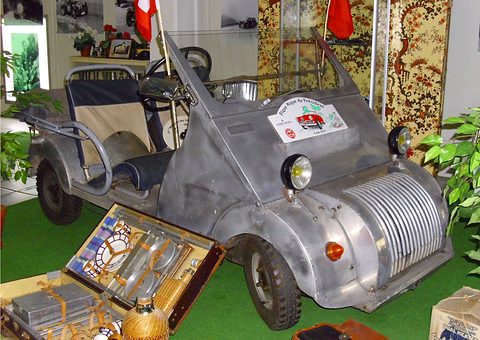
Bare aluminium open microcar with a ribbed nose and rally plaque, a picnic case open beside it.
An open aluminium 1951 Voisin C31 Biscooter with a period picnic hamper in a museum at Aigle, Switzerland, in 2010.Photo: Buch-t, CC BY-SA 3.0 de, via Wikimedia Commons
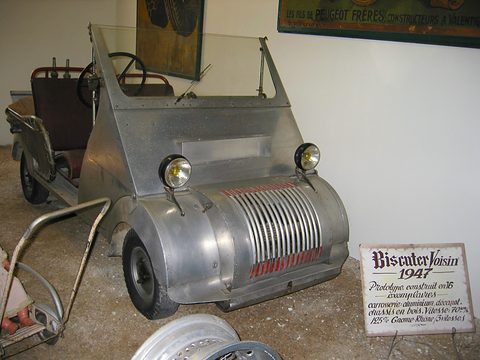
Unpainted aluminium open microcar with a ribbed grille and a hand-lettered museum sign in front.
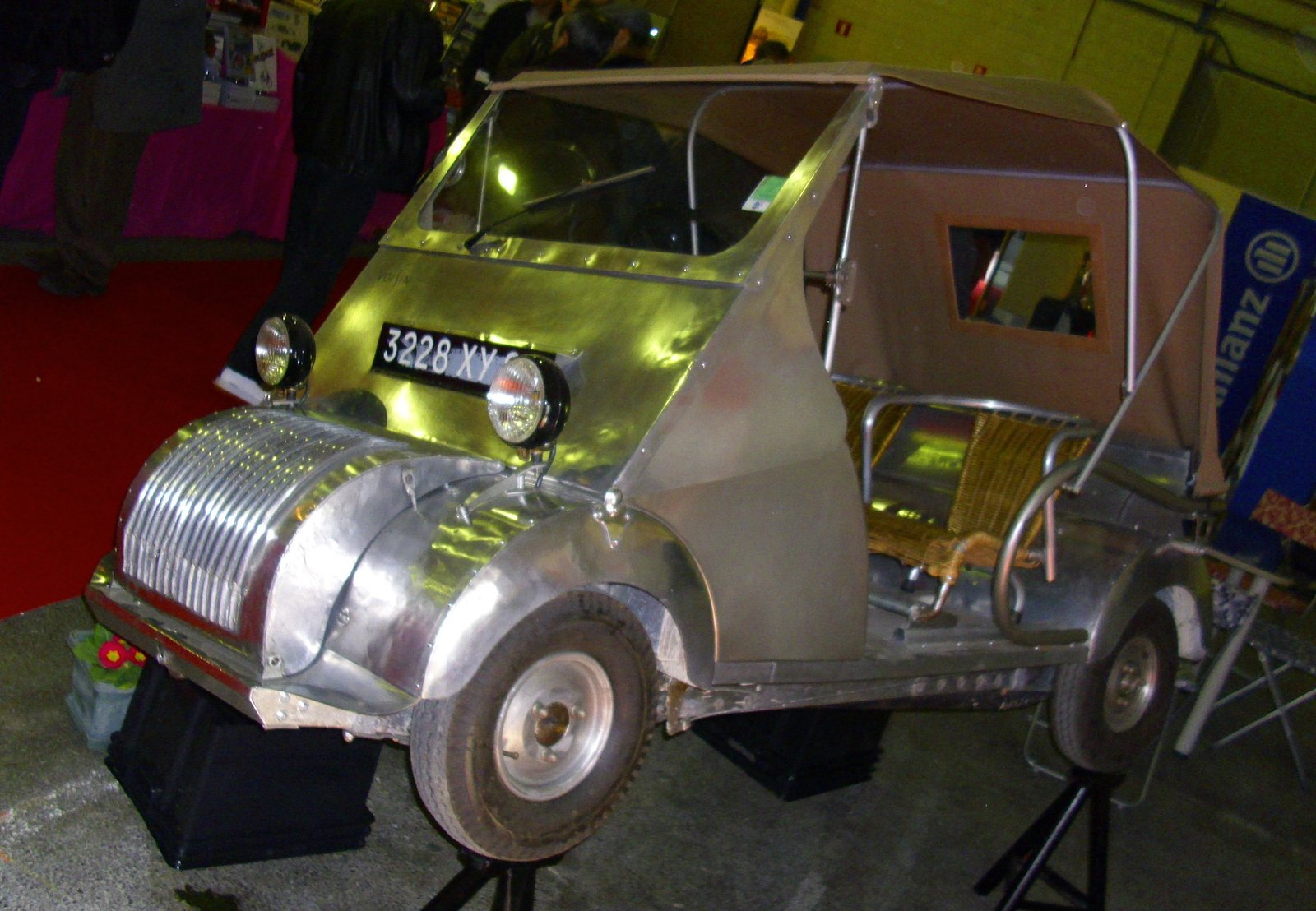
A bare aluminium Voisin Biscooter in a museum at Orgon, signed by the museum as a 1947 prototype.Photo: Buch-t, CC BY-SA 3.0 de, via Wikimedia Commons
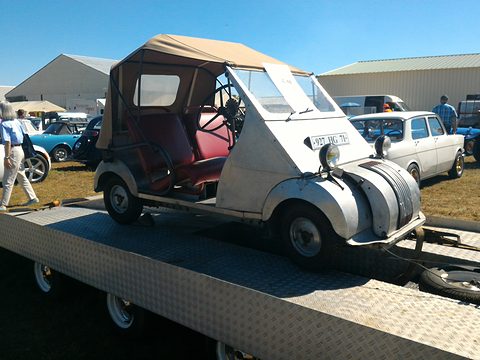
Aluminium microcar with a beige canvas hood and red interior on a flatbed trailer under blue sky.
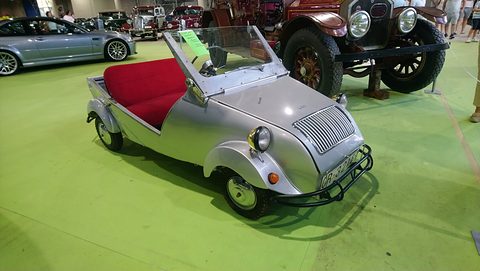
A Voisin C31 Biscooter with a canvas top and red seats on a transporter bed at a French meeting in 2016.Photo: Guillaume Vachey, CC0, via Wikimedia Commons

Pictures

More photographs, old and new

Variants

Voisin’s versions

The Biscooter in France
VariantYearsWhat differsHow many
Gnome et Rhône prototypeSummer 1949Riveted aluminium two-seater, 125 ccAbout 15, or 16
Low-sided bodyOctober 1950Redesigned with low body sidesNot found
Villiers-engined C311951–A 197 cc Villiers two-strokeNot found
One-, three- and four-seaters1950sVoisin’s further prototypesA few
Four-seater with round doorsDated 1957Near-circular doors, basket-weave seats, a speedometer in the steering wheel1

Specification

Two cars from the Weiner museum’s collection

1949 prototype

1949 prototype
EngineGnome et Rhône single-cylinder two-stroke, 125 cc, at the front, 6 hpsource 2
GearboxThree speeds, with a supplementary two-ratio boxsource 2
BodyRiveted aluminium sheet; soft top; spare wheel in the bootsource 2
Length8 ft 5 in (about 2,565 mm)source 2

Four-seater, dated 1957

Four-seater, dated 1957
EngineVilliers two-stroke, 197 cc, 9 hpsource 3RM lists two cylinders; the Villiers 197 is a single
GearboxThree speeds and reversesource 3
StructureAluminium monocoque, no chassissource 3
Suspension and steeringCoil springs front and rear; rack and pinionsource 3
BrakesCable, on the rear wheels onlysource 3
ElectricsDynastart, 12 Vsource 3
Tyres4.00 × 8 insource 3
Size and weight2,570 × 1,210 mm; 240 kgsource 3RM gives 8 ft 6 in, about 2,590 mm
Top speed55 km/hsource 3

How many were built?

The French prototypes

15 or 16 built in FranceGnome et Rhône built the prototypes in the summer of 1949: 16 by the Weiner museum’s count, about 15 by RM’s. Voisin’s later one-offs add a handful. The Spanish Biscúter’s numbers are on its own page.

  1. 16prototypes built by Gnome et Rhône, summer 1949One source

    Bruce Weiner Microcar Museumsource 3

  2. about 15prototypes, summer 1949One source

    RM Auctions, catalogue of the Weiner sale, 2013source 2

  • Two sources agreetwo good sources give the figure
  • One sourcea good source, alone
  • Unconfirmeda lead only, not yet checked

Famous for

Three points

  1. Voisin’s last car

    The aviation pioneer’s final design, built round a motorcycle engine.

  2. Nothing that need not be there

    Bare aluminium, front-wheel drive, two chairs and a flat windscreen.

  3. Made in Spain

    Over a thousand French orders went unfilled; Barcelona built it as the Biscúter from 1953.

Survivors and collecting

Today

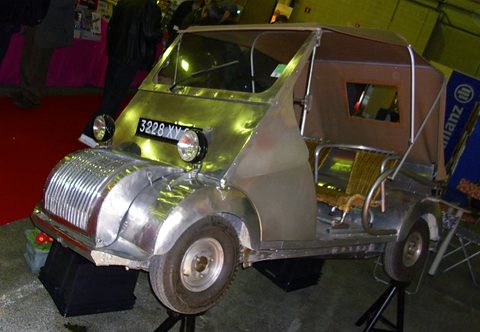
Very few French Biscooters survive, the Weiner museum said in 2002.source 3 Two of them were in its own collection (the Weiner museum appears in museums and meets), and both went when the collection came under RM Auctions’ hammer in Georgia in February 2013: Gabriel Voisin’s own 1949 prototype, unrestored and original, for $66,125, and the 1957 four-seater, which had come from a French museum, for $80,500.source 2source 1 A “Voisin Biscooter type C31, 1957” had been offered by Artcurial at its Rétromobile sale in Paris on 4 February 2011; it may have been the same four-seater.source 8 The photographs on this page show Biscooters in museums at Orgon and at Aigle in Switzerland, and at shows in France and Germany.

At auction
CarSalePrice
1957 four-seaterRM Auctions, Weiner museum sale, 2013source 1$80,500
1949 prototype, Voisin’s ownRM Auctions, Weiner museum sale, 2013source 2$66,125

Sources

Numbered as in the text

No French period press, Salon catalogue or memoir of Voisin’s has been read for this car; most of its history comes from the Weiner museum and RM’s catalogue of the museum’s sale. Sources are given as plain text; the links are on the Credits page.

  1. RM Auctions, The Bruce Weiner Microcar Museum sale, February 2013, lot 292, “1957 Voisin Biscooter C31”, read in full.
  2. RM Auctions, The Bruce Weiner Microcar Museum sale, Madison, Georgia, February 2013, lot 583, “1949 Voisin Biscooter Prototype”, read in full.
  3. Bruce Weiner Microcar Museum, “1957 Voisin Biscooter”, tour page (© 2002), read in full.
  4. English Wikipedia, Biscúter, read in full. Used as a lead.
  5. A web-search summary of RM’s descriptions and of a Hagerty past-sales record for a 1949 Biscooter; not read separately.
  6. Spanish Wikipedia, Biscúter, first half read. Used as a lead.
  7. French Wikipedia, Gabriel Voisin, read in extract. Used as a lead.
  8. Artcurial, Rétromobile sale, Paris, 4 February 2011, lot 209, “Voisin Biscooter type C31, 1957”, seen as a title only.