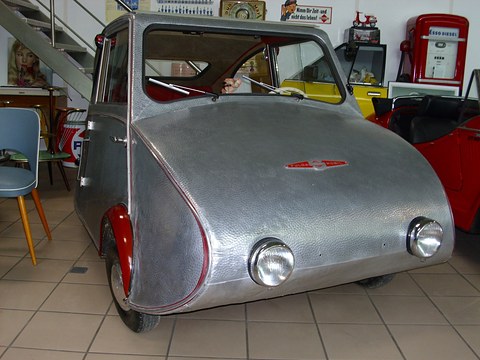
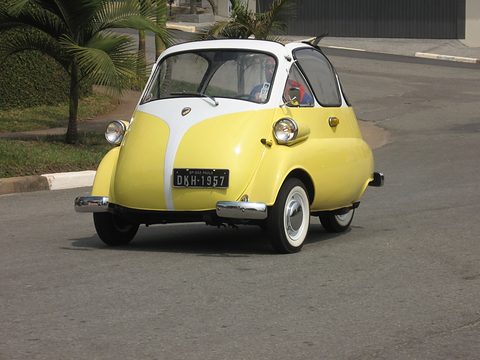
The Bambi, its Argentine version, used the same engine
Fuldamobil
1950–1969 · West Germany · 2.85 m
Also known as Dinarg D 200
The Dinarg had no reverse gear. To back it out of a space you stopped the engine, turned a key on the dashboard and started it again, now running backwards, and then you had four speeds in reverse.
The spec plate
Dinarg D‑200
2 + 2 micro-coupé · Córdoba
True proportion
2.43 m
It is 540 mm shorter than a Fiat 500, about 1.4 adults laid end to end.
History
In 1959 President Arturo Frondizi’s government brought in a scheme to promote a motor industry in Argentina, and many firms took it up.source 1source 2 One was Dinámica Industrial Argentina, Dinarg for short, founded in Córdoba about 1959 by a group of industrialists and engineers with purely Argentine capital.source 1source 2 Its president was the engineer José Fuad Elaskar, and it set out to build a small popular car that was cheap to buy and to run.source 1source 2 It was Argentina’s own design, an answer to the European micro-coupés coming in from abroad, not a car built under licence.source 3source 1
Three prototypes were finished in 1960, and each was driven about 100,000 km (62,000 miles) in tests across the country.source 1source 2 The Secretariat of Industry and Mining approved the project in 1961, in November by Spanish Wikipedia’s account, and production began in Córdoba.source 1source 2source 4 The plans were large: 2,000 cars in 1962, 2,500 in 1963 and 3,000 in 1964.source 1
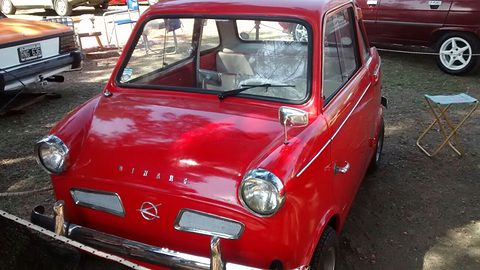
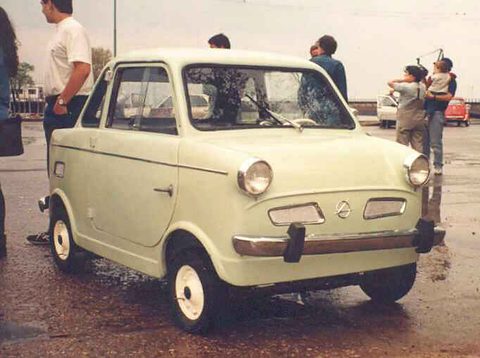
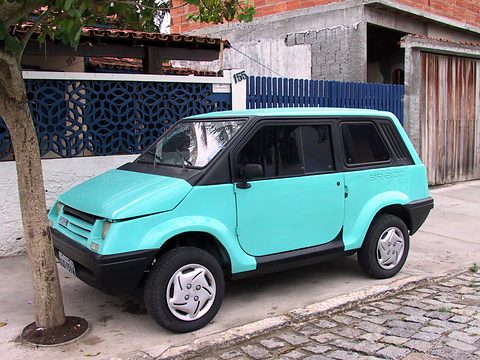
The D‑200 was a 2 + 2 coupé with a body of glass-reinforced polyester, 2,430 mm (96 in) long and weighing 300 kg (661 lb).source 5source 3source 4 Its two doors were hinged at the back and had sliding windows and big pockets, and behind the seat a folding panel could carry two children.source 3source 1 At the back sat a Sachs LDR 200, an air-cooled two-stroke single of 191 cc and 10 PS, the engine Small Cars Club says the Argentine Bambi also used.source 5source 3source 4 The starter was a Dynastart, a starter and dynamo in one.source 3source 4 The gear lever went back to the same place after each change, with a neutral between every gear.source 3
There was no fuel gauge and no rev counter, only a speedometer to 100 km/h, so owners had to remember when they last filled up.source 3source 1 The indicator switch was clockwork and cancelled itself after 30 seconds, and the red Dinarg badge in the middle of the steering wheel was not the horn: that was a knob on the column.source 3source 1 There was no boot. A large suitcase fitted behind the seats, and anything more went on a roof rack, though Small Cars Club warns that the little engine would feel the load.source 3
The Argentine magazine Parabrisas tested it in July 1963 and recorded 0–60 km/h in 28.8 seconds, 75 km/h (47 mph) flat out and 17.5 km to the litre.source 4 Being light, it stopped well.source 1
Output never came near the plans. Coche Argentino and Autitos Rosarinos put it at about 200; Spanish Wikipedia and German Wikipedia, after Linz and Schrader and Georgano, at up to 300.source 4source 2source 1source 5 When it ended is not settled either: 1961 by Spanish Wikipedia, 1962 by Linz and Schrader and by Georgano, 1964 by Coche Argentino, and as late as 1968 by d’Auto, as German Wikipedia reports it.source 1source 5source 4 The Parabrisas test shows that it was still current in the middle of 1963. No account of why Dinarg stopped has been found.
1959 · a record on this page
Metalmecánica, of José C. Paz in the province of Buenos Aires, joined the 1959 scheme and began with a small car, the De Carlo 200 or Minicar, before going on to the BMW-based De Carlo 600; the Minicar was dropped the same year.source 6source 7 Coche Argentino and German Wikipedia say 798 were made in 1959; Autitos Rosarinos says close to 800.source 6source 7source 8
What it was is not certain. English Wikipedia reads the 798 as Argentine-assembled BMW Isettas, with a small two-piece grille on the door.source 9 Autitos Rosarinos, in 2007, said there was no reliable information about its origin, and described a two-seater with an engine of about 200 cc of Italian origin and four gears and reverse, with no known owner’s manual or brochure.source 8 Coche Argentino calls it a micro-coupé on a frame, German Wikipedia an open small car, and Coche Argentino’s data sheet leaves every other field blank.source 6source 7 No photograph has been found that would settle it, and no survivor has been traced.
1958–1959 · a record on this page
Rol-Mar, also written Rolmar, was a Buenos Aires coachbuilder that put bodies on Ford F‑100 and Rastrojero pick-up chassis. As a sideline it made a small series of steel micro-coupés, the Jerry, with two doors, a body on a frame and an air-cooled Vespa scooter engine behind, driving the rear wheels.source 10source 11 Coche Argentino has it begin in 1958; German Wikipedia gives 1958 or 1959, ending the same year, calls it an open car, and says it also came as a pick-up and a van.source 10source 11 Coche Argentino puts the words Julián Álvarez y Charcas where it gives each maker’s location, which suggests a street corner in the federal capital; German Wikipedia reads them as the name of the man who ran it.source 10source 11 About 20 Rol-Mar vehicles of every kind were made.source 11 The engine’s size, the car’s dimensions and the origin of the name Jerry are not recorded, and no survivor has been traced.
1955–1960 · a record on this page
The brothers Octavio and Camilo Canal, sons of Spanish immigrants in the southern suburbs of Buenos Aires, made bicycle frames for the army from 1936 and in 1946 opened a workshop at 3552 Ministro Brin Street in Lanús Oeste; in 1955 they moved within Lanús Oeste, and there they built the Chasqui, at some time between 1955 and 1960. They cast and machined one- and two-cylinder engines of their own, but the Chasqui had a British Villiers two-stroke at the back. Its body was a small van with two rows of seats, a door on each side and headlamps mounted outside the body. Perhaps only one was built, and the family gave the surviving car to the Museo del Automóvil de Buenos Aires.source 12 Everything here rests on one source, Small Cars Club.
One model
| Variant | Years | What differs | How many |
|---|---|---|---|
| D‑200 | 1961–64 | A 2 + 2 glass-fibre coupé; long and short versions are mentioned, without details | About 200 to 300 |
From Coche Argentino’s data sheet, after the period brochures and Parabrisas
| Engine | Sachs LDR 200 two-stroke single, upright at the back, loop-scavenged; 65 × 58 mm, 191 cc, 6.3:1source 5source 3source 4 |
|---|---|
| Power | 10 CV at 5,250 rpmsource 410.2 hp by Small Cars Club |
| Torque | 1.5 mkg (about 14.7 Nm) at 4,000 rpmsource 4 |
| Gearbox | Sachs four-speed; no reverse gear: the engine restarts backwardssource 3source 1source 4 |
| Starter | Dynastart 12 V starter-dynamosource 3source 4 |
| Body | Glass-reinforced polyester on a frame; two doors hinged at the backsource 3source 4Spanish Wikipedia calls it a monocoque |
|---|---|
| Suspension | Independent all round, on transverse leaf springssource 3source 4 |
| Brakes | Drums all roundsource 1source 4 |
| Steering | Rack and pinionsource 4 |
| Tyres | 4.40 × 8source 4 |
Plans and output
About 200 builtNo official figures exist. The Argentine specialist sources, Coche Argentino from period publications and Autitos Rosarinos from Autos de Época, agree on about 200; Spanish Wikipedia and German Wikipedia, after Linz and Schrader and Georgano, go as high as 300. We follow the Argentine sources.
Three points
The engine was restarted backwards with a key, so every gear worked in reverse.source 3source 1source 4
A glass-fibre coupé designed and built in Córdoba with Argentine capital.source 3source 1
A clockwork indicator switch, but no way of telling how much petrol was left.source 3
Today
Autitos Rosarinos says very few still run, and Spanish Wikipedia calls the D‑200 a collector’s car; no count has been found, nor any museum example or auction result.source 2source 1 Of this page’s two photographs, one shows a red D‑200 at a show in Rosario in 2015, the other a pale green one at an outdoor gathering.
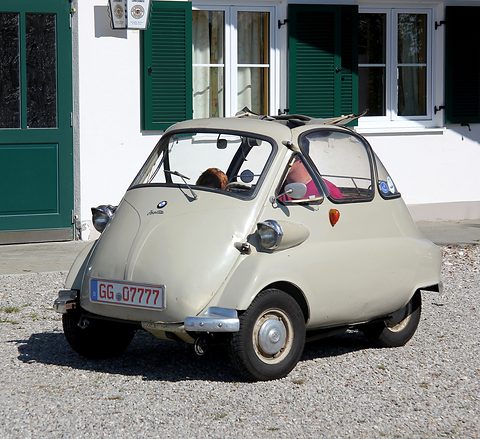
Small cars of South America
The Bambi, its Argentine version, used the same engine
1950–1969 · West Germany · 2.85 m
Numbered as in the text
The D‑200’s history comes from Spanish and German Wikipedia, Small Cars Club and two Argentine enthusiasts’ sites; the period test in Parabrisas was read only through Coche Argentino’s data sheet. The three folded records each rest on one or two thin sources. Sources are given as plain text; the links are on the Credits page.