microcarfan
  • Microcar
  • France
  • Three wheels

Avolette

Also known as Brütsch-Avolette, L’Avolette

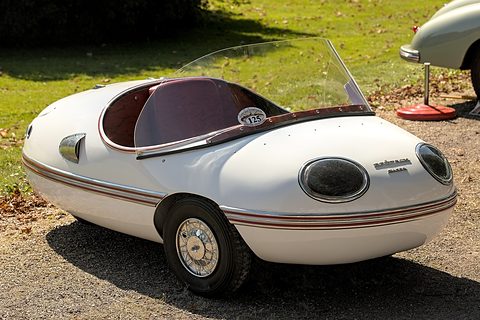
Two fibreglass shells joined at the waist by a rubber strip, a single headlamp running down the bonnet and no doors at all, put together in an aircraft hangar by the man who sold Cessnas in France.

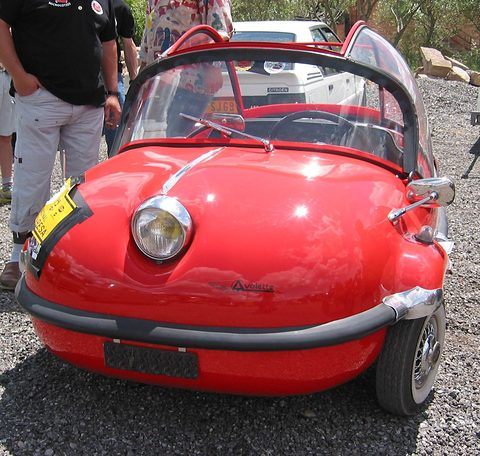
A rounded red open two-seater with a single headlamp in its nose and a wrap-round screen on gravel.
A red Avolette, an open fibreglass car, at an outdoor club meeting in 2009.Photo: Buch-t, Public domain, via Wikimedia Commons

At a glance

The spec plate

Avolette

L’Avolette · Toussus-le-Noble

Built
1955–⁠1958Shown in October 1955; built from the autumn of 1956 to 1957 or 1958
Country
FranceAssembled in a hangar at Toussus-le-Noble airfield, west of Paris
Maker
Société Air Tourist, headed by Jean AvotCessna’s French agent, under licence from Egon Brütsch
Engine
Ydral 125 or 175 cc, Sachs 191 cc or Maico 250 ccThe model code names the engine; the New Avolette of 1957 had a Lambretta
Power
14 hpAbout 10 kW, the Maico-engined Record de Luxe
Length
2,400 mm1,350 mm wide
Weight
204 kgThe Record de Luxe, by the Weiner museum’s card
Seats
2On a bench; no doors
Wheels
3One at the back; the Record de Luxe had two close-set rear wheels
Production
about 30By the Weiner museum and RM; about six survive
Survives
YesAn orange Record de Luxe sold for $74,750 in 2013
Top speed
110km/h110 km/hAbout 68 mph

How big is it?

True proportion

2.40 m

It is 570 mm shorter than a Fiat 500, about 1.4 adults laid end to end.

  • 1.35 m wide
  • 204 kg: about three adults
  • Two seats on a bench
  • No doors on any version
Drawn at true proportion. The track is 3.6 metres long; the adult stands at the same scale. The Peel P50 is the smallest production car, on every page for comparison.

The story

History

The design was German. Egon Brütsch of Stuttgart built small cars whose bodies were two egg-shaped fibreglass shells, joined round the middle by a strip of rubber, and he sold the right to make them across Europe.source 1 His Brütsch 200 prototype was shown at the Paris Salon of 1954.source 2 The story of Brütsch is mostly a story of licences, and the Avolette is one of the cars built under licence from him.source 3source 2source 4

He was more successful at licensing his concept to various European firms than he was at building them himself.

Bruce Weiner Microcar Museum, on Egon Brütsch, tour page for its 1956 Avolette Record De Luxe, about 2002.source 1

The French licence went to the Société Air Tourist, headed by Jean Avot, which was the French agent for Cessna aircraft.source 1source 2source 5 The cars were assembled in a hangar on the former military airfield of Toussus-le-Noble, about 16 km (10 miles) west of Paris.source 6source 2 Air Tourist sold aeroplanes rather than building them, which makes the Avolette a cousin of the aircraft makers’ microcars rather than one of them. The English Wikipedia says Air Tourist also built Brütsch’s Zwerg under licence, in single- and two-seat forms.source 7

From Brütsch-Avolette to L’Avolette

At the Paris Salon of October 1955 the car was shown as the Brütsch-Avolette, and it was in essence a Brütsch 200, still wearing the German chrome script on its nose. It had twin faired-in headlamps, an Avolette decal under the bumper, portholes in the tail, a fixed steering column, Brütsch’s single T-tube frame, and a 175 cc Ydral engine in place of the Sachs.source 2 Avot was not happy with that frame and, the Weiner museum says, designed his own tubular backbone.source 1 The production car’s frame, as RM describes it, kept the T-tube but stiffened it with two D-shaped hoops ahead of and behind the cockpit, joined under the cockpit rail to make a cage.source 2

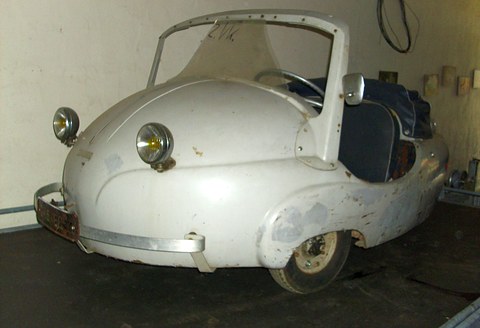
By the October 1956 Salon it had become L’Avolette, and it had changed a great deal, though it was still a three-wheeler with its single wheel at the back.source 2source 4 A single “Cyclops” headlamp ran the length of the bonnet. Polished cast-aluminium wing guards doubled as step plates, a proper chrome-framed windscreen stood up front, and vertical air slits appeared in the rear flanks. It was steered by Bowden cable, and sprung by Neidhart rubber-in-torsion units at the front and Niemann rubber rings at the rear.source 2 The coupé on the stand had a near-spherical top that slid back. Production coupés had something simpler: a tube-framed top with Plexiglas sides and a fabric roof, which tipped forward over the windscreen to let the occupants climb in, since no Avolette had doors.source 2source 1source 6

Five versions, one hangar

There were five versions, and the code on each said what it was: the number gave the engine size, the letter Y, S or M named Ydral, Sachs or Maico, and C or D marked a coupé or a décapotable, a convertible.source 1 The basic Normale, with a 125 cc Ydral, was started by hand and could be driven without a licence, one of the post-war 125 cc licence-free cars.source 3source 2 The Tourisme had a 175 cc Ydral, a top and a heater. The Tourisme de Luxe had the 191 cc Sachs of the Messerschmitt KR200.source 2source 6

The fastest, the Record de Luxe, was the odd one out: it ran on four wheels, two of them close together at the back, and used the 250 cc Maico engine of the Maicoletta scooter, with a rocking starter that RM likened to a washing machine’s. It was claimed to reach 110 km/h (68 mph).source 1source 2 Both of the Weiner museum’s cars had four gears forward and four in reverse.source 1source 6 A Compétition de Luxe with a differently styled body was dropped from the brochures early on.source 3source 6source 2

The Weiner museum dates production from the autumn of 1956 to the summer of 1957; the German and English Wikipedias end it in 1958.source 1source 6source 4source 8 How busy the hangar was is suggested by a journalist, never named, who came to the airfield to road-test a car and, RM reports, found the large hangar full of vehicles in various states of assembly.source 2 In 1957 a softer-shaped “New Avolette” with a Lambretta engine of 125 or 150 cc was shown at the Cycle Salon; RM thinks it may have been the Compétition rebodied, and says it came to nothing.source 3source 2 Brütsch’s last design then found another French maker, the V2N below.source 3source 6
V2N

1958–⁠1960 · a record on this page

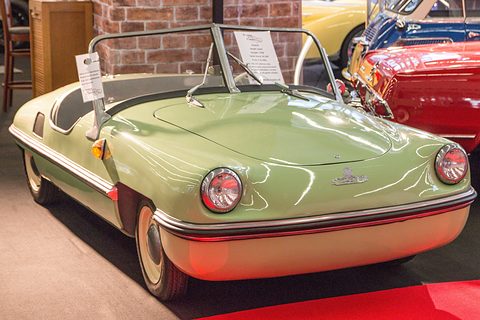
The V2N came from Brütsch’s last design, the V2, which in Germany led nowhere.source 3source 9 The German Wikipedia says that V2 stood for Volkszweisitzer, a people’s two-seater, and N for its backer, an Indonesian investor named Ngo.source 9 Who built it is unclear. The German Wikipedia names the Société France Jet, or the Union Industrielle of Neuilly-sur-Marne or Nogent-sur-Marne; the Weiner museum speaks of a connection with the Société France Jet in 1958.source 9source 6

The fuller story comes from the original microcarfan.com alone. In 1958 a “Jet 175” came first, and went no further. Then Monsieur Ngo asked for something sportier: scalloped flanks, a sharply tapered tail and unusual colours. Period documents give it a 175 cc Ydral, but the car the old site’s owner found in 2008 had a 200 cc Sachs, and had been painted blue over its original orange, the colour of its upholstery and tonneau.source 3

la V2N a un « look d’enfer »

Written about the V2N by the old microcarfan.com’s author, who found two of them. In English: “the V2N has a ‘hell of a look’.”source 3

A 1959 V2N, by the same account, had a door for the passenger, a taller windscreen with aluminium posts, an aluminium dummy grille and a big air grille at the back. It kept the beam chassis, but its running gear, transmission and engine were all new, the engine a French Ydral. A period advertisement offered 125, 175 and 200 cc, and the second V2N the old site’s owner found in 2008 had a 200 cc Ydral built for the purpose, with its own bore and stroke, not a rebored 175.source 3

There was an American venture too: a subsidiary, France-Jet Motor Ltd, showed the car in New York with an AMC 280 cc four-stroke, and a last American version of 1960, with a longer nose, big wheels and a 1,100 cc engine, was no longer a microcar.source 3 The German Wikipedia’s sources give the engines as Ydral 175, later AMC 280, or as 197 cc, 175 cc and 280 cc singles, a Fiat 500 twin having been planned and not used, and say only a few were built in 1959 and 1960.source 9

Variants

Five versions and a sequel

The Avolette range: in the code, the number is the engine size; Y, S or M names Ydral, Sachs or Maico; C is a coupé and D a convertible
VariantYearsWhat differsHow many
Normale (125 YD)1956–⁠1957The basic car, started by hand and licence-free; it could be upgradedWithin the 30 or so
Tourisme (175 YD, 175 YC)1956–⁠1957A top and a heater; Ydral 175 ccWithin the 30 or so
Tourisme de Luxe (200 SD, 200 SC)1956–⁠1957Convertible or coupé; the 191 cc SachsWithin the 30 or so
Compétition de Luxe (250 MB)1956A differently styled body; Maico 250 cc; dropped from the brochures earlyFew or none
Record de Luxe (250 MC, 250 MD)1956–⁠1957Four wheels, with twin rear wheels; the Maicoletta scooter’s 250 cc MaicoOne survivor known
New Avolette1957Softer shapes and a Lambretta 125 or 150 cc engineShown; few if any

Specification

The Record de Luxe, from the Weiner museum’s card unless noted

Engine and drive

Engine and drive
EngineMaico single-cylinder two-stroke, 250 ccsource 1source 2
Power14 hp (about 10 kW)source 3source 1source 2
GearboxFour forward and four reversesource 1
StarterDynastartsource 1RM describes the Maicoletta’s rocking starter
Other enginesYdral 125 and 175 cc; Sachs 191 cc, 9.5 hpsource 3source 6The old site gives the Sachs 10 ch at 5,000 rpm

Body and chassis

Body and chassis
BodyTwo fibreglass shells joined at the waist by a rubber strip; no doorssource 1source 6
FrameSteel tube: Brütsch’s T-tube stiffened by two D-shaped hoops into a cagesource 2
SuspensionNeidhart rubber-in-torsion at the front, Niemann rubber rings at the rearsource 1source 2
SteeringBy Bowden cablesource 1source 2
BrakesHydraulicsource 1
Wheels and electrics4.00 × 8; 12 Vsource 1

Dimensions

Dimensions
Length2,400 mmsource 1source 68 ft in RM’s catalogue; 2,710 mm in a 1958 annual, via the English Wikipedia
Width1,350 mmsource 11,420 mm in the 1958 annual
Height1,210 mm with the top, by the 1958 annualsource 8
Weight204 kg (450 lb)source 1

Performance and running

Performance and running
Top speed110 km/h (68 mph)source 1source 5The same is claimed for the 9.5 hp Tourisme de Luxe, which is doubtful
ExtrasA forward-tilting hardtop, a luggage carrier, hubcaps and a windscreen wipersource 6
Price newNot found

How many were built?

How many were built?

About 30 builtTwo museum records and the auction house that sold them agree on about 30, without a split by version. About six survive.source 1source 6source 2

  1. about 30all Avolettes, 1956–⁠1957Two sources agree

    Bruce Weiner Microcar Museum, two cards; RM Auctions, 2013source 1source 6source 2

  • Two sources agreetwo good sources give the figure
  • One sourcea good source, alone
  • Unconfirmeda lead only, not yet checked

Famous for

Three points

  1. Built in a hangar

    Cessna’s French agent assembled the cars in a hangar at Toussus-le-Noble airfield.

  2. The Cyclops

    From 1956 a single headlamp ran down the middle of the bonnet.

  3. Four ways back

    The Weiner museum’s cars had four forward gears and four in reverse.

Survivors and collecting

Today

About six Avolettes survive.source 1source 6 The Weiner museum had two, a Record de Luxe and a Tourisme de Luxe.source 1source 6 When its collection was sold in 2013, the Record de Luxe, restored in its original orange, was offered as the only surviving example of the most powerful version.source 2 The old site’s owner found two V2Ns in 2008.source 3 No club is known.

At auction
CarSalePrice
1956 Record de Luxe, identification no. 8RM Auctions, Weiner museum sale, Madison, Georgia, 2013, lot 604source 2$74,750

Sources

Numbered as in the text

No French period source has been read. Much of the V2N and France-Jet story rests on the original microcarfan.com alone. Sources are given as plain text; the links are on the Credits page.

  1. Bruce Weiner Microcar Museum, “1956 Avolette Record De Luxe”, tour page (© 2002), read in full.
  2. RM Auctions, The Bruce Weiner Microcar Museum, Madison, Georgia, 2013, lot 604, “1956 Avolette Record Deluxe”, catalogue text, read in full.
  3. The original microcarfan.com (2006–⁠2016), marque page “AVOLETTE”, one collector’s account, read in full from the archived copy.
  4. German Wikipedia, Avolette, read in full.
  5. cybermotorcycle.com, “Societe Air Tourist Microcars”.
  6. Bruce Weiner Microcar Museum, “1956 Avolette Tourisme (de Luxe)”, tour page (© 2002), read in full.
  7. English Wikipedia, Brütsch, the sections on the Zwerg.
  8. English Wikipedia, Avolette; it cites Automobilia, Toutes les voitures françaises 1958 (the Paris Salon of October 1957), not seen.
  9. German Wikipedia, V 2 N, read in full; it cites the Beaulieu encyclopaedia and Thyssen-Bornemissza’s Europäische Kleinwagen, not seen.