microcarfan
  • Microcar
  • United States
  • 22 makers

American post-war microcars

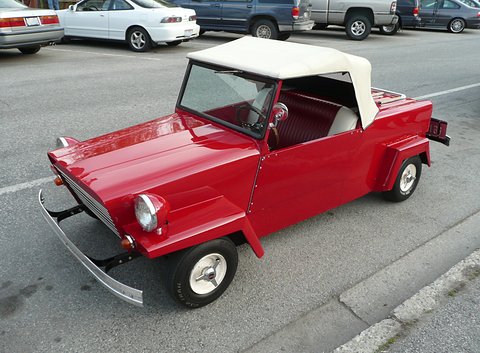
After the war America was short of cars, and dozens of small firms and lone inventors promised to fill the gap with a car for $600 that would do 80 km/h (50 mph) and 50 miles to the US gallon. One of them, the King Midget, built about 5,000. The rest built a few hundred at most, and some only one; a few were frauds.

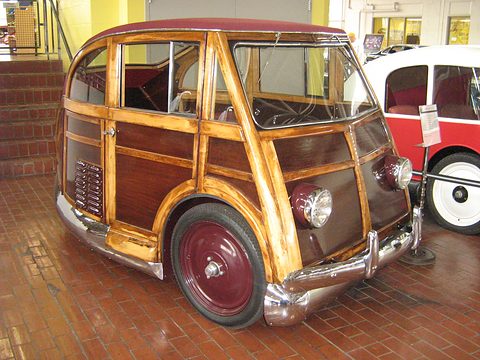
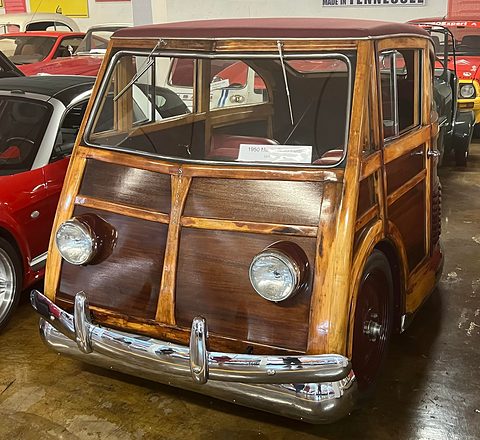
Varnished wooden small estate car with maroon wheels and a chrome front bumper, on a brick floor beside a red and white car.
The Martin Stationette at the Lane Motor Museum in 2009.Photo: dave_7, CC BY 2.0, via Wikimedia Commons

At a glance

The spec plate

American post-war microcars

Twenty-two cars · United States

Built
1944–⁠1964From the Russell Gadabout of October 1944 to the folding Diehlmobile of 1962–⁠64
Country
United StatesFrom San Diego and Los Angeles to Ohio, Baltimore, Boston and New York
Engine
Small industrial engines, mostly at the backBriggs & Stratton, Onan, Wisconsin and Kohler singles and twins; Crosley fours in the kit cars
Seats
2 to 6Two in most; six in the Delcar station wagons
Wheels
4Four on most; the Brogans, Publix, Basson’s Star and Diehlmobile three; the American Buckboard five
Price new
$400 to $1,500The Brogan at $400 in the late 1940s; the Panda at up to $1,500, the DeLuxe with a lift-off hard top, in 1954
Production
One to a few hundredEach; most fewer than 30

Not yet recordedpower and top speed.

The story

History

Buyers were starved of new cars, many feared a depression after the war, aircraft engineers and factories stood idle, and aluminium and glass fibre were new materials to try. Together they brought out dozens of would-be makers of small cars.source 1source 2source 3 The usual recipe was a single-cylinder or twin industrial engine by Briggs & Stratton, Onan, Wisconsin or Kohler at the back, a light body, a price under $600, and claims of 50 mph (80 km/h) and 50 US mpg (4.7 litres per 100 km).source 1source 2source 3 Several came from San Diego, where two Convair engineers drew small cars and one car was promoted from a former Convair plant; they were individuals, though, not the aircraft firm (see aircraft makers).source 2source 4source 3 Bob Cunningham, who has written the history of these cars, calls them orphan babies.source 5

Detroit stayed out. John Liefeld, who designed the Bobbi-Kar, remembered the big makers’ view.source 4

there is a market for a small car, but it is a limited market, and we don’t want to touch it unless we’re absolutely forced to.

The Detroit makers’ view of the small car, as recalled by John Liefeld, designer of the Bobbi-Kar, in English Wikipedia’s account.source 4

Money was the trouble. After the Tucker affair the Securities and Exchange Commission watched small-car share issues closely, and the Playboy, the Tucker and the Davis all faced indictments.source 4 Two of these cars, the Bobbi-Kar and the Towne Shopper, were fronted by a convicted fraudster (see frauds and never-weres).source 2 Besides the King Midget, only Brogan and Eshelman made more than a handful.source 1source 6source 7 Crosley’s parts turn up in several of them, and its farm runabout, the Farm-O-Road, has a page of its own. The cars below follow in date order.
Russell Gadabout

1944–⁠1945 · a record on this page

Ray Russell, a Detroit industrial designer who owned a Stout Scarab and lived in a house by Frank Lloyd Wright, showed the Gadabout in October 1944, which may make it the first all-new post-war American car. He had tried before, with a body of ethyl cellulose on wire mesh in 1941 and one of plywood in 1942, both on Chevrolet chassis. The Gadabout had a four-panel aluminium body on a widened MG chassis with an 80 in (2,032 mm) wheelbase, and seated three abreast. Its engine could be mounted at either end, and it had no axles and no gearbox: hydraulic motors in the hubs drove the wheels. The engine was an air-cooled two-stroke with direct injection and perhaps the first turbocharger on an American car. Popular Science and Mechanix Illustrated both praised it. One was built, and it is not known to survive; Russell went to Kaiser-Frazer.source 8

Bobbi-Kar

1945–⁠1947 · a record on this page

S. A. Williams founded the Bobbi Motor Car Corporation in San Diego in 1945–⁠46, and John Liefeld, a former Chrysler engineer who had spent the war at Convair, designed a two-seat runabout to sell for under $600, with its engine at the back.source 2source 4 During a share offer worth millions, California regulators found that Williams had a conviction for felony fraud from his years in the restaurant trade. The offer died, and Williams moved to Birmingham, Alabama, with a handful of staff, the blueprints, a few parts and the one finished car.source 2source 4 Around the turn of 1947 the management and George D. Keller, a former vice-president of sales at Studebaker, pushed him out, and the car became the Keller.source 2source 4

Keller Motors moved in mid-1947 into surplus chemical-munitions buildings at the Huntsville Arsenal, signed 1,689 dealers, offered $5 million of shares and planned 16,000 cars in its first year. The Keller grew into a larger car with Hercules engines and a wooden station wagon on a 94 in (2,388 mm) wheelbase, no longer a microcar. The SEC investigated the firm for two and a half years and found nothing wrong. George Keller’s death in 1950 ended it, after 18 Kellers.source 4

Arbet

1945–⁠1956 · a record on this page

The machinist Arliss Sluder began his car late in 1945 and finished it in 1956, making almost all of its 5,000 parts himself, and named it after himself and his wife Beth. It was 2,248 mm (88½ in) long, 1,016 mm (40 in) wide and 978 mm (38½ in) high, weighed just over half a ton, and with a 13 hp Onan twin did 72 km/h (45 mph) and 4.7 l/100 km (50 US mpg). The Guinness Book of Records listed it from 1993 to 1997 as the smallest car registered in the United States (see records and feats).source 9 There was only one.

Brogan

1946–⁠1958 · a record on this page

Frank Brogan’s B & B Specialty Company of Rossmoyne, Ohio, whose first product was a beer dispenser, built a three-wheeler with one wheel ahead of two, 2,438 mm (96 in) long, with no doors and no top. A Briggs & Stratton single or a 10 hp Onan twin sat at the back; it did 72–80 km/h (45–50 mph) and nearly 70 US mpg, and changed gear with a mercury-worked shift and no clutch pedal. It was designed with women in mind, and to change the front tyre you lifted the grille. Brogan built 30 himself and sold them at $400, losing $100 on each. He also made an Errand Boy delivery scooter and a small van, the Package Car.source 7

The answer to the demand for a tiny, inexpensive car.

Frank Brogan on the Broganette, 1951, as quoted by Small Cars Club.source 10

The Broganette of 1951 turned the layout round, with two wheels in front, and had the Onan twin, fold-down doors and a soft top for $500; there was an ice-cream van too. Fewer than 12 were sold, then about 50 of a revised design, before a fire destroyed the factory in 1958. Brogan moved to Cincinnati to make scooters, golf carts and go-karts, and later built a two-seater, the Brogan Street-Cart.source 10 MTDM calls Brogan the second most successful post-war minicar maker after the King Midget.source 1

Comet

1946–⁠1948 · a record on this page

English Wikipedia’s list records a Comet from the General Development Company of Ridgewood, Queens, New York, with a 4.5 hp engine.source 11 Nothing more has been found.

Airscoot

1947 · a record on this page

Aircraft Products of Wichita, Kansas, built the Airscoot in 1947 for pilots, to fold up and travel in a light aircraft. It was a two-seat runabout only 934 mm (37 in) long and 508 mm (20 in) high, weighing 33 kg (72 lb) and carrying 204 kg (450 lb), with a 2.6 hp single, 40 km/h (25 mph), 3.9 l/100 km (60 US mpg) and a rack for two suitcases.source 12

Publix

1947–⁠1948 · a record on this page

The Publix of Buffalo, New York, was a three-wheeled aluminium runabout of 136 kg (300 lb). Its steering wheel could be moved for driving on the left or the right, and the car could be stood on its tail for shipping, which suggests ambitions to export. MTDM finds the information sketchy and the story a little suspect, and doubts that many, if any, were sold.source 1

Towne Shopper

1947–⁠1948 · a record on this page

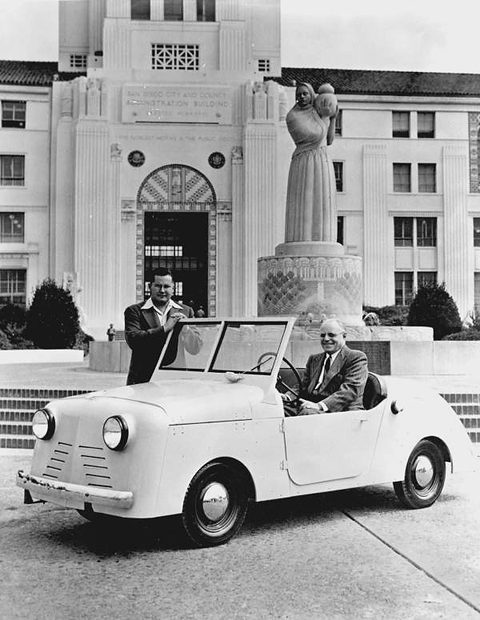
Williams, having lost the Bobbi-Kar, came back in San Diego as president of the International Motor Car Company, with J. D. Carter, also of the Bobbi firm, as chairman, in the former Convair plant.source 2source 13 Their Towne Shopper, launched in December 1947, weighed 272 kg (600 lb) and was to cost $600, with claims of 80 km/h and 50 US mpg. It was aimed at housewives: the engine was at the back, and the luggage boot in front had a latch worked by a pedal under the bumper, so that it opened with your arms full of shopping. MTDM gives it an aluminium body, two seats and no doors.source 2source 13source 1 The Lane museum’s car has an air-cooled twin of 12 hp with a centrifugal clutch.source 13

The Small Car with a Thousand Uses.

Towne Shopper advertising, 1947–⁠48, as recorded by MTDM and the Lane Motor Museum.source 2

Business Week covered it on 3 January 1948, Popular Science in March and Popular Mechanics put it on its cover in April. Dealers paid $1,500 for a franchise and a demonstrator, 50 of them by March 1948, and Williams promised 100 cars a day early that year and $500,000 of tooling.source 2source 13 But International Motor Car had ceased to exist by early 1948. Harvey Motors briefly took the car on, and in September 1948 the Carter Motor Corporation showed a facelifted steel Town Shopper and a larger front-engined Sportster at $750 (see the Carter Town Shopper); by the end of 1948 it was all over. Williams went on to promote an Electrakar and was later convicted of distributing counterfeit $20 notes.source 2 Very few were made. The Lane Motor Museum has two, a restored Carter car and an International Towne Shopper that was being restored in 2022.source 2source 13

A small white open car with a slatted nose, one man at the wheel and another standing by its windscreen, a large civic building behind.
Plate I · 1948 A San Diego Town Shopper, in its Towne or later Carter form, with two men outside the San Diego City and County Administration Building in 1948.Photo: State Library and Archives of Florida, No known copyright restrictions, via Wikimedia Commons

Carter Town Shopper

1947–⁠1948 · a record on this page

The Carter Town Shopper was the Towne Shopper under its maker’s third name. The International Motor Car Company had become the Harvey Motor Corporation by June 1948 and the Carter Motor Corporation by October, with J. D. Carter as president and H. M. Dickinson as vice-president.source 14source 2 Carter’s car had a steel body and its headlamps set in the front panel, and its engine moved to the front, driving the rear wheels: a 12 hp air-cooled single with a centrifugal clutch, which The Autopian identifies as a Gladden 75 “Bee-Line” four-stroke.source 15source 14 It cost $595 at San Diego, and the Lane museum gives it about 72 km/h (45 mph) and 5.2 litres per 100 km (45 US mpg).source 15source 14

gives the basic data with the exception that the motor has been moved from the rear of the car to the front

A Carter Motor company letter of 1948 on the car’s brochure, as quoted by The Autopian.source 14

The Lane Motor Museum’s page still dates its Carter car to 1942 and calls it a wartime errand car. Later research, by the museum itself and by MTDM, places the whole story in 1947–⁠48, and The Autopian suggests that the car was titled under a stray 1942 California plate.source 15source 14source 2

Delcar

1947–⁠1949 · a record on this page

English Wikipedia’s list gives the Delcar to American Motors Incorporated of Troy, New York, with a 25 hp engine: first a delivery van, then one or more six-seat station wagons on the same chassis.source 11 Nothing more has been found.

Thrif-T

1948–⁠1955 · a record on this page

Little is recorded. The Thrif-T is said to have been a three-wheeled utility vehicle, but the one source that might confirm it could not be read, and nothing more has been found.

Martin Stationette

1948–⁠1954 · a record on this page

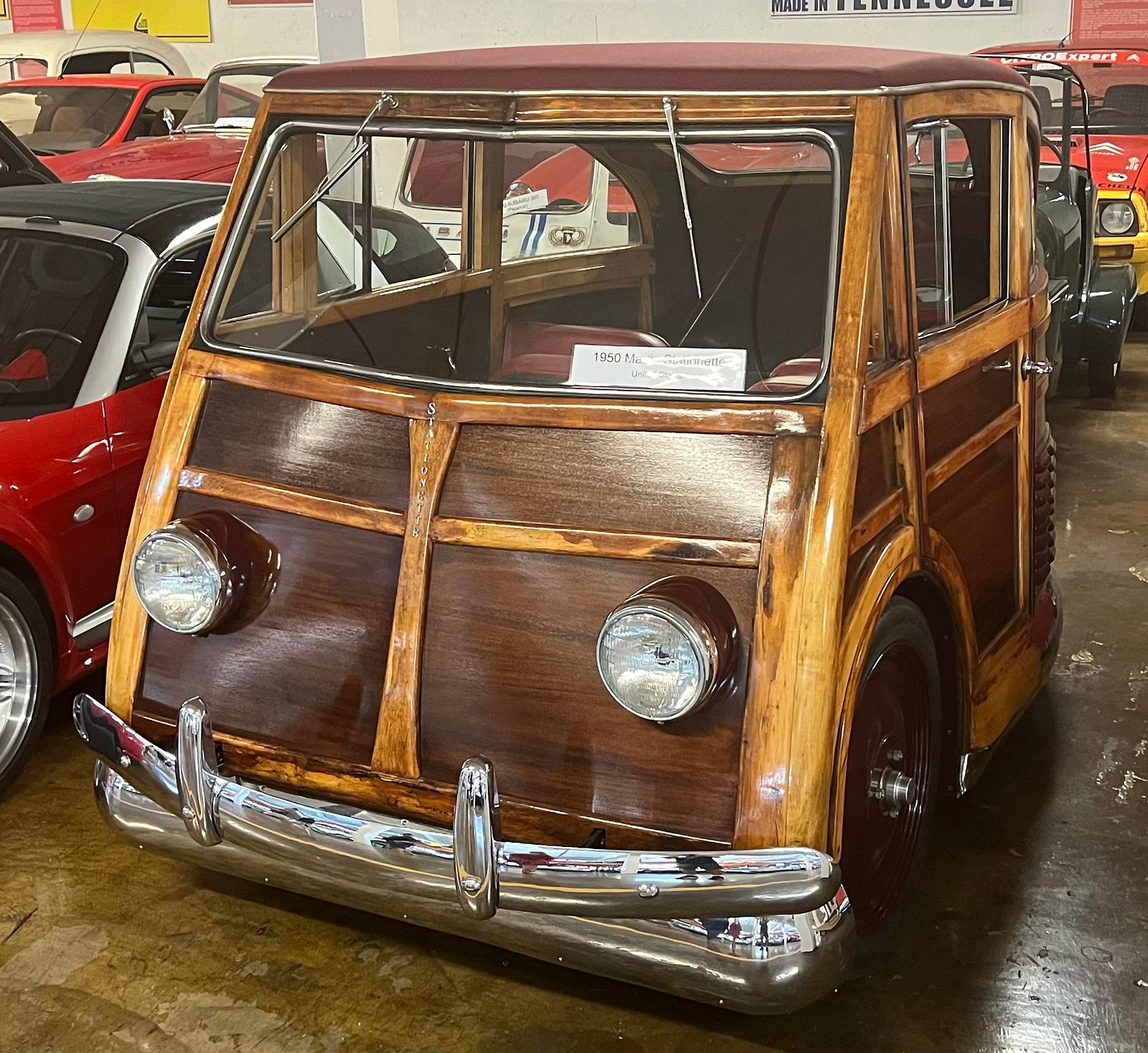
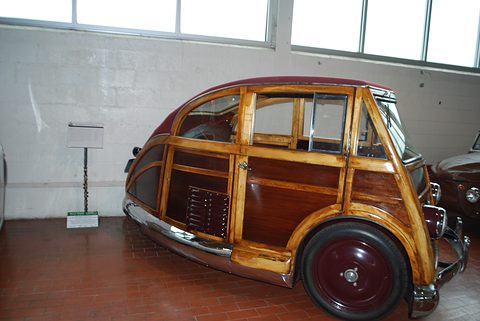
James V. Martin, a prolific inventor who had earlier built the Martin Aerodynamic and the Martinette, built the Stationette, a small wooden-bodied car whose body was a monocoque, with no axles, dampers or propeller shaft. A water-cooled Hercules four of 65 cu in sat at the back with three speeds, for a top speed of 97 km/h (60 mph). It was to cost $995, and at the World Motor Sports Show of 1954 it was billed as America’s economy car of the future.source 16 The Lane museum names its builder as the Commonwealth Research Corporation of New York and says one was made; MTDM names Martin Development Laboratories of Rochelle Park, New Jersey, says two, calls it a three-wheeler and mentions an automatic transmission with a magnetic coupling.source 16source 1 Small Cars Club adds that Basson’s Industries was involved.source 17 The Lane Motor Museum owns the car.source 16

Small varnished wooden estate car with maroon wheels, chrome bumpers and a maroon roof, on a brick museum floor.
The Martin Stationette’s varnished wooden body, at the Lane Motor Museum in 2012.Photo: dozier.donald, CC BY-SA 2.0, via Flickr

IMP

1948–⁠1951 · a record on this page

The IMP came from R. K. Griffin of Pasadena by MTDM’s IMP page, or International Motor Products of Glendale by its King Midget page. It was a two-seat runabout with a single-cylinder engine at the back and a one-piece glass-fibre body, one of the very first, inside an external frame meant to protect it all round. It was 2,489 mm (98 in) long, weighed 249 kg (550 lb) and cost $695, and it was aimed at teenagers.source 18source 1

A Little Car with a Big Future.

IMP advertising slogan, 1948, as recorded by MTDM.source 18

As many as seven were built in three years, and none is known to survive.source 18source 1

Pup

1948–⁠1949 · a record on this page

Nothing about the Pup has been confirmed. One local-history lead suggests that it was no more than a golf cart.

Airway

1949–⁠1950 · a record on this page

T. P. Hall graduated from MIT in 1931 and became Convair’s chief development engineer, working on the PBY Catalina and the B‑24 and building the Convair Model 116 and 118 flying cars of 1946 and 1947. With the designer W. Everett Miller he set up Airways Motors in San Diego, and early in 1949 built two prototypes: a two-seat coupé claimed at $600 and 272 kg (600 lb), and a three-seat aluminium saloon, the Town Traveler. A 10 hp Onan twin sat at the back, in place of the flying car’s 26 hp Crosley, driving through a fluid drive and a low gear. Its 2,540 mm (100 in) wheelbase puts it beyond this site’s size rule, and the claims were 80 km/h and 50 US mpg; the price rose to $750.source 3source 19source 1 MTDM sees it as serious engineering, not a scam. Only a handful were built.source 3source 1

Hoppenstand

1949–⁠1950 · a record on this page

Little is recorded. One lead puts the number of Hoppenstands built at about three, but no account of the car has been read.

Skorpion

1951–⁠1954 · a record on this page

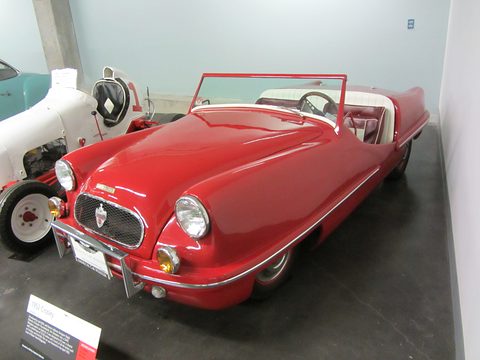
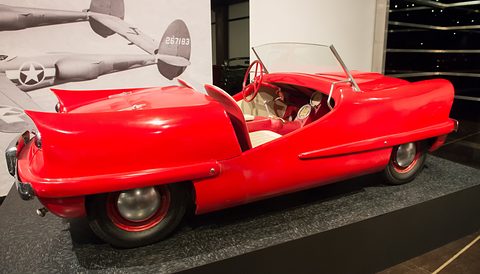
Ralph Roberts, who had worked for the coachbuilder LeBaron and for Chrysler, and the plastics specialist Jack Wills, of Wills and Roberts Manufacturing in Pasadena, worked with Burt Dake of Plastics, Inc. on a small car called the Wasp, with an Indian motorcycle engine at the back, and then on the front-engined Skorpion, built on modified Crosley frames. It was shown at the Los Angeles Motorama in 1951 and featured in Motor Trend in April 1952. Mostly it was sold through the WilRo Company as a glass-fibre body kit, at $445, for any chassis with a wheelbase of up to 2,032 mm (80 in). About 25 bodies were made before the business was sold in 1952 to Doug Caruthers’s Viking-Craft of Anaheim, which made the Super Skorpion until 1954; Wills said about 150 kits were made in all. A restored Skorpion took second in its class at the Napa concours in 1984, and Burt Dake restored a 1952 Crosley-based car.source 20 It was a sports-car kit rather than an economy car.

Low red open two-seater with an oval mesh grille, round headlamps and a chrome-rimmed windscreen, on a dark museum floor.
A red 1952 Skorpion glass-fibre roadster in a museum in 2015.Photo: Hugo-90, CC BY 2.0, via Flickr

Eshelman

1953–⁠1960 · a record on this page

The C. L. Eshelman Company of Baltimore made lawn mowers, rotary tillers, children’s pedal cars and coin-operated rides. It built four cars: a child’s car of 2 hp, 1,372 mm (54 in) long and 122 kg (270 lb); the Adult’s Sport Car, 1,626 mm (64 in) long with 6 hp and brakes on all four wheels; the 8½ hp Sportabout, 1,829 mm (72 in) long; and at last a two-cylinder two-seater, the Model 903. How many were made is not known, though MTDM thinks not likely more than a few hundred, and calls it the second most successful after the King Midget, a place its King Midget page gives to Brogan.source 6source 1

Panda

1953–⁠1956 · a record on this page

Finn S. Hudson, a Norwegian-born engineer and a former Crosley dealer, set up Small Cars, Inc. in Kansas City, Missouri, in February 1953. In the autumn of 1954 he showed the Panda: a Crosley chassis with its wheelbase cut from 2,159 to 1,778 mm (85 to 70 in) and a two-seat glass-fibre roadster body. A 27 hp air-cooled Kohler twin was standard, for a claimed 105 km/h (65 mph), and a Crosley engine was offered, for 121 km/h (75 mph). Twelve pilot cars were assembled, at $1,000–1,500, the DeLuxe with a hard top that lifted off; a station wagon was on the way, and the plan was 10,000 a year. In 1956 the venture collapsed. The pilot cars went to settle debts, the tooling was scrapped, and none is known to survive.source 5

American Buckboard

1955–⁠1956 · a record on this page

The American Buckboard Corporation of Los Angeles revived the idea of the Briggs & Stratton Flyer in 1955–⁠56 with an open car on five wheels, also called the Bearcat; the fifth wheel, between and behind the rear pair, was driven by a two-cylinder motorcycle engine.source 1source 11

Basson’s Star

1956 · a record on this page

Basson’s Industries of the Bronx, New York, offered the Star in 1956, styled by Gil d’Andrea: an open three-wheeler with a two-piece glass-fibre body, 3,170 mm (125 in) long, over this site’s size limit, but weighing only 181 kg (400 lb). An ILO single-cylinder two-stroke was claimed to give 2.9 litres per 100 km (80 US mpg). It had a 1.5 m turning radius, independent rear suspension, hydraulic brakes and an aeroplane-type steering wheel, and cost $999. Few bought it.source 17 English Wikipedia’s list calls it a prototype three-wheeled light delivery van.source 11

Colt

1958 · a record on this page

Colt Motors of Boston showed a two-seat convertible in 1958 with a one-piece glass-fibre body made by a local boat builder and finished in a hat factory owned by one of its directors. It weighed about 318 kg (700 lb), and a Wisconsin air-cooled single of 23 cu in, with a centrifugal clutch, gave 80 km/h (50 mph) and 3.9 l/100 km (60 US mpg), for $995. By Small Cars Club’s account Colt tried and failed to buy King Midget chassis wholesale from Midget Motors, and the project was cancelled.source 21

Diehlmobile

1962–⁠1964 · a record on this page

The H. L. Diehl Company of Willington, Connecticut, made the Diehlmobile in 1962–⁠64: a folding three-wheeled spare car with a 3 hp Briggs & Stratton engine, to be carried in the boot of a full-size car.source 11 Nothing more has been found.

Pictures

More photographs, old and new

Variants

Twenty-two cars, in date order

American post-war microcars, 1944–⁠64
VariantYearsWhat differsHow many
Russell Gadabout1944–⁠45Detroit: hydraulic motors in the wheel hubs1
Bobbi-Kar1945–⁠47San Diego, then Alabama; became the Keller18 Kellers
Arbet1945–⁠56A machinist’s home-built car, 2,248 mm long1
Brogan1946–⁠58Ohio three-wheelers, one wheel in front, then two30, then about 60
Comet1946–⁠48Queens, New York; 4.5 hpNot found
Airscoot1947Wichita: folded to fit in a light aircraftNot found
Publix1947–⁠48Buffalo: an aluminium three-wheelerFew, if any
Towne Shopper1947–⁠48San Diego: $600, rear engine, a boot opened by foot; then Carter’s front-engined steel carVery few
Delcar1947–⁠49Troy, New York: a small van, then station wagonsNot found
Thrif-TSaid to be 1947–⁠55A three-wheeled utilityNot found
Martin Stationette1948–⁠54A wooden monocoque with no axles1 or 2
IMP1948–⁠51California: a one-piece glass-fibre bodyUp to 7
Pup1948–⁠49Perhaps only a golf cartNot found
Airway1949–⁠50San Diego: a Convair engineer’s aluminium carA handful
Hoppenstand1949–⁠50Little recordedAbout 3, by one lead
Skorpion1951–⁠54Pasadena: a glass-fibre body kit for a Crosley chassisAbout 150 kits
Eshelman1953–⁠60Baltimore: four sizes, from a child’s car upA few hundred at most
Panda1953–⁠56Kansas City: a glass-fibre roadster on a shortened Crosley12 pilot cars
American Buckboard1955–⁠56Los Angeles: five wheels, the fifth drivenNot found
Basson’s Star1956The Bronx: a glass-fibre three-wheeler, $999Very few
Colt1958Boston: a glass-fibre convertible, $995Not found
Diehlmobile1962–⁠64Connecticut: a folding spare car for the bootNot found

Specification

The four best recorded

Towne Shopper, 1948

Towne Shopper, 1948
EngineAir-cooled four-stroke twin, 12 hp, centrifugal clutch, at the backsource 13
Weight and price272 kg (600 lb), $600source 2source 13
Claims80 km/h (50 mph) and 4.7 l/100 km (50 US mpg)source 2source 13

Brogan three-wheeler, 1946–⁠50

Brogan three-wheeler, 1946–⁠50
EngineBriggs & Stratton single or a 10 hp Onan twin, at the backsource 7
Size2,438 mm (96 in) long; 1,676 mm (66 in) wheelbasesource 7
Running72–80 km/h (45–50 mph); nearly 3.4 litres per 100 km (70 US mpg)source 7
Price$400source 7

Martin Stationette, 1950

Martin Stationette, 1950
EngineHercules water-cooled four, 65 cu in, at the back; three speedssource 16
ConstructionA wooden monocoque, with no axles, dampers or propeller shaftsource 16
Top speed97 km/h (60 mph)source 16
Price$995, proposedsource 16

Panda, 1954

Panda, 1954
ChassisCrosley, the wheelbase cut from 2,159 to 1,778 mm (85 to 70 in)source 5
EngineKohler air-cooled twin, 27 hp; a Crosley engine optionalsource 5
Top speed105 km/h (65 mph) claimed; 121 km/h (75 mph) with the Crosley enginesource 5
Price$1,000–1,500source 5

How many were built?

The few figures found

From one car to a few hundredNo maker in this group is known to have built more than a few hundred cars, and most built fewer than 30. The best documented is Brogan: 30 three-wheelers, then about 60 Broganettes. Eshelman’s output is MTDM’s estimate only.

  1. a few hundred at mostEshelmans, an estimateUnconfirmed

    MTDMsource 6

  2. about 150Skorpion body kits, by Jack Wills’s accountOne source

    Small Cars Clubsource 20

  3. about 60Broganettes: fewer than 12, then about 50 of a revised designOne source

    Small Cars Clubsource 10

  4. 30Brogan three-wheelers, 1946–⁠50One source

    Small Cars Clubsource 7

  5. 18Kellers, the Bobbi-Kar’s successorOne source

    English Wikipediasource 4

  6. 12Panda pilot carsOne source

    Bob Cunningham, after MotorLifesource 5

  7. up to 7IMPs in three yearsOne source

    MTDMsource 18

  • Two sources agreetwo good sources give the figure
  • One sourcea good source, alone
  • Unconfirmeda lead only, not yet checked

Famous for

Three points

  1. Fraud and engineering

    A convicted fraudster fronted two of these cars; others, like the Airway, were serious engineering.source 2source 3

  2. Early glass fibre

    The IMP, Skorpion, Panda, Basson’s Star and Colt all had glass-fibre bodies.source 18source 20source 5source 17source 21

  3. Odd to the end

    A car that folded into an aeroplane, one with five wheels and the smallest car registered in the United States.source 12source 1source 9

Survivors and collecting

Today

Few survive. The Martin Stationette and two Towne Shoppers are at the Lane Motor Museum in Nashville.source 16source 2 Burt Dake restored a 1952 Skorpion, and two of this page’s photographs were taken of Skorpions in museums in 2014 and 2015.source 20 No IMP, Russell Gadabout or Panda is known to survive, and none of these cars has turned up in the results of the big auction houses.source 18source 8source 5

Sources

Numbered as in the text

Almost every car here rests on one source, usually The Makes That Didn’t Make It or Small Cars Club, four are known from little more than a line in English Wikipedia’s list of American microcars, and three only from unchecked leads. No period magazine article was read, and Gunnell’s Standard Catalog of American Cars, which would cover most of them, was not consulted. Sources are given as plain text; the links are on the Credits page.

  1. The Makes That Didn’t Make It, “King Midget”, the section “More Microcars”, read in full.
  2. Mal Pearson, “Towne Shopper”, The Makes That Didn’t Make It, 2022, read in full.
  3. Mal Pearson, “Take to the Air in an Airways”, The Makes That Didn’t Make It, 25 October 2021, read in full.
  4. English Wikipedia, Keller (automobile), read in full. Used as a lead; it rests largely on John Liefeld’s recollections.
  5. Bob Cunningham, “1954 Crosley Powered Roadster Proposal Resulted in ‘Panda’-Monium”, Undiscovered Classics, March 2020, read in full.
  6. The Makes That Didn’t Make It, “It’s a Small World: the Eshelman”, 11 August 2021, read in full.
  7. Small Cars Club, “B&B Brogan Doodlebug”, read in full.
  8. The Makes That Didn’t Make It, “Russell Gadabout”, 2023, read in full.
  9. The Makes That Didn’t Make It, “Let’s Get Small, Really Small: the Arbet”, June 2026, read in full.
  10. Small Cars Club, “B&B Broganette”, read in full.
  11. English Wikipedia, List of microcars by country of origin: U, the relevant rows read. A lead only.
  12. Small Cars Club, “Airscoot”, read in full.
  13. Lane Motor Museum, “Harvey Towne Shopper – 1948”, collection page, read in full.
  14. Rex Bennett, “How the world’s quirkiest car museum is solving the mystery of this strange tiny car”, The Autopian, 11 August 2022, read in summary; it draws on the Lane Motor Museum’s research and company letters.
  15. Lane Motor Museum, “Carter Town Shopper – 1942”, collection page, read in full.
  16. Lane Motor Museum, “Martin Stationette – 1950”, collection page, read in full.
  17. Small Cars Club, “Basson’s Star”, read in full.
  18. The Makes That Didn’t Make It, “Imp”, read in full.
  19. Small Cars Club, “Airway”, read in full.
  20. Small Cars Club, “Skorpion and Super Skorpion”, read in full.
  21. Small Cars Club, “Colt Economy”, read in full.