microcarfan
  • Prototype
  • Several countries
  • 6 makers

American city-car prototypes

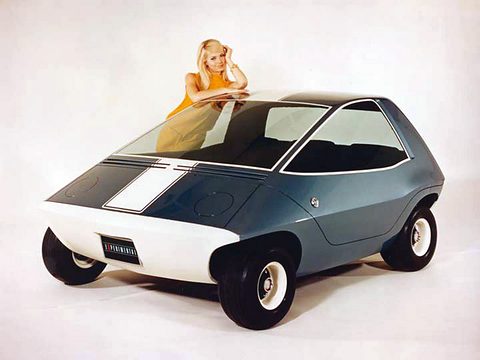
In December 1967 American Motors showed a three-seat city car 2,159 mm long, with lithium batteries, regenerative braking and a claimed range of 240 km (150 miles). It never reached a showroom.

A short wedge-shaped two-tone concept car with a white stripe, a large curved windscreen and small wheels, a woman behind it.
AMC Amitron electric city-car prototype of 1967 in American Motors’ publicity photograph, a model leaning on its roof.Photo: American Motors Corporation, Public domain, via Wikimedia Commons

At a glance

The spec plate

American city-car prototypes

Six makers · United States and Canada

Built
1959–⁠1989Prototypes only, from the Nu-Klea Starlite of 1959 to GM’s Lean Machine, shown in 1982 and still under study in 1989
Country
Several countriesLansing and Warren, Michigan, among others; the Venus at Valcourt, Quebec
Engine
Mostly electricLead-acid in the Starlite and XP-512E; lithium and nickel-cadmium cells in the Amitron; a Daihatsu three-cylinder in the Venus
Seats
1 to 3One in the Lean Machine, three in the Amitron
Wheels
4Four on most; the Lean Machine three, two of them at the back
Production
NonePrototypes; the Markette perhaps a handful

Not yet recordedpower and top speed.

The story

History

Between 1959 and the end of the 1980s, smog, the federal electric-vehicle bills of 1966 and then the oil crises pushed large companies, and a few would-be ones, to build city cars of microcar size.source 1source 2 American Motors and General Motors built them, and so did Westinghouse, which made generators, and Bombardier in Quebec; so did a firm in Lansing, Michigan, that never got further.source 1source 2source 3source 4source 5 Most were electric microcars. Each is described below in date order, and none of them went on sale, except perhaps a handful of Westinghouse Markettes.source 4 The electric city car that did reach production in these years, Sebring-Vanguard’s CitiCar, has its own page.
Nu-Klea Starlite

1959 · a record on this page

Stephen P. Kish designed the Starlite at the Nu-Klea Automobile Corporation, or Kish-Nu-Way Industries, in the old Auto Body plant in Lansing, Michigan. It was planned as a two-seat electric runabout with a glass-fibre body and a separate motor in each wheel, each fed by three lead-acid batteries, with a seventh battery for the accessories; a clear acrylic top that lifted off was planned too. It was to weigh under 1,089 kg (2,400 lb), about 408 kg (900 lb) of it batteries, and go 97 km (60 miles) on an overnight charge.source 3 It was driven in the Lansing Centennial parade in 1959, and the unrestored car now in Nashville’s Lane Motor Museum matches the photograph of the parade car.source 3 Its length has not been found; its weight suggests it was larger than a microcar.

Westinghouse Markette

1966–⁠1967 · a record on this page

Westinghouse Electric, the maker of generators, built a little box-shaped saloon called the Markette. Its name and its range of 56 km (35 miles) suggested quick trips to the market, and by MTDM’s account an unknown but very small number ever got there.source 4 Nothing more has been found.

AMC Amitron

1967 · a record on this page

American Motors built the Amitron with Gulton Industries of Metuchen, New Jersey, prompted by the federal electric-vehicle bills of 1966 and the amendment to the Clean Air Act.source 1 Its batteries were the point. Two lithium-nickel-fluoride cells of 34 kg (75 lb) each carried it at a cruise, and two nickel-cadmium batteries of 11 kg (24 lb) gave bursts of power, enough for 0–80 km/h (50 mph) in 20 seconds; the whole set weighed 91 kg (200 lb), where lead-acid batteries for the same job would have weighed nearly a ton. Regenerative braking, the first in the American industry, charged them as the car slowed, with an ordinary feel to the pedal, and AMC claimed a range of 240 km (150 miles) at 80 km/h.source 1 The body was a snub-nosed three-seater 2,159 mm (85 in) long, with air-filled seat cushions and no side doors: the canopy hinged up and back.source 1

could eliminate many problems that up to this point have made electric-type cars impractical

Roy D. Chapin Jr., chairman of American Motors, introducing the Amitron in December 1967, as quoted by English Wikipedia.source 1

AMC spoke of selling to commuters within five years, and in 1968 it tried the drive in a converted Rambler American. The cost of the batteries ended it. In 1977 the car was repainted, given mirrors and renamed the Electron for AMC’s Concept 80 show, without a working powertrain.source 1 English Wikipedia sees its short, wide proportions in AMC’s Pacer and its tail in the Gremlin, and AMC’s electric work went on in the Jeep DJ-5E Electruck postal van from 1974.source 1 Where the car is now has not been established.

GM XP-512

1969 · a record on this page

General Motors showed a family of commuter studies, the XP-512, at its Progress of Power event at Warren, Michigan, in 1969; the electric one, the XP-512E, is the best recorded, and an XP-512G and an XP-512H are known only by name.source 2 It was a two-seat electric bubble car with a glass-fibre body, a wrap-round glass canopy that opened upwards, and a front panel that opened as on the BMW Isetta. It was 2,192 mm (86.3 in) long, 1,422 mm (56 in) across, on a wheelbase of 1,321 mm (52 in), and weighed 567 kg (1,250 lb) with its 84-volt pack of lead-acid batteries and a 12-volt battery for the accessories. It went 93 km (58 miles) at 40 km/h (25 mph), or 76 km (47 miles) at its top speed of about 48 km/h (30 mph), and took seven hours to charge from a 115-volt socket.source 2

American Electric Urban Runabout

1979 · a record on this page

Small Cars Club records a 1979 prototype by the American Electric Company: a very simple two-seater on four small wheels, probably with a rear motor and rear-wheel drive, and a little luggage space under a lid at the front. Beyond that, it says, there is almost no information.source 6

GM Lean Machine

1982–⁠1989 · a record on this page

Frank Winchell of General Motors wanted a one-seat commuter with a car’s stability and weather protection in a motorcycle’s size. His Lean Machine was a three-wheeler in two parts: a fixed lower power pod carrying the two rear wheels, and an upper passenger pod on the single front wheel that leaned into corners. The rider leaned it with pedals and worked the throttle and brakes by hand, on handlebars. There were two versions, and the second was said to reach 97 km/h (60 mph) in 6.8 seconds.source 7 GM said in 1989 that it was considering it for sale in congested California.source 7 It never was, but in 1993 it appeared with 16 other GM concept cars, valued together at $69 million, in Demolition Man.source 7

Bombardier Venus

1984–⁠1985 · a record on this page

In the early 1980s Bombardier’s president, Laurent Beaudoin, came across the French voitures sans permis, the licence-free cars, and the quadricycles in Paris, but Yvon Lafortune, who ran the firm’s works at Valcourt, Quebec, found that they could not meet Canadian safety standards.source 5 So in 1984 Bombardier began Project Venus, for Vehicle, Economical, New, Utilitarian and Safe, with Daihatsu supplying the engine and gearbox. Two recent graduates, Jean Labbé and Louis Morasse, designed it in a converted building on a Bombardier family farm, known as the barn, under the chief engineer Yves Fontaine. A working prototype, a modified Japanese car, was ready in six months and was tested at Transport Canada’s centre, and two more prototypes followed.source 5

It was to cost under $5,000, cheap enough to go on a credit card, and to be sold through Canadian Tire in Canada and Sears in the United States; Daihatsu’s Charade and Rocky were to be built at Valcourt too, and The Globe and Mail put the cost of the scheme at up to $500 million. It never went into production. The one surviving prototype, with a working Daihatsu three-cylinder, a five-speed gearbox and fixed windows with dummy winders, is in the Musée de l’ingéniosité J. Armand Bombardier at Valcourt.source 5

Variants

Seven prototypes, in date order

American city-car prototypes, 1959–⁠89
VariantYearsWhat differsHow many
Nu-Klea Starlite1959Lansing, Michigan: a two-seat electric with a motor in each wheel1, which survives
Westinghouse Markette1966–⁠67A small box-shaped electric saloon with a 56 km rangeA very small number
AMC Amitron1967Three seats, lithium and nickel-cadmium batteries, regenerative braking; shown again in 1977 as the ElectronPrototype
GM XP-512E1969A two-seat electric bubble with an opening front and a lifting canopyPrototype
American Electric Urban Runabout1979A simple two-seat electricPrototype
GM Lean Machine1982–⁠89A tilting single-seat three-wheelerTwo versions
Bombardier Venus1984–⁠85Valcourt, Quebec: a Daihatsu-engined people’s car3; 1 survives

Specification

The four best recorded

Nu-Klea Starlite, 1959

Nu-Klea Starlite, 1959
MotorsOne in each wheel, each fed by three lead-acid batteries, with a seventh for the accessoriessource 3
BodyGlass fibre; a removable clear acrylic top plannedsource 3
WeightUnder 1,089 kg (2,400 lb), with about 408 kg (900 lb) of batteriessource 3
Range97 km (60 miles) on an overnight chargesource 3

AMC Amitron, 1967

AMC Amitron, 1967
BatteriesTwo lithium-nickel-fluoride cells of 34 kg (75 lb) for range, two nickel-cadmium of 11 kg (24 lb) for bursts; 91 kg (200 lb) in allsource 1
BrakingRegenerative, the first in the American industrysource 1
Length2,159 mm (85 in); three seats; no side doorssource 1
Claims0–80 km/h (50 mph) in 20 seconds; 240 km (150 miles) at 80 km/hsource 1

GM XP-512E, 1969

GM XP-512E, 1969
Batteries84 V lead-acid, with a 12 V battery for the accessories; 7 hours to charge at 115 Vsource 2
Size2,192 mm (86.3 in) long, 1,422 mm (56 in) wide, 1,321 mm (52 in) wheelbasesource 2
Weight567 kg (1,250 lb)source 2
Range93 km (58 miles) at 40 km/h (25 mph); 76 km (47 miles) at its top speed of about 48 km/h (30 mph)source 2

Bombardier Venus, 1984–⁠85

Bombardier Venus, 1984–⁠85
EngineDaihatsu three-cylindersource 5
GearboxFive-speed manualsource 5
WindowsFixed, with dummy winders, on the survivorsource 5
Target priceUnder $5,000source 5

Famous for

Three points

  1. Lithium in 1967

    The Amitron carried lithium cells and regenerative braking in 1967.source 1

  2. A car that leaned

    GM’s Lean Machine tilted its passenger pod into corners like a motorcycle.source 7

  3. Canada’s licence-free car

    Bombardier’s Venus tried to bring the French small-car idea to North America.source 5

On screen

Confirmed appearances only

Survivors and collecting

Today

Two of these prototypes are known to survive: the Nu-Klea Starlite, unrestored, at the Lane museum, and the Bombardier Venus at the Musée de l’ingéniosité J. Armand Bombardier in Valcourt, Quebec.source 3source 5 Where the Amitron, the XP-512E and the Lean Machine are now has not been established.

Sources

Numbered as in the text

Every prototype here rests on one source: English Wikipedia for the Amitron and the Starlite, MTDM for the Markette, and Small Cars Club for the rest, the Venus section of which draws on La Presse and The Globe and Mail. None was road-tested by the press in any source read. Sources are given as plain text; the links are on the Credits page.

  1. English Wikipedia, AMC Amitron, read in full. Used as a lead; it cites Anderson and Anderson (2005, 2010) and the press of the day.
  2. Small Cars Club, “GM XP-512E”, read in full.
  3. English Wikipedia, Nu-Klea Starlite, read in full. Used as a lead; it cites the Lane Motor Museum and a people’s history of Old Town Lansing (2023).
  4. The Makes That Didn’t Make It, “Sebring-Vanguard”, the paragraph on the Westinghouse Markette, read in full.
  5. Small Cars Club, “Bombardier Venus”, read in full; it draws on La Presse and The Globe and Mail.
  6. Small Cars Club, “American Electric Urban Runabout”, read in full.
  7. Small Cars Club, “General Motors Lean Machine”, read in full.