The story
History
David Edmonson started on a car of his own in 1970, and his rule, as the owners’ club gives it, was to build it small and light.source 1 By the club’s account his prototype won a real-road mileage contest run by the SAE in 1977, at 2.9 litres per 100 km (80.3 US mpg), and again in 1978, at 2.7 litres (88.3 mpg).source 1 In 1978, with backers behind him, he announced two models for early 1979: an open Freeway with a snap-down cover and the smaller engine, and the enclosed Freeway II with a bigger one. The smaller engine came with the 100 mpg guarantee, the larger was expected to do about 2.9 litres per 100 km (80 mpg) at 64 km/h, and an electric model was offered. A factory was set up and orders were taken.source 1
Snowmobile parts
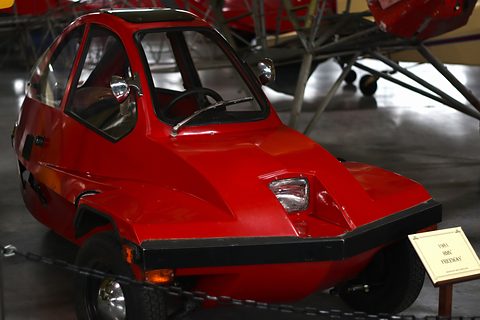
The Freeway was a three-wheeler with two wheels at the front and a lone driven wheel at the back. A Tecumseh air-cooled single, of 340 cc and 12 hp or 450 cc and 16 hp, sat behind the driver and drove through a variable belt of the kind used on snowmobiles to a jackshaft, then by chain to the rear wheel. There was no reverse; one was promised for the Deluxe and never made.source 2source 1 The frame was a welded steel-tube ladder with a second frame round it at bumper height, the suspension was independent all round, and the two-piece body was glass fibre about 3.2 mm thick, coloured in the moulding, red, yellow or orange as standard, with a full undertray beneath. It had one seat with a three-point harness, and a single headlamp.source 2source 1 At 2,921 mm (115 in) long and about 318 kg (700 lb), it could be registered as a motorcycle under federal rules, though some states took it as a car.source 2source 3 MTDM jokes that no helmet was needed, since the car was one.source 3
Thirty hours a car
The backers could not pay the bills, and after a split with one of them, Vexilar, in August 1979 Edmonson cut back, moved production and built only the hard-top, in Standard and Deluxe trim. The prototypes, with wings, a blended bumper and twin headlamps, looked different from the cars that followed. Orders had grown from 200 to over 1,000, on small refundable deposits.source 1 Six pilot cars were built in December 1979 and the first six production cars in March 1980. Money was always short: suppliers wanted cash in advance, and each car took 30 hours to build. One customer, order number 38, received the car in August 1980, 18 months after he ordered it, and about two-thirds of the orders were cancelled before delivery.source 1 By August 1981, 350 petrol cars and 15 electric ones were reported built.source 1
The electric Freeway had a 4 hp motor and four batteries behind the seat, later six, which made it very heavy at the back. The club tells of a Stanford professor, Bob Schneeveis, who tipped one onto two wheels while testing its stability, and of a Department of Transportation report that called the electrics extremely unstable.source 1 A diesel was listed but never ordered.source 2source 1
In 1982 HMV sent cars to dealers as samples, hoping to build a network, but fuel prices fell and sales fell with them.source 1source 3 The company went bankrupt in June 1982, after about 700 Freeways.source 2source 3source 1 By the club’s account the leftover stock paid the bills: one employee was paid in three cars, and a lawyer took one as his final fee. D&A Vehicles of Minnesota bought the rights and in 1984 built 15 Minikins, a two-seat convertible; MTDM says only a handful.source 1source 3 MTDM also points out that the later Elio three-wheeler claimed exactly the 84 mpg it says the Freeway had claimed.source 3