microcarfan
  • Microcar utility
  • United States
  • Three wheels
  • Post Office van

Westcoaster Mailster

Also known as Mailster, mail scooter

A letter carrier on foot could carry 16 kg (35 lb) of mail. Put him behind the wheel of a three-wheeled quarter-ton van and he could carry 230 kg (500 lb). By the early 1960s a third of the American Post Office’s vehicles were mailsters, and carriers had plenty to say about them.

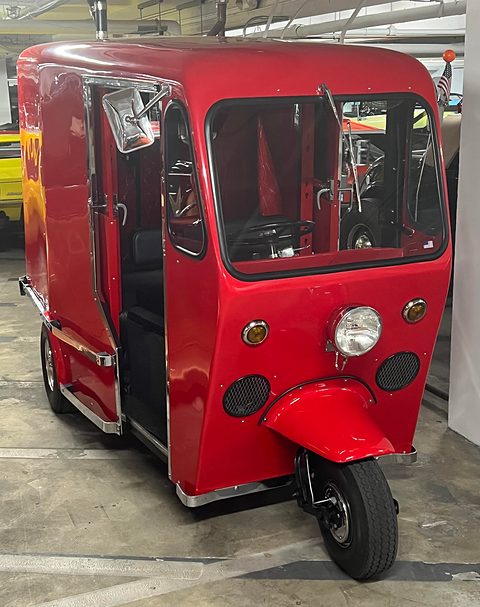
Red three-wheeled glass-fibre mail van with its sliding door open and a single headlamp in the nose.
A restored red Westcoaster Mailster at the Petersen Automotive Museum, Los Angeles, in August 2024.Photo: TaurusEmerald, CC BY-SA 4.0, via Wikimedia Commons

At a glance

The spec plate

Westcoaster Mailster

Quarter-ton mail van · California

Built
1950–?Three-wheeled mail scooters were first tried in Miami in 1950; the fleet peaked in 1966, and when Westcoaster stopped building them is not recorded
Country
United StatesWestcoaster Company, California
Maker
Westcoaster CompanyFormerly the West Coast Machinery Company; Cushman and others built mailsters too
Engine
Onan air-cooled opposed twinPetrol, with an electric starter and a manual back-up
Power
7.5 hp
Length
2,921 mm1,499 mm wide, 1,880 mm high
Seats
1The carrier
Wheels
3One wheel at the front, two at the back
Production
no total foundAbout 17,700 mailsters of all makes were in service in 1966
Top speed
56km/h56 km/hThe Post Office’s own film says 40 km/h (25 mph), and 24 km/h (15 mph) or less in turns

Not yet recordedweight.

How big is it?

True proportion

2.92 m

It is 49 mm shorter than a Fiat 500, about 1.7 adults laid end to end.

  • 1.50 m wide
  • A payload of about 230 kg (500 lb) of mail
Drawn at true proportion. The track is 3.6 metres long; the adult stands at the same scale. The Peel P50 is the smallest production car, on every page for comparison.

The story

History

For the first half of the 20th century, trucks took American letter carriers and their mail to the start of their rounds, and from there they walked. After the war the suburbs grew, routes grew longer, and the Post Office Department wanted each carrier to take more mail to more homes. It began putting carriers behind the wheel, in vehicles that were light and easy to handle.source 1source 2 In 1950 it tried three-wheeled scooters in Miami, and in Florida they worked well. A carrier on foot could carry 16 kg; in one of these he could carry about 230 kg of mail, big parcels included.source 1source 2

They were called mailsters, or by carriers mail scooters, and at least seven firms built them, Cushman among them.source 1source 2source 3 Carriers began using them in the middle of the decade, and because they were cheap their numbers grew fast: more than 5,700 were on the road in 1960, and by the early 1960s they made up a third of the Post Office’s fleet. In 1966, at the peak, about 17,700 were in use.source 1source 2

The Westcoaster

The Westcoaster Company of California, formerly the West Coast Machinery Company, made electric and petrol vehicles for farms, airports and golf courses.source 2source 3 Its Mailster was a three-wheeler with a glass-fibre body and sliding metal doors, and an Onan air-cooled opposed twin of 7.5 hp driving through three gears, changed on the column.source 3source 1source 4 The one in the Smithsonian is 2,921 mm (115 in) long, 1,499 mm (59 in) wide and 1,880 mm (74 in) high, a micro van for one carrier and a quarter ton of mail.source 2

The Post Office made a film, How to Drive the Mailster Safely. It shows how to start one with the electric starter or by hand, how to change gear, and how to brake: the rear wheels with a foot pedal, the front wheel with a lever on the handlebar, and the parking brake on hills. Its mailster has a front apron that comes off for air and side curtains with an armhole for hand signals. It sets 40 km/h (25 mph) as the most that is safe, and 24 km/h (15 mph) or less in turns; English Wikipedia gives a safe maximum of 56 km/h (35 mph).source 4source 1

Children are attracted by the unusual size and design of the mailster.

The narrator of How to Drive the Mailster Safely, a Post Office training film, as quoted by the National Archives’ Unwritten Record blog, 6 December 2022.source 4

Snow, wind and a dog

The mailster was at its best on flat ground in a mild climate, and elsewhere it was sometimes useless. Snow 8 cm (3 in) deep could stop it, the heater was poor, and it could tip over if cornered at more than 40 km/h or caught by a gust of wind; one carrier complained that a large dog had tipped his over. In city traffic its 7.5 hp was too little to keep up.source 2 Brakes, clutches, fuel pumps, front axles and gear levers broke.source 2source 3 The Post Office replaced the mailsters with more reliable vehicles, Jeeps among them; when the last one went has not been found.source 1source 2
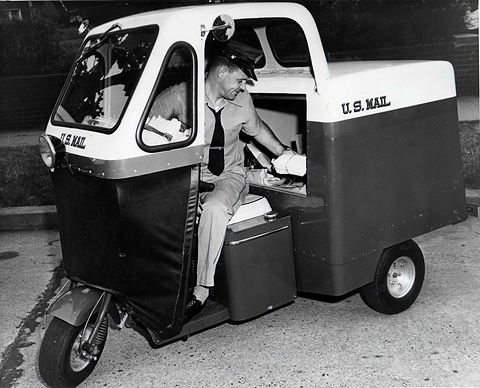
A uniformed postman seated in a small three-wheeled van lettered U.S. Mail, handing letters from its box.
Plate I · 1955 A city letter carrier at work in a three-wheeled Cushman mailster in 1955.Photo: Smithsonian National Postal Museum, No known copyright restrictions, via Wikimedia Commons
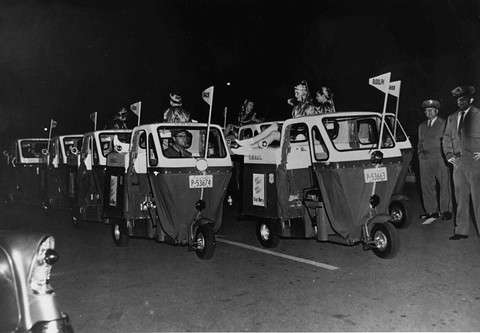
A row of small three-wheeled mail vans with pennants and drivers at night, officials standing alongside.
Plate II · 1954 Post Office mailsters dressed as Santa’s reindeer in a Christmas parade in Maryland in 1954.Photo: Smithsonian National Postal Museum, Public domain, via Wikimedia Commons

Cushman Truckster

1952–⁠2002 · a record on this page

Cushman, one of the mailster’s other makers, built a utility three-wheeler of its own for half a century, and the record of it is thin. Cushman Motor Works of Lincoln, Nebraska, was founded in 1903 by Everett and Clinton Cushman, by English Wikipedia’s account, or in 1901 by two cousins, by Cushman’s own; it became a division of Outboard Marine in 1962, was bought by Ransomes in 1989 and then, with Ransomes, by Textron, and is now based at Augusta, Georgia.source 5source 6 English Wikipedia lists the Westcoaster Mailster among Cushman’s models, but the Westcoaster was another firm’s; Cushman built a mailster of its own.source 5source 2

The Truckster was built from 1952 to 2002, with one wheel in front, a single-seat cab with folding doors or curtains, and a load box behind; Cushman’s police advertising gave it as 2,590 mm (102 in) long and 1,220 mm (48 in) wide.source 5source 7 It sold ice cream, maintained shopping malls and stadiums, delivered mail, kept grounds and enforced parking, and New York’s police were its best-known users.source 5source 8 A 1967 example has an 18 hp overhead-valve flat twin and three speeds on the column, and its owner puts its top speed at about 48 km/h (30 mph).source 8

it is small enough to maneuver in crowded areas, park without impeding the flow of traffic

Cushman’s advertising to police forces in the 1960s, as quoted by the Winnipeg Police Museum.source 7

Winnipeg’s police took Trucksters from 1964, after a short trial, as a winter alternative to motorcycles with sidecars, for the cab had a manifold heater.source 7 In December 1967 Patrol Sergeant Ted Ryland told the Winnipeg Free Press that its main work was spotting illegally parked cars and checking the Commissionaires on their rounds, and that it was most valuable in winter, as protection from the cold. The city’s last two were built in 1981, and its Cushmans were retired in 1985. One of the 1981 pair, Parking Patrol Unit 1741, was restored by students of the Manitoba Institute of Trades and Technology and handed to the Winnipeg Police Museum on 19 September 2024.source 7 A 1954 Model 782 has been photographed at the California Automobile Museum.source 9 No production figure has been found, and its models and engines from year to year are not reliably documented.

Variants

Several makers, one job

Mailsters by maker, as far as they are recorded
VariantYearsWhat differsHow many
Westcoaster Mailster1950s–60sGlass-fibre body with sliding metal doors; Onan twin of 7.5 hpNot found
Cushman mailster1950s–60sCushman’s own postal three-wheelerNot found
Other makersNot recordedAt least five more firms built mailstersNot found

Specification

The Westcoaster, from the Smithsonian’s record and The Autopian unless noted

Engine and drive

Engine and drive
EngineOnan air-cooled opposed twin, petrolsource 3source 1
Power7.5 hpsource 1source 2source 3
GearboxThree speeds, column shiftsource 3source 4
StartingElectric starter, with a manual back-upsource 4

Body and chassis

Body and chassis
BodyGlass fibre, with sliding metal doorssource 3
BrakesRear wheels by a foot pedal, front wheel by a lever on the handlebar, in the training filmsource 4
WeatherA removable front apron for air, and side curtains with an armhole for hand signals, in the training filmsource 4

Dimensions

Dimensions
Length2,921 mm (115 in)source 2
Width1,499 mm (59 in)source 2
Height1,880 mm (74 in)source 2
WeightNot reliably recordedThe museum record gives about 1,200 kg (2,645 lb), probably a gross or shipping weight; that is an inference

Performance and running

Performance and running
PayloadAbout 230 kg (500 lb), a quarter tonsource 1source 2source 3
Safe speed56 km/h (35 mph)source 1source 340 km/h (25 mph), and 24 km/h (15 mph) or less in turns, in the training film
Price newNot found

How many were built?

Mailsters in service, all makers

No production figure foundNeither Westcoaster’s output nor the total of mailsters built has been found. The figures below count vehicles of all makes in Post Office service, not vehicles built.

  1. about 17,700in service at the peak, 1966One source

    English Wikipediasource 1

  2. more than 5,700in service in 1960One source

    English Wikipediasource 1

  • Two sources agreetwo good sources give the figure
  • One sourcea good source, alone
  • Unconfirmeda lead only, not yet checked

Famous for

Three points

  1. A third of the fleet

    By the early 1960s, one in three of the Post Office’s vehicles was a three-wheeled mailster.

  2. Tipped by a dog

    Above 40 km/h (25 mph) in a corner, or in a gust of wind, it could tip over; one carrier said a large dog knocked his over.

  3. Its own film

    The Post Office made a training film, How to Drive the Mailster Safely.

Survivors and collecting

Today

The Smithsonian’s National Postal Museum in Washington, DC, has a Westcoaster mailster, the gift of the Van Allen family in memory of Neil G. Van Allen.source 2 Neither a survivor count nor a club or auction result has been found. A restored Westcoaster was photographed at Los Angeles’ Petersen Automotive Museum in 2024.

Sources

Numbered as in the text

The mailster’s history rests on the Smithsonian’s record of its own Westcoaster, English Wikipedia, and summaries of a National Archives blog post and a magazine article that draws on the Smithsonian. Westcoaster’s own history, its production years and output have not been found. The Cushman Truckster’s story rests mainly on a single local history from the Winnipeg Police Museum and on English Wikipedia. Sources are given as plain text; the links are on the Credits page.

  1. English Wikipedia, Westcoaster Mailster, read in full in a plain-text copy without its references.
  2. Smithsonian Institution, National Postal Museum, object record “Westcoaster mailster”, 1985.0372.1, read in full in an archived copy.
  3. The Autopian, “Before getting real cars, postal workers had to drive these…”, read through a summary; it draws on the Smithsonian.
  4. National Archives, The Unwritten Record blog, “How to Drive the Mailster: A Time-Traveling Lesson in Postal Technology”, 6 December 2022, read through a summary.
  5. English Wikipedia, Cushman (company), read in full in a plain-text copy without its references.
  6. Cushman (Textron), “About Cushman”, read in full in the Wayback Machine’s copy of 19 February 2016.
  7. John Burchill, “Cushman Truckster: Winnipeg Police Parking Patrol, Unit 1741”, Winnipeg Police Museum, 22 September 2024, read in full. It quotes the Winnipeg Tribune of 17 December 1964, the Winnipeg Free Press of 27 December 1967 and Cushman’s advertising.
  8. Mark Tucker, a 1967 Cushman Truckster against a 1994 Ford F‑250, The Autopian, 13 May 2025, read through a summary.
  9. Wikimedia Commons, Category:Cushman Truckster, the file descriptions, read 9 October 2026.