microcarfan
  • Kei car
  • Japan
  • Four wheels
  • About 200 built

Auto Sandal

Also known as Autosandal

In the early 1950s a scooter was a running chair, in the words of the day. A Nagoya firm called its little car a running sandal: the Auto Sandal, the first four-wheeled kei car on sale in Japan. You started it with a kick, from outside, and then climbed in.

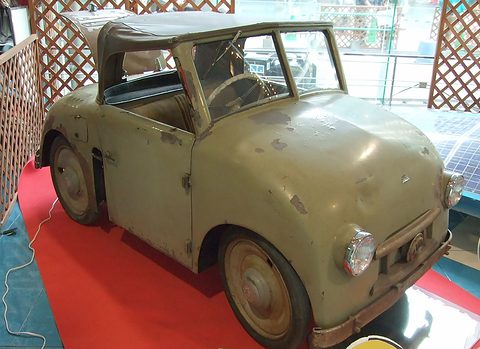
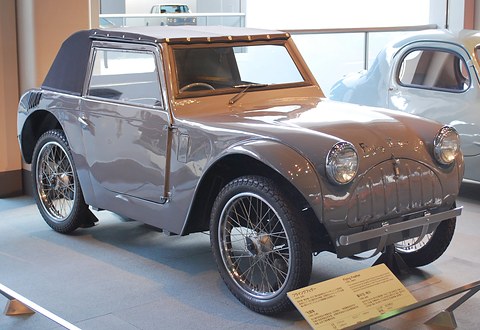
Olive-green open two-seater with a canvas hood, chipped paint and round headlamps, standing on red carpet.
The surviving 1950s Auto Sandal FS with its folding hood, displayed in Japan in 2010.Photo: Muyo, CC BY-SA 3.0, via Wikimedia Commons

At a glance

The spec plate

Auto Sandal

FS and FN · Nagoya

Built
1951–⁠1954A prototype in 1951; on sale from 1952; production ended in 1954
Country
JapanNagoya
Maker
Autosandal Lightcar Mfg. Co.Founded in 1952; later renamed Nippon Autosandal Jidōsha
Engine
348 cc air-cooled side-valve singleA Central Comipower CE30, built by Naka-Nihon Jūkōgyō, the post-war Mitsubishi firm; 349 cc in some figures
Power
5 PSAbout 3.7 kW at 2,700 rpm; 5.3 to 6.0 hp by version in Iwatate’s tables
Length
2,280 mm1,135 mm wide, 1,200 mm high
Weight
390 kgThe friction-drive car; 407 kg for the geared one
Seats
2A four-seater, with two seats in the tail, is photographed
Wheels
4A single cylinder ahead of the rear axle or behind it, driving the rear wheels
Production
about 200To 1954; 196 by an unsourced count
Survives
YesTwo, an FS and an FN, in a dealer’s collection at Kurume
Top speed
45km/h45 km/h45 km/h (28 mph); 50 km/h for the geared car

How big is it?

True proportion

2.28 m

It is 690 mm shorter than a Fiat 500, about 1.3 adults laid end to end.

  • 1.14 m wide
  • 390 kg: about five adults
  • Started by a kick-starter on the outside of the body
Drawn at true proportion. The track is 3.6 metres long; the adult stands at the same scale. The Peel P50 is the smallest production car, on every page for comparison.

The story

History

Nakano Kashirō ran Nagoya’s Ford parts agency by 1926, and from 1931 his firm built the Giant, a three-wheeled truck, which later passed to other makers.source 1 In 1950 and 1951 his Nakano Jidōsha Kōgyō built a prototype car in Nagoya, with a toy-like body and rounded lids front and rear.source 1source 2 In 1952 a new company, Autosandal Lightcar Mfg. Co., put it on sale; it was later renamed Nippon Autosandal Jidōsha.source 1source 2 For production the nose was raised, to make room for luggage, and given a dummy grille. Each car was made by hand, so no two were quite alike: the surviving FS has no boot lid.source 1 English Wikipedia’s list places the maker in Tokyo, but it was in Nagoya.source 1source 2source 3

The engine was an industrial one, the Central Comipower CE30: an air-cooled side-valve single of 348 cc and about 5 PS, built by Naka-Nihon Jūkōgyō, the post-war Mitsubishi firm, and the catalogue made much of its Mitsubishi origin.source 1source 2 The driver kicked it into life with a kick-starter on the outside of the body, then got in.source 1

Friction or gears

There were two models. By Japanese Wikipedia’s labels, the FS had its engine ahead of the rear axle and a friction-disc drive with no gears, a chain to the differential and half-shafts to the rear wheels; it weighed 390 kg and reached 45 km/h. The FN had its engine at the back, a two-speed gearbox (three-speed from the 1953 model), 110 mm more overhang, 407 kg and 50 km/h.source 1 Iwatate Kikuo’s tables give the same two cars the opposite letters.source 2 If both were sold side by side, Japan had its first choice between gears and a gearless drive in one range, Japanese Wikipedia observes.source 1

The catalogue claimed 25 km per litre and a 200 kg load, and that the car crossed the Hakone and Suzuka passes with ease. Japanese Wikipedia doubts it: even the 16 PS Subaru 360, of similar weight, overheated on steep climbs.source 1 The catalogue also showed a pickup, a truck, a jeep and a four-seat saloon; apart from the two-seater, it is not known which were made, though a four-seater with two seats in the tail was photographed.source 1

In 1954 a front-drive car was planned, with a water-cooled two-stroke twin of 238 cc and 10 HP (about 7.5 kW), electric starting and separate lubrication, 2,810 mm long and 400 kg. Japanese Wikipedia calls it the FN-L; Iwatate calls it the Roly and gives FN-L to a longer rear-drive single of 1953. Either way it seems to have stayed a prototype.source 1source 2

About 200

The company stopped in 1954, after about 200 cars, and its later fate is not known.source 1source 4 The history of the Subaru 360 that Japanese Wikipedia draws from Katsuragi Yōji’s book names the Auto Sandal as the first four-wheeled kei passenger car, but says it hardly stood up to everyday use, and that its records have almost all gone.source 4 (The same history gives it a 250 cc engine, probably an error: every other source says about 349 cc.)source 4source 1source 2
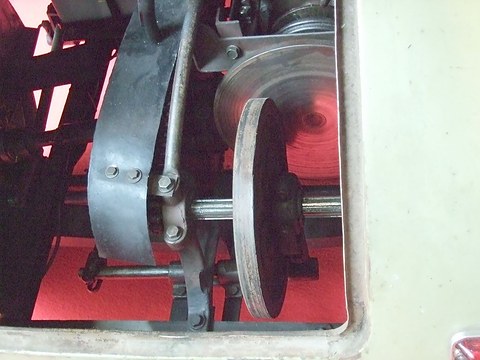
A metal drive disc pressed against a larger flywheel, with a chain guard and shaft, seen through a cut-out in a cream panel.
The friction-disc drive of the surviving FS, seen through an opening in the floor in 2010.Photo: Muyo, CC BY-SA 3.0, via Wikimedia Commons

NJ (Nikkei Taro)

1953–⁠1961 · a record on this page

The NJ was one of the few four-wheeled kei cars on Japan’s roads before the Subaru 360: Japanese Wikipedia’s history of that car names it with the Auto Sandal, the Flying Feather and the Suzuki Suzulight.source 4 Japanese Wikipedia’s article on its maker names that maker as Nippon Jidōsha Kōgyō, dates the NJ and the later Nikkei Taro to 1953–⁠61, gives a length of 2,910 mm (115 in), and counts about 60 built by May 1954.source 5 Its engine and its later versions are not described in any source read in full here, and no photograph of one is shown.

Variants

Two drives, and a front-drive plan

The Auto Sandal, 1951–⁠54
VariantYearsWhat differsHow many
Prototype1951A toy-like body with rounded lids front and rear1 or more
FS (Iwatate: FN)From 1952Engine ahead of the rear axle, friction-disc drive with no gears; 390 kg, 45 km/hPart of about 200
FN (Iwatate: FS)1952–⁠54Engine at the back, a two-speed gearbox (three-speed from 1953), 110 mm more overhang; 407 kg, 50 km/hPart of about 200
Front-drive car1954A 238 cc water-cooled two-stroke twin and front-wheel drive; FN-L to Japanese Wikipedia, Roly to IwatatePrototype
Four-seaterNot knownTwo more seats in the tailPhotographed only

Specification

The cars of 1952

Engine and drive

Engine and drive
EngineCentral Comipower CE30, an air-cooled four-stroke side-valve single, by Naka-Nihon Jūkōgyōsource 1source 2
Capacity348 ccsource 1349 cc in Iwatate’s 1952 entries
Power5 PS at 2,700 rpmsource 15.3, 5.5 or 6.0 hp by version in Iwatate’s tables
TransmissionFriction-disc drive with no gears on one model; two speeds and reverse, later three, on the othersource 1source 2
StartingA kick-starter on the outside of the bodysource 1

Body and chassis

Body and chassis
BodyHand-made open two-seater, “Roadster Lorry” in the cataloguesource 1
SuspensionSemi-elliptic leaf springs front and rear, from the catalogue drawingssource 1

Dimensions

Dimensions
Length2,280 mm (90 in), the FS catalogue figuresource 12,400 mm by Iwatate; 2,300 mm for the 1951 prototype
Width1,135 mmsource 21,070 mm for the 1951 prototype
Height1,200 mmsource 2
Wheelbase1,430 mmsource 1source 2
Weight390 kg (860 lb) friction-drive; 407 kg (897 lb) gearedsource 1source 2

Performance and running

Performance and running
Top speed45 km/h (28 mph) friction-drive; 50 km/h geared, the catalogue’s figuressource 1
Consumption25 km per litre, by the cataloguesource 1
Payload200 kg, by the cataloguesource 1

How many were built?

Almost no records

About 200 builtAbout 200 by 1954, the figure Japanese Wikipedia’s history of the Subaru 360 takes from Katsuragi Yōji’s book; the company left almost no records. A count of 196 appears without a source.

  1. about 200all cars, to 1954One source

    Katsuragi Yōji’s Tentōmushi ga hashitta hi, as Japanese Wikipedia’s Subaru 360 article cites it; its article on the maker gives the samesource 1source 4

  2. 196rear-engined carsUnconfirmed

    Japanese Wikipedia, with no source given, adding that some books say more than 200source 1

  • Two sources agreetwo good sources give the figure
  • One sourcea good source, alone
  • Unconfirmeda lead only, not yet checked

Famous for

Three points

  1. The first on sale

    Japan’s first four-wheeled kei car sold to the public, in 1952.source 1source 4

  2. A running sandal

    The name made a joke of the scooter, the running chair of the day.source 1

  3. Kicked from outside

    The driver started the engine from outside the car, then climbed in.source 1

Survivors and collecting

Today

Two survive, an FS and an FN, both in the collection of the classic-car dealer Sepia Collection at Kurume, in Fukuoka, as of 2025; the FS is said to be the only one of its kind left.source 1 On 13 August 2024 the FS appeared on TV Tokyo’s appraisal programme Kaiun! Nandemo Kanteidan, valued at ¥3.5 million (more in microcars on screen).source 1 Under today’s road law it counts as a small special vehicle, held to 15 km/h on public roads.source 1

Sources

Numbered as in the text

No catalogue, price or period press report was seen, and the main source, Japanese Wikipedia, is flagged there for lacking sources. Iwatate Kikuo’s tables, the second source, label the two models the other way round. Sources are given as plain text; the links are on the Credits page.

  1. Japanese Wikipedia, Nippon Autosandal Jidōsha, read in full on 7 October 2026; the article is tagged for lacking sources and for original research.
  2. Iwatate Kikuo, “Japanese Midget Motor Vehicles Post WW II, 11: Four Wheelers 3”, kiwat.com (2001–⁠03), read in full from the archived copy.
  3. English Wikipedia, List of microcars by country of origin: J, the Auto Sandal row, read. Used as a lead.
  4. Japanese Wikipedia, Subaru 360, its section on the kei cars before Subaru, citing Katsuragi Yōji, Tentōmushi ga hashitta hi, p. 48, read in full.
  5. Japanese Wikipedia, Nippon Kei Jidōsha (the NJ, Nikkei Taro and Constac), used through a summary only; not read in full.