The story
History
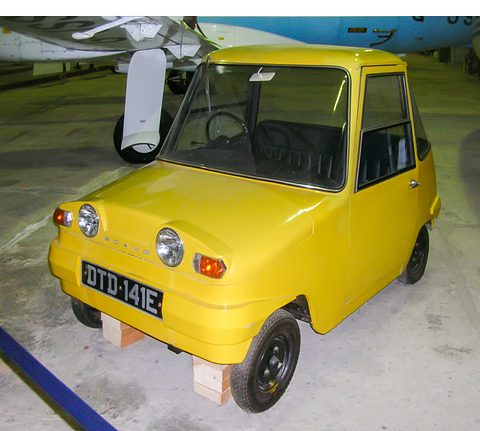
In the spring of 1967 Ford of Britain was studying congestion and pollution in towns, and as part of that work it developed the Comuta, an experimental electric car, at its brand-new technical centre at Dunton, near Laindon in Essex.source 1source 2 English Wikipedia and Mac’s Motor City Garage call it Ford’s first electric car.source 3source 2
Ford UK designed the Comuta in the 1960s as a non-polluting car for urban and suburban motoring.
Four 12-volt lead-acid batteries of 85 ampere-hours sat under the seat.source 3source 1source 2 By Mac’s account they fed two DC motors of about 5 hp each, driving the rear wheels, and air ducted through the central backbone cooled the motors and warmed the cabin. The body was glass fibre on a steel backbone chassis, with independent suspension on leading arms at the front and trailing arms at the back, and small drum brakes. Two adults sat in front, with room behind for two small children or the shopping, and the car weighed 544 kg (1,200 lb).source 2 Ford’s engineers noted at the time that the batteries were the bottleneck.source 2 The Comuta would run 60 km (37 miles) at 40 km/h (25 mph), and its top speed was 60 km/h (37 mph), though Mac’s gives 40 mph.source 3source 1source 2 The Science Museum measures its car at 2,080 mm by 1,370 mm by 1,560 mm (82 by 54 by 61 in).source 1
How many were built is not settled. The Science Museum, which has one, says only two; Mac’s says somewhere between two and six, and English Wikipedia a limited number.source 1source 2source 3 In 2017 BBC News marked 50 years since what it called the Comuta electric car trial, which suggests the cars were tried out in public or by the press in 1967; no account of that trial has been found.source 3 It never went into production. The Comuta is no relation of the American Comuta-Car, a version of the CitiCar.source 3