microcarfan
  • Electric microcar
  • Britain
  • Four wheels
  • Electric
  • 13 built

Scottish Aviation Scamp

Also known as Scamp Mk I

At Prestwick Airport the baggage tugs were electric and were plugged in between jobs. The aircraft maker based there thought a car could live the same way: a small two-seater to fetch commuters from the station, charged overnight from a 13-amp socket.

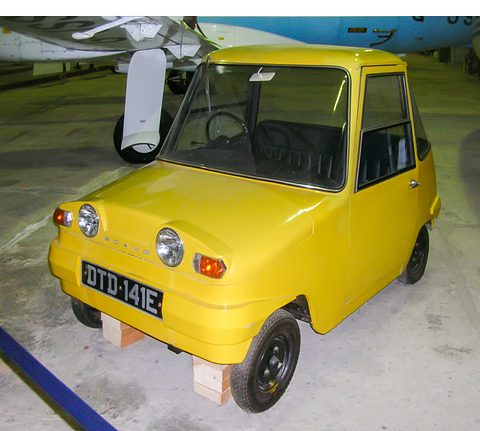
Yellow tiny electric car on wooden blocks, an aircraft nose above and behind it.
A yellow Scottish Aviation Scamp pre-production car, DTD 141E, on blocks beneath aircraft at the National Museum of Flight, East Fortune, in 2008.Photo: DeFacto, CC BY-SA 3.0, via Wikimedia Commons

At a glance

The spec plate

Scottish Aviation Scamp

Mk I pre-production · Prestwick

Built
1965–⁠1967Designed from 1964; the project ended in 1968
Country
BritainPrestwick, Ayrshire
Maker
Scottish Aviation LtdIts Project Department, under Dr W. Gordon Watson
Engine
Two electric motorsLucas lead-acid batteries; chain drive to the rear wheels
Length
2,134 mm1,168 mm wide
Seats
2Or one adult and two small children
Wheels
4Two motors driving the rear wheels by chains
Production
13One test vehicle and 12 pre-production cars
Survives
5Believed; three in Scottish museums
Top speed
58km/h58 km/h36 mph; MIRA found 30–35 mph the most a pre-production car could do

Not yet recordedpower and weight.

How big is it?

True proportion

2.13 m

It is 836 mm shorter than a Fiat 500, about 1.2 adults laid end to end.

  • 1.17 m wide
  • Designed to recharge in eight hours from a 13-amp socket
Drawn at true proportion. The track is 3.6 metres long; the adult stands at the same scale. The Peel P50 is the smallest production car, on every page for comparison.

The story

History

Scottish Aviation built aircraft at Prestwick, the Twin Pioneer and later the Bulldog trainer, and went on building them throughout the Scamp’s life; it was bought by Cammell Laird in 1966 and merged into British Aerospace in 1977 (see aircraft makers).source 1 In 1964 its Project Department, headed by Dr W. Gordon Watson, studied electric cars. The idea came from the battery tugs at the airport, and from something Watson noticed at his own station: wives waiting in cars to drive their commuting husbands home.source 2 A cheap second car for that run, he reasoned, did not need range or speed. His specification asked for two adults, or one adult and two children, with shopping; 56 km/h (35 mph); 0–30 mph in under 12 seconds; a laden restart on a 1 in 4 hill; at least 40 km (25 miles) of range; and a full charge in eight hours from a household socket. The running costs were reckoned at better than the equivalent of 150 miles per gallon.source 2 The name was a contraction of Scottish and amp.source 2

The farm cart

The first test vehicle, built early in 1965, was not much more than a seat on a chassis, and the works called it the farm cart. It reached 58 km/h (36 mph), went from 0 to 30 mph in 10.5 seconds, and covered 29 km (18 miles) of simulated town driving with six stops to the mile, against a target of 15 miles, or 42 km (26 miles) at constant throttle.source 2 From July 1965 Scottish Aviation courted the electricity industry, hoping to sell the car through the regional electricity boards’ showrooms. The Electricity Council and the South Western Electricity Board had the rig bodied in wood, light alloy and Perspex and registered as DAG 908C, and it was demonstrated at the board’s headquarters in Bristol and in London.source 2 At the closing press conference Stirling Moss drove it, and almost 200 enquiries followed from would-be customers and distributors around the world.source 2 Design, the journal of the Council of Industrial Design, took it up in July 1966: 2,134 mm (84 in) long and 1,168 mm (46 in) wide.source 2

Twelve cars, and MIRA

Twelve pre-production Scamps followed for development and market study, with glass-reinforced plastic bodies on wooden members, doors, two electric motors driving the rear wheels by chains, and Lucas lead-acid batteries. The first left Prestwick at the end of February 1967 for the Electricity Council’s stand at the Ideal Home Exhibition.source 2 The council sent two to the Motor Industry Research Association. MIRA’s evaluation of 13A 0004 in 1967 found flimsy knobs, poor demisting and a tiny luggage space; no interlock to stop the car being driven off while still plugged in; drive chains worn after 322 km (200 miles); a cracked wheel at 56 miles; two motor failures under hard acceleration; and pitching at all speeds, all at the 30–35 mph that was the most it could manage.source 2

Negotiation of bends with adverse cambers revealed a tendency to travel straight on.

MIRA, Evaluation of a Scamp Mk. 1 battery-electric vehicle, 1967, as quoted in English Wikipedia.source 2

The endurance test of 13A 0003, reported on 1 October 1968, was worse. The windscreen pillar cracked at 15 miles, front rims buckled and tyres burst again and again, the footwells flooded an inch deep at 87 miles, the spare wheel fell out of its compartment at 481, and the dash screws pulled out of the wood at 523. At 738 miles the steering was dangerously indefinite and spring leaves had broken, and at 979 a track rod broke and the car stopped dead. Either failure would normally have ended the test, but the testers patched the car up and completed 1,611 km (1,001 miles).source 2

The Electricity Council called the Scamp “unfit for purpose”, returned its cars and asked to cancel the contract. Lucas’s batteries were lasting about 12 months instead of 18, and longer-lived ones would have cost more than the project could find. Scottish Aviation ended the work in 1968 and looked for partners; Reliant and the Rootes Group showed interest.source 2 Of the pre-production cars, battery makers in England and Finland bought two, and two stayed at Prestwick with the company and with Scottish Express.source 2
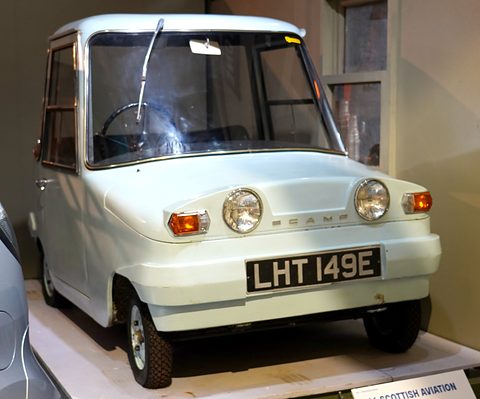
Pale blue tiny upright electric car with twin round headlamps on a museum plinth.
LHT 149E, the light-blue survivor, at the Grampian Transport Museum, Alford, in 2026.Photo: kitmasterbloke, CC BY 4.0, via Wikimedia Commons
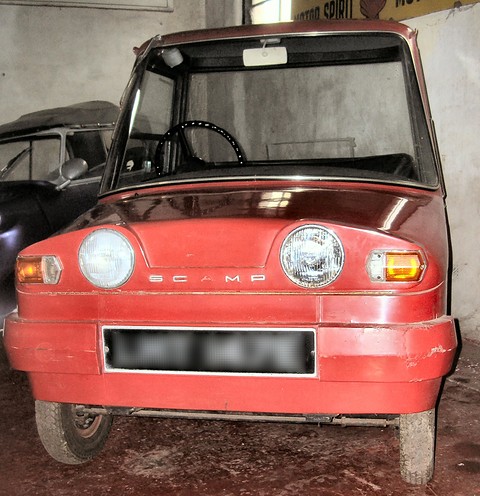
Faded red tiny electric car head-on in a whitewashed shed, an old car beside it.
A red Scamp at the Myreton Motor Museum, Aberlady, in 2008.Photo: DeFacto, CC BY-SA 3.0, via Wikimedia Commons

Variants

A farm cart and twelve cars

The Scamps
VariantYearsWhat differsHow many
Test vehicle1965“Not much more than a seat on a chassis”, then bodied in wood, light alloy and Perspex and registered DAG 908C1
Scamp Mk I1966–⁠1967Pre-production cars, numbered 13A 000x: glass-reinforced plastic and wood, doors, a rear compartment12

Specification

The pre-production Scamp, 1966–⁠67

Motors and batteries

Motors and batteries
MotorsTwo electric motors, chain drive to the rear wheelssource 2
BatteriesLucas special development lead-acid, front and rear; a 48-volt systemsource 2The source’s wording on the voltage is unclear
Charging13-amp domestic socket, eight hourssource 2
ControlForward, Off and Reverse selectorsource 2

Body and chassis

Body and chassis
BodyGlass-reinforced plastic, with wooden members in the dash and frame; doors; rear compartment for the spare wheelsource 2
SuspensionLeaf springs at the front; spring and damper units at the rearsource 2
SteeringSteering box with drag link and universal jointsource 2

Dimensions

Dimensions
Length2,134 mm (84 in)source 2From Design, July 1966
Width1,168 mm (46 in)source 2

Performance and running

Performance and running
Top speed58 km/h (36 mph) by the test vehiclesource 2Target 35 mph; MIRA got 30–35 mph from a pre-production car
Acceleration0–30 mph (48 km/h) in 10.5 seconds, test vehiclesource 2
Range29 km (18 miles) in stop-start driving; 42 km (26 miles) at constant throttlesource 2Test vehicle, 1965
PriceNever set; never sold to the publicsource 2

How many were built?

Every figure, with its source

13 builtThirteen: one test vehicle in 1965 and a batch of 12 pre-production cars. Grace’s Guide, independently, calls one survivor one of the twelve made by Scottish Aviation.

  1. 13vehicles: the test vehicle and 12 pre-production carsOne source

    English Wikipedia, from Watson’s own accountsource 2

  2. 12pre-production carsTwo sources agree

    English Wikipedia and Grace’s Guidesource 2source 1

  • Two sources agreetwo good sources give the figure
  • One sourcea good source, alone
  • Unconfirmeda lead only, not yet checked

Famous for

Three points

  1. An aircraft maker’s car

    Built at Prestwick by Scottish Aviation while it went on building aircraft.

  2. Plug it in at night

    A second car for the station run, charged overnight from a 13-amp socket.

  3. Stirling Moss drove it

    At the press conference that brought almost 200 enquiries.

Survivors and collecting

Today

Five Scamps are believed to survive.source 2 The yellow DTD 141E was in the National Motor Museum’s collection until 1995, then passed to National Museums Scotland; it was shown at the National Museum of Flight at East Fortune and moved in 2012 to the museums’ collection centre at Granton, Edinburgh. The red LHT 147E, once at the Myreton Motor Museum, is now at the Dundee Museum of Transport, and the light-blue LHT 149E is at the Grampian Transport Museum, after a spell with the Scottish Motor Museum Trust at Loch Lomond. Two white cars, LHT 150E and OSD 697H, are privately owned.source 2source 1

Sources

Two sources

Almost all of this page rests on one source, English Wikipedia’s article, which is built on primary documents: Design of July 1966, Watson’s unpublished account, Robertson’s company history and the two MIRA reports. Sources are given as plain text; the links are on the Credits page.

  1. Grace’s Guide, “Scottish Aviation”, read in full, with its photographs of Scamps at the Myreton Motor Museum and the National Museum of Flight.
  2. English Wikipedia, Scottish Aviation Scamp, revision of 18 September 2026, read in full. Used as a lead; it cites Carr, “In search of the town car”, Design no. 211 (1 July 1966); W. G. Watson, The Scamp: The Electric Car Project of Scottish Aviation Limited (unpublished); Alan Robertson, Lion Rampant and Winged (1986); and the MIRA evaluation (1967) and endurance (1968) reports.