The story
History
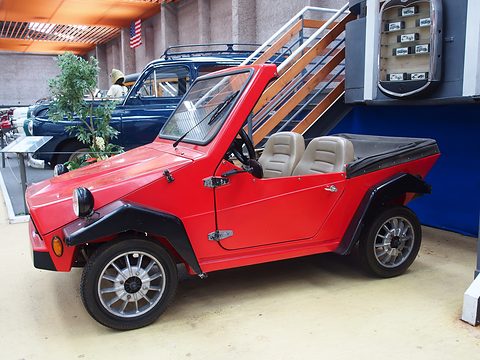
Jean-Pierre Ponthieu worked in advertising in Paris and was already known for highly original promotional vehicles for the motor trade when, in 1966, he built the Valérie.source 1 It was a small, doorless cabriolet: a polyester body on a basic tube chassis, 8-inch wheels and a Sachs two-stroke engine. Legally it was a cyclomoteur, a moped, and so one of France’s licence-free cars.source 1source 2 The author of the original microcarfan.com called it a real town car, with nothing superfluous and everything necessary, and thought the newcomers of ten or fifteen years later did no better.source 1
Sold, then hired
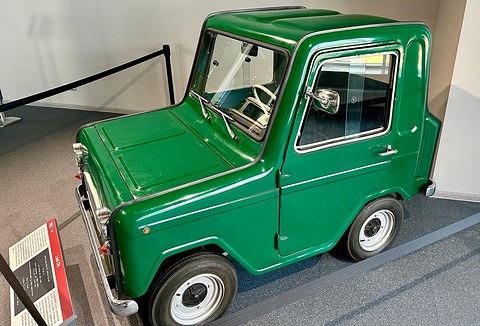
Ponthieu soon saw that a vehicle like this could not be sold at a price the market would pay. So he turned to originality instead, and built a family of eccentric little cars to hire out for exhibitions, fairs, openings and advertising.source 1 The first was the Eugénie, styled like a car of about 1900 and, for all its size, well proportioned. More girls’ names were announced: Pamela, Rosalie, Jennifer and Tiphanie. The old site printed a photograph of the Tiphanie but was not sure all of them were built. Valérie and Eugénie were the most publicised and the most built, and traces of them turn up in period advertisements and in fashion magazines, fashion being another of Ponthieu’s fields.source 1
Dans ce monde où tout est banal et laid, il faut savoir créer du beau et de l’insolite.
The car was officially presented as the Otokart, but the few known survivors all carry a Pussycar maker’s plate, which is why that is the name it goes by. By 1968 neither name left any further trace.source 1 How many were made is a guess. The old site suggested a few dozen, with a question mark; a blog of 2016 says more than 200, without giving a source.source 1source 2
The Automodule
Ponthieu went on to something stranger. According to the old site, L’Auto-Journal presented his Automodule in 1970 as the automobile of the year 2000: a spherical machine that could rise, sink, rear up and travel crabwise, with a 248 cc engine and a three-speed hydraulic transmission. In normal running its rear wheel lifted, so it counted as a tricycle.source 1 The 2016 blog dates it to 1968 instead.source 2
What we know, and do not
The old site’s owner had a Pussycar of his own, unpainted when he wrote about it, and posted a short film of it in 2009.source 1source 3 Almost everything here comes from his page. The car’s wheels, size, weight, speed and price in francs all wait for a period source: a road test or Salon report of 1966–67, the fashion features, or a newsreel.