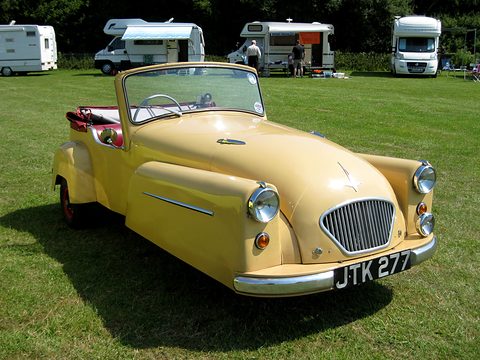
microcarfan
  • Three-wheeler
  • Britain
  • Three wheels
  • Rear engine
  • Four seats

Bond 875

Also known as Bond 875 Ranger (the van)

A three-wheeler that beat the Mini: in Autocar’s test of 1966, Bond’s 875 reached 133 km/h (82.8 mph) and 60 mph in 22.5 seconds, on a Hillman Imp engine in its tail. It had to weigh under 8 cwt to keep its tax concession, so even the spare wheel was an extra.

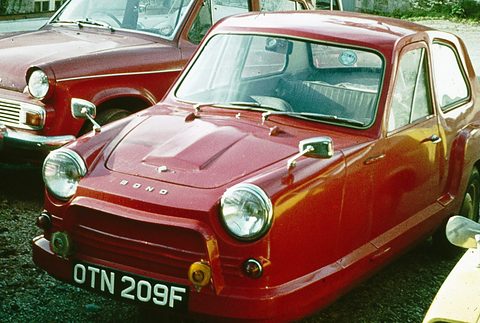
Red small rear-engined three-wheeler parked on gravel beside a maroon saloon.
A red 1968 Bond 875 saloon, OTN 209F, with its round headlamps and dummy grille.Photo: Charles01, CC BY-SA 3.0, via Wikimedia Commons

At a glance

The spec plate

Bond 875

875 Mk I · Preston

Built
1966–⁠1970Announced in August 1965; built from April 1966 to February 1970
Country
BritainBond Cars Ltd, Preston, Lancashire
Maker
Bond Cars LtdOwned by Reliant from February 1969
Engine
875 cc Hillman Imp four, in the tailThe lower-compression tune of the Commer Imp van, with the Imp’s transaxle
Power
34 bhpAbout 25 kW
Seats
4One, then two, in the Ranger van
Wheels
3One at the front, two at the back; engine in the tail
Price new
£496 19s 7dMk I with purchase tax, April 1966
Production
3,441Saloons, Ranger vans and one estate prototype
Top speed
133km/h133 km/h82.8 mph

Not yet recordedlength and weight.

How big is it?

True proportion

Length unknown

No reliable length has been found. The Fiat 500, the Peel P50 and the adult stay, so the gap is shown, not hidden.

  • Kept under 8 cwt (406 kg) unladen, the tricycle tax limit
Drawn at true proportion. The track is 3.6 metres long; the adult stands at the same scale. The Peel P50 is the smallest production car, on every page for comparison.

Beside its contemporaries

The British microcars on the road in 1966, on the same 3.5 m scale. Lengths of cars without a page yet come from the census and are unverified.

  1. Scottish Aviation Scamp1965–⁠1967 · Britain

    2.13 m
  2. Bond Minicar1949–⁠1966 · Britain

    2.69 m
  3. Invacar1946–⁠1977 · Britain

    2.97 m
  4. Reliant Regal1952–⁠1973 · Britain

    3.43 m
  5. Reliant Supervan1963–⁠1973 · Britain

    3.43 m
  6. Bond 8751966–⁠1970 · Britain

    length unknown

The story

History

The Bond Minicar, built at Preston since 1949, was ageing. In 1963 Bond launched the Triumph-based Equipe, and after its success the maker, Sharp’s Commercials of the Loxhams and Bradshaw group, renamed itself Bond Cars Ltd.source 1 Its answer to the Reliant Regal was a four-seat three-wheeler with its engine in the tail, unusual among British three-wheelers of the day.source 2source 3 English Wikipedia says Lawrie Bond had a hand in the design; the owners’ club’s history does not name a designer for the 875.source 3source 1

The Mark I saloon was announced in August 1965. It had an all-glass-fibre body and the 875 cc engine and transaxle of the Hillman Imp at the back, four gears and reverse, and independent suspension all round; the single front wheel sat on a leading arm in the main front tube, designed to lean over as the wheel was steered.source 2 In 1965 the racing driver John Surtees lapped Brands Hatch in one in 1 minute 22 seconds and reached over 161 km/h (100 mph), by The Bond Magazine’s account; whether his car was standard is not known.source 3 The first few cars had aluminium bumpers, bonnet and engine cover, a full-width Imp dashboard and sprung seats.source 2

Under 8 cwt

Testing found problems with the body moulds, the weight, the steering and the cooling, and saloon production began only in April 1966.source 2 The production 875 used the lower-compression 34 bhp engine of the Commer Imp van, which ran on cheap 2-star petrol. It had no front bumpers, a glass-fibre bonnet, Perspex rear side windows, thin tubular seats and a simple instrument binnacle. To stay a motor tricycle it had to weigh under 8 cwt (406 kg) unladen, and to help keep the weight down its spare wheel, heater and roof suitcase were sold as extras.source 2source 3 A floating front brake back plate cured the steering. It cost £496 19s 7d with purchase tax, in white, Cherry Red, Wedgwood Blue, Cactus Green or Golden Sand.source 2

Autocar tested one in September 1966. It recorded 82.8 mph, 0–60 mph in 22.5 seconds and 34.5 mpg, better than an 850 Mini on all three, and liked the performance, economy, gearbox and brakes. It found the car unstable at high speed, and was disappointed by poor seats and detail finish. At £506 it cost more than the Mini at £478, and less than an Imp at £549.source 3 That December a standard car lapped Silverstone in 1 minute 43.34 seconds and went through the Hangar Straight trap at 122 km/h (76 mph); Bond would neither confirm nor deny a racing version.source 3

Ranger, estate and Mark II

The van, the Ranger, went into production in April 1967: a lift-up tailgate, no side windows, a flat floor of about 1.1 m³ (40 cu ft) behind a single driver’s seat, and a wing mirror on the right, as the law required. As a commercial vehicle it paid no purchase tax, and cost £417 10s in primer, with paint £10 more; a passenger seat at £9 15s soon became standard.source 2source 3 That September a show-finish Ranger was turned into an estate car. It weighed 8 cwt 21 lb.source 2

It therefore seems unlikely that we could produce an Estate car version of the 875 within the statutory weight limit.

Bond’s Product Development Committee, minutes of 3 October 1967, as quoted by the Bond Owners’ Club.source 2

The Mark II came in March or April 1968, with a restyled nose, rectangular headlamps, a larger opening bonnet, a grille over the heater intake, and the heater and washers standard. It cost £576 8s 11d.source 2source 3 In February 1969 Reliant bought Bond, and Preston ran the 875 down to clear the way for the Bond Bug; its sales were already falling.source 1source 4 On 2 June 1969, 240 cars remained to be built. The last saloon, a white car registered YMU 51H, left the line in the week ending 20 February 1970, and the last Ranger, the last chassis number of all, followed that week.source 2 In 1970 Motor Sport remembered it simply as the Hillman Imp-powered Bond.source 5
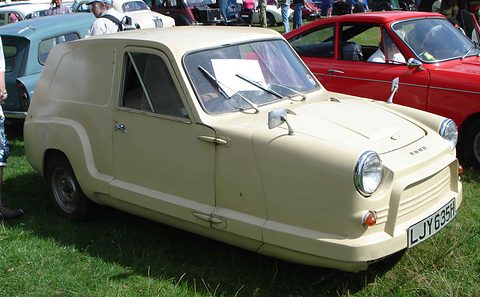
Cream three-wheeled van with blind rear sides parked on grass, a red car behind.
A 1970 Bond 875 Ranger van, LJY 635H, at a show in 2007: no side windows behind the doors.Photo: Malcolma, CC BY-SA 3.0, via Wikimedia Commons
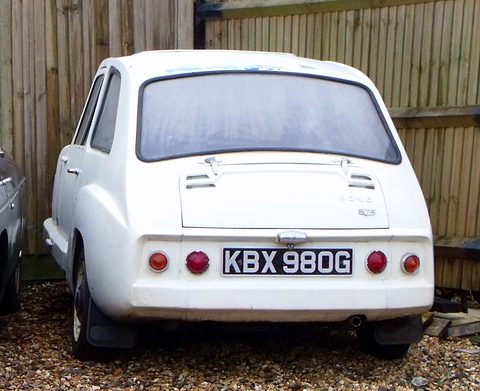
White small car from behind, four round tail lamps and louvres on the engine lid, on gravel.
A late-1960s 875 from behind: the louvred lid covers the Imp engine.Photo: grassrootsgroundswell, CC BY 2.0, via Wikimedia Commons

Variants

Saloon, van and an estate that weighed too much

The 875 family
VariantYearsWhat differsHow many
875 Mk I saloon1966–⁠1968Round headlamps, a simple instrument binnacle; spare wheel and heater as extras2,037 with the Mk I Rangers
875 Ranger1967–⁠1970Van: lift-up tailgate, no side windows, a flat floor of about 1.1 m³ (40 cu ft); sold in primerIn the Mk I and Mk II totals
875 estate1967A Ranger converted to an estate; 8 cwt 21 lb, over the limit1
875 Mk II saloon1968–⁠1970Restyled nose with rectangular headlamps and a grille, larger bonnet, heater and washers standard1,403 with the Mk II Rangers

Specification

The 875 saloon, 1966–⁠70

Engine and drive

Engine and drive
EngineRootes Imp four-cylinder OHC, aluminium, water-cooled, in the tail; 875 cc; compression 8:1source 2source 3The Commer van tune, which ran on cheap 2-star petrol
Power34 bhp (25 kW)source 2source 3
GearboxImp transaxle, four speeds and reversesource 2source 3

Body and chassis

Body and chassis
BodyGlass fibre, with aluminium doorssource 1source 3
SuspensionIndependent all round: a leading arm at the front, built to lean the wheel when steered; the Imp’s at the rearsource 2
Brakes8 in hydraulicsource 2
Electrics12 Vsource 2

Dimensions

Dimensions
LengthNot settledsource 2source 33,251 mm (10 ft 8 in) by the owners’ club; 2,946 mm (116 in) in English Wikipedia
Width1,397 mm (4 ft 7 in)source 2source 3
Height1,295 mm (4 ft 3 in)source 2
Wheelbase1,981 mm (78 in)source 3
WeightUnder 406 kg (8 cwt) unladensource 2source 3

Performance and running

Performance and running
Top speed133 km/h (82.8 mph)source 3Autocar, September 1966
0–60 mph22.5 secondssource 3
Consumption34.5 mpg overall in Autocar’s testsource 350–55 mpg claimed
Fuel tank27 litres (6 gallons)source 2
Price new£496 19s 7d (Mk I, 1966); £576 8s 11d (Mk II, 1968)source 2Ranger £417 10s in primer

How many were built?

Every figure, with its source

3,441 built3,441, the Bond Owners’ Club’s count from Bond’s records, which the chassis numbers bear out: they ran from 50001 to 53441. English Wikipedia’s 3,431, citing the same club page, is a copying slip.

  1. 3,4412,037 Mk I saloons and Rangers, 1,403 Mk IIs and Rangers, one estate prototypeTwo sources agree

    Bond Owners’ Club production statistics, matched by the chassis numbers in its modification recordssource 6source 2

  2. 3,431875sOne source

    English Wikipedia, citing the club’s pagesource 3

  • Two sources agreetwo good sources give the figure
  • One sourcea good source, alone
  • Unconfirmeda lead only, not yet checked

Famous for

Three points

  1. Faster than a Mini

    82.8 mph and 60 mph in 22.5 seconds, in Autocar’s test of 1966.

  2. An Imp in the tail

    A rear engine, unusual among the British three-wheelers of its day.

  3. The estate that failed

    At 8 cwt 21 lb, 21 lb too heavy for the tax limit, it was shelved.

Survivors and collecting

Today

No count of surviving 875s has been published. The Bond Owners’ Club holds Bond’s production records, from which the totals here come.source 6

Sources

Numbered as in the text

Autocar’s road test of 9 September 1966 was not read; its figures come through English Wikipedia. No survivor count was found. Sources are given as plain text; the links are on the Credits page.

  1. Bond Owners’ Club, “A brief history of the Bond Company”, archived 23 December 2018, read in full.
  2. Bond Owners’ Club, “875: Vehicle Modifications by Chassis Number” (2001), archived 2018, read in full.
  3. English Wikipedia, Bond 875, read in full. Used as a lead; it cites Autocar (9 September 1966, 8 July 1967, 11 April 1968), Motor Cycling (24 December 1966), The Bond Magazine (Autumn 1965) and Marshall, Microcars (1999).
  4. Lancaster Insurance, “The Bond Bug: A Celebration”, 25 September 2024, read in full.
  5. “Rumblings”, Motor Sport, July 1970, read in full.
  6. Bond Owners’ Club, “Production Statistics”, archived 25 December 2018, read in full.