microcarfan
  • Microcar
  • France
  • Four wheels

Atlas Babycar

Also known as Atlas Coccinelle

A roadster in miniature, its curves formed in steel by craftsmen, with an engine that drove the left rear wheel and nothing else. It was first called the ladybird, and its makers aimed it at women.

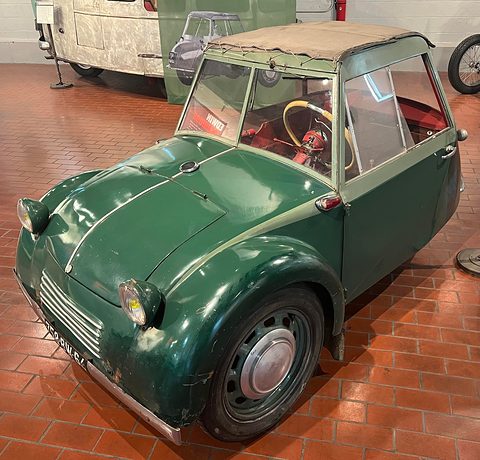
No photograph yet. Two Babycars are known to survive, and neither is pictured here: no photograph that may be published has turned up. We do not draw cars, so the space waits for one.

At a glance

The spec plate

Atlas Babycar

Babycar · Paris

Built
1949–⁠1952Shown at the 1949 Paris Salon; built from 1950 to 1952
Country
FranceParis; sold in France only
Maker
Société Industrielle de Livry (S.I.L.)Body built by Duriez of Paris
Engine
175 cc AMC four-stroke single170 cc on the Weiner museum’s card
Power
8.5 hpAbout 6.3 kW
Length
2,770 mm1,240 mm wide
Weight
270 kg
Seats
2Side by side, on a bench
Wheels
4Engine at the front, driving the left rear wheel only
Price new
245,000 FThe Kover 215,000 F, Le Piaf 200,000 F
Survives
YesTwo are known; one sold for $60,375 in 2013
Top speed
60km/h60 km/h65 km/h by the old site

How big is it?

True proportion

2.77 m

It is 200 mm shorter than a Fiat 500, about 1.6 adults laid end to end, and twice the length of a Peel P50.

  • 1.24 m wide
  • 270 kg: about four adults
  • Two seats on a bench
  • Doors from early in production
Drawn at true proportion. The track is 3.6 metres long; the adult stands at the same scale. The Peel P50 is the smallest production car, on every page for comparison.

The story

History

At the Paris Salon of 1949 the Société Industrielle de Livry, S.I.L., showed a small two-seat roadster with rounded, bulbous wings and called it the Coccinelle, the ladybird. Early in its development the name became Babycar.source 1source 2 Its body was built in Paris by Duriez.source 1source 2

There was another Coccinelle at the same Salons. RM’s cataloguer noted a curious relationship with the Sofravel Coccinelle, shown in 1948 and 1949 by the Société Annonay Sofravel: the two cars looked strikingly alike, and Duriez had the stand next to Sofravel’s. Duriez, which converted war-surplus American lorries and designed four-speed gearboxes for the Citroën 2CV, was then contracted to build the Atlas for S.I.L.source 2 What passed between the three firms is not recorded.

Small, but engineered

Underneath, the Babycar was a well-engineered car. It had a steel-tube chassis with independent suspension on every wheel, A-arms and coil springs at the front, rack-and-pinion steering, cable brakes and two-piece cast aluminium wheels.source 1source 2 The engine drove only the left rear wheel, through a separate gearcase that also held the reverse, so the car needed no differential.source 1source 2 It was started by pulling a lever on the floor.source 1source 2

The engine settled on was an AMC four-stroke single of 175 cc and 8.5 hp, 170 cc by the Weiner museum’s card; 125, 150 and 250 cc units had been considered or offered along the way.source 1source 2 An ILO of 250 cc with an electric starter was considered with the buyers in mind, who were mostly women.source 1source 2 The German Wikipedia gives the prototype a 125 cc engine and says a 200 cc twin was offered later.source 3

Over its first year or so the windscreen, the grille casting, the seat cushions and the height of the headlamps all changed, and doors were added, which suited those buyers too.source 1source 2 The body really was steel, its compound curves formed by Duriez’s craftsmen.source 2 The old site was firm about it.

Contrairement à ce qu’il est quelquefois possible de lire à son propos, la carrosserie de ce charmant cabriolet était bel et bien en tôle.

From the Atlas entry of the first microcarfan.com, by the collector who wrote it. In English: “Contrary to what one sometimes reads about it, the body of this charming cabriolet really was steel.”source 4

Three cars, three prices

S.I.L. then tried an idea that keen cyclecar advocates in the press had put forward before, as RM tells it: three cars on the one chassis, at three prices. The Atlas cost 245,000 francs; the doorless Kover 215,000 francs; and Le Piaf, the sparrow, 200,000 francs.source 2 Le Piaf, of 1951, was the barest of the three: flat alloy panels, sides completely open, a steeply raked screen and canvas hammock seats, much in the manner of the Voisin Biscooter.source 5source 2

It did not work. Sales, RM says, never materialised to any great extent, and S.I.L. was not heard from at the 1953 Salon.source 2 Production ended in 1952; the old site dates the cars 1949–⁠1951.source 1source 3source 4 The Atlas was sold in France only, and only ever made in very small numbers.source 1source 4source 2
Kover

1951–⁠1952 · a record on this page

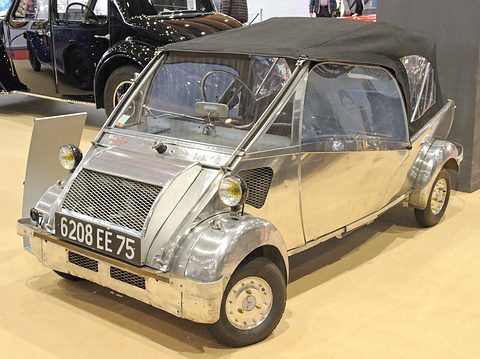
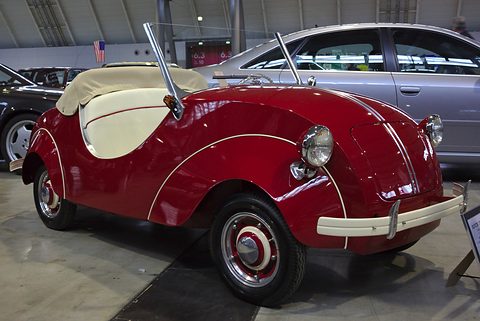
The Kover was the middle step of the ladder: the Babycar’s chassis without doors or a folding screen, with its headlamps on the wings and plainer castings.source 5source 2 RM dates it to 1950; the Weiner museum says it was introduced at the 1951 Salon.source 2source 5 It cost 215,000 francs, 30,000 less than the Atlas.source 2

Its engine is disputed. The Weiner museum’s card for its 1951 Kover CK 1 lists an AMC of 125 cc and 5.5 hp, described as a two-stroke; the German Wikipedia gives the 175 cc AMC four-stroke of the Atlas.source 5source 3 The card adds four gears and reverse, cable brakes, a length of 2,450 mm (8 ft 0 in), a width of 1,150 mm (3 ft 9 in), 235 kg (518 lb) and 60 km/h (37 mph).source 5 It was made, the museum says, for only a short time and in very small numbers.source 5

The name has its own puzzle. One website says the Kover was designed by a French engineer, Alex Kover, and was also built in Spain as the Kover-Capilla.source 6 The German Wikipedia, citing the Beaulieu encyclopaedia, says there was no link with the Spanish Kover-Capilla.source 3 The Weiner museum had a 1951 Kover CK 1, and the German Wikipedia says Kovers can be seen in some microcar museums.source 5source 3

Variants

One chassis, three prices

The S.I.L. family, 1949–⁠1952
VariantYearsWhat differsHow many
Coccinelle1949The Salon car, under its first namePrototype
Atlas Babycar1950–⁠1952Doors added; a new windscreen and grille; 245,000 FVery few
Kover CK 11950/51–1952No doors, no folding screen, lamps on the wings, plainer castings; 215,000 FVery few
Le Piaf1951–Flat alloy panels, open sides, a raked screen and canvas hammock seats; 200,000 FNot known

Specification

The 1951 Babycar, from the Weiner museum’s card unless noted

Engine and drive

Engine and drive
EngineAMC single-cylinder four-stroke, 175 ccsource 4source 2170 cc on the Weiner card
Power8.5 hp (about 6.3 kW)source 1source 2
GearboxFour forward and reverse; the reverse in a separate gearcasesource 1source 2
DriveTo the left rear wheel only, so no differentialsource 1source 2
StarterA pull lever on the floorsource 1source 2

Body and chassis

Body and chassis
BodySteel, by Duriezsource 4source 1source 2
ChassisSteel tubesource 1source 2
SuspensionIndependent all round: A-arms and coil springs at the frontsource 1source 2At the rear, leaf springs by the Weiner card, triangular trailing arms by RM
SteeringRack and pinionsource 1source 2
BrakesCable, on all four wheelssource 1source 2
Wheels270 × 90, two-piece aluminium castingssource 1source 2

Dimensions

Dimensions
Length2,770 mmsource 1source 39 ft in RM’s catalogue
Width1,240 mmsource 1
Weight270 kgsource 1source 3

Performance and running

Performance and running
Top speed60 km/hsource 165 km/h by the old site
Electrics6 V, coil ignitionsource 1
Price new245,000 Fsource 2

Famous for

Three points

  1. One wheel driven

    The engine drove the left rear wheel only, through a gearcase of its own.

  2. Three prices

    Atlas, Kover and Le Piaf: one chassis, offered at three prices from 200,000 to 245,000 francs.

  3. Coins for washers

    Its restorers found one-franc coins doing the work of steel washers on the steering arms.

Survivors and collecting

Today

Two Atlas Babycars are known to survive.source 1 The Weiner museum’s 1951 car, identification no. FH297, was found in original condition in France and fully restored. Period French press was so scarce that the restorers studied old photographs with a jeweller’s loupe, and they found one-franc coins fitted in place of steel washers on the steering arms, a small sign of how short materials were.source 2 It sold for $60,375 when the collection was dispersed in 2013.source 2 Nothing is known of an owners’ club.

At auction
CarSalePrice
1951 Atlas Babycar, no. FH297The Weiner collection, sold by RM Auctions in Madison, Georgia, 2013, lot 271source 2$60,375

Sources

Numbered as in the text

No period French press has been read, and no production figure exists in any source found. Sources are given as plain text; the links are on the Credits page.

  1. Bruce Weiner Microcar Museum, “1951 Atlas ‘Babycar’”, tour page (© 2002), read in full.
  2. RM Auctions, The Bruce Weiner Microcar Museum, Madison, Georgia, 2013, lot 271, “1951 Atlas Babycar”, catalogue text, read in full.
  3. German Wikipedia, Atlas (Automarke) and Kover, read in full; they cite Linz and Schrader, Georgano and Zeichner, not seen.
  4. The original microcarfan.com (2006–⁠2016), marque page “ATLAS”, a short note, read in full from the archived copy.
  5. Bruce Weiner Microcar Museum, “1951 Kover”, tour page (© 2002), read in full.
  6. cybermotorcycle.com, “Atlas Babycar Microcars”.