The American cyclecar craze
American cyclecars and small-car experiments
1913–1932 · United States · 10 makers
Also known as JB Rocket, Scripps-Booth Cyclecar, Packet (the delivery version)
A rocket-shaped bonnet, a torpedo tail, two hammock seats one behind the other and a pair of long belts to the back wheels, with no differential: the first car of the artist James Scripps Booth was the stylish end of the American cyclecar craze.
The spec plate
Scripps-Booth Rocket
Rocket and Packet · Detroit
Not yet recordedlength.
True proportion
Length unknown
No reliable length has been found. The Fiat 500, the Peel P50 and the adult stay, so the gap is shown, not hidden.
History
In January 1914 a reporter from Motor Age came to Detroit to see the city’s new cyclecars, and had his first sight of the Rocket from the pavement outside the Scripps-Booth plant.source 3
The writer had his first glimpse of the Rocket from the sidewalk in front of the plant… suddenly saw the little narrow car fairly jump over the railway tracks at the crossing, drop onto the pavement again, and come speeding down the freshly sprinkled asphalt at an easy 30 miles an hour.
Then James Scripps Booth took him for a ride. Booth drove from the back seat, jerking the wheel from side to side so that the car darted from kerb to kerb across the wet asphalt without slowing and without a skid.source 3
Booth was an artist and engineer, and a son of the Scripps newspaper family that owned the Detroit News.source 5source 6source 7 His first machine, the Bi-Autogo of 1912, was something else entirely: a V8 two-wheeler with outrigger wheels, which stayed a prototype. The two are sometimes confused, but they were different machines.source 5source 6source 7
The Rocket prototype was built from May 1913 at the family’s Scripps Motor Works, on Lincoln Avenue by the Michigan Central Railroad. It had no chassis in the usual sense: the sheet-steel body, stiffened with wooden sills, was the girder. The seats were hammocks of canvas and leather, and the tail held a luggage space with a lock. A De Luxe air-cooled V-twin, its crankshaft across the frame, drove by chain to a planetary countershaft, and from there very long leather V-belts ran to pulleys on the rear wheels, which turned freely on a fixed axle. The steering worked by wire cable and windlass, and the wheel stood behind the front seat back, for a driver in the rear seat. There was one door, to the front seat.source 4
Without a differential, the belts had to look after the corners. J. J. Batterman of the firm explained that on a bend the outer belt tightened, climbed higher in the groove of its pulley and so changed its own ratio, and in practice the tyres and belts showed no wear from the lack of one.source 4
In October 1913 Booth drove the prototype 1,609 km (1,000 miles) through Michigan, Indiana and Ohio, at an average of 27 km/h (17 mph), with a longest day of 324.6 km (201.7 miles), from 7.00 in the morning to 7.15 at night.source 4source 3 He then redesigned it: spur-gear steering replaced the cables, and the driver moved to the front seat.source 4
By January 1914 Detroit had a crop of American cyclecar makers, the Davis, Rocket, Mercury, Downing, J.P.L., Speedster and Malcolm-Jones among them, but Motor Age found only the Rocket and the Mercury with cars on the road. Its reporter rode in the experimental car, which still had no mudguards and no silencer, and admired the hammock seats, “the finest comfort imaginable”; the acceleration surprised him, and the brake, he found, was the reverse gear. At the plant a plank ramp at 45 per cent tested the cars’ climbing. A first lot of 25 cars was going through, and the firm hoped to build 1,000 by the end of the season.source 3
On a pot-holed boulevard a motorcycle followed them and could not gain an inch. Its rider was a policeman, who had timed them at 64 km/h (40 mph).source 3
“Would you believe it, if I told you you were going 40 miles an hour?” … “It’s a pretty small car to go that fast, isn’t it?”
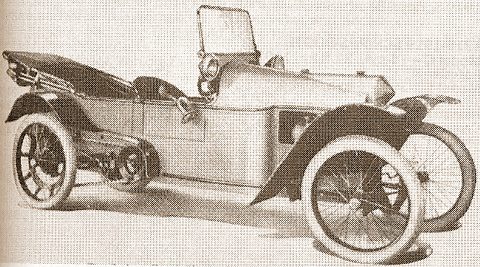
Production began in January 1914.source 5source 8 Motor Age’s directory listed two bodies on one chassis: the Rocket, a tandem two-seater, and the Packet, a one-seat closed delivery van.source 1 The maker’s sheet gives an air-cooled V-twin of 88.9 × 93.2 mm (3½ × 3.67 in), about 1,157 cc, of 10–12 hp at normal speeds and 15 hp at 2,600 rpm, with a two-speed planetary gearbox with reverse, belts to the rear wheels and still no differential. The wheelbase was 2,540 mm (100 in) and the track 914 mm (36 in). Complete, it weighed 340 kg (750 lb), and it would reach “all speeds up to 45 m.p.h.”, 72 km/h. It came in grey with black moulding and nickel fittings; a one-man top cost $15 more and a speedometer $12.source 2source 1 The Rocket sold for $385, and the Packet, with heavier rear springs for 159 kg (350 lb) of goods, for $395.source 5source 9source 2
The great motor event of 1914 is the advent of the cyclecar. It is a long-looked-for necessity because it fills a distinct and separate motor want.
Whether it was strictly a cyclecar depends on the rule. Its 1,157 cc twin was just over the international limit of 1,100 cc, and German Wikipedia says the Scripps-Booth cars were called cyclecars though they did not meet the criteria; but it was inside the American cyclecar class of 71 cubic inches.source 1source 7
The craze ended almost as soon as the Rocket was on sale. The cyclecar boom collapsed in 1914 as the Ford Model T came down in price, and in December 1914 the Scripps-Booth Cyclecar Company was sold to the Puritan Machine Company.source 5source 8 How many Rockets were made is not certain: about 400, with the Packets, by one figure that has not been checked.source 7 In Canada the car was assembled under licence for a short time by Toronto’s Dart Cyclecar Company (more in built under licence and cyclecars elsewhere).source 10
Booth moved up a class. His Scripps-Booth Company launched the Model C light car in 1915, designed by William B. Stout; the firm merged with Sterling in 1916, was bought by Chevrolet in 1917 and became a division of General Motors, and the marque ended in 1922.source 6source 7 Booth went on to design the experimental Da Vinci car of 1925.source 10
Two bodies, one chassis
| Variant | Years | What differs | How many |
|---|---|---|---|
| Prototype | 1913 | Driven from the rear seat, steered by cable and windlass; one door; a De Luxe twin by one account, a Spacke by another | 1, or a few |
| Rocket | 1914 | Tandem two-seater driven from the front seat; two doors on the right; torpedo tail | About 400 with the Packet, unchecked |
| Packet | 1914 | One-seat closed delivery van of 38 cu ft (1.08 m³), with heavier rear springs for 159 kg (350 lb) of goods | Included above |
| Dart | 1914 | Assembled under licence in Toronto, Canada | Not found |
The 1914 Rocket, from the maker’s sheet unless noted
| Engine | Air-cooled V-twin, fan-cooled, mechanically operated valves, Hess-Bright ball bearings; 88.9 × 93.2 mm (3½ × 3.67 in), 1,157 ccsource 2source 1source 7The capacity is calculated. The prototype’s engine is a De Luxe with its crankshaft across the frame in Dolnar’s account, and a Spacke set fore and aft in Motor Age’s; these were successive layouts |
|---|---|
| Power | 10–12 hp (7–9 kW) at normal speeds; 15 hp (11 kW) at 2,600 rpmsource 2The prototype 10–12 bhp at 2,500 rpm |
| Ignition and carburettor | Atwater-Kent; Schebler, primed from the front seatsource 1source 2 |
| Gearbox | Scripps-Booth planetary, two speeds and reverse, with bevels to a jackshaftsource 1source 2 |
| Final drive | V-belts over pulleys of 8 in and 15½ in to the rear wheels; overall 5:1; no differentialsource 1source 2 |
| Frame | None as such: the sheet-steel body, stiffened with wooden sills, was the girdersource 4 |
|---|---|
| Springs | Quarter-elliptic, vanadium steel, 508 mm (20 in)source 2Half-elliptics on the prototype |
| Front axle | I-beam drop forgingsource 4source 2 |
| Brakes | Internal-expanding drums of 203 mm (8 in) on the rear wheelssource 2On the prototype the brake was the reverse gear |
| Wheels | Wire, with 28 × 3 in clincher tyressource 4source 2 |
| Finish | Grey with black moulding, nickel fittings and black upholsterysource 2 |
| Top speed | “All speeds up to 45 m.p.h.” (72 km/h)source 2Dolnar gave the prototype 50 mph (80 km/h) |
|---|---|
| Fuel | 35–45 miles per US gallon, about 5.2–6.7 litres per 100 kmsource 2 |
| Fuel tank | 17 litres (4½ US gal), with a gallon of oilsource 4source 2 |
| Price new | $385 for the Rocketsource 5source 9; $395 for the Packet at Detroitsource 2 |
| Extras | One-man top with side curtains, $15; speedometer, $12source 2 |
One figure, unchecked
About 400, unverifiedThe only figure found is about 400 Rockets and Packets, from German Wikipedia, which cites Kimes’s Standard Catalog of American Cars; the book itself was not checked. In January 1914 the firm had a first lot of 25 cars going through and hoped for 1,000 by the end of the season.
about 400Rockets and Packets, 1914Unconfirmed
German Wikipedia, citing Kimes and Clarksource 7
Three points
Sheet steel stiffened with wooden sills was the car’s girder; there was no chassis in the usual sense.
Long V-belts drove each rear wheel, and the outer belt changed its own ratio on a bend.
In January 1914 a motorcycle policeman timed Booth and a reporter at 64 km/h (40 mph).
A proving run
No race entry for the Rocket is known; what it did was drive a long way (more in records and feats).
Today
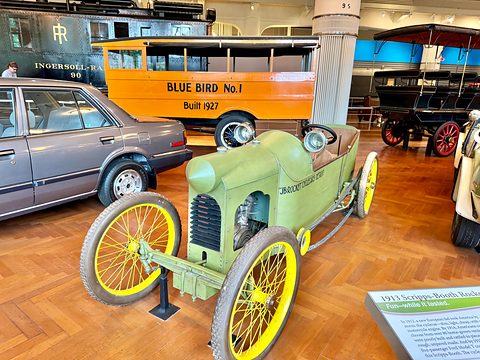
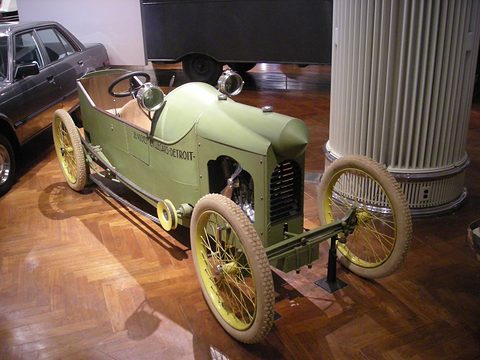
None of the sources read describes a surviving Rocket, and no Rocket has been traced at auction. The photographs on this page show a 1913 Rocket at the Henry Ford Museum, Dearborn, in 2012 and 2024; its history has not been found. A Scripps-Booth Register looks after the marque as a whole.source 6
Its world
The American cyclecar craze
1913–1932 · United States · 10 makers
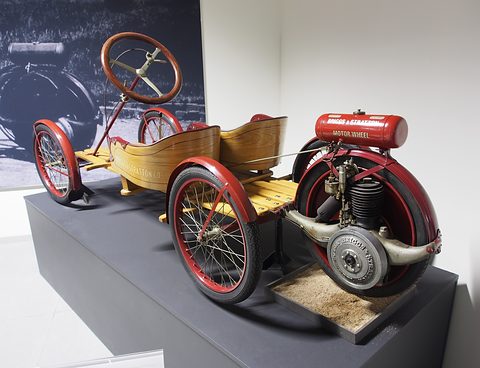
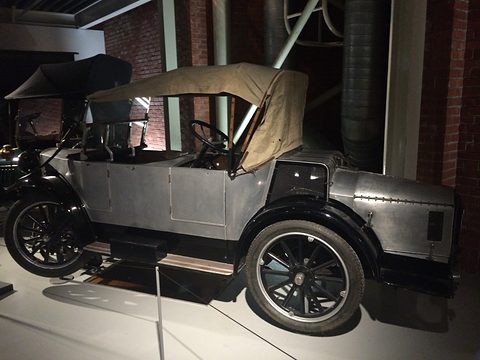
Its licence-built twin, the Dart
1913–1939 · Several countries · 24 makers
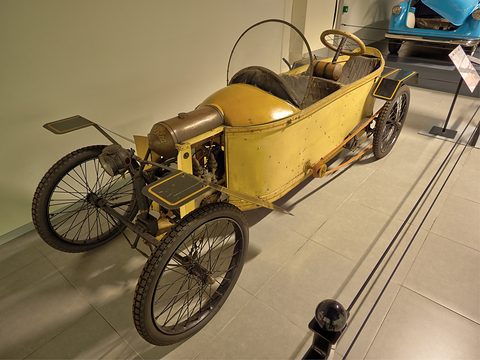
Numbered as in the text
The story of the car rests on three period documents, all read in full: Motor Age’s Detroit report and directory of 15 January 1914, and Hugh Dolnar’s trade article and the maker’s specification sheet, both reprinted in Horseless Carriage Gazette in 1957. Booth’s life and the firm’s later history come from encyclopedia snippets and Wikipedia. Sources are given as plain text; the links are on the Credits page.