
microcarfan
  • Cyclecar
  • Spain
  • Belt drive

David cyclecar

Also known as David, Autociclo David

It began with a bobsleigh and no snow. A young man in Barcelona fitted wheels to his sled, raced it down the Tibidabo, tired of pushing it back up and gave it an engine. The result was Spain’s leading cyclecar, named after the biblical David.

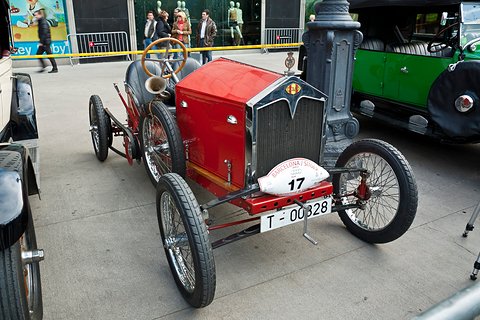
A red open racing cyclecar with exposed chassis, wire wheels and a rally plate numbered 17, a green car and passers-by behind.
Red David cyclecar No. 17 on show in Barcelona, Spain, before the Barcelona–Sitges rally in March 2012.Photo: Jordi Payà, CC BY-SA 2.0, via Wikimedia Commons

At a glance

The spec plate

David cyclecar

Autociclo · Barcelona

Built
1913–⁠1923First car in 1913; the factory from 14 July 1914; car making ended in 1922 or 1923
Country
SpainBarcelona, Catalonia
Maker
Fábrica Nacional de Autociclos DavidFounded on 14 July 1914; David, S.A. from 1919
Engine
Air-cooled JAP V-twins, then water-cooled MAG twins and fours; Hispano-Suiza, Ballot and Elizalde engines from 1919At the front
Seats
2 or 4Open bodies, and closed versions
Wheels
4Front engine; twin belts to the rear wheels
Production
Not settledAbout 100 by 1915; 1,500 in all by one unsourced estimate

Not yet recordedpower, top speed, length and weight.

How big is it?

True proportion

Length unknown

No reliable length has been found. The Fiat 500, the Peel P50 and the adult stay, so the gap is shown, not hidden.

Drawn at true proportion. The track is 3.6 metres long; the adult stands at the same scale. The Peel P50 is the smallest production car, on every page for comparison.

The story

History

In 1907 the Centre Excursionista de Catalunya chose José María Armangué, aged 17, to drive one of its bobsleighs in the Coupe du Président de la République.source 1 There was no snow, so he put the sled on wheels and made a “down-car”, which he raced down the Tibidabo and the Rabassada road. Tired of pushing it back up, he fitted it with a motor.source 1source 2source 3 Down-car racing on the Tibidabo became popular, and in 1910 the brothers José María and Ramón Moré won the Copa Barcelona with one.source 1source 3 Before 1913 the Armangué brothers designed a four-stroke engine, which was never built, and patented a progressive gear change that became a hallmark of the cars to come.source 3

With his brothers or cousins Luis and Federico (“Frick”) Armangué, the Moré brothers, Fernando Comas, the Puig brothers and others, Armangué built the first car in 1913, in Sebastián Juanico’s workshop on the Avinguda del Tibidabo, a name often misspelt “Juanito”.source 1source 2source 3 They called it David, because the little car could take on much bigger ones.source 1source 4source 2 On 14 July 1914 the Fábrica Nacional de Autociclos David was founded in Barcelona with 65,000 pesetas of capital, when Armangué was 24, and by 1915, according to a newspaper article of 2014, about a hundred cars had been built. The works later stood at carrer Pallars 71, now 77, in Poblenou.source 1source 4source 2

Belts and a wide track

The David had a wooden frame, independent front suspension by transverse leaf springs one above the other, and a very wide track, which the RACC’s history of Catalan motoring credits with great stability and agility. Twin belts drove the rear wheels at an adjustable ratio, through the Armangués’ patented progressive change.source 2source 3 English Wikipedia says the belts and pulleys gave 16 speeds, and that the car had front-wheel brakes, but cites no source for either.source 5 The engines grew from air-cooled JAP V-twins to water-cooled MAG twins and fours, and from 1919 Davids had Hispano-Suiza, Ballot and Elizalde engines.source 1source 2 The same history says the most powerful could reach 130 km/h (81 mph) on the flat, a figure that is high for a cyclecar.source 2 There were two- and four-seaters and closed versions, and the duc de Montpensier ordered one; the model named after him was “the most perfected of the Davids”.source 4source 2
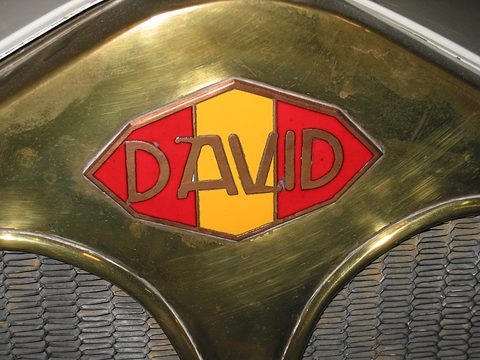
An elongated red, yellow and red enamel badge reading David on a brass radiator shell above the honeycomb core.
The red and yellow enamel DAVID badge on the radiator of a 1917 David cyclecar.Photo: Buch-t, Public domain, via Wikimedia Commons

Pictures

More photographs, old and new

Variants

From prototype to taxi

The David cyclecars
VariantYearsWhat differsHow many
First David1913The prototype, from the Juanico workshop1
Early cyclecar1914 to about 1916Two- or four-seat open bodies; belt drive; air-cooled JAP V-twinNot found
MAG-enginedAbout 1916–⁠22Water-cooled MAG twin or fourNot found
MontpensierNot datedNamed after the duc de Montpensier, who ordered one; “the most perfected of the Davids”Not found
Post-19191919–⁠22 or 1923Bought-in Hispano-Suiza, Ballot and Elizalde enginesNot found
“La Bala de Plata”1922Competition car with a more aerodynamic body; MAG four of 1,100 cc with overhead valves1
Two-seat taxiAbout 1917–⁠23Small taxi bodyNot found

Specification

What the sources record

Engine and drive

Engine and drive
EnginesAir-cooled JAP V-twin, then water-cooled MAG twin and four; Hispano-Suiza, Ballot and Elizalde from 1919source 1source 2English Wikipedia’s list of singles and fours of 6–8 hp and 10–12 hp is unsourced
TransmissionTwin belts to the rear wheels, with an adjustable ratio: the progressive change the Armangué family patentedsource 2source 3English Wikipedia says 16 speeds, without a source

Body and chassis

Body and chassis
FrameWoodsource 2
Front suspensionIndependent, by superimposed transverse leaf springssource 2
TrackVery wide, for stabilitysource 2
BrakesOn the front wheels, by English Wikipedia’s unsourced accountsource 5

Dimensions

Dimensions
Length, width, weightNot found

Performance and running

Performance and running
Top speedUp to 130 km/h (81 mph) “on the flat” for the most powerful, by one later accountsource 2High for a cyclecar; from the RACC’s history, through Catalan Wikipedia
PriceNot found

How many were built?

Every figure, with its source

About 100 by 1915; the total is not settledNo figure from the period has been found. About a hundred cars by 1915 comes from a newspaper article of 2014; the 1,500 in all is an enthusiast site’s estimate, unsourced and repeated by Catalan Wikipedia.

  1. 1,500vehicles built in allUnconfirmed

    losorigenes.net, 2007, repeated by Catalan Wikipediasource 4source 2

  2. about 100vehicles built by 1915One source

    El Periódico, 2014, through Catalan Wikipediasource 2

  • Two sources agreetwo good sources give the figure
  • One sourcea good source, alone
  • Unconfirmeda lead only, not yet checked

Famous for

Three points

  1. A sled with an engine

    The David began as a bobsleigh on wheels, raced down the Tibidabo for want of snow.

  2. Barcelona–Madrid–Barcelona

    Luis Armangué won the road race of more than 1,250 km in 1916 in a David.

  3. Black and yellow

    The firm became Barcelona’s great taxi company, and its colours became the city’s.

Racing and records

Road races and a hill-climb

For years Davids dominated cyclecar competition in Spain (more in racing and rallying).source 1source 2

1914
J. M. Armangué won the Barcelona–Sabadell–Barcelona race.source 1
October 1915
J. M. Moré won the Moto Club de Barcelona’s first team trial, the Prova per Equips, teamed with two Rudge motorcycles and a Rover sidecar.source 1
1,250 km
and more, Barcelona–Madrid–Barcelona in 1916, won by Luis Armangué at about 44 km/h (27 mph).source 1
1922
José María Moré was second, behind Satrústegui’s Bugatti, in the first Rabassada hill-climb, in the 1,100 cc MAG-engined “La Bala de Plata”, the Silver Bullet.source 1

After the cyclecar

Taxis, and today

On Monday 29 October 1917 José María Armangué was killed in a flying accident at El Prat. The Moré brothers took control and turned the works to small two-seat taxis.source 1source 2source 3 In 1919 the firm became David, S.A., and Ernesto Rodríguez Iranzo, Moré’s regular co-driver, took charge of its technical office. From 1921 to 1923 cyclecars raced for the Trofeo Armangué in his memory; in 1922 “Frick” Armangué drove a Loryc-EHP in it.source 1 The factory closed in about 1923, after an attempt to convert it failed, and the unsold cars became taxis. Some sources date the end to 1922, others to 1923.source 1source 4source 2source 6

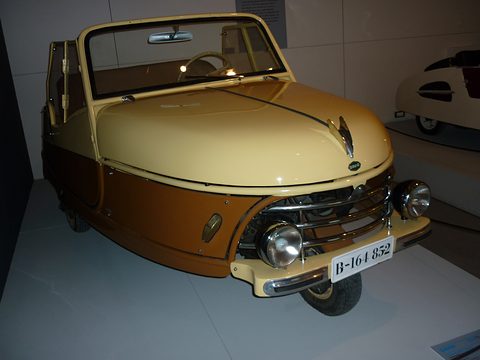
The taxis outlived the cars. David became Barcelona’s great taxi company, with about 1,000 cabs and a figure of Michelangelo’s David on their fronts, and in 1931 the city took David’s black and yellow as the colours of its taxis. The Edificio David on carrer d’Aribau opened that year.source 3source 6 The firm was also a Citroën agent and ran car parks and a towing service, built about ten electric cars on Citroën chassis in the 1940s, and in the 1950s returned to small cars with a three-wheeler, the David Torpedo 2S.source 3source 6 The Weiner microcar museum credited that car to Armangué, which cannot be, since he had died in 1917.source 1source 3 David, S.A. still exists, as a property company.source 2source 3

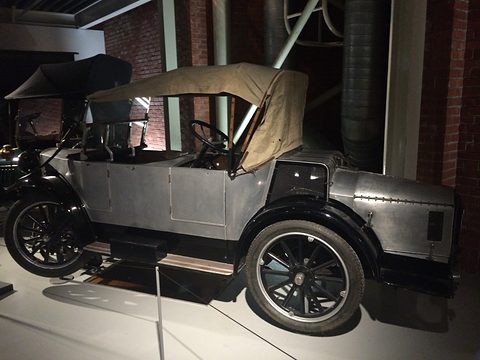
A David of 1917 is photographed on Wikimedia Commons, in the Catalan Wikipedia article, but where it is kept is not stated; no museum example and no auction result have been found.source 2

A tall stone-faced office building with long window bands and a blue David sign over a street-level entrance.
The Edificio David of 1931 on carrer d’Aribau, Barcelona, built by the David company after its cyclecar years, in December 2022.Photo: Pere López Brosa, CC BY-SA 4.0, via Wikimedia Commons

Sources

Numbered as in the text

The history rests on Josep Astudillo’s article on Autopasion18, Catalan Wikipedia (which cites the RACC’s history of Catalan motoring) and the David company’s own history, all later accounts; no period road test or catalogue was read. Translations from Spanish and Catalan are ours. Sources are given as plain text; the links are on the Credits page.

  1. Josep Astudillo, “David (1913–⁠1959)”, Autopasion18, read in full (Spanish).
  2. Catalan Wikipedia, David (empresa), read in full. Used as a lead; it cites the RACC’s La història de l’automobilisme a Catalunya, El Periódico of 21 October 2014, La Vanguardia of 22 January 1991, losorigenes.net and the MUHBA.
  3. David, S.A., “Historia del Edificio David y sus Autos”, the company’s history, read in full (Spanish).
  4. Embouteillage, “David”, losorigenes.net, 2007, read in full in an archived copy of 2016 (Spanish).
  5. English Wikipedia, David (company), read in full. Used as a lead.
  6. MUHBA (Museu d’Història de Barcelona), L’enginy de postguerra. Microcotxes de Barcelona, 2012, p. 17, the David section read (Catalan).