microcarfan
  • Microcar
  • Several countries
  • 7 makers

Dutch and Belgian microcars

The Low Countries built no microcar in numbers. They assembled other people’s, under licence or from kits, showed a few prototypes, and produced one true original: the Shelter, a home-made three-wheeler meant to be hired from stations around Amsterdam.

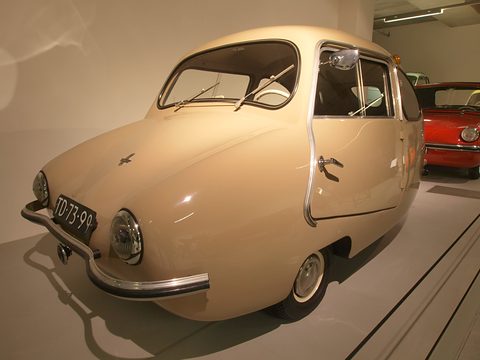
Egg-shaped cream microcar with rear-hinged door and chrome bumper on a museum plinth, a red sports car behind.
A cream Bambino 200 at the Louwman Museum in 2011.Photo: Alf van Beem, CC0, via Wikimedia Commons

At a glance

The spec plate

Dutch and Belgian microcars

Seven makers · Netherlands and Belgium

Built
1951–⁠1958From the Ghent kits of about 1951 to the Citeria of 1958; a last Shelter was put together from spare parts in about 1970
Country
Several countriesThe Netherlands and Belgium
Engine
123 cc to 400 cc, and a BMW twinILO engines in the Kleinschnittger, the Bambino and the Claeys Flandria, and a 200 cc ILO in the Shelter prototype; Arnold van der Goot’s own 228 cc in the production Shelter; a German 200 cc twin planned for the Succes; a BMW two-cylinder in the Citeria
Wheels
Three, two in front, on the Shelter and the Bambino; four on the Kleinschnittger
Production
7Shelters, the best-supported figure (one source says five or six); 100 Kleinschnittger kits were taken for assembly in Ghent
Top speed
80km/h80 km/hThe Citeria sports car: about 135 km/h

Not yet recordedpower and seats.

The story

History

The Dutch word is dwergauto, dwarf car, and the dwarf cars of the Netherlands and Belgium in the 1950s were one-offs, kits and licences.source 1source 2source 3 The DAF 600 of 1958 is too big to count here. Seven makers are below. The four without sections of their own come first, by date; the three with sections of their own follow, also by date.

Kits for Ghent, early 1950s

The Belgian Jules De Reuck took 100 German Kleinschnittger F125s in kit form, for assembly in Ghent.source 4 What followed, the Kleinstwagen Belge, is told with its parent.

The Succes, 1952

At the Brussels show of January 1952 a prototype called the Succes appeared, to have a German 200 cc twin. It was a close copy of the Fuldamobil N roadster, with no known link to Fulda, and it was not produced.source 5

The Bambino, 1955

The Netherlands’ licence-built Fuldamobil, sold under the Hostaco brand as the Bambino 200, was assembled by NV Alweco at Veghel from 1955 to 1957. It is told, with the doubts about where it was really built, on the Fuldamobil’s page.source 6source 5 The Louwman Museum in The Hague has one (see museums and meets).source 6

A Trippel for Belgium, 1956

Ateliers de Constructions Mécaniques Ch. Wilford et Fils took a licence for Hans Trippel’s Trippel 750 coupé, the design that Weidner built in Germany as the 70 S; no record has been found of any Belgian cars being built. Trippel’s earlier cars are on the page for German Kabinenroller small makers.source 7
Claeys Flandria

1954 · a record on this page

Ateliers Claeys Flandria of Zedelgem had made bicycles since 1896, and mopeds and motorcycles after them, and sponsored the Flandria cycling team. For what it billed as its 60th anniversary it showed a microcar at the Brussels motor show in February 1954: a steel body with front-hinged doors and 2 + 2 seats, and a two-cylinder ILO two-stroke of 250 or 400 cc at the back. With the larger engine it was said to reach 80 km/h (50 mph); its quoted thirst was 4.5 litres to the 100 km (63 mpg). It was not produced.source 8 The firm came back to the idea in 1979, with 50 cc microcars on three and four wheels.source 8

Shelter

1954–⁠1958 · a record on this page

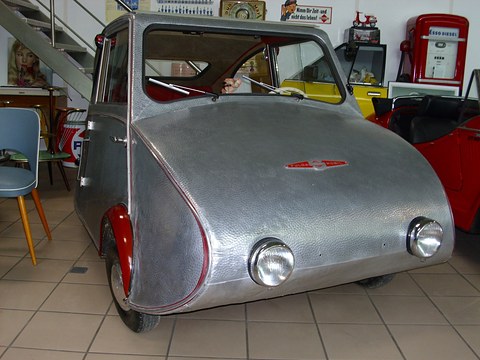
Arnold van der Goot began thinking about a small car in 1947, while a student at Delft, and after the war he worked for the Bristol Aeroplane Company; two sources spell his name van der Groot, but his family and his son Erik use Goot.source 1source 2source 3source 9source 10 His first plan was a three-wheeler made of two bicycle frames welded together. It grew into a small pool car, to be hired at stations round a city, driven inside it and left at any station, and the Dutch government backed it, because traffic in Amsterdam’s narrow cobbled streets was already a problem.source 3source 2source 9source 10 It is seen as a forerunner of the Witkar, the shared electric car Amsterdam tried in the 1970s.source 10

He made almost all of it himself. The two seats were plain metal pressings, the steering wheel bent steel tube, and the road wheels, suspension and steering were his own; the roof was formed by forcing water between the halves of a concrete mould, and a local cookware firm made the headlamp surrounds.source 3source 2 The prototype had a 200 cc ILO engine. The production cars had his own 228 cc two-stroke of 8 hp (6 kW), whose connecting rod was made from curved, spot-welded gas pipe, with three gears and an automatic centrifugal clutch.source 1source 2source 3 It sat behind the seats, driving the single rear wheel, and the whole unit came out in minutes.source 2source 3

it was claimed that in the event of a breakdown it was possible to remove the defective power unit and replace it with a new one in ten minutes!

Tony Marshall, Isetta Gazette, June 1980.source 3

Upright at the front, with SHELTER across the nose, and curved at the back, it was about 2.3 m (7½ ft) long by one account, 2 m by another.source 2source 3source 10 The prototype was built in Amsterdam, production moved to Terborg in the Achterhoek, and parts were made for 20 cars, to be offered for rent or lease as a test of the public. Seven were built, or five or six by Marshall’s count.source 1source 2source 3source 9source 10 The axles broke on the cobbles and there were engine fires, and the government withdrew; the car had also come too late, and looked old-fashioned and home-made.source 2source 10source 3source 9 A last car was put together from leftover parts in about 1970.source 9

Two are known. One belongs to the designer’s son, Erik van der Goot, with a large stock of parts, and one to the collector Sjoerd ter Burg; AM Klassiek reports the best example in the Louwman Museum and a yellow car awaiting restoration at Terborg, which may be the same cars.source 2source 3source 10source 9

Citeria

1958 · a record on this page

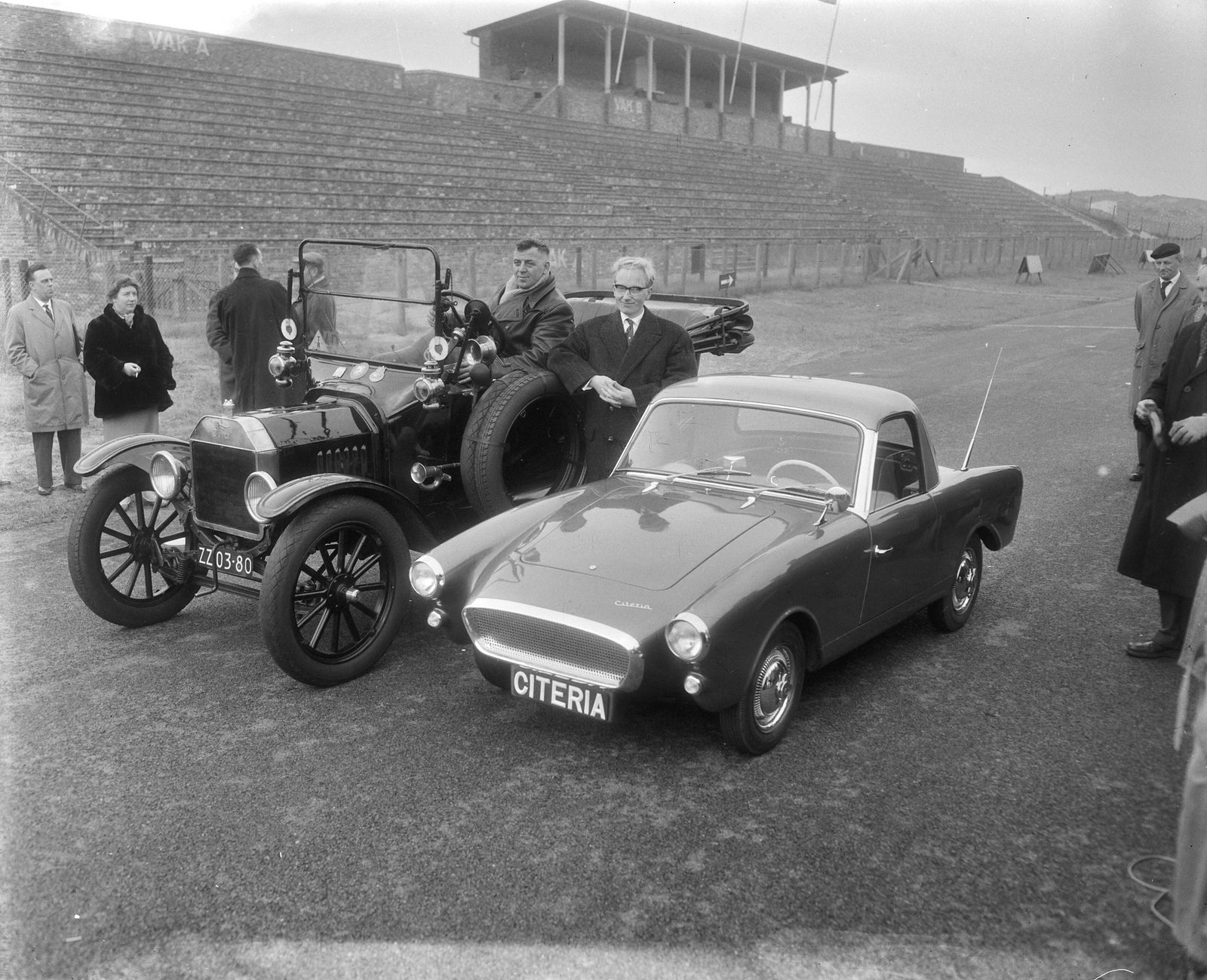
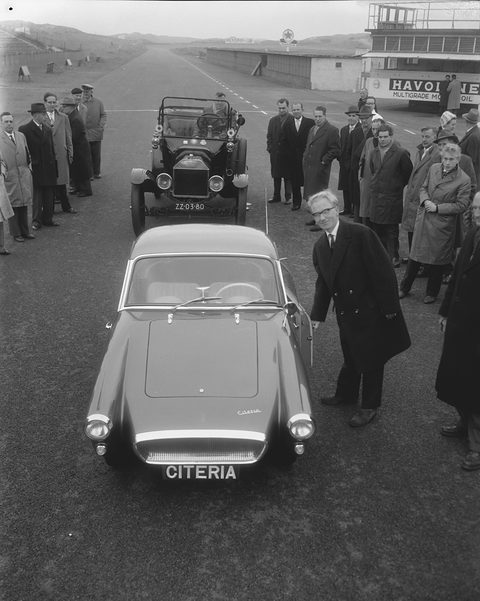
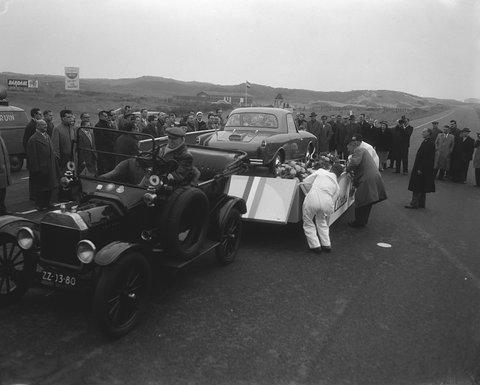
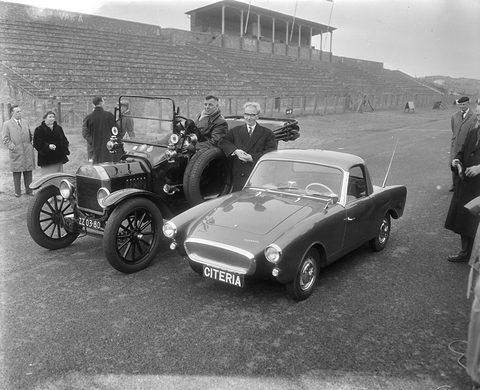
The Citeria was a small sports car rather than a microcar. The garage owner Puck van Beekum, hoping to recover his losses on an earlier project, the Bellcar, built it with the engineer Han van der Blij: a glass-fibre body, a BMW two-cylinder four-stroke at the back, independent suspension all round and about 135 km/h (84 mph), for 7,450 guilders.source 11source 12source 13 After about two years of building and testing it was launched at Zandvoort on 17 November 1958. Stirling Moss and Carel Godin de Beaufort came, de Beaufort drove it round the circuit, and Dutch television filmed it.source 11source 12 A few days later Van Beekum was arrested for financial irregularities, and he was later sentenced to two and a half years. Only the one car was built, and it survives in its original state in Wil van Buuren’s private collection.source 11source 13

Black-and-white photograph of a small rounded sports coupé with CITERIA on its nose plate, a veteran car and onlookers behind.
Plate I · 1958 The Citeria at its launch at Zandvoort on 17 November 1958.Photo: Harry Pot for Anefo, CC0, via Wikimedia Commons
Black-and-white photograph of an old open car towing a trailer with a small coupé, a crowd and dunes behind.
Plate II · 1958 The Citeria arriving on a flower-decked trailer behind a veteran Ford at Zandvoort in November 1958.Photo: Harry Pot for Anefo, CC0, via Wikimedia Commons

Pictures

More photographs, old and new

Variants

Seven makers, in date order

The Low Countries’ small cars
VariantYearsWhat differsHow many
Kleinschnittger kits, GhentEarly 1950sJules De Reuck’s Kleinschnittger F125s, assembled from kits100 kitssource 4
Succes1952A Belgian copy of the Fuldamobil N roadster; a German 200 cc twin plannedPrototypesource 5
Claeys Flandria1954A bicycle maker’s 2 + 2 with a rear ILO twinPrototypesource 8
Shelter1954–⁠58Three wheels, the designer’s own 228 cc engine; a city hire car7, or 5 or 6source 1source 2source 3
Bambino 2001955–⁠57The Fuldamobil under licence, assembled at Veghel; ILO 197 ccsource 6source 5Not found
Wilford Trippel1956–⁠57A licence for Hans Trippel’s 750 coupésource 7Not found
Citeria1958A glass-fibre sports car with a BMW twin1source 11source 12

How many were built?

Maker by maker

Kits, prototypes and seven SheltersNo Dutch or Belgian microcar of the 1950s went beyond a small series. Seven Shelters is the best-supported figure, from three sources; the 100 Ghent cars were German kits taken for assembly.

  1. 100Kleinschnittger F125 kits for GhentOne source

    Bruce Weiner Microcar Museumsource 4

  2. 7Shelters, from parts for 20Two sources agree

    German, English and Dutch Wikipediasource 1source 2source 10

  3. 5 or 6Shelter bodies used, of about ten madeUnconfirmed

    Tony Marshall, Isetta Gazette, 1980source 3

  4. 1CiteriaTwo sources agree

    Dutch Wikipedia and zwischengas.comsource 11source 12

  • Two sources agreetwo good sources give the figure
  • One sourcea good source, alone
  • Unconfirmeda lead only, not yet checked

Famous for

Three points

  1. A hire car in 1954

    The Shelter was meant to be picked up at one city station and left at another.

  2. An engine change in minutes

    Its home-made 228 cc engine and gearbox could be swapped in minutes.

  3. Launched, then arrested

    The Citeria’s promoter was arrested days after its launch at Zandvoort.

Sources

Numbered as in the text

The Shelter has the most sources, among them a 1980 club article and a Dutch article drawing on the family; the Belgian cars rest on one source each, and the Citeria on a Dutch Wikipedia article, a summary of a zwischengas.com piece and an enthusiasts’ page. Sources are given as plain text; the links are on the Credits page.

  1. German Wikipedia, Shelter (Automarke), read in full; it cites Linz and Schrader (2008) and Georgano’s Beaulieu Encyclopedia (2001).
  2. English Wikipedia, Shelter (automobile), read in full; used as a lead. It cites Adrienne Kessel, The World’s Strangest Automobiles (2001).
  3. Tony Marshall, “Shelter”, Isetta Gazette, June 1980, archived, read in full.
  4. Bruce Weiner Microcar Museum, “1955 Kleinschnittger F‑125”, tour page, archived.
  5. Dutch Wikipedia, Hostaco, and English Wikipedia, Fuldamobil, read in full.
  6. German Wikipedia, Bambino (Automarke), read in full.
  7. German Wikipedia, Protek Gesellschaft für Industrieentwicklungen and Weidner 70 S, read in full.
  8. German Wikipedia, Claeys Flandria, read in full. It cites Kupélian and Sirtaine (2012), p. 297, Linz and Schrader, and Zeichner.
  9. AM Klassiek, “De Shelter, een Nederlandse dwergauto”, 28 October 2019.
  10. Dutch Wikipedia, Shelter (automerk), read in full.
  11. Dutch Wikipedia, Citeria, read in full.
  12. zwischengas.com, “Citeria – a compact sports car from Holland”, 22 October 2012; known from a search summary only.
  13. catsandcaddies.com, Citeria page, an enthusiasts’ database, archived 2007, read in full.