microcarfan
  • Three-wheeler
  • Britain
  • Three wheels
  • Tiller steering

AC Sociable

Also known as A.C. Sociable, Auto-Carrier, Autocarrier, “Mighty Atom”

It began with a butcher who wanted his meat delivered. The tiller-steered tricar he paid for carried a goods box between its front wheels and its gearbox inside the rear hub, and its name, Auto-Carrier, became AC.

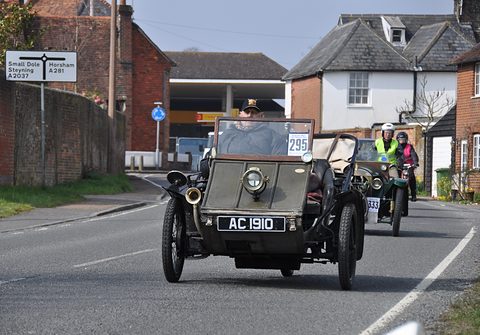
A small dark three-wheeled car with a driver aboard on a village road, motorcycles following.
A 1910 AC Sociable, AC 1910, on the Sunbeam Motor Cycle Club Pioneer Run from Epsom to Brighton, England, in March 2011.Photo: Rob, CC BY-SA 2.0, via Wikimedia Commons

At a glance

The spec plate

AC Sociable

Auto-Carrier and Sociable · London

Built
1904–⁠1914The Auto-Carrier from 1904, the Sociable from about 1907
Country
BritainWest Norwood, London; Thames Ditton, Surrey, from 1911
Maker
Autocars and AccessoriesAuto Carriers Ltd from 1907; Auto Carriers (1911) Ltd at Thames Ditton from 1911
Engine
648 cc air-cooled singleUnder the seat; 95 × 102 mm, about 723 cc, by 1912
Power
5 RAC hp“5–6 hp” in 1911
Seats
1 to 3The driver alone behind the box; passengers in front of him; two side by side from about 1909
Wheels
3Two at the front, one chain-driven at the back
Production
about 1,500–1,800Two estimates, neither documented

Not yet recordedtop speed, length and weight.

How big is it?

True proportion

Length unknown

No reliable length has been found. The Fiat 500, the Peel P50 and the adult stay, so the gap is shown, not hidden.

  • The driver sat behind the goods box, or behind the passengers
Drawn at true proportion. The track is 3.6 metres long; the adult stands at the same scale. The Peel P50 is the smallest production car, on every page for comparison.

The story

History

In 1903 the Weller brothers of West Norwood showed a 20 hp touring car at the Crystal Palace motor show.source 1source 2 John Weller, born in Peckham on 28 November 1877, was managing director and chief draughtsman of the family firm, which made motorcycle engines.source 3 Their backer was John Portwine, a West Norwood butcher who owned the London Suburban Meat Store chain, and he thought the tourer “would be too expensive to produce and encouraged Wellers to design and produce a little delivery 3-wheeler”.source 1source 4 RM Sotheby’s says it was to meet the delivery needs of his shops, and others, in crowded London.source 5

The Auto-Carrier went into production in 1904, built by a new company, Autocars and Accessories, at 42 Martell Road.source 6source 1 It was a three-wheeler with a large goods box between its two front wheels. The driver sat behind on a single seat and steered with a tiller; under him was an air-cooled single of 648 cc and 5 RAC hp, driving the single rear wheel by chain, and the rear hub held a two-speed epicyclic gear and the clutch.source 7source 8source 5 It was simple, and RM Sotheby’s says even inexperienced recruits could be trained on it quickly.source 5 It caught on quickly and made money, and it gave the company its name: Auto-Carrier, then A.C.source 1source 6source 2 Portwine’s obituary says it found a market as far away as Japan.source 4 Working tricars of its kind are the subject of micro vans and pick-ups.

He met young John Weller, an engineer and backed him financially… Their enterprise produced the cheap three-wheel tiller steered motor vehicle, first built in a West Norwood factory rented by John Portwine.

John Portwine’s obituary, Norwood News, 30 May 1958, as transcribed by Grace’s Guide.source 4

Passengers instead of parcels

The company became Auto Carriers Ltd in 1907, and that year a passenger version appeared, with a seat in place of the cargo box.source 6source 1 RM Sotheby’s gives the order of what followed. The first passenger tricars put one seat where the box had been, with the driver still behind; later ones, now called Sociables, had room for two passengers in front of him; and finally the controls moved to a two-seat bench, so that driver and passenger sat side by side, sociably.source 5 The seating moved forward, a sloping front protected the occupants’ legs, and a wood-framed hood was offered.source 8 Owners took them into reliability trials.source 8 One Sociable is said to have been timed at 47 mph (76 km/h) at Brooklands, but no date or driver is given.source 8

In 1911 the business moved to the Ferry Works at Thames Ditton, Surrey, which had been Willans and Robinson’s.source 1source 2 On 26 September that year the old company was wound up voluntarily and its business taken over as a going concern by Auto Carriers (1911) Ltd.source 1 The AC roundel dates from 1911, and the 1912 advertisements called the Sociable the “Mighty Atom”.source 2source 1

Olympia, 1912

At Olympia’s Motor Cycle and Cycle Car Show in November 1912, A.C. had stand 60. The first issue of The Cyclecar described its single of 95 × 102 mm, about 723 cc, against the 648 cc of earlier accounts, so the engine had probably grown. The gear was still in the back hub, with a single roller chain to the back axle; steering was by tiller, the tyres were 2½ in on all three wheels, and front-wheel brakes cost extra, the standard brakes being bands on the back wheel. The construction was the other way round from a car’s: “It has a frame of angle steel built into the body, and the chassis is erected on the body instead of the other way about.”source 9 AC showed eight vehicles that year, and The Auto Motor Journal called the Sociable “one of the most popular cycle cars on the road, both for pleasure and business”.source 2 The new magazine counted it a cyclecar, the oldest of the type, and drove it hard alongside the Morgan Three-Wheeler.

We have driven both the A.C. sociable, which has been before the public longer than any other type of cyclecar, and the Morgan three-wheeler at their top speeds, in traffic, and round right-angled corners, and have demonstrated that the tendency to skid is slight, while there is absolutely no propensity to turn over.

“The Stability of Cyclecars”, The Cyclecar, 27 November 1912.source 9

In 1913 a reader could find “A Fortnight’s Tour on a secondhand A.C.” in the same magazine,source 10 and AC built its first four-wheeled car.source 1source 2 English Wikipedia says the army used Sociables with bodies to carry a machine gun, citing only enthusiast sites.source 11

From tricar to Cobra

Passenger three-wheeler production ended in 1914, and in the war the Ferry Works made shells and fuses.source 1source 2source 6 The Auto-Carrier was built again for a time in the 1920s, and an advertisement for one appeared in March 1924.source 7source 1 Weller and Portwine left after Selwyn Edge took control in 1921–⁠22, and the company became AC Cars Ltd in 1922.source 1source 2 The money the tricars made had paid for the move to Thames Ditton and for the first four-wheeler, the start of the line that leads to the Ace and the Cobra.source 1source 2 AC came back to three wheels after the Second World War, with invalid carriages and the AC Petite of 1953.source 1
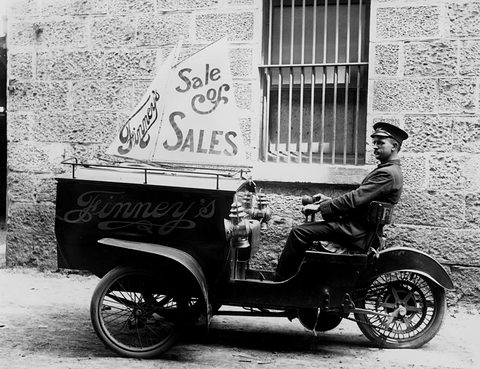
A man in a peaked cap sits behind a box lettered ‘Finney’s’ on a three-wheeled delivery vehicle.
Plate I · c. 1905 A worker of Finney Isles & Co., a Brisbane store, at the tiller of its Auto-Carrier, about 1905: the goods box in front, the driver behind.Photo: State Library of Queensland, Public domain, via Wikimedia Commons
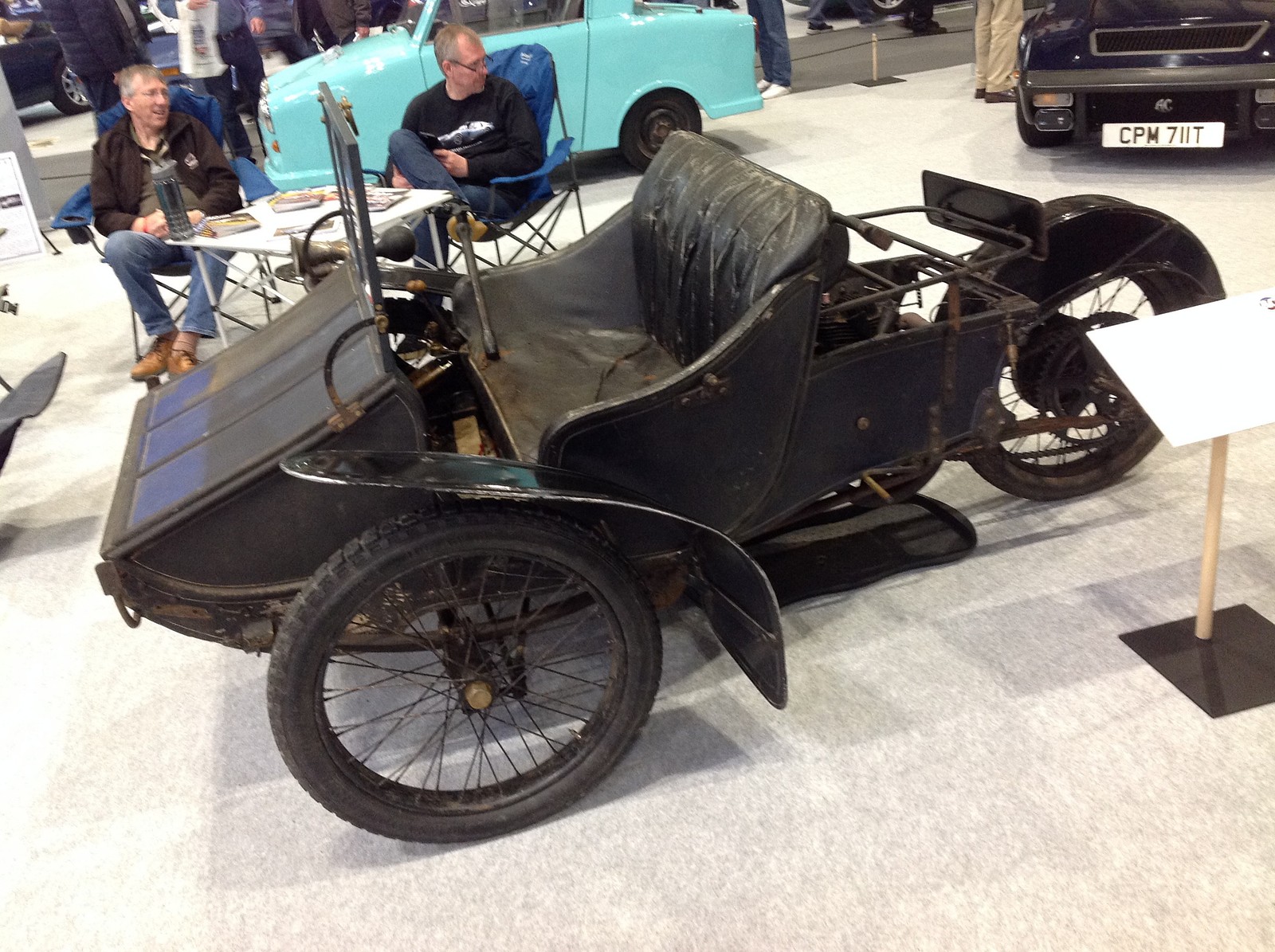
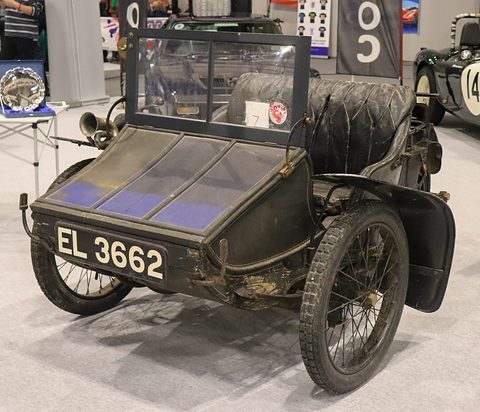
Front of a black three-wheeled vehicle with a lidded box between two wheels and a windscreen behind.
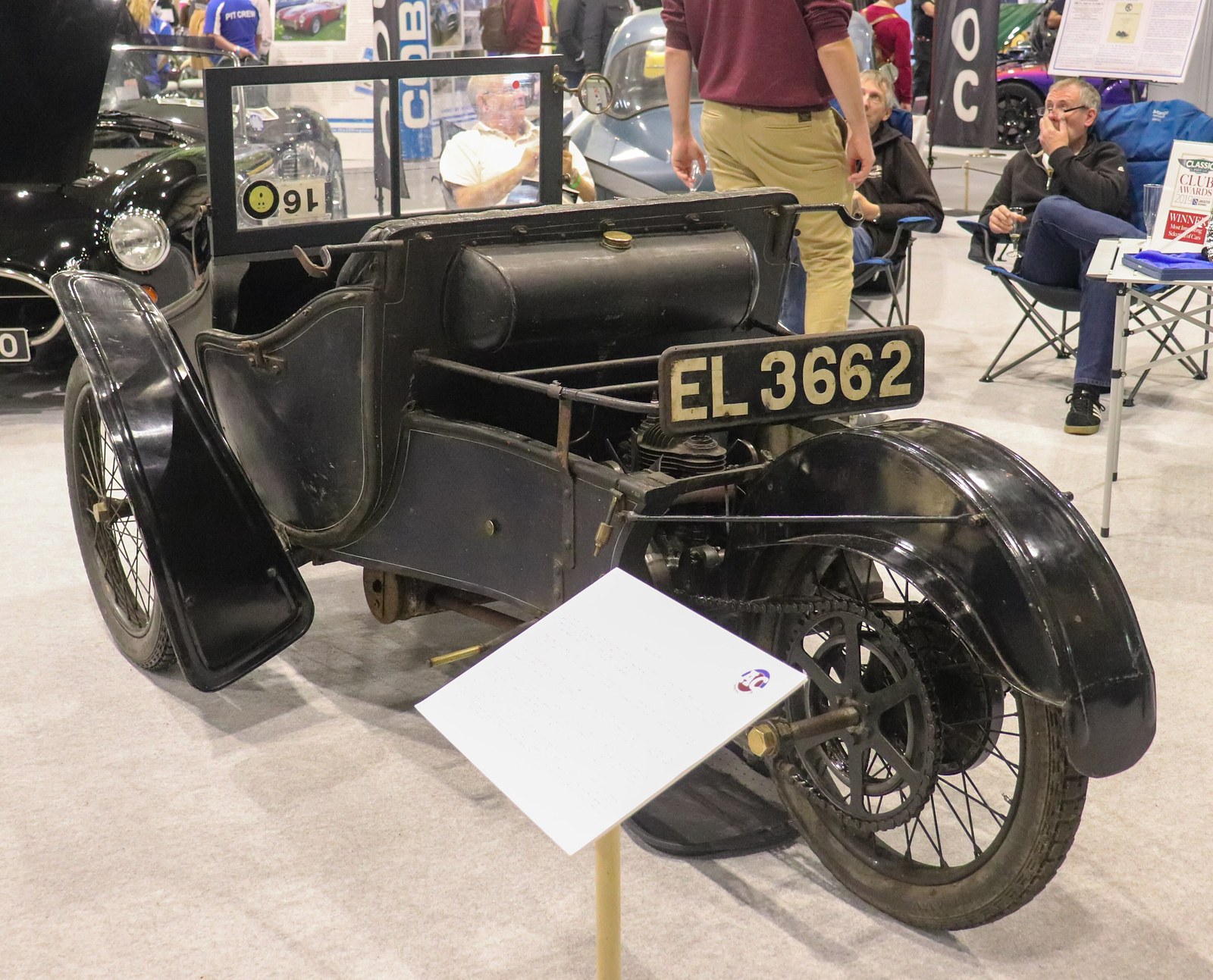
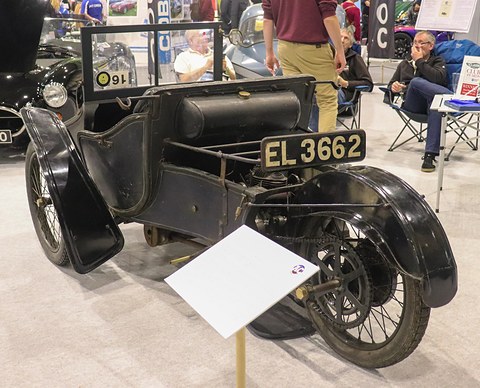
An unrestored 1910 AC tricar, EL 3662, at the Classic Motor Show, Birmingham, in 2019.Photo: Vauxford, CC BY-SA 4.0, via Wikimedia Commons

Pictures

More photographs, old and new

Variants

From goods box to bench seat

The Auto-Carrier family
VariantYearsWhat differsHow many
Auto-Carrier1904–⁠14; 1920sBuilt again for a time in the 1920s. A goods box between the front wheels, the driver behind on a single seat with a tiller“About 1,500 of all types” by one estimate
Passenger tricarc.1907–One passenger seat where the box had been, the driver still behindNot recorded
Sociable, two in frontc.1908–Room for two passengers ahead of the driverNot recorded
Sociable, side by side (“Mighty Atom”)c.1909–⁠1914The controls moved to a two-seat bench; hood, windscreen and front brakes optional“Possibly 1,800”, 1907–⁠14, by another

Specification

The Sociable, 1910–⁠1912

Engine and drive

Engine and drive
EngineSingle cylinder, air-cooled, T-head, under the seat ahead of the rear wheelsource 5source 8
Capacity648 ccsource 6source 895 × 102 mm, about 723 cc, at Olympia in 1912; the engine probably grew
Power5 RAC hpsource 8source 5“5–6 hp” in The Autocar, 1911
GearboxTwo-speed epicyclic gear and clutch in the rear hubsource 8source 9source 5
ReverseNone recorded
Final driveA single roller chain to the rear wheelsource 9source 5

Body and chassis

Body and chassis
ConstructionAn angle-steel frame built into the body, the chassis “erected on the body”source 9
SteeringTillersource 9source 5
SuspensionElliptic springs in front, quarter-elliptics behindsource 9
BrakesBands on the rear wheel; front brakes at extra costsource 9
Tyres2½ in section on all three wheelssource 9

Dimensions

Dimensions
Length, width, weightNot found

Performance and running

Performance and running
Top speedNot foundOne Sociable is said to have been timed at 47 mph (76 km/h) at Brooklands
Price newNot found

How many were built?

Two estimates

No reliable figure; about 1,500 to 1,800Two estimates circulate, and they cannot both be right: Grace’s Guide gives “possibly 1,800” Sociables alone, while the South African Historic Bulletin gives about 1,500 of every type together. Neither shows its working, so we give both.

  1. possibly 1,800Sociables, 1907–⁠1914One source

    Grace’s Guide, citing British Motor Cars 1950/51source 6

  2. about 1,500of all types, 1904–⁠1914One source

    South African Historic Bulletinsource 8

  3. some 1,500Auto-CarriersUnconfirmed

    English Wikipedia, with no citationsource 11

  • Two sources agreetwo good sources give the figure
  • One sourcea good source, alone
  • Unconfirmeda lead only, not yet checked

Famous for

Three points

  1. The name

    Auto-Carrier became A.C., and the company that grew from the tricar went on to build the Ace and the Cobra.

  2. A butcher’s van

    John Portwine wanted a cheap three-wheeler to deliver for his chain of London meat shops.

  3. The gearbox in the hub

    Two speeds and the clutch sat inside the single rear wheel, driven by one chain and steered from a tiller.

Survivors and collecting

Today

No survivor count has turned up. The Brooklands Museum shows a 1910 Sociable.source 6 Another 1910 car, a side-by-side two-seater from Jim Feldman’s AC collection, restored in Britain years earlier and dated by the Veteran Car Club, sold at RM Sotheby’s in Monterey in August 2021 for $47,600. It wore Griffiths “Beacon” side lamps, a “Dependence” tail lamp and a Howes & Burley acetylene headlamp, and its owner called it adorable.source 5source 12

At auction
CarSalePrice
1910 Sociable, 0R458RM Sotheby’s, Monterey, August 2021, lot 304source 12$47,600

Sources

Numbered as in the text

Much of this page rests on Grace’s Guide’s pages, and the one period source read in full is The Cyclecar of 27 November 1912. No dimensions, weights or prices new were found. Sources are given as plain text; the links are on the Credits page.

  1. Grace’s Guide, “AC Cars”, read in full: the chronology to 1922, company names and advertisement captions.
  2. English Wikipedia, AC Cars, early history. Used as a lead; it cites The Auto Motor Journal, 30 November 1912.
  3. Grace’s Guide, “John Weller”, read in full.
  4. Grace’s Guide, “John Portwine”, with his obituary from the Norwood News, 30 May 1958, read in full.
  5. RM Sotheby’s, Monterey, August 2021, “1910 AC Sociable”, lot description, read in full.
  6. Grace’s Guide, “AC Cars: Sociable”, read in full.
  7. Grace’s Guide, “AC Cars: Autocarrier”, read in full.
  8. South African Historic Bulletin, “Snapshot 482: 1910 AC Sociable”, read in full.
  9. The Cyclecar, first issue, 27 November 1912: the Olympia show survey and the editorial “The Stability of Cyclecars”, read from Grace’s Guide’s scan.
  10. Grace’s Guide, index of The Cyclecar, 23 July 1913 (contents only).
  11. English Wikipedia, AC Autocarrier, read in full. Used as a lead; it cites enthusiast sites.
  12. RM Sotheby’s, Monterey 2021, lot 304, sale result.