The story
History
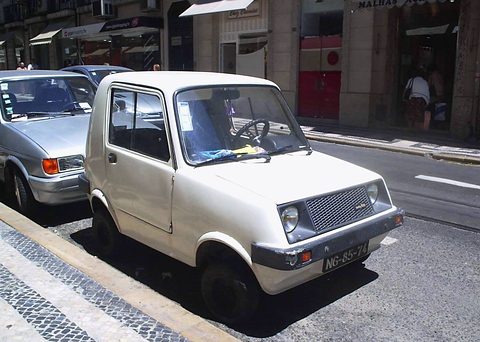
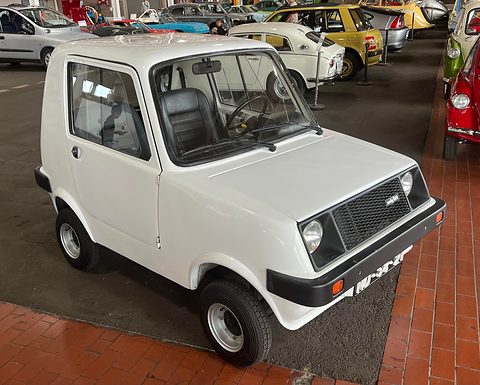
The Sado 550 is Portugal’s only production microcar, and one of very few Portuguese-designed cars ever to reach production.source 1source 3 Its maker, Entreposto Comercial, was founded in 1967 to import, assemble and sell Datsuns, by the Lane Motor Museum’s account; Portuguese sources describe a metal-engineering group active since the 1950s, which also built trailers and caravans.source 1source 2source 4 After the revolution of April 1974 the firm was in financial difficulty.source 4source 5 With imports of cars restricted, a car with a high national content made sense.source 1
In 1975 Entreposto began Projecto Ximba. For about three years it worked towards an extremely small car, cheap, functional and reliable, for Portuguese buyers making short trips in town, and with as much Portuguese content as possible.source 1source 2source 3 The technical team included the former racing driver José Megre and Reis Thomaz, and José Galamba styled it; Jalopnik puts the team at 11.source 1source 5 The prototype was built in the commercial-vehicle division’s workshops at Moscavide, in Lisbon, in 1978, and testing of every part of it went on into 1979; Lisbon’s technical university did the noise and vibration tests.source 1source 3source 5
A Japanese heart
The body, a two-box hatchback with three doors, was glass-reinforced polyester on a tubular steel chassis.source 2source 5 The engine was Japanese: the Daihatsu AB20, a 547 cc water-cooled twin of 28 or 29 hp with the Daihatsu Cuore’s four-speed gearbox, mounted lengthways at the front and driving a beam axle at the back.source 1source 2source 4source 5 About 70 per cent of the car, labour included, was Portuguese.source 2source 3source 6 It was built at Setúbal, on the lines that built Datsun commercial vehicles, and Portuguese Wikipedia says that is where its name comes from: Setúbal stands on the River Sado.source 1source 6source 4
Sold out, then stopped
The Sado went on sale in 1982 through Entreposto’s branches, beside the Datsuns, in five versions priced from 70,000 to 290,000 escudos.source 1source 2source 3 Almost all were white; yellow or blue could be ordered.source 1source 2 The first cars sold out quickly and a waiting list formed.source 3 The Automóvel Club de Portugal tested an early car that year, with very positive results.source 1 Turbo describes the engine as flexible and strong enough for steep hills, the visibility as excellent and the car as comfortable for two on short trips, though the suspension was hard; Portuguese Wikipedia adds that its tiny wheels made it unstable under braking.source 1source 2
It cost more to build than planned, and in 1985 sales stopped because the project could not pay its way; the Lane museum and Jalopnik end it in 1984.source 2source 3source 4source 5 One of those responsible blamed the lack of planning and productivity in most Portuguese firms, which drove production costs up despite cheap labour.source 2 Entreposto went back to importing other makes.source 1 How many were made is not settled: about 500 by most accounts, 272 by the Lane museum’s (see the figures). The Museu do Caramulo published a book on the car in 2013.source 1