microcarfan
  • Prototype
  • France
  • One built

Bugatti Type 68

Also known as Type 68B, Type 68 Roadster

The valves, says a Bugatti specialist, are so small they look like nails. Early in the war Ettore Bugatti drew a supercharged four of about 320 cc, meant to rev to 12,000 rpm, for a two-seater that post-war France would need. One car was finished; it never went into production.

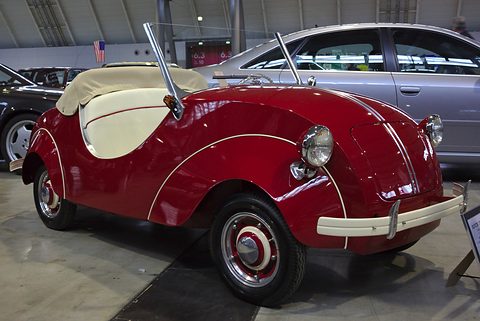
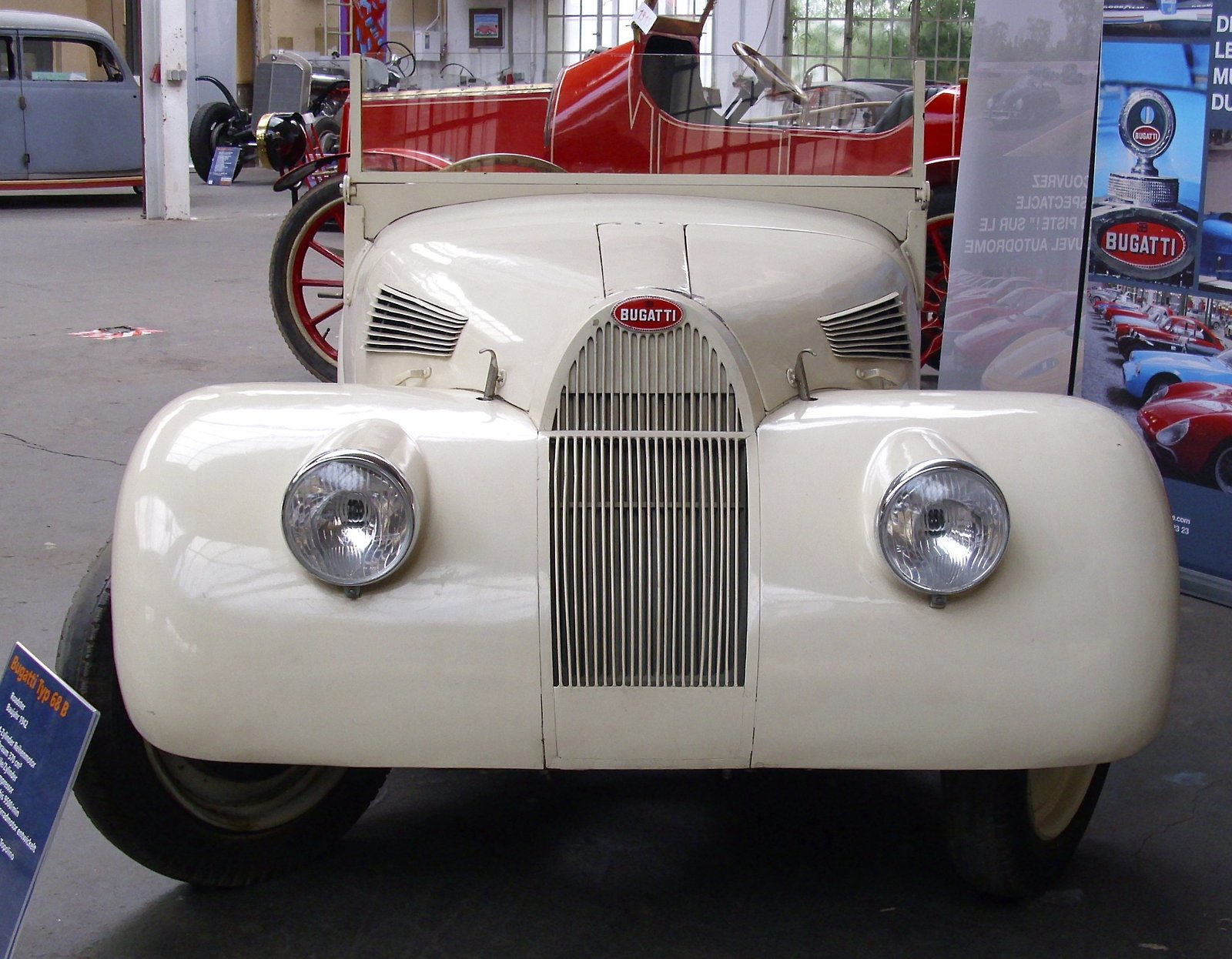
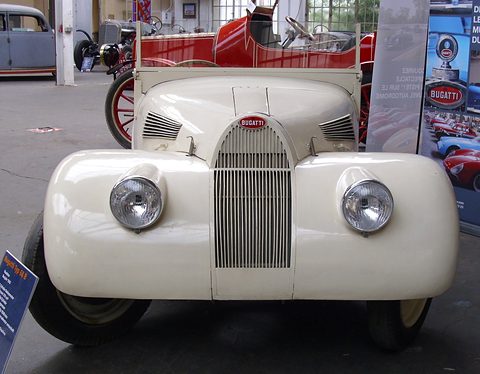
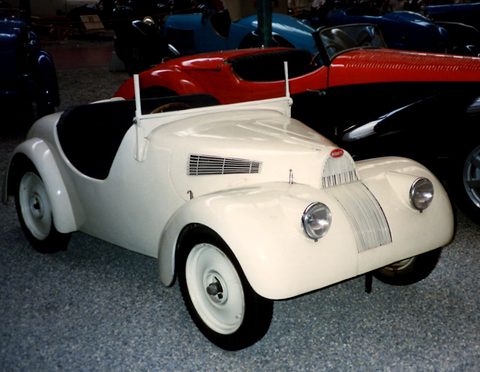
Cream rounded roadster with a horseshoe grille and faired headlamps, an information board beside it.
The cream Bugatti Type 68B roadster prototype at an exhibition in Kassel in 2013.Photo: Thomas Vogt from Paderborn, Deutschland, CC BY 2.0, via Wikimedia Commons

At a glance

The spec plate

Bugatti Type 68

Type 68B roadster · Paris

Built
1942–⁠1947A prototype: begun in 1942 or 1944, finished in 1946 or 1947
Country
FranceDrawn at Levallois-Perret, Paris
Maker
Automobiles Ettore BugattiDrawn in Ettore Bugatti’s Paris office while Molsheim was occupied
Engine
369.5 cc supercharged four, twin overhead camshaftsThe first Type 68 engine: 318 cc with 16 valves
Length
2,900 mm1,380 mm wide
Seats
2An open roadster
Wheels
4
Production
1One car; about three engines and perhaps three chassis frames
Survives
YesCité de l’Automobile, Mulhouse, without its engine

Not yet recordedpower, top speed and weight.

How big is it?

True proportion

2.90 m

It is 70 mm shorter than a Fiat 500, about 1.7 adults laid end to end.

  • 1.38 m wide
  • About 2,900 mm long, by German Wikipedia’s account
  • A fiscal 2 CV
Drawn at true proportion. The track is 3.6 metres long; the adult stands at the same scale. The Peel P50 is the smallest production car, on every page for comparison.

The story

History

Bugatti’s son Jean had died in 1939, and the Germans occupied the Bugatti works at Molsheim. Ettore worked from an office at Levallois-Perret in Paris, drawing everything from an engine for a bicycle to a marine eight of 62 litres.source 1 Among the drawings was a very small car.

The engine came first. Designed about 1940, the Type 68 was a four of 45 × 50 mm, 318 cc, though it is often quoted as 330 cc, with twin overhead camshafts driven by gears, four valves a cylinder, a Roots supercharger in front and four contact breakers and coils instead of a distributor.source 1source 2 Long bolts clamped its cast-iron liners between the head and the crankcase with no gasket at all, and it was designed to rev to 12,000 rpm.source 1 Unusually for Ettore, the head came off: the Type 68 and Type 73 are, Jacob Munkhammar notes, the only Bugattis of his time without a fixed cylinder head.source 2 About three engines were made. To keep the project quiet, one was tested with its transmission in a motorcycle, a frame of Ettore’s own design.source 1source 2

With classic Bugatti features scaled down, such as the oil filter, it’s a jewel of a thing… The valves are so small they look like nails.

Tim Dutton, Bugatti specialist, to Mick Walsh, Classic & Sports Car, 28 August 2019.source 1

The 16-valve head was impractical to make. About 1945 Ettore drew a simpler one, with two valves a cylinder, for the Type 68B, and opened the bore to 48.5 mm for 369.5 cc. The supercharger moved to the side, and the engine gave its best at 9,000 rpm.source 1source 2source 3

It was an incredible design for the time, but would have been too expensive to produce because the critical machining of the cylinder head would have been impractical in 1945.

Richard Day, former curator of the Bugatti Trust, to Classic & Sports Car, 2019.source 1

A roadster for 2 CV

Work on the car began in 1942 or in 1944; German Wikipedia cites one source for each.source 3 The engine went on show at the Paris Salon in October 1946, and the car, a puggish open two-seater, was finished in 1946 or 1947; the photographs show its horseshoe grille.source 3source 1 It was rated at 2 fiscal horsepower. The engine, mounted in front, turned a propeller shaft to the rear axle; both axles were solid, on leaf springs, with reversed quarter-elliptics at the back.source 3source 1source 2 For the gearbox Ettore planned two speeds with a fluid flywheel, or possibly a Cotal electromagnetic box. The car is about 2,900 mm (114 in) long and 1,380 mm (54 in) wide.source 1source 3

Other bodies were drawn. Roland Bugatti, then 25, sketched a gullwing coupé and a cut-down roadster with head fairings in the manner of the Grand Raid, Ettore himself an Atlantic-style coupé, and three low “underslung” chassis frames are believed to have been completed.source 1source 2

Who else in 1945 was thinking about material shortage, limited fuel supply and city congestion?

Tim Dutton, to Classic & Sports Car, 2019.source 1

Ettore Bugatti died in August 1947. Roland and the new director, Pierre Marco, tried to revive the firm with the Type 101 instead, and the little car lost its place.source 1source 4 The Grand Prix driver Maurice Trintignant remembered testing it in the early 1950s; the fluid flywheel gave trouble, and the car went into storage.source 1

The mini Atlantic

Half a century later the coupé was begun after all. From the 1970s the German collector Uwe Hucke gathered Bugatti drawings and parts, among them a Type 68 chassis frame, a rear axle and an incomplete engine. About 1996 Richard Day built up a 16-valve engine from the original drawings and a new block; on the bench it ran for three seconds at 1,500 rpm. For the gearbox he used modern Reliant gears in a case of Bugatti style. Tim and Ivan Dutton fitted the axles and steering, Steeve Bernaud-Heyd, a stylist who had worked on the Bugatti EB110, drew the body from Roland’s sketch, and Terry Hall built it in aluminium. Michel Bugatti came to see it, and loved the “mini Atlantic”.source 1source 3

Hucke died in April 2002 with the car unfinished, and his daughter Angela inherited it. It was shown on Dutton’s stand at Rétromobile in Paris in February 2018, then went to the Bugatti Trust at Prescott; in 2019 it was said to be 80 per cent done.source 1
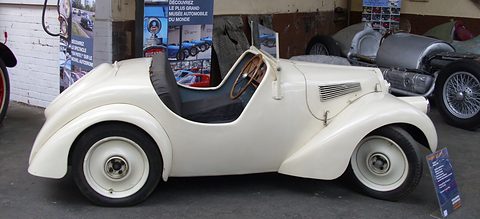
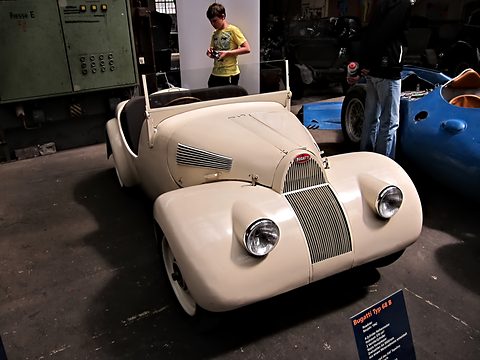
Side view of a small cream open two-seater with rounded wings and a low cut-away door.
The Bugatti Type 68B roadster in profile in Kassel in 2013, with its cut-away door.Photo: Buch-t, CC BY-SA 3.0 de, via Wikimedia Commons
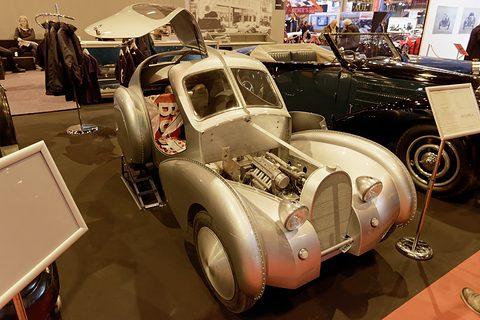
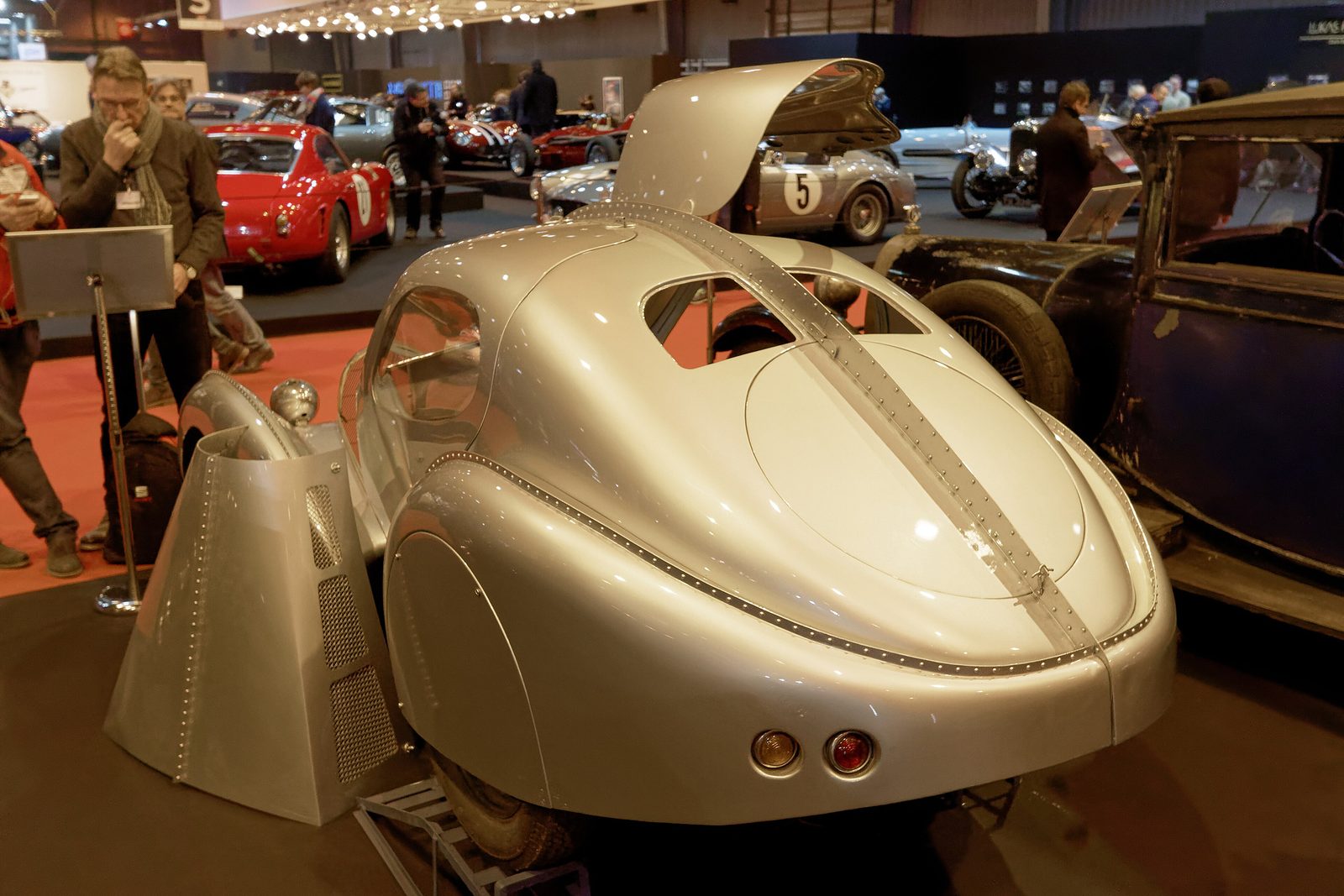
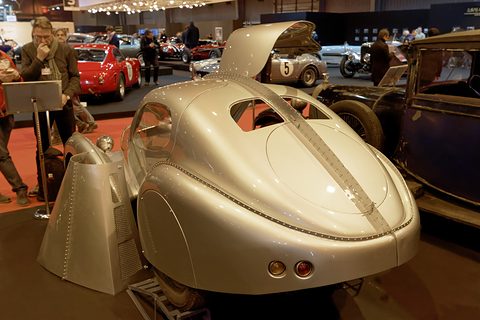
Silver streamlined miniature coupé with its bonnet open and gullwing doors raised on a show stand.
The Hucke gullwing coupé, a modern build around original Type 68 parts, at Rétromobile in 2018.Photo: Thesupermat, CC BY-SA 4.0, via Wikimedia Commons

Pictures

More photographs, old and new

Variants

Engines, a car and a coupé

The Type 68 family
VariantYearsWhat differsHow many
Type 68 engineDesigned about 1940318 cc, 16 valves, supercharger at the frontAbout three engines in all
Motorcycle test bed1940sA frame of Ettore’s own design, to test the engine in secret1
Type 68B roadster1945–⁠47369.5 cc, eight valves; the one finished car1
Hucke coupéAbout 1996–⁠2002; shown 2018A gullwing “mini Atlantic” built up from drawings and original parts1, unfinished in 2019

Specification

Engine data from Jacob’s Bugatti Pages unless noted

Type 68B engine

Type 68B engine
TypeWater-cooled light-alloy four, twin overhead camshafts, two valves per cylindersource 3source 2
Capacity369.5 cc (48.5 × 50 mm)source 2369 cc in German Wikipedia; 370 cc on the old microcarfan.com
SuperchargerRoots, mounted at the sidesource 2
RevsPeak power at 9,000 rpm, 12,000 rpm at mostsource 3source 2One source quoted by German Wikipedia gives 48 PS; unconfirmed

First Type 68 engine

First Type 68 engine
Capacity318 cc (45 × 50 mm)source 1source 2Often quoted as 330 cc
Valves16, from gear-driven twin overhead camshaftssource 1source 2
IgnitionFour contact breakers and four coils, no distributorsource 2
ConstructionCast-iron liners clamped between head and crankcase by long bolts, without gasketssource 1

Chassis

Chassis
DriveFront engine, propeller shaft to the rear axlesource 3source 2
GearboxTwo speeds with a fluid flywheel planned, or perhaps a Cotal electromagnetic boxsource 1
SuspensionSolid axles on leaf springs, reversed quarter-elliptics at the rearsource 1
Frame width540 mm at the front, 800 mm at the rearsource 3

Dimensions

Dimensions
LengthAbout 2,900 mmsource 3
WidthAbout 1,380 mmsource 3
Wheelbase1,600 mm or 2,200 mmsource 3Sources differ; the second looks too long for the car
Track1,150 mm or 1,260 mmsource 3Sources differ

Famous for

Three points

  1. Ettore’s last car

    Drawn in Paris during the occupation and abandoned after his death in 1947.

  2. Sixteen valves, 318 cc

    A supercharged four with twin overhead camshafts, designed to rev to 12,000 rpm.

  3. Tested in secret

    One engine ran in a motorcycle frame of Ettore’s own design, to hide the plan.

Survivors and collecting

Today

The one roadster survives. Hans and Fritz Schlumpf saved it from the scrapyard, and it is now in the Cité de l’Automobile, the national museum at Mulhouse, shown without its engine.source 1source 3 It left Mulhouse in 2013 for an exhibition at Kassel, for the city’s 1,100th anniversary, and three of the photographs were taken at Kassel.source 3 Several of the engines survive, and the Hucke coupé was still with Hucke’s family in 2019.source 2source 1 No auction result has been found. The roadster and the coupé have both been made as models at 1:43.source 3 The Cité de l’Automobile is among the stops in museums and meets.

Cream rounded roadster with a horseshoe grille on grey gravel, a red racing car behind.
The Bugatti Type 68B roadster in the Schlumpf collection, Mulhouse, in 1989.Photo: Andrew Bone, CC BY 2.0, via Wikimedia Commons

Sources

Numbered as in the text

Sources are given as plain text; the links are on the Credits page.

  1. Mick Walsh, “Bugatti Type 68: the missing link”, Classic & Sports Car, 28 August 2019, read in full.
  2. Jacob Munkhammar, “Jacob’s Bugatti Pages: Type 68”, updated 1998, read in full.
  3. German Wikipedia, Bugatti Type 68, read in full. Used as a lead; it cites Schmarbeck and Wolbold, Typenkompass Bugatti (2009), von Saldern (1991) and Bellu (2011).
  4. The original microcarfan.com (2006–⁠2016), marque page “BUGATTI”: one collector’s note, cut short in the archived copy.